
What is material identification and why is it important?
In industrial environments, materials largely determine product performance, system reliability, and component durability. However, clear information about the material being used or analyzed is not always available. It is relatively common to encounter parts without traceability, components supplied by external vendors, legacy products with no technical documentation, or samples recovered after a failure in service. In these situations, a specific technical need arises: to identify a material with the highest possible degree of certainty.
The process of material identification involves determining the nature of a material, its composition, and its main characteristics using different analytical techniques. This does not simply mean recognizing whether a material is metallic, polymeric, or ceramic. It involves understanding its chemical composition, internal structure, and often the conditions under which it was manufactured or processed. This information makes it possible to interpret how the material will behave under real operating conditions.
Two materials may look identical but behave very differently due to differences in composition or structure.
From an industrial perspective, correctly identifying a material has direct implications for quality control, failure investigations, supplier validation, and the development of alternatives to existing products. When the actual material does not match the expected specification, issues such as premature degradation, loss of mechanical properties, or incompatibility with the operating environment may arise. For this reason, materials analysis has become a fundamental tool for technical decision-making.
In many industrial contexts, the need to understand how to identify an unknown material appears when the original documentation has been lost or when working with products for which complete information is not available. In older industrial facilities, it is common to encounter components whose exact specification is no longer known. In such cases, determining the real material becomes essential to perform repairs, modifications, or replacements safely.
Another common scenario occurs when analyzing products already on the market or evaluating components supplied by external vendors. In these situations, verifying the actual material may be necessary to confirm that it meets the required technical specifications. This also occurs frequently in engineering processes aimed at understanding how a specific product has been manufactured or which materials were used in its design.
Material identification from a technical perspective
From a scientific standpoint, materials characterization involves analyzing different aspects that allow a material to be described accurately. These aspects include chemical composition, crystal structure, microstructure, physical properties, and thermal or chemical behavior. Each of these elements provides different information about the nature of the material.
For example, two materials may have similar chemical compositions but different crystal structures, leading to completely different mechanical properties. Similarly, two polymers may appear visually identical while having different molecular structures that determine how they respond to temperature, radiation, or chemical exposure.
For this reason, the process of identifying a material rarely relies on a single analytical technique. Instead, multiple materials analysis methods are typically combined to obtain complementary information. The integrated interpretation of these results is what allows the material being analyzed to be reliably identified.
In industrial environments, this approach becomes particularly important when the material is part of critical systems or when its behavior directly affects the safety or performance of the final product. Correct identification helps understand how the material was manufactured, what its limitations are, and how it is likely to perform under service conditions.
Factors that explain how to identify an unknown material
The need to understand how to identify an unknown material usually arises in situations where material traceability has been lost or never existed. In industrial practice, there are many scenarios in which this situation can occur.
One common case involves the analysis of legacy components. Industrial equipment that has been operating for decades may contain parts manufactured with materials whose specifications are no longer available. When these components must be repaired or replaced, determining the original material becomes essential to ensure that the new component will perform equivalently.
Another common scenario occurs in materials reverse engineering, where an existing product is analyzed to understand its composition and characteristics. This type of analysis may be carried out to develop alternatives to an existing product, evaluate competitor solutions, or understand the technical reasoning behind certain design decisions.
Situations also arise where the material supplied by a vendor does not match the specification indicated in the technical documentation. In these cases, laboratory tests for material identification allow verification of whether the material truly corresponds to the declared specification.
In the context of failure investigation, correctly identifying the material can be a critical step in understanding the origin of a problem. A material different from the one originally specified may completely alter the behavior of a component and explain phenomena such as premature fracture, accelerated degradation, or chemical incompatibilities.
In all these contexts, material identification transforms a situation of technical uncertainty into verifiable knowledge about the nature of the analyzed material.
Working with unidentified materials leads to decisions based on assumptions rather than verified data.

Technical impact and industrial implications
Correctly identifying a material can have direct consequences for the safety, reliability, and performance of industrial systems. When a component operates under demanding conditions involving temperature, pressure, mechanical loads, or chemical exposure, even small differences in the nature of the material can result in significant changes in performance.
The chemical composition of materials is one of the factors that most strongly influences their properties. Relatively small variations in the concentration of certain elements can modify mechanical strength, corrosion resistance, or thermal stability. In metals, even minor differences in alloying elements can significantly alter the microstructure obtained after thermal processing.
Minor changes in chemical composition can significantly affect mechanical properties or corrosion resistance.
In polymers, the situation can be even more complex. Two plastic materials with a similar external appearance may have different molecular structures or contain additives that alter their behavior under temperature, radiation, or chemical exposure. In these cases, identifying only the polymer type may not be sufficient. It is often necessary to analyze mineral fillers, plasticizers, or stabilizers that influence the final properties of the material.
For this reason, materials analysis plays an essential role in quality control processes, supplier evaluation, and failure investigations. The ability to accurately determine which material is being used helps prevent technical decisions based on incorrect assumptions.
Risks associated with incorrect material identification
When a material is incorrectly identified, subsequent technical decisions may be based on inaccurate information. This can lead to a chain of errors affecting design, maintenance, or system operation.
One of the most evident risks is the occurrence of premature failures in service. If a component is manufactured using a material different from the one specified, its mechanical resistance may be lower than expected. This can result in fractures, deformation, or loss of functionality under normal operating conditions.
Another significant risk arises in environments where materials must withstand corrosive conditions or high temperatures. A material with lower chemical resistance or thermal stability may degrade rapidly, leading to operational issues or even safety risks.
Component replacement can also be affected when the original material has not been correctly identified. If a different material is used to manufacture a replacement part, the new component may behave differently during service. This can lead to dimensional incompatibilities, differences in thermal expansion, or accelerated degradation.
In industries where safety is critical, such as chemical processing, energy, or aerospace, the identification of metals and alloys or the identification of polymers using reliable analytical techniques is essential before making technical decisions.
Regulatory requirements and material traceability
In many industries, material traceability is essential for ensuring product quality and safety. Sectors such as automotive, energy, medical devices, and aerospace require control systems that make it possible to track the origin and characteristics of materials used in each component.
When this traceability is lost, materials characterization techniques must be used to reconstruct the original information. This process may involve everything from elemental analysis of materials to the study of microstructure or thermal behavior.
Correct identification may also be required during quality audits or technical certification processes. In these contexts, analytical results obtained through laboratory tests for material identification can demonstrate that a component meets the required technical specifications.
For this reason, material identification is not simply a punctual analytical task. It forms part of a broader system of quality management, risk control, and regulatory compliance in industrial environments.
Methods of analysis, evaluation, or solution
The process of identifying a material relies on the use of different analytical techniques that provide information about its composition, structure, and properties. Each technique offers a different perspective and, when properly combined, allows a complete picture of the material’s nature to be constructed.
The methodologies used in material identification techniques may vary depending on the type of material being analyzed. Metallic materials, for example, require different techniques than those used for polymers or ceramics. However, the ultimate goal is always the same: to determine as accurately as possible which material is being studied.
Material identification techniques based on chemical and structural analysis
One of the first steps in material identification is usually determining the chemical composition of materials. This is achieved through different elemental analysis methods capable of detecting the elements present and their relative concentrations.
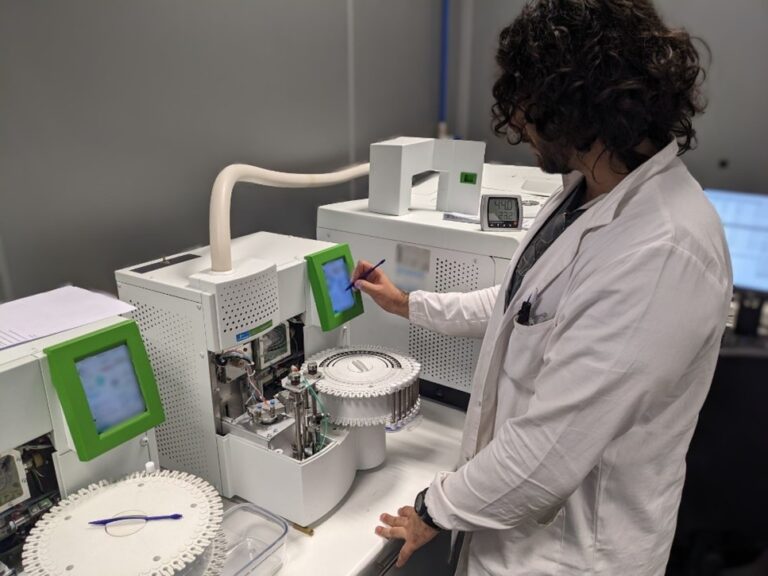
Among the most widely used tools are spectrometry techniques or X-ray-based methods that allow identification of the chemical elements present in the material. These techniques provide an initial approximation of the material’s nature and enable comparison with databases of known compositions.
For polymeric or organic materials, spectroscopy techniques for material identification are particularly useful. Methods such as infrared spectroscopy or Raman spectroscopy allow the chemical structure of the base polymer to be identified and help distinguish between different types of plastics.
Material identification requires combining multiple analytical techniques and interpreting results together.
In addition to chemical analysis, studying the structure of the material also provides valuable information. Techniques such as X-ray diffraction can identify crystalline phases present in the material, while electron microscopy can reveal microstructural characteristics that help explain how the material was manufactured.
The combination of these materials characterization techniques provides a detailed view of the analyzed material and forms the basis of the identification process.
Practical applications in materials reverse engineering
One of the contexts where material identification becomes particularly relevant is materials reverse engineering. In these studies, an existing product is analyzed to understand its composition, structure, and manufacturing technologies.
This approach is commonly used when developing alternatives to existing products or when it is necessary to understand how a particular component has been manufactured. Different analytical techniques are combined to identify the base material, applied treatments, and potential additives.
For metallic components, the combination of elemental analysis, electron microscopy, and microstructural studies can reveal the alloy used and the processing history of the material. In polymeric materials, the analysis may focus on polymer identification, the presence of mineral fillers, and the thermal behavior of the material.
These types of studies are also common in forensic engineering, where correctly identifying the material is a fundamental step in understanding the behavior of a component that has failed in service.
Understanding which material is being used, how it was manufactured, and what characteristics it presents allows engineers to correctly interpret its behavior and make well-founded technical decisions.
How to approach material identification in industry
The need to identify a material frequently arises in industrial environments when clear information about its origin or composition is not available. In these situations, combining materials analysis and materials characterization techniques makes it possible to accurately determine the nature of the analyzed material.
Understanding the chemical composition, structure, and properties of a material allows its behavior in service to be interpreted and helps prevent problems derived from incorrect material selection. This knowledge is particularly relevant in quality control, failure investigation, supplier evaluation, and product development.
Modern analytical techniques provide highly precise information about the nature of materials. However, the real value of the identification process lies not only in the technology used but also in the integrated interpretation of the results obtained. The ability to identify a material with technical rigor transforms uncertainty into useful knowledge for industrial decision-making.
When this analysis is carried out systematically and supported by reliable analytical techniques, it becomes a key tool for ensuring product quality, safety, and reliability. In contexts where technical information is limited or nonexistent, proper characterization replaces assumptions with analytical evidence and provides a clear understanding of the material being used and how it will behave under real operating conditions.