Reverse engineering for product development
Analyzing, replicating and improving existing components and systems — that’s what reverse engineering in product development is for. A methodology that makes it possible to optimize product design, identify improvement opportunities and adapt solutions to new market needs, reducing development times and minimizing manufacturing costs.
At INFINITIA Industrial Consulting we are true reverse engineering experts. We work with industries seeking to improve existing products, develop spare parts when no drawings are available, or adapt designs to new standards and regulations. Interested? Discover more in this category.
Talk to a specialist
Request a free initial consultation; contact a consultant from our team of specialists

What does reverse engineering in product development involve?
What is it?
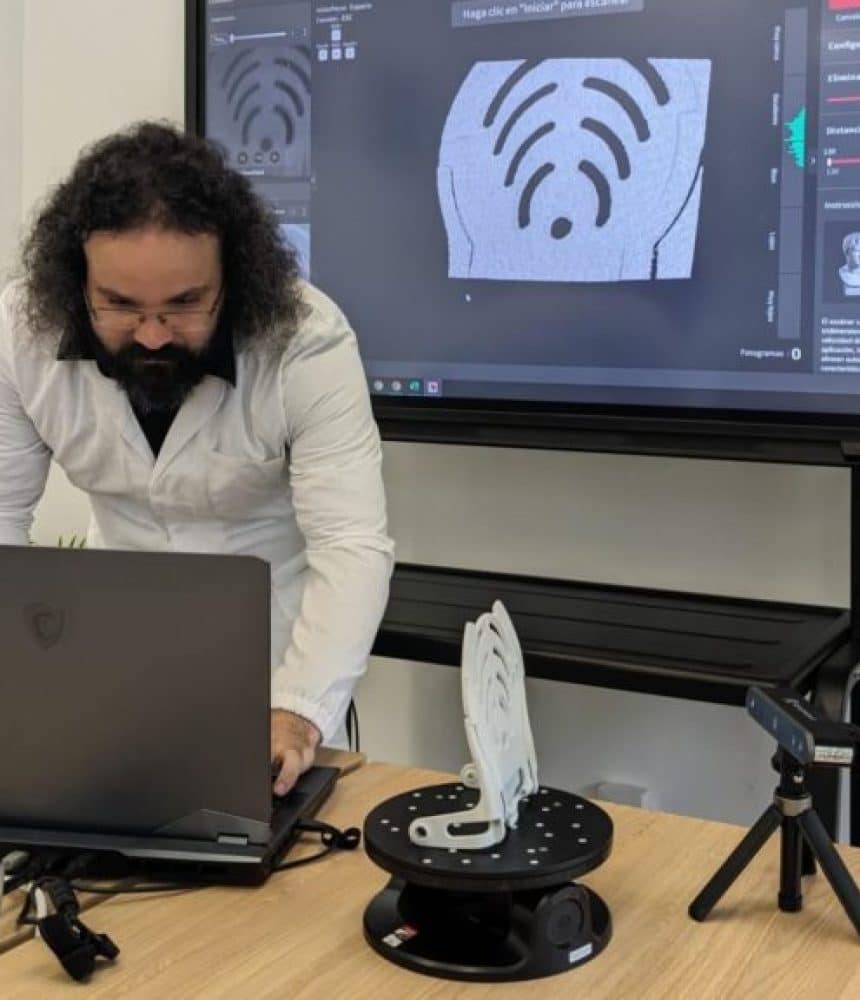
Reverse engineering in product development is a technical process that makes it possible to analyze an existing object or system to understand its structure, composition and operation in detail. At INFINITIA we use advanced tools such as 3D modeling, digital simulation or material analysis to create exact CAD models that facilitate the reconstruction and optimization of components.
Reverse engineering makes it possible to improve existing products and develop innovative solutions without needing to start from scratch. From the aerospace and automotive industry to manufacturing and medicine, here are its most common applications:
- Design optimization to improve strength, durability or performance.
- Adapting existing products to new materials or technologies.
- Repairing and manufacturing spare parts when the original drawings aren’t available.
- Redesigning products to reduce costs or improve their energy efficiency.
Compliance with new regulations and certifications in highly regulated sectors.
Benefits of reverse engineering in product development for industrial competitiveness
BENEFITS
Reverse engineering reduces development time and cost by eliminating the need to design from scratch when a valid physical reference already exists. Starting from a real part and reconstructing its model avoids entire conceptualization phases and shortens the path to a manufacturable design, something especially relevant for complex components whose geometry would be extremely costly to define manually.
Reverse engineering ensures continuity of supply for discontinued or undocumented parts. When a component goes out of catalog, the supplier disappears, or the documentation has been lost, reconstructing the model makes it possible to manufacture the part again and keep a machine or line operational, avoiding downtime and forced obsolescence that compromise the facility’s reliability.
Reverse engineering improves the existing design by making its limitations measurable and makes it possible to break down parts to better understand their operation. With the real model available, it becomes possible to detect over-dimensioning, poorly adjusted tolerances or unsuitable materials, and act on them to optimize strength, weight or cost. This connects with alloy composition analysis, which makes it possible to understand which material explains the observed behavior before replicating or replacing it.
Reverse engineering brings confidence to decision-making by basing the redesign on objective data rather than assumptions. Measuring instead of estimating reduces the risk of error in critical components and makes it easier to technically justify each change to clients, auditors or regulatory requirements, reinforcing the quality and traceability of the final product.
Types of reverse engineering for product development
types
Reverse engineering’s applications span the product’s entire lifecycle, from recovering old parts to improving in-production designs and technically analyzing the competition. Its broad relevance stems from the fact that almost any design decision improves when it’s grounded in a precisely measured physical reference rather than an estimate.
INFINITIA’s approach to these applications prioritizes the industrial usefulness of the result. Each project is sized according to what the client needs to do next with the model (manufacture, improve, adapt or compare), adjusting the level of geometric detail and material characterization to that real objective.
3D scanning and part digitization
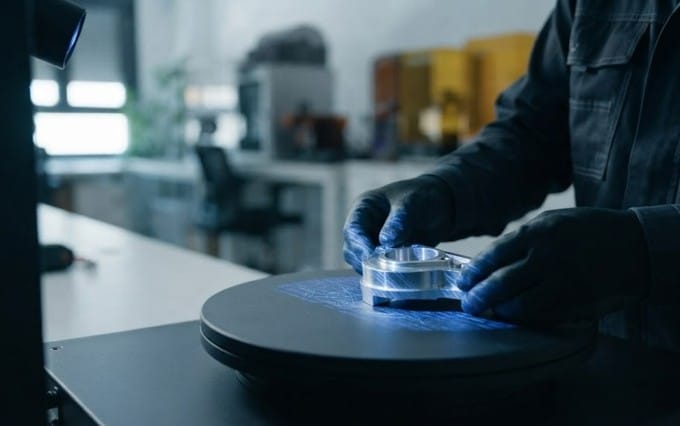
The 3D scanning for reverse engineering is a fundamental tool for capturing a product’s physical characteristics with maximum precision. Combining the latest 3D scanning technology for part digitization for reverse engineering with our experience and knowledge allows us to obtain exact representations of its geometry, structure and materials.
By creating CAD models through reverse engineering, we make adjustments, develop spare parts or even improve the design of original products. These are the main advantages of this reverse engineering action in product development:
- Fast, precise capture of complex surfaces, without needing to disassemble the product.
- Creation of detailed CAD models, ready for optimization and manufacturing.
- Reduced time and costs by eliminating manual measurement and design processes.
- Identification of wear or defects in already-used parts.
- Comparison with the original design to detect modifications over time.
Product development based on reverse engineering
Reverse engineering for product improvement not only optimizes existing designs, but is also key to creating new products based on reverse engineering. This allows companies and manufacturers to accelerate innovation and reduce risks, using pre-existing models as a basis for new developments:
- Innovative products are developed based on proven designs.
- Development time is reduced by leveraging information from similar products.
- Compatibility with current industry standards and regulations is ensured.
- Functional and aesthetic improvements are implemented to increase the product’s market value.
Sectors such as automotive, aerospace, the medical industry or manufacturing are some examples, where design optimization can lead to significant savings in costs and resources.
What is re-engineering of existing products?
Re-engineering of existing products is one of reverse engineering’s most valuable applications. It’s used to update products, improve their performance and adapt them to new technological or manufacturing challenges. In other words, it makes it possible to reduce production costs, improve compatibility with new systems and increase products’ competitiveness in the market.
To do this, at INFINITIA we carry out a complete component analysis in reverse engineering that helps us detect optimization opportunities in:
- Structure and materials: We replace materials with lighter, stronger or more sustainable options.
- Geometry and design: We optimize component shapes to improve efficiency and reduce material waste.
- Manufacturing processes: We adapt products to more modern processes such as 3D printing or CNC machining.
- Durability and performance: We evaluate improvements to extend the product’s service life and reduce maintenance costs.
Reverse engineering techniques in design
We apply advanced reverse engineering techniques in design, combining different methodologies to obtain detailed information about each product. It’s worth highlighting some of the tools we use most in reverse engineering for product development. With them, we create more efficient, resistant and cost-effective products, minimizing failures and maximizing performance:
- 3D scanning and CAD modeling: Capture of complex shapes with high precision.
- Material analysis: Identification of composition, mechanical properties and compatibility with manufacturing processes.
- Digital simulation: Evaluation of product behavior under different usage conditions.
- Geometric optimization: Weight reduction and strength improvement without compromising functionality.
Sectors where reverse engineering for product development makes a difference
sectors
Reverse engineering adds value in any sector that manufactures, maintains or improves physical components, but its impact is greatest where technical demands, part obsolescence and strict regulatory frameworks coexist. Its cross-sector nature translates into very different applications depending on each industry’s service conditions and constraints.
INFINITIA adapts its approach by sector, adjusting the level of geometric precision, the depth of material characterization and the regulatory requirements to each client’s reality. This adaptation is what allows the same service to solve problems as different as replicating a railway spare part or comparing an aerospace component.
Why choose product optimization with reverse engineering at INFINITIA?
Value
We ensure every component is optimized to meet the highest standards of quality and efficiency. From 3D scanning and part digitization to product optimization with reverse engineering, this comprehensive approach helps us maximize the product’s profitability.
So, what are the benefits of choosing reverse engineering in product development with INFINITIA? Let’s take a look:
- We achieve greater precision and quality in developing digital models.
- We reduce costs by reusing optimized designs.
- We use less development time by adapting existing products.
- We improve the product’s durability and performance thanks to structural optimization.
We guarantee compatibility with new technologies and advanced manufacturing processes.