

Our customers
We are your trusted partner in industrial engineering































Technical Consulting
Technical industrial consulting is a key service for companies that need to make complex decisions in industrial settings where multiple variables come into play: materials, processes, regulations, costs, and actual conditions of use. In these contexts, acting without a solid technical foundation can lead to design errors, product failures, or production inefficiencies that are difficult to correct later on.
At INFINITIA, our industrial technical consulting services are designed to resolve these types of uncertainties through an approach based on evidence, applied knowledge, and objective analysis. Our goal is to provide clear, well-founded, and actionable answers that enable companies to move forward confidently with their projects, minimizing risks and optimizing resources.
It is not merely a matter of offering recommendations, but of understanding the problem within its real-world context, evaluating alternatives, and defining the most appropriate path forward from both a technical and strategic perspective.
Talk to a specialist
Request a free initial consultation; contact a consultant from our team of specialists

What does the technical industrial consulting service entail?
What is it?
Technical industrial consulting is a specialized service designed to advise companies on decision-making regarding products, materials, processes, and industrial strategy, based on proven scientific criteria. Its purpose is not merely to make recommendations, but to analyze key variables and determine the best decision in terms of efficiency, feasibility, and performance. In industrial practice, it is essential when questions arise regarding materials, processes, or regulations—especially when small decisions impact quality or costs—and this is where our engineering consulting plays a fundamental role.
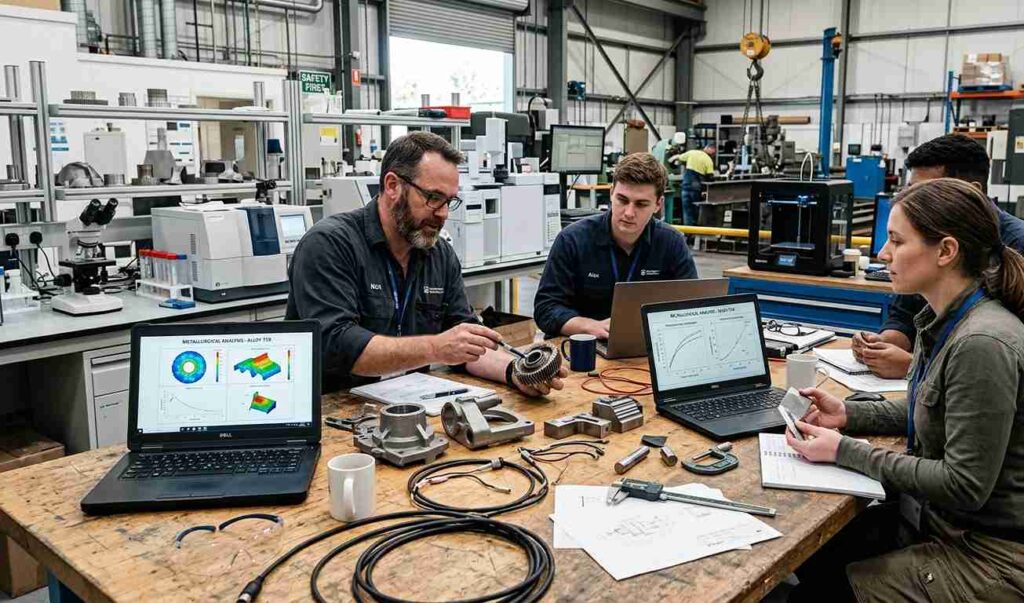
From the perspective of industrial technical consultancy, it is necessary to analyse the problem holistically. It is not enough to examine a single variable; materials, processes, conditions of use, regulations and product requirements must all be taken into account. To this end, we combine technical review, data analysis, applied expertise and, where necessary, experimental validation. This approach helps to reduce uncertainty and improve decision-making.
One of the key distinguishing features of engineering consultancy is its impartial nature. As it is not linked to manufacturing or marketing, it focuses on identifying the best technical solution for each case. This ensures that recommendations are based on objective criteria, avoiding bias. As a result, companies can make decisions with greater confidence, backed by proven technical expertise.
At INFINITIA, technical industrial consultancy is approached as a tool for decision-making and knowledge generation. Specific issues are analysed, solutions are proposed and the next steps are defined. During development phases, it enables risks to be anticipated and designs to be optimised. In this way, not only are specific problems resolved, but the long-term robustness of the product and process is also improved through an innovative approach.
INFINITIA’s industrial consultancy: impartial advice based on science and technology
At INFINITIA, technical industrial consultancy is approached as an integrated service within a technical and experimental environment, where knowledge is based on both experience and proven evidence. This approach enables us to analyse each case rigorously, providing data-driven solutions tailored to the client’s industrial reality through our engineering consultancy services.
We work alongside companies’ teams as an extension of their organisation, taking part in industrial technical consultancy sessions aimed at addressing specific queries, analysing problems and defining the next steps. This collaborative model facilitates agile decision-making, whilst always being based on sound technical criteria and the expertise of the consultancy team.
Our work focuses on addressing key issues such as the selection of materials, process optimisation, compliance with regulations and product validation. The engineering consultancy services we provide are tailored to each individual case, customising our approach to the client’s specific circumstances and avoiding generic approaches that do not add value.
One key distinguishing feature is our impartiality: as we are not manufacturers, our recommendations are focused exclusively on the best possible technical solution. Furthermore, we combine consultancy with analytical and testing capabilities, which enables us to validate hypotheses where necessary and enhance the reliability of decisions.
Benefits of Technical Industrial Consulting for Industrial Companies
benefits
One of the main benefits of technical industrial consulting is that it enables companies to move from assumptions to evidence-based decision-making in industrial settings. In many cases, decisions are based on past experience or unvalidated hypotheses, which can lead to errors or unnecessary iterations; therefore, it is crucial to have an expert consultant. Industrial technical consulting allows these hypotheses to be tested against technical criteria, reducing uncertainty and improving efficiency in problem-solving.
It also helps to optimise costs associated with incorrect technical decisions. Poor choice of materials, a poorly optimised process or incomplete information can lead to significant cost overruns. Materials and process consultancy helps to identify more efficient solutions, avoiding oversizing and reducing the risk of product or system failure.
At INFINITIA, technical industrial consultancy is used to improve product quality from an objective, data-driven perspective. Appropriate parameters are defined, specifications are validated and potential deviations are identified before they impact production or the market, covering all relevant aspects. This approach enables companies to make more confident decisions, reduce incidents and ensure consistency between design, materials and processes.
Furthermore, engineering consultancy enables organisations to anticipate risks, validate changes, identify areas for improvement in industrial processes, and make decisions with greater confidence, particularly during critical phases such as development or industrialisation. Added to this is the transfer of knowledge through ongoing advice on technical projects, which strengthens companies’ in-house capabilities and improves their long-term competitiveness.

services
How do we carry out technical industrial consultancy at INFINITIA?
-
 Technical Consulting
Prospecting and validation of suppliers
At INFINITIA, we approach this service through a structured process in which potential suppliers are identified, analysed and selected to supply materials or services for…
-
 Technical Consulting
Expert reports
An expert report is a document prepared by an expert with accredited knowledge in a specific discipline, whose purpose is to analyze, interpret, and objectively present the…
-
 Technical Consulting
Definition of raw material quality parameters
Defining the quality parameters of raw materials involves assessing and analyzing the physical, chemical and mechanical properties of materials before they are used in production. This process includes identifying key characteristics…
-
 Technical Consulting
Define product requirements and specifications
Requirements definition is the process through which the client’s needs and expectations regarding the final product are established. This process is complemented by the technical specification, which details how…
Applications of Engineering Consulting in Materials, Processes, and Products
applications
Technical industrial consultancy is applied in a wide range of industrial contexts where decisions based on technical knowledge need to be made. Its value lies in its ability to adapt to each situation, providing specific and practical solutions.
At INFINITIA, we take a practical approach to these applications, combining analysis, expertise and validation to ensure that the decisions taken have a real impact on the business and promote sustainability.
Definition of quality parameters and management systems
These studies enable the establishment of the technical criteria that products must meet, depending on their application, regulations and actual conditions of use. Specifications, technical data sheets and regulatory requirements are analysed, identifying potential deviations that could cause problems in production or on the market, such as quality failures, functional faults or non-compliance with regulations.
At INFINITIA, we apply this approach to define quality parameters tailored to each individual case, designing specific tests that enable these requirements to be validated objectively. This facilitates the early detection of errors, improves consistency between design and manufacture, and reduces the risk of incidents once the product is in service.
Furthermore, this approach makes it possible to anticipate deviations before they occur, thereby strengthening quality control and ensuring that the product meets the required standards from the earliest stages of development and industrialisation.
Supplier sourcing and technical validation
These studies enable suppliers to be analysed and validated from a technical perspective, assessing their capacity, quality and suitability for the product’s requirements, and offering effective solutions. Manufacturing processes, the materials used and compliance with specifications are reviewed, identifying potential risks associated with the supply chain.
At INFINITIA, we have applied this approach to the sourcing and vetting of suppliers for complex industrial projects, verifying their actual performance and ensuring they meet the client’s requirements. This helps to reduce uncertainty, prevent production deviations and guarantee the reliability of supply.
Furthermore, this approach facilitates strategic decision-making when selecting partners, improving consistency between the supplier, the process and the final product, and reducing the risk of future incidents.
Definition of technical requirements and product specifications
These studies enable the technical requirements that a product must meet to be defined, based on its application, conditions of use and industrial environment. Functional specifications, material properties, tolerances and acceptance criteria are analysed, identifying potential risks associated with an incomplete or unrepresentative definition.
At INFINITIA, we apply this approach to ensure that specifications are properly structured from the outset, avoiding ambiguities and ensuring that all stakeholders work to aligned criteria. This helps to minimise deviations during development, manufacturing and validation, thereby improving the consistency of the final product.
Furthermore, this approach facilitates the translation of functional requirements into measurable technical parameters, enabling the design of appropriate tests, the validation of compliance with requirements, and the optimisation of decision-making throughout the entire product lifecycle.
Preparation of technical reports for expert witness purposes
These studies enable technical incidents to be analysed from an objective and well-documented perspective, with the aim of determining causes, assessing liability and providing evidence in legal or technical contexts. Materials, processes, conditions of use and the background to the case are reviewed, combining technical and documentary analysis to reconstruct the events.
At INFINITIA, we apply this approach to produce scientifically based reports, drawing on material characterisation, testing and comparative analysis where necessary. This enables us to support sound technical conclusions that are valid in legal and arbitration proceedings, or in negotiations between parties.
Furthermore, this approach facilitates decision-making in conflict situations, providing clarity on the root cause of the problem and enabling corrective actions or defence strategies to be defined with technical rigour and traceability.
Material selection and product optimisation
These analyses enable the selection of the most suitable materials based on the product’s technical requirements, taking into account factors such as mechanical strength, thermal behaviour, chemical compatibility and conditions of use. The interaction between materials and their performance in service is studied, identifying any potential limitations or associated risks.
At INFINITIA, we have used this approach to evaluate materials in various industrial environments, analysing their actual performance and proposing more efficient alternatives. This enables us to optimise product performance, prevent premature failures and reduce costs arising from incorrect decisions or unnecessary oversizing.
Furthermore, this type of study makes it possible to improve the formulation or composition of materials by introducing modifications that enhance their durability, functionality or suitability for specific operating conditions.
Technical consultancy on industrial product development
These studies help to guide product development from a technical perspective, analysing configurations, materials and processes to ensure that the final solution meets the defined requirements. Potential risks are identified at an early stage, thereby preventing errors that could carry over into production or onto the market.
At INFINITIA, we have used this approach to support the development of new products, defining validation and optimisation strategies tailored to each individual case. This enables us to improve the efficiency of the development process, reduce the number of iterations and ensure the technical feasibility of the product prior to its industrialisation.
Furthermore, this approach allows quality, cost and functionality criteria to be incorporated from the outset, improving the robustness of the design and facilitating a more controlled transition to production.
Definition of quality parameters for raw materials
These studies enable us to establish the quality criteria that raw materials must meet. Depending on their application, the manufacturing process and the requirements of the final product, we offer specialised solutions through our engineering consultancy. We analyse physicochemical properties, batch-to-batch variability and technical specifications, identifying any potential deviations that may affect process performance or stability.
At INFINITIA, we apply this approach to characterise raw materials and define acceptance criteria tailored to each industrial context. This enables us to identify significant differences between suppliers, anticipate production issues and ensure consistency between the raw material and the final product.
Furthermore, this approach facilitates quality control right from the outset, making it possible to establish objective validation criteria, improve the reproducibility of the process and reduce risks associated with uncontrolled variations in materials.
Industrial sectors in which industrial technical consulting adds value to decision-making
sectors
Technical industrial consultancy is applicable across a wide range of industrial sectors, as any activity based on materials, processes and product development requires decision-making that has a direct impact on quality, cost and reliability. However, technical challenges, regulatory requirements and operating conditions vary significantly from sector to sector, making it necessary to tailor the consultancy approach to each specific context in order to ensure effective results.
At INFINITIA, we carry out industrial technical consultancy projects by combining applied knowledge, technical analysis and, where necessary, experimental validation, through our industrial consultancy service. Our aim is to interpret each requirement within its real-world context, evaluate alternatives and provide objective criteria to facilitate decision-making, ensuring consistency between materials, processes and product requirements across every industrial sector.
Technical consultancy in the automotive sector: materials, processes and product validation
In the automotive sector, components are subjected to demanding conditions in terms of load, temperature, vibration and wear, where even minor deviations can lead to critical failures or quality issues in mass production. The combination of stringent regulatory requirements and mass production makes it essential to ensure the robustness of the product from the earliest stages.
- Material validation: analysis of behaviour under fatigue, impact, temperature or corrosion.
- Process evaluation: identification of deviations in manufacturing, assembly or treatment.
- Analysis of operating conditions: the influence of cyclic loads, the environment and maintenance on performance.
At INFINITIA, we address these scenarios to optimise materials, validate processes, improve product reliability and achieve cost reductions. This approach helps to reduce production incidents, minimise warranty costs and ensure compliance with technical requirements in demanding applications.
Technical consultancy in electronics and household appliances: reliability, assembly and conditions of use
In the electronics and household appliances sectors, products combine a variety of materials and complex assembly processes, where miniaturisation and thermal sensitivity increase the risk of failure. Even minor variations can lead to functional or aesthetic problems that have a direct impact on perceived quality.
- Evaluation of materials and components: analysis of thermal degradation, fatigue or material compatibility.
- Assembly analysis: identification of faults in welds, adhesives or multi-material interfaces.
- Validation under operating conditions: the influence of temperature, humidity or operating cycles on performance.
At INFINITIA, we analyse production processes and carry out various types of projects to identify the causes of failure and propose improvements to design and processes. This approach enables us to increase reliability, reduce returns and improve product durability under real-world conditions.
Technical consultancy in the chemical industry: compatibility, materials and operational safety
In the chemical industry, materials are exposed to corrosive substances and harsh operating conditions that can lead to progressive degradation or unexpected failures. The correct selection and validation of materials is critical to ensuring safety and operational continuity.
- Chemical compatibility assessment: analysis of interactions between materials and chemical agents.
- Degradation study: identification of corrosion, swelling or loss of properties.
- Analysis of operating conditions: the influence of temperature, pressure and contaminants on performance.
At INFINITIA, we analyse these environments to validate technical solutions and identify associated risks. This approach enables us to optimise the selection of materials, improve process safety and increase the durability of equipment and facilities, thereby contributing to greater efficiency.
Technical consultancy in the defence sector: reliability, validation and extreme conditions
In the defence sector, systems and materials must operate in extreme conditions where failure is not an option. Factors such as harsh environments, dynamic loads, thermal exposure and durability requirements mean that even minor deviations can compromise the functionality or safety of the system.
- Testing of materials under extreme conditions: behaviour under impact, temperature, corrosion or fatigue.
- Validation of critical components: reliability analysis in systems subject to high operational demands.
- Analysis of real-world operating conditions: the influence of the environment, operating cycles and maintenance on performance.
At INFINITIA, we tackle these scenarios from an industrial technical consultancy perspective, identifying the variables that influence the system’s behaviour and defining tailored solutions. This approach enables us to improve robustness, reduce operational risks and ensure compliance with technical requirements in applications where reliability is critical.
Technical consultancy in consumer goods: quality, materials and user experience
In the consumer goods sector, products must meet functional, aesthetic and durability requirements, and any deviation from these has a direct impact on customer perception. Faults such as wear and tear, discolouration or breakage can lead to complaints and damage the brand’s image.
- Defect assessment: analysis of wear, ageing or loss of properties.
- Study of materials and processes: identification of deviations in manufacturing or design.
- Real-world analysis: the influence of usage and maintenance conditions on performance.
At INFINITIA, we analyse these cases to identify the causes and propose bespoke technical improvements. This approach enables us to optimise the product, reduce incidents in the market and improve the quality perceived by the end user.
Technical consultancy on machinery and critical infrastructure: design, materials and operation
In industrial machinery, equipment is subjected to demanding conditions in terms of load, wear and continuous operation, where reliability is key to avoiding downtime and the associated costs. The design and choice of materials have a direct impact on its performance and service life.
- Assessment of structural materials: analysis of strength, wear or fatigue in service.
- Study of operating conditions: the influence of load, temperature or the environment on performance, assessed by experts in the field.
- Design and process review: identification of critical points and opportunities for improvement.
At INFINITIA, we analyse these systems to optimise their performance and reliability. This approach helps to reduce faults, improve operational efficiency and extend the service life of the equipment under real-world operating conditions.
The INFINITIA team—your expert consultant for reducing risks and making better decisions
Value
Technical industrial consulting is a key tool for transforming uncertainty into informed decisions in complex industrial environments. In these contexts, multiple variables (materials, processes, conditions of use, or product requirements) interact simultaneously, making the source of a problem or the best solution unclear without a structured analysis. This approach allows for structuring the analysis, identifying critical factors, and establishing technical criteria that guide decision-making with greater rigor.
At INFINITIA, drawing on years of experience, industrial technical consultancy is approached from an evidence-based perspective, combining applied knowledge with technical analysis and, where necessary, experimental validation. This approach enables us to identify the critical variables that determine the behaviour of the product or process, avoiding generic approaches and ensuring that every decision is aligned with the technical reality of the case.
This service enables us to tackle the root causes of problems directly, thereby reducing risks, optimising costs and improving product quality. Engineering consultancy facilitates the formulation and validation of hypotheses, technological innovation, the comparison of alternatives and the definition of technical strategies that prevent recurring errors or decisions based on assumptions.
Furthermore, the integration of consultancy, technical analysis and validation under representative conditions ensures that the proposed solutions are applicable in a real-world environment. As a result, companies can move forward with greater confidence, improve the robustness of their products and processes, and make decisions based on sound, proven technical grounds.

Projects
Projects carried out in technical industrial consultancy
-
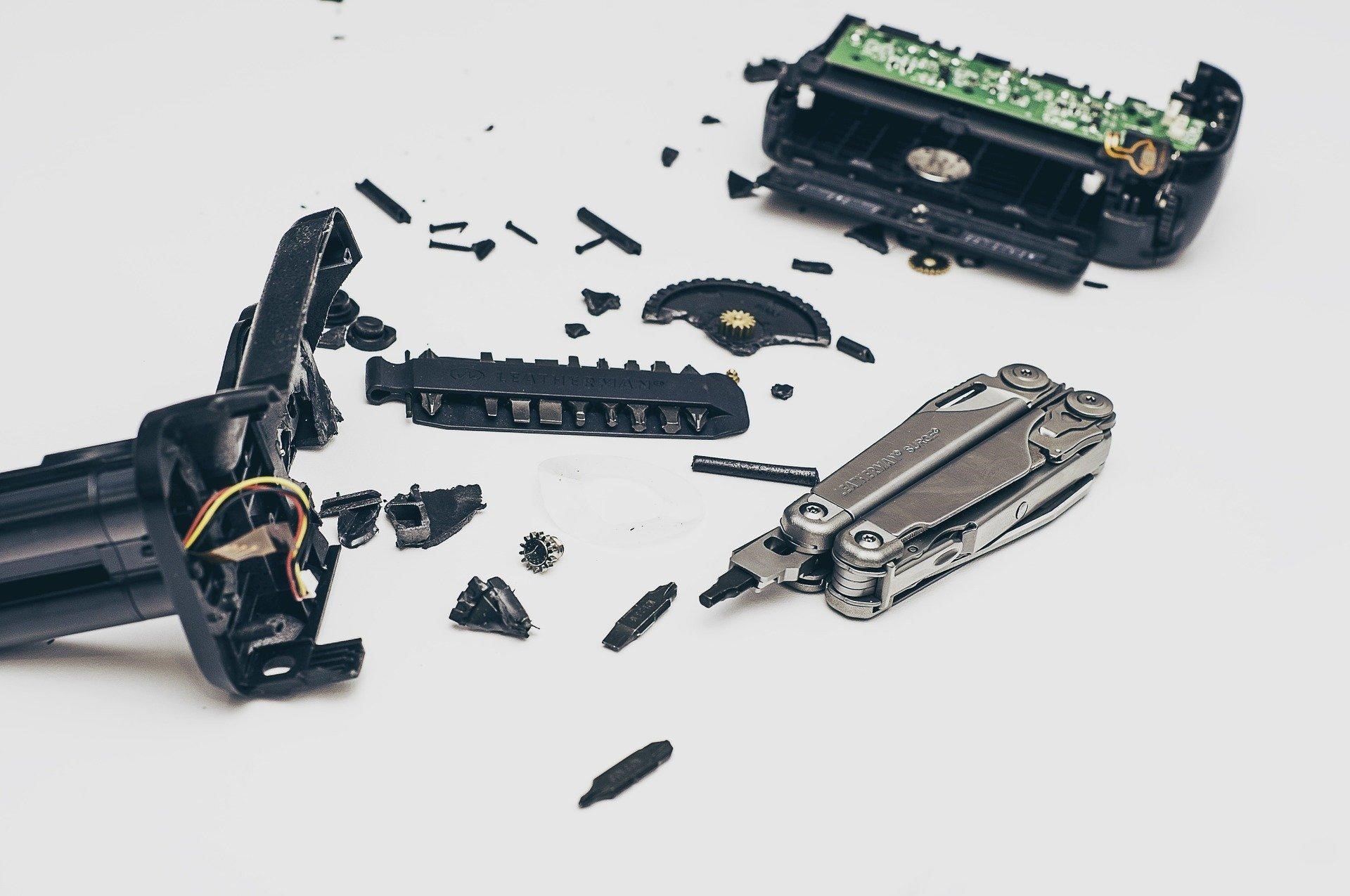
 Life tests – accelerated tests – homologationForensic engineering
Analysis of defective materials, prospecting and validation of suppliers
-
 Metals – alloys – weldsForensic engineering
Validation of materials requirements for ASME certification
-
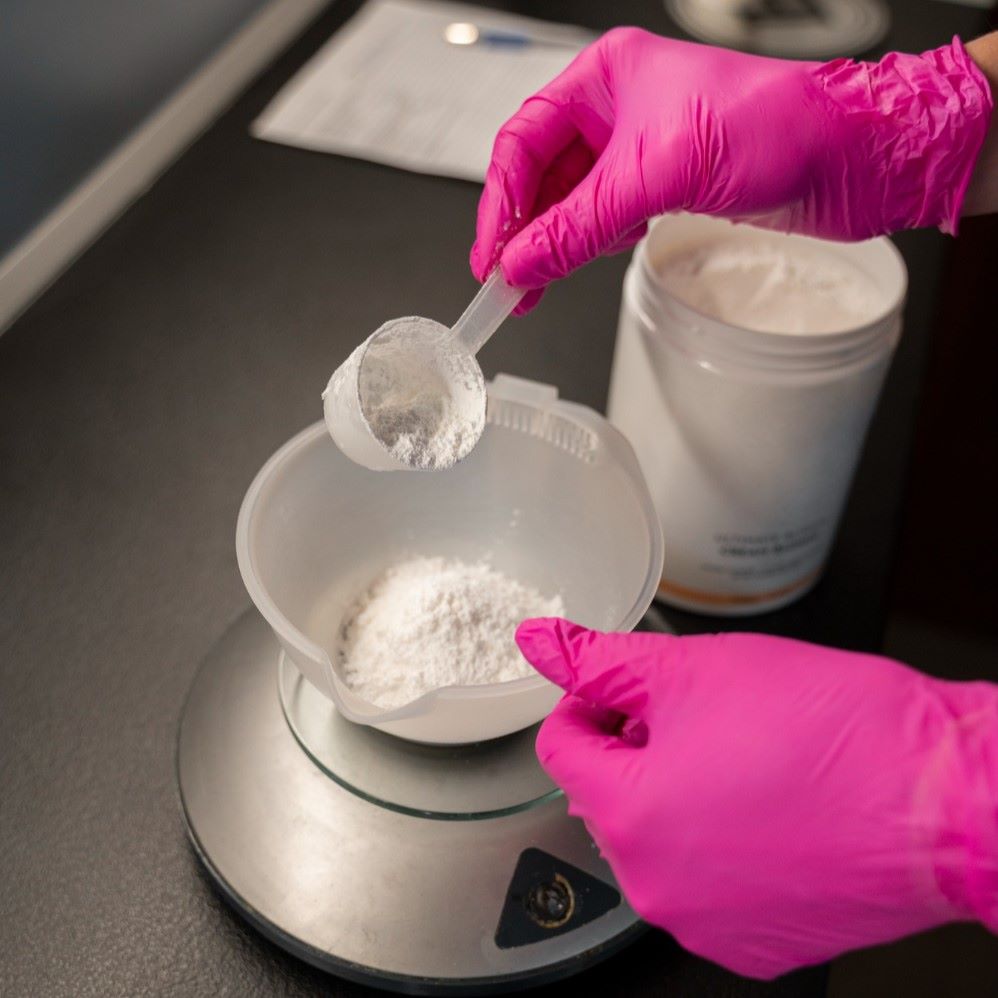 Chemicals – detergents – oils
-
 Metals – alloys – welds
 Forensic engineering
Biocompatibility Testing to Approve New Materials and Manufacturing Methods
-
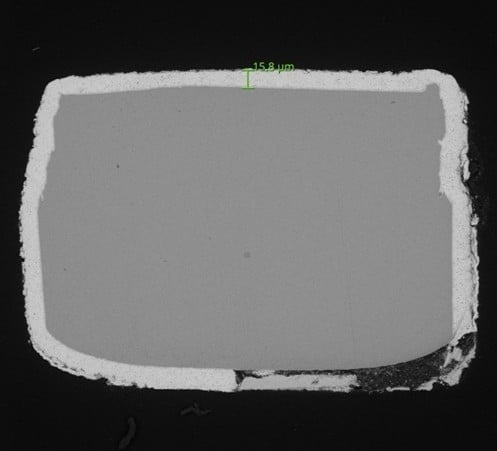 Electrical – electronics components
 Forensic engineering
Quality control to validate suppliers through corrosion resistance analysis
Frequently Asked Questions About Industrial Technical Consulting and Engineering Decision-Making
Faqs
What is technical industrial consultancy?
Technical industrial consultancy is a specialised service that helps industrial companies make informed decisions on materials, processes, products and regulations, based on objective technical analysis and verified data. Unlike a generic business consultancy, it draws on experimental evidence and applied engineering knowledge.
At Infinitia, we approach each case within its real-world context: we analyse critical variables, evaluate alternatives and define the most appropriate technical solution. Our impartial approach, free from ties to manufacturers or suppliers, ensures that our recommendations are guided solely by the best possible technical decision.
What is the purpose of technical industrial consultancy?
Technical industrial consultancy serves to reduce uncertainty in complex industrial decision-making, anticipate failures, optimise processes and improve product performance before problems reach production or the market.
In practice, it enables us to address situations such as: selecting the right material for a specific application, validating compliance with a standard (ISO, ASTM, ASME, etc.), comparing process alternatives, or identifying the cause of a recurring quality deviation. The result is a decision backed by data, not assumptions. Do you have a specific, unresolved problem? Tell us about it and we’ll offer you some guidance, with no obligation.
When is it necessary to engage a technical industrial consultancy?
It is necessary to engage technical industrial consultancy when a company is faced with decisions regarding materials, processes or design where there is insufficient internal certainty, particularly if an error could have a significant economic, functional or regulatory impact.
Some common scenarios include: a product failing under real-world conditions of use; a change of supplier leading to variations in quality; the launch of a new product where it is advisable to validate hypotheses before moving to industrial-scale production; or the need to demonstrate compliance with technical requirements to a client or regulator.
How does working with Infinitia differ from commissioning a laboratory, a technology centre or a university?
Laboratories, technology centres and universities are valuable resources within the industrial ecosystem, and in many cases we work alongside them in a complementary manner. The difference lies in the approach: a laboratory carries out technical procedures; a technology centre or university works to timetables and objectives dictated by research priorities, which are not always aligned with a company’s operational urgency. Infinitia acts as an external technical partner with an industrial focus: it understands the problem from the outset, defines which analysis is required and why, and supports the decision-making process right through to the end.
The practical difference is that at Infinitia, the point of contact is always an engineer with applied industrial experience. The focus is on solving the client’s specific problem as quickly as possible and at the lowest cost, not on delivering a standard service or completing a research project.
How does Infinitia ensure the impartiality of its recommendations?
Infinitia does not manufacture or market any materials, components or industrial processes. This independence is structural: our recommendations are not influenced by commercial agreements with suppliers or by any interest in a specific solution.
The criterion guiding each recommendation is purely technical: which material, process or decision best solves the client’s problem within its real-world context? This model enables us to act as a trusted technical partner, particularly when it comes to sensitive decisions such as evaluating changes of supplier or validating product specifications.
Which industrial sectors work with Infinitia on technical consultancy?
Infinitia carries out technical industrial consultancy projects across sectors with widely varying operating conditions, regulations and product requirements. The main sectors are:
Automotive: validation of materials against fatigue, corrosion and temperature; evaluation of manufacturing and assembly processes.
Electronics and household appliances: analysis of thermal degradation, multi-material compatibility and assembly reliability.
Chemical industry: chemical compatibility, material degradation and process safety in aggressive environments.
Defence: validation of critical components under extreme conditions of load, temperature and environmental exposure.
Consumer goods: analysis of aesthetic and functional defects, durability and perceived quality.
Machinery and infrastructure: structural strength, in-service wear and optimisation of equipment service life.
Some real-world examples: the validation of materials for ASME certification or biocompatibility testing to approve new manufacturing methods.
How does technical industrial consultancy help to reduce costs?
Technical industrial consultancy reduces costs by identifying problems at early stages of development or production, when correcting them is significantly cheaper than doing so after industrialisation or once the product is on the market.
The most common ways of achieving savings are: avoiding the incorrect selection of materials that lead to serial failures, identifying overspecification, anticipating incompatibilities between processes and materials, and preventing recurring quality deviations through structured preventive analysis. In supplier validation projects, the cost of consultancy is usually marginal compared to the impact of bringing on board a supplier who causes serial problems.
What specific results can my company expect from an industrial technical consultancy?
The most common outcomes of a technical industrial consultancy with Infinitia include: a documented and justified technical decision (choice of material, process change, supplier validation); the identification of the root cause of a quality issue, accompanied by a proposed solution; or a technical report to support negotiations or a type-approval process.
The deliverable is tailored to the project’s objective: it may be a technical report, a test protocol, product specifications or a technical assessment for use as expert evidence. In all cases, the guiding principle is that the result must be directly actionable by the client’s technical or management team.
What is the working process like at a technical industrial consultancy with Infinitia?
The process begins with a problem-definition phase: we seek to understand the client’s actual context, the variables at play and the objective of the analysis. This phase is critical because a poorly defined problem leads to irrelevant answers, regardless of the technical quality of the tests carried out subsequently.
This is followed by the technical analysis (document review, evaluation of alternatives, applied expertise) and, where necessary, the design and execution of specific tests to validate hypotheses experimentally. At this stage, we may work independently or coordinate with specialist laboratories where the case requires it. The process concludes with clear and actionable conclusions. We work as an integral part of the client’s team, which facilitates a genuine transfer of knowledge and streamlines decision-making.
Can technical industrial consultancy support the development of new products?
Yes. Technical industrial consultancy is particularly valuable during product development phases because it enables technical risks to be anticipated before they reach the production stage, where rectifying them is much more costly.
At Infinitia, we support the development process from the definition of requirements and technical specifications right through to final validation, including the selection of materials, the evaluation of processes and the identification of critical design points. This support is suitable for both projects aimed at improving existing products and developments starting from scratch.
How long does a technical industrial consultancy take?
Typical turnaround times range from 1 to 4 weeks, depending on the technical complexity of the case: a consultation involving a literature review and technical recommendation can be completed at the lower end of this range, whilst studies requiring experimental testing, material characterisation or hypothesis validation fall at the upper end.
For urgent situations (production line issues, active complaints or time-critical decisions), we offer an urgent quotation service that delivers results within 24 to 72 hours. If you have a case with a tight deadline, please let us know when you first contact us and we will prioritise it.
How much does technical industrial consultancy cost?
The cost varies depending on the complexity of the problem, the scope of the analysis and whether validation tests are required. There is no fixed rate: services range from a one-off technical consultation to a comprehensive study of materials and processes.
At Infinitia, we work on a fixed-price basis once we have assessed the case. Our aim is not to bill by the hour, but to solve the problem at the lowest possible cost to the client. Tell us about your situation and we’ll prepare a no-obligation quote for you.