


3D design and modeling using CAD
Our industrial laboratory has highly qualified specialists and state-of-the-art tools to offer design solutions tailored to each sector’s technical requirements. Discover what we can do for your project.
3D design and CAD (Computer-Aided Design) modeling is a key tool in industrial product development, as it makes it possible to create, simulate and optimize digital models with great precision. At INFINITIA Industrial Consulting we use this advanced technology to turn ideas into tangible products, reducing development times and improving production efficiency.
Talk to a specialist
Request a free initial consultation; contact a consultant from our team of specialists

What is 3D design using CAD and 3D product modeling?
What is it?

3D design using CAD is 3D modeling. A digital modeling process for parts and components in a virtual environment, using specialized software to define every detail of a product’s geometry and functionality. Through this technology, it’s possible to simulate structural testing, analyze materials and anticipate potential failures before manufacturing.
At INFINITIA we take 3D design using CAD to the next level through the use of cutting-edge software and advanced modeling methodologies. The combination of modern infrastructure and a multidisciplinary team of design and engineering experts makes it possible to develop tailored solutions for each client.
We apply this methodology across various product development projects, from creating prototypes to optimizing existing designs through reverse engineering and advanced simulations.
3D design and CAD modeling at INFINITIA. From concept to 3D prototype and additive manufacturing
At INFINITIA, we take 3D design using CAD to a higher level thanks to the combination of cutting-edge technological infrastructure and an expert team in product engineering. Our industrial laboratory is equipped with advanced simulation, 3D scanning and metrology systems, allowing us to integrate digital modeling with validation and prototyping processes.
We also apply methodologies based on forensic engineering to detect potential failure modes at the design stage, avoiding future problems and ensuring every component is optimized for its final application. As such, companies that trust us don’t just get a precise design, but also scientific and technical backing that guarantees product reliability.
Benefits of 3D design with CAD software in product design
Benefits
One of the main benefits of 3D design using CAD is the precision and flexibility it brings to product development. Thanks to this technology, companies can reduce production costs, minimize errors and improve the quality of the final productreduce production costs, minimize errors and improve the quality of the final product.
We innovate through CAD design, optimizing products with efficient modeling and virtual performance testing. In sectors such as automotive, the manufacturing industry and product engineering, the use of CAD makes it possible to speed up processes, optimize materials and ensure functionality in design for manufacturing.
Types of 3D design using CAD and CAD 3D modeling
Types
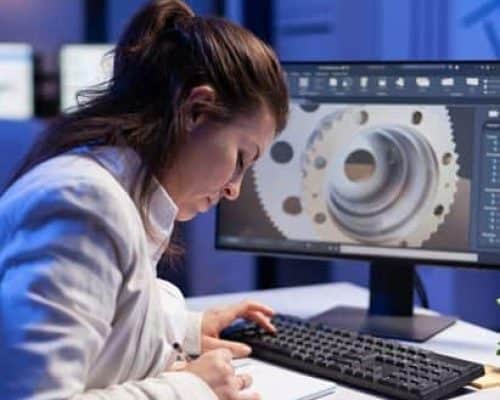
At INFINITIA, we develop different types of 3D design using CAD to address the technical requirements of highly diverse sectors. Our goal is to offer precise, functional digital models, facilitating the workflow in part design. that make it possible to optimize product development processes, reduce costs and ensure manufacturing efficiency.
Parametric modeling
Parametric modeling makes it possible to define geometries using parameters and constraints. This way, any change automatically propagates throughout the design, ensuring consistency and reducing errors.
At INFINITIA we apply this technique in mechanical design and manufacturing projects, allowing us to modify components without redoing them from scratch and reuse configurations across different products. Thanks to this methodology, we optimize flexibility and 3D design efficiency in industrial environments.
Surface modeling
Surface modeling focuses on creating complex, flowing shapes, ideal for automotive design or the aerospace industry. With this technique we generate high-quality surfaces for aerodynamic structures, aesthetic housings or parts with free-form geometries.
At INFINITIA, we work with advanced CAD technologies to develop designs that not only serve a structural function, but also add value in aesthetics and ergonomics.
Solid modeling
Solid modeling forms the foundation of industrial CAD design, as it makes it possible to generate detailed 3D representations with complete information about volume, material and assembly.
At INFINITIA we use it to validate part feasibility, identify interferences in mechanical assemblies and anticipate manufacturing problems. This technique is essential in sectors where dimensional precision and structural strength are decisive.
Mesh-based modeling (Mesh Modeling)
Mesh-based modeling is used in reverse engineering and the digitization of existing parts. It makes it possible to reconstruct components from 3D scanning, facilitating design optimization or the creation of digital replicas using CAD software.
At INFINITIA, we use this methodology for 3D printing projects, component adaptation and redesign of industrial parts, speeding up the rapid prototyping process.
Generative design and topology optimization
Generative design and topology optimization are advanced methodologies that apply algorithms to create optimized structures based on mechanical and material requirements.
At INFINITIA we integrate these techniques into aerospace and automotive projects, reducing component weight, improving strength and optimizing material use in additive manufacturing.
Sectors where 3D design and CAD modeling validates critical geometries
sectors
Industrial 3D CAD modeling is applied broadly across all sectors where geometric precision, reliability and manufacturability are decisive. Each sector imposes different tolerance, material and regulatory requirements, which determine how the digital model must be built and validated.
INFINITIA adapts its modeling approach to each sector’s requirements, integrating the applicable regulations and each component’s real conditions of use. This sector-specific approach ensures the model isn’t generic geometry, but a definition tailored to the specific constraints of the target industrial environment.
3D design in automotive: CAD modeling of components for structural optimization
In the automotive sector, 3D CAD design is essential for developing bodywork, chassis and mechanical components that must meet strict safety, durability, energy efficiency and aerodynamic requirements. Digital modeling makes it possible to analyze multiple scenarios before moving to prototyping or production phases, reducing physical iterations and improving decision-making in the early stages of development.
- Aerodynamic simulations: validating bodywork efficiency and reducing fuel consumption through digital analysis of airflow behavior.
- Mechanical fatigue analysis: evaluating parts subjected to repetitive load cycles to anticipate failures and optimize structural design.
- Structural optimization of components: reducing weight without compromising mechanical strength, stiffness or in-service behavior.
- Geometric adjustment of parts: improving tolerances, assembly and maintenance to facilitate integration into complex production processes.
At INFINITIA we apply these design and modeling tools to optimize components from the earliest stages, reduce redesign risks and accelerate technical validation before industrialization.
3D design in the aerospace and defense industry: parametric modeling of lightweight, safe structures
The aerospace and defense industry demands extremely high-precision designs, with very tight tolerances and compliance with international regulations. The use of 3D CAD and parametric modeling makes it possible to develop lightweight, robust structures that are easily adjustable to changing requirements, while also facilitating the validation of complex configurations in highly demanding technical environments.
- Topology optimization: lightweighting critical components while maintaining structural integrity and the required mechanical behavior.
- Advanced structural simulations: verifying resistance to extreme loads, vibrations and severe operating conditions.
- Structure development: metallic and composite structures adapted to severe environments.
- Efficient management of design revisions using parametric models: efficient geometry updates in response to changing requirements.
At INFINITIA we use these methodologies to develop lighter, safer solutions, improve design traceability and reduce deviations during validation and manufacturing phases.
3D design in mechanical engineering and manufacturing: dimensional precision and manufacturing efficiency
In mechanical engineering and manufacturing, 3D CAD design makes it possible to maximize precision, reduce manufacturing errors and ensure product feasibility from the earliest design phases. It’s a key tool both for individual parts and complex assemblies, facilitating early detection of interferences and geometric validation.
- Design of molds, dies and tooling for production processes.
- Dimensional and geometric validation of complex mechanical structures: ensuring tolerances and functionality.
- Assembly simulation to detect interferences and assembly problems.
- Preparation of technical documentation and drawings for production.
At INFINITIA we use CAD modeling as a validation and optimization tool, reducing errors and improving manufacturability.
3D design for medical devices and health: customized prosthetics and implants
In the healthcare sector, 3D CAD design makes it possible to develop customized solutions, tailored to each patient’s specific anatomy and needs, improving clinical and functional outcomes. It also facilitates the prior validation of complex geometries and their integration with advanced manufacturing technologies.
- Design of customized prosthetics through digital modeling.
- Geometric optimization of medical implants through structural simulations: improving their mechanical behavior and fit.
- Integration with additive manufacturing to produce precise surgical devices.
- Development of functional prototypes for clinical and technical validation.
At INFINITIA we apply these capabilities to improve personalization and reduce uncertainties during validation.
3D design in architecture and interior design: planning, modeling and visualization of spaces
In architecture and interior design, CAD design brings technical precision and realistic visualization that facilitates decision-making in the early stages of a project. 3D modeling makes it possible to anticipate construction problems and optimize spatial design, reducing execution errors and improving technical coordination.
- Creation of detailed digital drawings for complex architectural projects.
- 3D modeling of spaces, structures and construction elements.
- Lighting and shadow simulations to evaluate different scenarios.
- Coordination between technical disciplines through shared digital models.
At INFINITIA we use these tools to anticipate construction issues and optimize the project’s definition.
3D design for 3D printing and additive manufacturing: rapid prototyping and validation of complex geometries
3D CAD design is the foundation of additive manufacturing, as it makes it possible to rapidly prototype, validate complex geometries and optimize material use before mass production. This approach enables fast iterations and reduces product development times.
- Development of functional prototypes through 3D CAD modeling.
- Validation of the mechanical performance of 3D-printed components, using CAD software to ensure compatibility.
- Optimization of geometries and materials to improve part durability.
- Rapid design iterations to accelerate product development.
At INFINITIA we apply CAD design and additive manufacturing to quickly validate solutions and improve development efficiency.
3D design service. How INFINITIA turns ideas into products through 3D design and AutoCAD software
Value
3D design using CAD has established itself as an essential tool in industrial product development, allowing companies to optimize every phase of the process, from initial conceptualization to final manufacturing. Thanks to its ability to generate precise digital models, simulate real service conditions and anticipate potential failures, this methodology has become a strategic factor for ensuring quality, reliability and efficiency across different industrial sectors.
At INFINITIA Industrial Consulting, we have shown that the advanced use of 3D CAD delivers decisive competitive advantages. By integrating parametric modeling, surface design, solid modeling and methodologies such as topology optimization, we offer our clients product engineering solutions tailored to each need. Our industrial laboratory, equipped with state-of-the-art technology, allows us to combine digital design with advanced simulation, 3D metrology and rapid prototyping processes, ensuring every project is backed by technical and scientific rigor.
The importance of CAD design also lies in its versatility. In sectors such as automotive, aerospace, health, manufacturing or architecture, this technology makes it possible to create lighter, safer and more efficient designs, with shorter development cycles and greater control over the product’s final functionality. Looking ahead, trends such as additive manufacturing, generative design and the integration of reverse engineering will open new opportunities to keep optimizing prosses and improving the performance of industrial products.
Trusting INFINITIA for 3D design using CAD means having a strategic partner capable of turning ideas into tangible, innovative, high-value solutions. Our multidisciplinary approach, based on the combination of forensic engineering, material characterization and validation testing, ensures every design not only meets the specifications, but is also prepared to overcome the challenges of today’s and tomorrow’s industry.
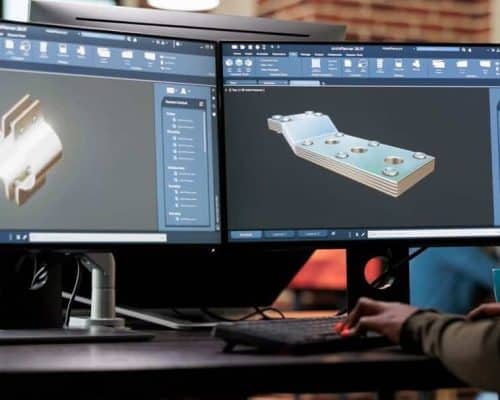
Frequently asked questions about 3D design and CAD modeling
FAQs
What is 3D design using CAD and what is it used for in industrial engineering?
3D design using CAD is the process of digitally modeling parts and products in a virtual environment, using specialized software to precisely define their geometry, functionality and behavior before manufacturing. In industrial engineering it’s used to develop new products, optimize existing components, simulate usage conditions and validate design decisions without needing to build costly physical prototypes in the early stages.
At INFINITIA we apply 3D CAD modeling integrated with material testing and advanced simulations, which makes it possible to detect design problems before they reach production. We have worked on projects in automotive, defense, manufacturing and medical devices where this integration between design and experimental validation has been decisive in reducing iterations and shortening time-to-market. If you’d like to know how we apply these tools in real projects, you can explore the technologies we use in our technology selection and testing process.
When is it necessary to hire an external 3D CAD design service?
Hiring an external 3D CAD design service is necessary when the project requires technical capabilities that don’t exist internally, when timelines are tight, or when the design needs to be validated with engineering criteria that go beyond geometric modeling. It’s also common when the starting point is a physical part that needs digitizing, or when the design needs to be integrated with material testing or behavior simulations.
At INFINITIA we work with industrial companies that need to outsource the modeling of complex parts, the topology optimization of components or the preparation of geometries for additive manufacturing. We have seen cases where the client had a seemingly correct design that showed systematic failures in use; integrating our CAD service with laboratory capabilities made it possible to identify the source of the problem and redesign the component on an experimental basis, not just a geometric one. You can see how we approach the prior conceptual phase on our design and innovation page.
What is the difference between parametric, solid and surface modeling in CAD?
Parametric modeling works with geometries defined by modifiable parameters that automatically propagate throughout the design; solid modeling generates 3D representations with complete information on volume, material and assembly; and surface modeling is geared toward complex, aesthetic shapes where free-form geometry and aerodynamics are decisive.
Each technique addresses a type of problem. Parametric is ideal for manufacturing and iterative mechanical design; solid is essential for validating interferences and manufacturability; surface modeling is used in sectors such as automotive or aerospace. At INFINITIA we select and combine these methodologies according to each project’s technical requirements, also including mesh modeling when the starting point is an existing component. Once the model is completed, we can generate realistic visualizations of the final product through our product rendering service.
Can INFINITIA generate a 3D CAD model from an existing physical part?
Yes. INFINITIA can generate a complete 3D CAD model from a physical part using 3D scanning and reverse engineering techniques, producing a precise digital replica ready to optimize, redesign or prepare for manufacturing. This process combines real-geometry capture with parametric or mesh-based reconstruction, depending on the project’s objective.
This is a common approach in component improvement projects, replacement of discontinued parts, adaptation of legacy designs to new production processes, or validation of dimensional tolerances. The advantage of doing this at INFINITIA is that the resulting model can be validated directly with material testing or structural simulations, closing the loop between the physical and digital worlds. To understand how we apply reverse engineering within a broader context of industrial analysis, you can check our industrial benchmarking and comparative trials page.
How does INFINITIA ensure that a 3D CAD model is viable for manufacturing?
INFINITIA ensures the manufacturing viability of its 3D CAD models by integrating the design with DFM (Design for Manufacturing) criteria, structural simulations, assembly interference analysis and experimental material validation from the project’s earliest phases. It’s not just about the model being geometrically correct, but about it working under real usage conditions and being efficiently manufacturable.
We also apply preventive failure analysis techniques during design, allowing us to anticipate failure modes before the component reaches production — something that sets our service apart from a conventional CAD study. We have worked on cases in manufacturing and the defense industry where early detection of a structural problem in the digital model avoided costly redesigns after manufacturing the first prototype. When the design involves special parts or production tooling, this rigor also extends to tooling and complex spare part design.
What are the consequences of not validating a CAD design before manufacturing?
Not validating a CAD design before manufacturing usually results in prototypes that don’t work as expected, costly physical iterations and product launch delays. When the failure reaches mass production or the market, the economic impact is exponentially greater than the cost of having resolved the problem at the digital design stage.
Without structural simulations or material validation, decisions about geometry, tolerances or assembly are based on assumptions that don’t always reflect the component’s real in-service behavior. At INFINITIA we have stepped in on projects where the design was documentarily compliant but failed under load or temperature conditions not covered in the initial validation. Detecting these deviations in the digital model (before machining or printing) is precisely the value that comes from integrating CAD design with laboratory capabilities. You can see how we structure that process from the outset on our technical feasibility analysis page.
Does INFINITIA’s 3D CAD design service also include prototyping?
Yes. INFINITIA offers a comprehensive service that ranges from 3D CAD modeling to physical prototyping through 3D printing and additive manufacturing, making it possible to validate the design quickly and cost-effectively before moving to production. This integration drastically reduces iteration times and facilitates technical decision-making with a tangible product in hand.
Depending on the project’s status and validation objectives, we can develop anything from a proof of concept to a Minimum Viable Product (MVP) or a Minimum Exciting Product (MEP), according to the required level of maturity. In every case, the prototype doesn’t replace experimental validation: we combine it with material and in-use behavior testing when the project requires it. You can see in detail how the early validation phase works on our proof of concept page.
What are generative design and topology optimization, and when are they applied?
Generative design and topology optimization are advanced CAD methodologies that use algorithms to generate optimized structures based on mechanical, weight and material requirements. They’re applied when the goal is to reduce a component’s weight without compromising its strength, improve its structural performance, or prepare complex geometries for additive manufacturing where the shape doesn’t add production cost.
At INFINITIA we integrate these techniques into projects in sectors such as aerospace, automotive or high-precision manufacturing, where weight, fatigue and reliability requirements are decisive. We combine topology optimization with structural testing to validate that algorithmically generated geometries behave as expected under real load conditions, closing the loop between the digital model and the component’s physical behavior. If the project also requires a technical or commercial presentation of the result, we offer a final presentation and infographics service.
How much does an industrial 3D design and CAD modeling service cost?
The cost of an industrial 3D design and CAD modeling service depends on three factors: the geometric and functional complexity of the parts to be modeled, the project’s scope (from a single component to a complete assembly system with simulations and validation), and the level of integration required with other services such as 3D scanning, material testing or prototyping. A parametric model of a simple part can’t be compared to a complete project that includes topology optimization, a feasibility report and preparation for manufacturing.
At INFINITIA we always size the service to the real technical objective: we prioritize the methodologies most representative of the problem, avoid unnecessary work and optimize the cost-value ratio for the client. If you’d like an estimate tailored to your case, you can first find out how we structure the preliminary study and idea maturation phase before getting started, or contact us directly to receive a no-obligation technical-economic proposal.
How long does it take to complete a 3D CAD design project?
The time to complete a 3D CAD design project ranges from a few days, for modeling parts with defined geometry, to between two and eight weeks for projects that include conceptual design, optimization iterations, structural simulations and preparation of technical documentation for manufacturing. The number of components, review cycles and integration with prototyping or validation testing are the factors that most affect the timeline.
In urgent cases with a direct impact on the development schedule, at INFINITIA we prioritize the critical deliverables to unblock the following phases and complete the detailed documentation afterward. A precise scope definition from the start is the most effective lever for optimizing timelines without compromising the technical quality of the result. If you’d like to understand how we manage that initial definition, you can check our co-creation sessions page, or state your urgency directly in the contact form.
Why does the design work in the CAD model but fail when manufacturing the prototype or in real use?
A CAD model can be geometrically correct and still fail to predict the component’s real behavior when it doesn’t incorporate critical variables from the manufacturing process or real usage conditions: manufacturing tolerances, anisotropic material behavior, thermal effects during production, or dynamic interactions with other components in the assembly.
At INFINITIA we address this situation by combining CAD modeling with real material characterization and behavior testing under service conditions, which makes it possible to align the digital model with physical reality before manufacturing. We have resolved cases in manufacturing and the medical sector where the discrepancy between model and prototype originated in the additive manufacturing process, not in the design itself. Identifying that cause on an experimental basis is what makes it possible to apply a correction that also works in production. If you’d like to understand in depth how we diagnose this type of problem, you can see how we approach work-line selection when the origin of the failure isn’t clear from the outset.
How does a 3D design and CAD modeling project with INFINITIA get started?
A 3D design project with INFINITIA begins with an initial technical diagnosis in which we analyze the product’s functional requirements, usage conditions, manufacturing objectives and the client’s starting point, whether it’s an idea, an existing design, or a physical part that needs digitizing. Based on that diagnosis, we define the most appropriate CAD methodology, the project’s scope, and a work plan adjusted to the available timeline and budget.
This first step is fundamental: it allows us to identify whether the project needs to start from scratch, optimize an existing design, incorporate 3D scanning, or integrate modeling with validation testing. Without that context, any budget is an estimate without a real technical basis. If the project is still at a very early stage, it may be helpful to first learn how we handle the ideation and concepts phases, or contact us directly to receive a personalized proposal.