
Industrial benchmarking and comparative trials
Industrial benchmarking based on comparative testing is a technical service designed to objectively evaluate how materials, components, products or technologies perform against existing market alternatives using comparative analysis methods. In industrial settings, this comparison is not based on perceptions or stated specifications, but on data obtained through physicochemical, mechanical and functional testing that quantifies real differences in performance, durability, quality and safety.
This type of assessment is particularly relevant in sectors where competitiveness depends directly on the product’s technical performance. Comparative testing makes it possible to identify which solutions deliver superior performance, which materials behave more consistently under demanding conditions and which technologies can optimise production processes. The analysis extends beyond final results to examine the composition, microstructure, coatings and manufacturing conditions that explain the observed differences.
At INFINITIA, this service is carried out using advanced characterisation techniques and testing programmes designed to reproduce real-world conditions of use. This approach produces measurable and reproducible results for the comparative validation of products, providing a sound technical basis for decisions on the development, improvement or replacement of materials and components, while reducing uncertainty in demanding industrial environments.
Talk to a specialist
Request a free initial consultation; contact a consultant from our team of specialists

What does comparative testing in industrial benchmarking involve?
What is it?
Comparative tests involve the experimental evaluation of different solutions under controlled and reproducible conditions, with the aim of making objective comparisons between products, materials or technologies. This process involves defining test protocols, selecting critical variables and measuring key parameters such as mechanical strength, thermal behaviour, chemical stability or functional response under specific conditions.
Unlike theoretical or documentary analyses, this approach is based on results obtained directly in the laboratory, which makes it possible to identify differences that are not apparent in technical specifications. This is particularly relevant when comparing products from different manufacturers or materials with similar formulations, where small variations can have a significant impact on the final performance.
At INFINITIA, tests are designed specifically for each individual case, combining characterisation techniques with mechanical, thermal and accelerated ageing tests. This approach makes it possible not only to determine which solution offers the best performance, but also to identify the technical causes behind these differences, thereby facilitating a rigorous interpretation of the results obtained.
Benchmarking and comparative testing at INFINITIA
Industrial benchmarking based on comparative testing enables experimental data to be transformed into applicable technical knowledge, which is essential for data analysis in innovation. In an environment where performance optimisation, cost reduction and regulatory compliance are key factors, having results measured under controlled conditions enables decisions to be made with greater precision and less uncertainty.
From a technical point of view, this approach makes it possible to identify the variables that directly influence a product’s performance. By comparing physical, chemical and mechanical properties, it is possible to determine which factors affect durability, strength or functionality under specific conditions, thereby providing valuable information for strategic decision-making. This is particularly relevant during the development phase, where even small variations can have a significant impact on the final performance.
Furthermore, comparative tests enable a product to be assessed against market benchmarks from an experimental perspective. This evaluation facilitates the validation of designs, the optimisation of performance and the justification of technical decisions based on relevant information.
At INFINITIA, this service is delivered through a combination of forensic engineering, advanced characterisation and testing under controlled conditions, enabling us to interpret results and translate them into technical recommendations that can be applied to the development, validation and continuous improvement of industrial products.
Benefits of applying comparative testing and benchmarking in industry
BENEFITS
Comparative testing of industrial products helps to address a key need: to have objective data to understand why seemingly equivalent solutions behave differently in service. In many cases, technical specifications do not reflect actual performance, which introduces uncertainty into the selection of materials, the validation of suppliers or the development of new products.
One of the main benefits is the ability to identify the cause of premature failures or unexpected degradation. Through comparative testing, it is possible to determine whether these deviations are related to the material composition, the manufacturing process or the conditions of use. Furthermore, these tests enable the validation of claimed performance characteristics, such as strength, durability or stability, using verifiable experimental data.
Another important aspect is the validation of alternatives through benchmarking and how they compare with competitors. When replacing materials or changing suppliers, comparative tests make it possible to assess whether a solution offers equivalent or superior performance, thereby reducing the risk associated with unverified decisions. They also help to identify opportunities for improvement through direct comparison with market benchmarks.
Overall, this approach makes it possible to quantify differences, identify critical variables and predict behaviour under real or simulated conditions, thereby improving the quality of technical decisions and reducing the risks associated with the development and use of industrial products
Types of comparative tools and tests in industrial benchmarking
types
Comparative tests are carried out in a wide range of contexts where it is necessary to objectively assess the performance of different solutions under real-world conditions. Through physico-chemical, mechanical, thermal and functional tests, it is possible to analyse both overall performance and specific variables that affect the product’s behaviour.
This approach makes it possible to identify technical differences that are not immediately apparent, providing a sound experimental basis for decision-making. Furthermore, the ability to replicate real-world conditions in the laboratory makes it possible to anticipate behaviour and reduce the risks associated with changes to materials, processes or suppliers.
Comparison of composition and materials
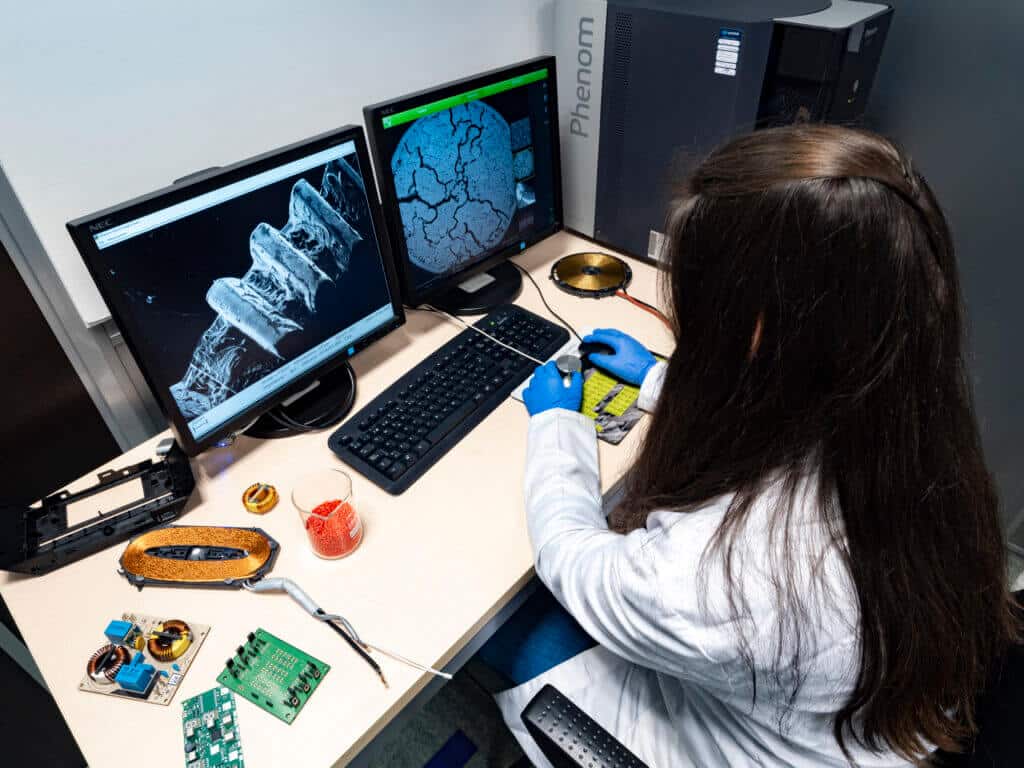
In this type of testing, the chemical composition, internal structure and phase distribution of materials are analysed in depth using advanced techniques such as SEM-EDX, ICP-OES, FTIR, DSC and TGA. These methodologies enable the precise identification of additives, fillers, coatings, contaminants or variations in alloys that may directly influence the material’s behaviour in service. Furthermore, structural analysis allows for the detection of differences in microstructure, degree of crystallinity or matrix-reinforcement interaction in composite materials.
This approach is particularly relevant when comparing materials that appear to be equivalent but behave differently under real-world conditions, helping to identify patterns in their performance. Comparative tests enable the composition to be correlated with mechanical, thermal or chemical properties, identifying which variables are critical to the material’s performance. They also facilitate the detection of deviations from technical specifications or target formulations, offering insights into potential improvements, such as in product development.
The results obtained enable informed decisions to be made regarding the selection of raw materials, the optimisation of formulations or the validation of alternatives, thereby improving product performance, optimising costs and reducing the risks associated with changes in materials or suppliers.
Comparative performance and functionality tests
These tests evaluate the product’s behaviour under real or simulated operating conditions, analysing properties such as mechanical strength, impact resistance, fatigue resistance, wear, friction and functional response to specific loads. Using test benches and set-ups tailored to each application, it is possible to replicate representative operational scenarios and measure the product’s performance quantitatively, thereby identifying areas for improvement.
Comparative analysis makes it possible to identify differences in behaviour between solutions, even when the technical specifications are similar. Parameters such as deformation, failure, loss of properties or functional efficiency are assessed, enabling objective comparisons to be made between materials, components or complete products. This approach is key to design validation and new product development processes.
The results make it possible to determine which solution offers the best performance in line with the application requirements, thereby optimising the design, improving reliability and providing a basis for technical decisions supported by experimental data. Furthermore, they help to identify critical issues that could compromise performance in service.
Comparative durability and service life tests
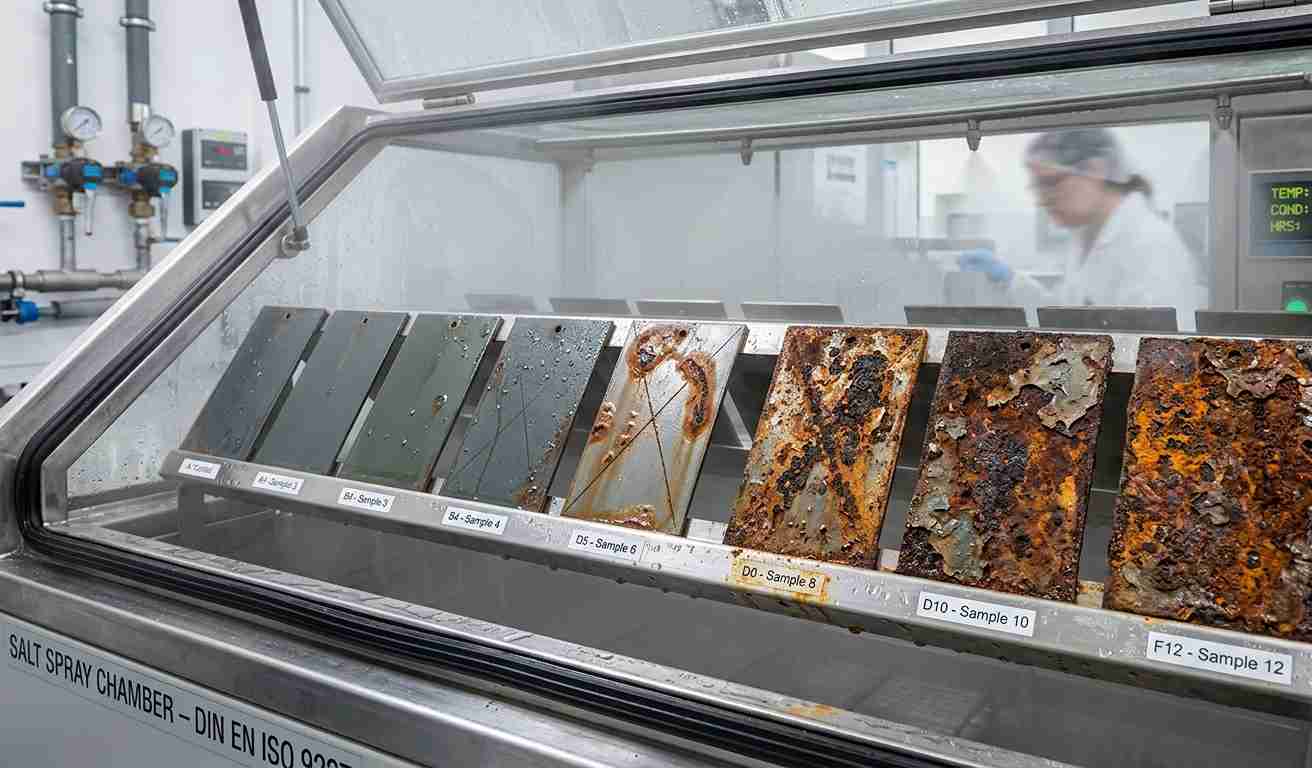
Through accelerated ageing tests, exposure to UV radiation, thermal cycling, humidity, salt spray or chemical agents, the evolution of the material’s properties over time is analysed. These tests make it possible to simulate in the laboratory conditions that occur in service over a period of months or years, accelerating the degradation processes and facilitating the assessment of durability.
The comparative approach makes it possible to assess how different materials or solutions maintain their properties under demanding conditions, identifying phenomena such as thermal degradation, oxidation, loss of mechanical properties or coating failure. It also allows the results to be correlated with real-world conditions of use, helping to understand how to predict long-term behaviour.
These tests make it possible to predict in-service behaviour, compare the stability of different solutions and validate their suitability in terms of the product’s service life requirements. As a result, reliability is improved, costs associated with maintenance or replacement are reduced, and the selection of materials is optimised on the basis of their durability.
Comparative tests on safety, quality and performance
In this type of testing, physical characteristics, risks associated with use and the consistency between the declared performance and the product’s actual behaviour are assessed. Aspects such as structural integrity, behaviour under extreme conditions, potential critical failures and deviations from technical specifications are analysed.
Comparative analysis makes it possible to verify compliance with applicable regulations and to identify potential shortcomings in design, materials or manufacturing processes. Quality-related parameters, such as uniformity, repeatability and the presence of defects, which may affect the product’s performance and safety, are also assessed.
This approach enables regulatory requirements to be validated, quality to be improved and risks associated with failures or defects during service to be reduced. It also facilitates the technical justification of performance and helps to strengthen confidence in the product from both a technical and regulatory perspective.
Comparative trials of suppliers and technologies
Comparative trials enable the evaluation of different suppliers or technologies in terms of performance, durability, quality and behaviour under specific conditions. This analysis is based on controlled trials that allow for an objective comparison of different materials, processes or technological solutions.
This approach is particularly relevant in standardisation processes, the substitution of raw materials or the search for more efficient alternatives, identifying areas of opportunity for similar companies. Testing makes it possible to verify whether a new solution meets the technical requirements and offers performance equivalent to or better than the current option, thereby reducing the risk associated with unvalidated changes.
The results obtained enable decisions to be made based on experimental data, optimise the supply chain and improve the product’s competitiveness. Furthermore, they facilitate the identification of opportunities for improvement in terms of cost, performance or sustainability, always on a sound technical basis and with data analysis to underpin the decisions.
Industrial sectors where benchmarking and comparative testing can be applied
industries
Comparative testing of industrial products is used across a wide range of sectors where reliability, durability and performance are critical factors. Experimental evaluation enables solutions to be compared under controlled conditions, ensuring they meet the specific requirements of each application.
Each sector faces specific challenges relating to conditions of use, materials or regulations. In this context, comparative testing enables these challenges to be addressed using objective data, facilitating decision-making and continuous improvement, in line with market trends.
Industrial benchmarking in construction: assessment of the durability and performance of materials under demanding environmental conditions
In the construction sector, materials must maintain their integrity in the face of harsh environmental conditions such as humidity, solar radiation, thermal cycles or exposure to corrosive agents. These conditions can accelerate degradation processes that directly affect structural safety, durability and maintenance costs, making it essential to validate them through comparative testing.
- Evaluation of façade coatings: application of salt spray, UV radiation and accelerated ageing tests to analyse resistance to corrosion and environmental degradation under real-world exposure conditions.
- Validation of thermal insulation: tests in climatic chambers to verify the stability of thermal properties following cycles of humidity and temperature, ensuring their energy efficiency over time.
- Analysis of concrete and mortar: assessment of compressive strength, abrasion resistance and mechanical strength against market benchmarks to ensure their structural integrity in service.
At INFINITIA, we carry out comparative tests to select the most durable materials, optimise maintenance costs and ensure compliance with technical and regulatory requirements in construction projects.
Industrial benchmarking in the chemical industry: a comparative analysis of formulations, composition and resistance in aggressive environments
The chemical industry works with materials and products exposed to highly aggressive environments, where even small variations in composition can lead to significant differences in performance. Validation through comparative testing makes it possible to identify these differences and optimise formulations using an experimental approach.
- Comparison of industrial paints: analysis of additives and pigments using techniques such as ICP-OES or SEM-EDX to assess their resistance to chemical agents and their stability under conditions of use.
- Evaluation of detergents and cleaning products: functional tests to measure their effectiveness in removing contaminants such as grease, limescale or biofilms under controlled and reproducible conditions.
- Validation of engineering polymers: analysis of additives such as flame retardants or plasticisers to verify their performance, safety and regulatory compliance.
At INFINITIA, these tests enable us to improve the performance of formulations, ensure their stability under demanding conditions and validate solutions against technical and regulatory requirements.
Industrial benchmarking in household appliances: validation of the durability, reliability and performance of components in real-world use
In the household appliances sector, perceived quality and reliability depend directly on the behaviour of materials and components under real-world conditions of use. Comparative tests make it possible to replicate these conditions and assess performance objectively.
- Impact tests on plastic casings: validation of resistance to drops and knocks during everyday use, identifying potential points of structural failure.
- Comparison of metallic coatings: salt spray chamber corrosion tests and abrasion tests to assess durability in humid or aggressive environments.
- Evaluation of electronic components: analysis of stability and thermal behaviour in encapsulants and resins under demanding operating conditions.
At INFINITIA, these tests enable us to anticipate failures, improve material selection and ensure product reliability throughout its service life.
Industrial benchmarking in the defence sector: comparative assessment of the performance, durability and reliability of materials and systems
In the defence sector, materials and components must be guaranteed to function in extreme conditions, where factors such as impact, vibration, harsh environmental conditions or chemical exposure may compromise their integrity. Differences in materials, processes or design can have a direct impact on the safety, operability and service life of the system.
- Mechanical and ballistic strength tests: assessment of the behaviour of materials under impact, dynamic loads and extreme stresses.
- Analysis of behaviour in aggressive environments: corrosion, salt spray, thermal cycling and chemical exposure tests to validate stability under severe operating conditions.
- Validation of electronic and functional components: thermal stability, vibration and electromagnetic compatibility testing on critical systems.
At INFINITIA, these tests enable us to validate performance under conditions representative of real-world use, optimise materials and designs, and ensure the reliability and safety of systems in defence sector applications.
Industrial benchmarking in the energy and electronics sectors: analysis of thermal stability, dielectric behaviour and material reliability
In the energy and electronics sectors, materials must operate under demanding thermal and electrical conditions, where any failure can have critical consequences. Comparative tests enable their performance to be assessed in highly demanding scenarios.
- Evaluation of electronic encapsulants: thermal testing using DSC and TGA to analyse stability under load and temperature cycles.
- Comparison of dielectric insulators: analysis of their behaviour under high voltages and electrical discharges to validate their reliability.
- Testing of batteries and rechargeable batteries: evaluation of coatings and separators to improve system safety and service life.
At INFINITIA, these tests enable us to optimise component design, improve system efficiency and reduce the risks associated with electrical or thermal failures.
Industrial benchmarking in the automotive sector: comparative assessment of in-service performance and validation of critical components
In the automotive sector, components are subjected to variable and demanding operating conditions, involving dynamic loads, thermal cycles, environmental exposure and continuous mechanical stress. Differences in manufacturing processes, surface treatments or the choice of materials can result in reduced performance or premature failure.
- Fatigue and vibration behaviour tests: assessment of components subjected to cyclic loads and continuous vibrations to identify failure mechanisms such as cracks, deformations or loss of mechanical properties.
- Stability analysis under environmental conditions: accelerated ageing, thermal shock and exposure to moisture or chemical agents to validate the durability of materials and coatings.
- Functional validation of systems and sub-assemblies: assessment of the behaviour of assembled parts, joints and electronic components under representative operating conditions.
At INFINITIA, these comparative tests enable us to identify deviations in performance, optimise component design and ensure the product’s robustness under real-world conditions in the automotive sector.
Comparative testing-based benchmarking for industrial competitiveness at INFINITIA
Value
Industrial benchmarking supported by comparative testing provides crucial value for technical decision-making in complex industrial environments. Experimental data obtained under controlled and reproducible conditions reduces uncertainty about the behaviour of materials and products, enables solutions to be validated from a technical perspective and improves the reliability of components and production processes. This approach avoids relying solely on theoretical specifications or third-party information, provides an objective basis for assessment and makes it possible to identify development opportunities.
One of the main benefits is the ability to detect real differences between seemingly equivalent solutions, facilitating the development of more effective products. Comparative tests make it possible to identify variations in behaviour that are not apparent from technical data sheets, such as deviations in mechanical strength, thermal stability, chemical degradation or functional response. This makes it easier to select the most suitable option based on conditions of use and helps to understand which variables actually influence product performance, as well as the associated cost, serving as a basis for optimising designs and introducing technical improvements aimed at product innovation.
Furthermore, this approach makes it possible to anticipate problems before they arise in service. By simulating real-world or accelerated conditions, the tests enable the identification of weaknesses in materials, designs or manufacturing processes that could lead to premature failure. This predictive capability is key to reducing risks, preventing incidents in the field and minimising costs associated with maintenance, warranties or product recalls, whilst facilitating the early validation of new, innovative solutions prior to their industrialisation.
Finally, comparative testing enables the validation of alternatives, the optimisation of processes, the reduction of costs and the improvement of industrial competitiveness. By providing an objective view of a product’s technical positioning compared with market alternatives, it facilitates informed decision-making and continuous improvement. At INFINITIA, this service is designed to transform experimental results into technical knowledge that can be applied to the development and validation of industrial products, driving innovation by identifying new combinations of materials, processes and technologies with greater added value.