


Analysis of unknown substances
The analysis of unknown substances is a technical service that qualitatively and quantitatively identifies the chemical composition and structure of a material or mixture whose formulation is unknown. It provides data to answer a critical question in any industrial setting: what does a sample actually contain when its origin, purity, or authenticity is uncertain?
This service combines advanced analytical techniques (mass spectrometry, gas or liquid chromatography, and FTIR, Raman, and UV-Vis spectroscopy) to identify substances, both in targeted studies and in untargeted compositional screening. As an external technical partner with an industrial perspective, INFINITIA does not simply deliver an analytical result: it interprets its technical significance and implications for the process, the product, or regulatory compliance.
In industries where even the slightest chemical deviation can lead to nonconformities, batch failures, or regulatory risks, knowing the exact composition of an unknown substance is the foundation of any reliable corrective decision. That is why this analysis is based on reverse engineering principles: starting with a sample with no prior information and arriving at a complete and actionable chemical characterization.
Talk to a specialist
Request a free initial consultation; contact a consultant from our team of specialists

What is the analysis of unknown substances?
What is it?
El análisis de sustancias desconocidas consiste en identificar los compuestos presentes en una muestra sin partir de su formulación conocida, determinando tanto qué sustancias la integran como en qué proporción. Sirve para caracterizar materiales de origen incierto, detectar impurezas inesperadas, confirmar contaminaciones o verificar la autenticidad de una formulación cuando la información documental es insuficiente o contradictoria.
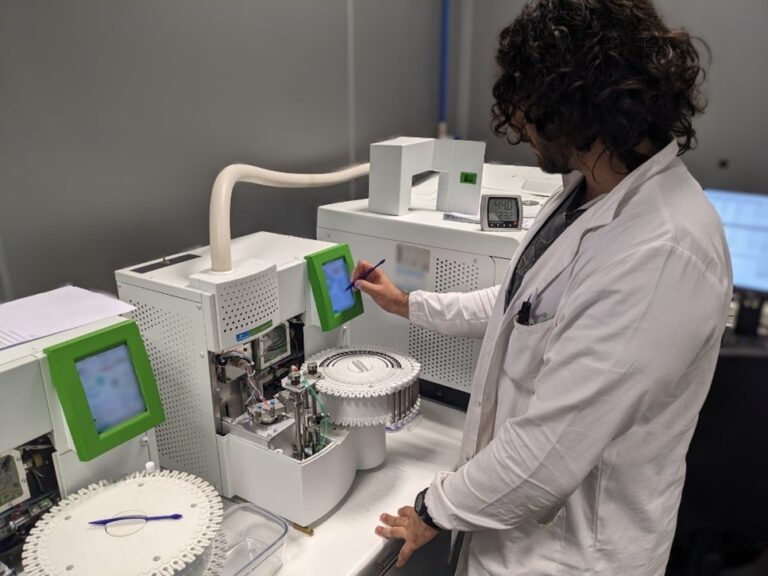
This type of study falls within the field of molecular chemical characterisation and addresses a recurring need to obtain analytical results in demanding industrial environments: making technical decisions regarding a material whose actual composition is unknown. In regulated sectors such as the automotive industry, food packaging and cosmetics, this identification is essential to ensure compliance with technical specifications and regulatory frameworks, such as the requirements of Regulation (EU) No 10/2011 on materials in contact with food or the quality standards applicable to each supply chain.
The technical approach comprises two complementary methods. On the one hand, targeted analyses, which quantify specific compounds when a hypothesis has already been established, using gas chromatography (GC-FID) or high-performance liquid chromatography (HPLC). On the other hand, there are non-targeted or compositional screening analyses, which generate a complete profile of the sample without a pre-existing hypothesis, using GC-MS and LC-MS. These techniques are complemented by the identification of compounds through chemical analysis, as well as elemental analysis and chemical composition analysis where the problem requires it.
As an external technical partner, INFINITIA tailors its methodology to each specific case, enabling it to tackle everything from complex industrial matrices to waste or uncharacterised mixtures. Its unique value lies not only in its instrumental capabilities, but also in its interpretation: translating a chemical profile into an actionable conclusion for the client.
Analysis of unknown substances at INFINITIA. From chemical data to industrial decision-making
The technical value of analysing unknown substances lies in turning an unknown into actionable information. INFINITIA approaches this service as an external technical partner with an industrial perspective, which means that each study is designed around the client’s specific problem rather than a standardised battery of tests. The aim is not merely to identify which substances are present, but to understand their origin, their impact and their technical or regulatory implications.
The methodology combines exploratory and targeted techniques, depending on the nature of the case. Untargeted compositional screening using GC-MS and LC-MS generates a comprehensive fingerprint of the sample, whilst targeted chromatographic analyses quantify specific compounds with precision. FTIR, Raman and UV-Vis spectroscopy provide the structural spectra of polymers, additives and degradation products. When the issue points to a material failure, this approach ties in naturally with the comparative characterisation of the failure.
The reliability of the conclusions is underpinned by the complementary nature of the approaches: instrumental analysis, expert interpretation and technical judgement. Identifying both major compounds and trace elements in complex matrices requires the integration of various techniques on a single sample, cross-checking results before reaching a conclusion. It is this rigour that underpins a robust quality control and industrial testing service.
INFINITIA’s unique approach combines analytical rigour with industrial insight. Each study is tailored to the client’s specific needs, from sample preparation to the interpretation of the technical report, with maximum traceability. INFINITIA interprets the results within the context of the client’s actual production process, ensuring that the report does not merely list compounds but provides clear guidance on the next steps.
Benefits of Analyzing Unknown Substances for Industrial Decision-Making
Beneficts
Analyzing unknown substances makes it possible to identify the contaminant, its chemical nature, and its likely route of entry before an incident escalates. Knowing exactly what caused an unexpected contamination reduces the risk of prolonged shutdowns, limits the number of affected batches, and replaces decisions based on assumptions with corrective actions grounded in chemical evidence.
The OK/NOK compositional comparison makes it possible to determine the exact cause of unexpected variations between batches or suppliers, by isolating the trace element or additive responsible for the anomalous behaviour. This capability directly strengthens quality control: early detection of a chemical deviation prevents it from impacting costs, safety and product stability throughout the supply chain.
Verifying that the formulation supplied by a supplier matches the one specified safeguards the integrity of the production process. The analysis identifies undeclared plasticisers, mineral fillers or manufacturing residues that alter critical material properties without this being reflected in the technical data sheet, and is complemented by the analysis of contaminants and impurities to determine the true extent of the problem.
Identifying the volatile compounds responsible for abnormal odours or unexpected emissions provides the scientific basis needed to respond rigorously to a complaint or an audit. Determining whether a VOC or semi-volatile compound originates from the material, the process or cross-contamination removes uncertainty and enables action to be taken on the actual cause, thereby reducing exposure to avoidable regulatory and reputational risks.
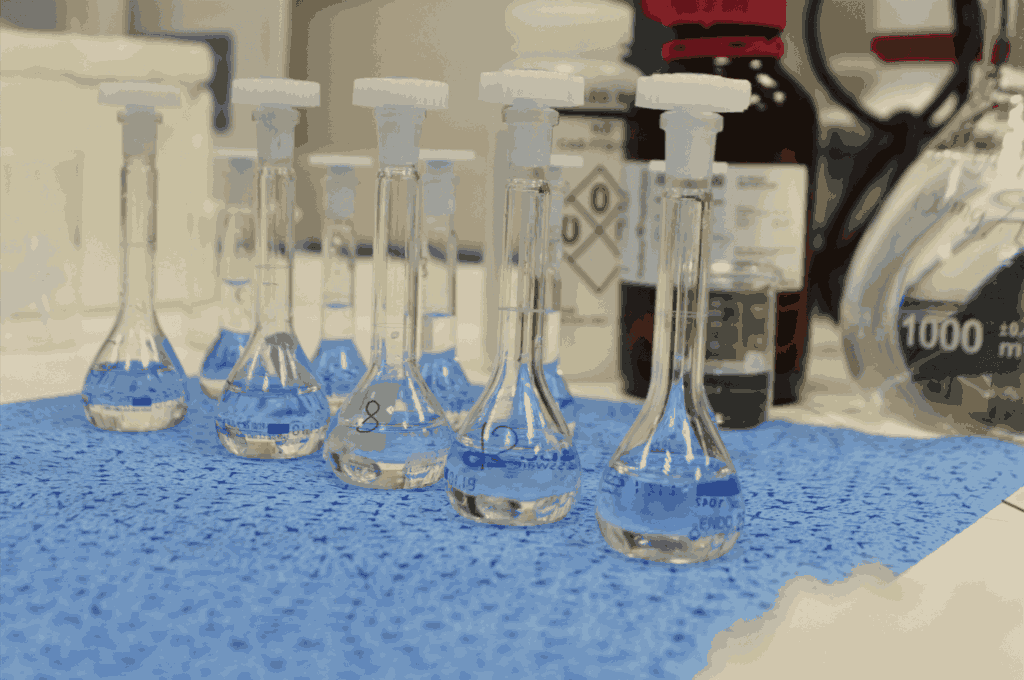
Applications of the Analysis of Unknown Substances to Resolve Technical Issues
Aplications
The applications of the analysis of unknown substances cut across the entire industrial value chain, from the receipt of raw materials to the inspection of the finished product. Each application addresses a different scenario (contamination, non-conformity, de-formulation, validation) but shares the same principle: to provide verifiable chemical evidence where previously there were only hypotheses.
INFINITIA tackles these applications by combining targeted and exploratory techniques, tailoring the analytical plan to the client’s specific question in order to produce accurate and actionable analytical results. This approach, as an external technical partner, ensures that the analysis is always geared towards an operational decision, rather than being a mere characterisation exercise.
Identification of contamination, particles and unexpected impurities: microscopy and instrumental analysis
The identification of contaminants involves determining the chemical nature of a substance, other than that intended in the formulation, which is present in a material, product or process. The study assesses organic and inorganic residues, residual traces and foreign particles in matrices ranging from polymers and metals to industrial liquids, using GC-MS, infrared spectroscopy (FTIR) and, where appropriate, Raman microscopy or X-ray fluorescence to identify localised contaminants such as pigments, mineral fillers or manufacturing residues on surfaces and in microscopic inclusions.
This application enables informed corrective decisions to be made: isolating the source of contamination, ruling out or confirming a supplier’s liability, and validating the effectiveness of a corrective action. The impact on quality and cost is direct, as unidentified contamination leads to rejected batches and recurring complaints. As an external technical partner, INFINITIA guides the analysis to pinpoint the problem with precision.
Identifying contamination through analytical testing transforms an unclear incident into a well-defined and solvable problem. This is the difference between a reactive response and a sound technical decision in the face of a critical non-conformity.
Product formulation and compositional analysis for manufacturing
Deformulation is the compositional analysis that reconstructs the formulation of an existing product in order to identify its ingredients, additives and proportions. This study is essential when seeking to manufacture an equivalent formulation, develop a technical alternative or understand why a market leader offers superior performance, drawing on chromatography, spectroscopy and quantitative techniques.
This application enables design decisions to be made on an objective basis: identifying the assets responsible for an observed functionality and determining the compositional structure required to replicate it. The impact on product development is strategic, as it is based on a validated industry benchmark rather than a hypothesis. INFINITIA, as an external technical partner, integrates this information into the client’s manufacturing context, linking the analysis to materials characterisation.
Having a precise understanding of the composition of a successful product turns innovation into an informed process rather than a process of trial and error. Deformulation is a strategic starting point for competitive development.
Analysis of volatile compounds and abnormal odours
The analysis of volatile compounds identifies low-boiling-point organic compounds emitted by a material, which are usually associated with abnormal odours or unexpected emissions. The study uses headspace-GC/MS techniques to characterise VOCs and semi-volatiles from polymeric materials, textiles, inks or adhesives, and establishes a link with the material’s volatile substance content.
This application enables users to determine whether an odour or emission originates from the material, the process or contamination, and to assess its potential impact on perceived quality or compliance through precise measurements. The impact on product acceptance is direct, particularly in sectors where VOC emissions are a critical parameter. INFINITIA focuses the analysis on the cause of the phenomenon, not merely on its description.
Assigning a chemical name to an unusual odour transforms a subjective complaint into a manageable technical piece of data. The identification of VOCs forms the basis for rectifying a sensory quality issue.
Comparison of the composition of OK and NOK samples
The OK/NOK compositional comparison identifies chemical differences between a compliant sample and a non-compliant one when the two should be equivalent. The study employs a multi-technique approach (chromatography, FTIR and mass spectrometry) to detect the trace element, additive or variation in proportion that explains the anomalous behaviour of the NOK sample, even when the difference is minimal.
This application enables users to determine whether the cause of a fault lies within the formulation or is unrelated to it, thereby reducing the risk of incorrectly attributing a problem and directing corrective efforts to the correct source. The impact on process reliability is significant, as it isolates the critical variable between batches or suppliers. INFINITIA applies this analysis to support structured incident resolution.
Comparing what works with what fails at a molecular level is the most direct way of turning an unexplained variation into an identified and correctable cause.
Detection of additives and undeclared substances
The detection of undeclared substances identifies compounds present in a material that are not listed in its technical data sheet or that the supplier has not disclosed. The study seeks to identify additives, plasticisers, fillers or residues that alter the behaviour of the material, using chemical analysis of plastics and polymers, as well as infrared spectroscopy (FTIR) and chromatography techniques applied to the specific matrix.
This application enables you to check whether the delivered product matches the specifications and to decide whether to accept or reject a batch. The impact on quality and safety is significant, as an undeclared additive may compromise regulatory compliance or the stability of the final product. INFINITIA provides the technical criteria for interpreting the finding in terms of industrial risk.
Detecting substances that should not be present safeguards the integrity of the supply chain. Analytical evidence supports any claims or renegotiations with a supplier.
Quantitative determination and measurement of components
Quantitative analysis measures the exact concentration of a specific component within a sample using standardised quantification methods. The test is used to validate the presence of active ingredients, verify migration limits or confirm that a formulation meets its technical specifications, using quantitative chromatography and techniques calibrated against reference standards.
This application enables users to determine whether a product complies with a defined threshold, which is essential in regulated sectors. It has a direct impact on regulatory compliance, as it replaces a qualitative estimate with a measured and traceable value. INFINITIA uses this quantification to validate specifications and confirm limits for products and materials.
The precise measurement of a component turns a specification into a verifiable criterion, and a verifiable criterion into a justifiable quality decision.
Sectors where the analysis of unknown substances helps ensure compliance and reliability
Sectors
The analysis of unknown substances is applied across a range of sectors where chemical composition determines product safety, regulatory compliance and reliability. In each of these sectors, the nature of the samples and the associated risks differ, but the need to identify uncharacterised compounds is common to all.
INFINITIA tailors the analytical plan to the specific requirements of each sector, taking into account the applicable regulations and the predominant type of material. This sector-specific approach ensures that the analysis addresses the real challenges faced by each industry, rather than following a generic protocol.
Analysis of unknown substances in the automotive sector: materials subject to stringent specifications and process non-conformities
In the automotive sector, where reliability and safety are paramount, materials must meet strict technical specifications, and injection moulding, painting and assembly processes cannot tolerate chemical deviations that cannot be traced. The analysis identifies residues, contaminants and variations in composition that compromise the conformity of metal and polymer components.
- Identification of organic and inorganic residues using GC-MS and FTIR in components and treated surfaces.
- Comparison of the composition of OK and NOK samples to detect minor variations between batches or suppliers.
- Assessment of alternative suppliers through compositional screening prior to their approval.
Compositional analysis applied to components and materials in the sector – including testing of metallic materials and alloys – enables the root cause of a non-conformity to be identified before it escalates into a field failure. INFINITIA addresses these challenges by integrating chemical identification with the context of the manufacturer’s production process.
Analysis of unknown substances in the food and packaging industries: migration, NIAS and food-contact materials
In the food and packaging sectors, the migration of substances and the presence of unauthorised compounds in contact with food pose a direct health and legal risk. Analysis ensures the safety, regulatory compliance and traceability of materials in accordance with frameworks such as Regulation (EU) No 10/2011.
- Screening for unintentionally added substances (NIAS) using GC-MS and LC-MS.
- Detection of abnormal odours through VOC analysis in packaging and films.
- Control of the migration of additives, such as plasticisers or antioxidants, into food.
Compositional analysis applied to food packaging, supported by the food analysis laboratory’s capabilities, ensures that materials in contact with food fulfil their function without compromising consumer safety. INFINITIA addresses these cases by prioritising regulatory compliance and documentary traceability.
Analysis of unknown substances in cosmetics and consumer products: cross-contamination and formulations
In cosmetics and consumer products, the presence of undeclared substances or cross-contamination compromises the stability, safety and legality of the product prior to its launch. Analysis confirms that formulations are safe and compliant, identifying any deviations from the intended formulation.
- Confirmation of active ingredients and their concentrations using HPLC.
- Identification of cross-contamination on production or packaging lines.
- Final product screening to detect unauthorised compounds prior to launch.
Compositional analysis applied to cosmetic formulations makes it possible to resolve non-compliance alerts and validate product safety on a scientific basis. INFINITIA addresses these challenges by integrating the quantification of active ingredients with the detection of contaminants within a single analytical strategy.
Analysis of unknown substances in plastics and composites: additives, masterbatches and material defects
In plastics and composite materials, verifying that the formulation is correct and free from problematic additives is key to ensuring strength, appearance and functionality. The analysis identifies compositional deviations that account for thermal, mechanical or aesthetic alterations in parts and semi-finished products.
- Identification of undeclared additives using FTIR and chromatography.
- Verification of mixtures and phase distribution in masterbatches.
- Post-failure analysis of components exhibiting thermal damage, oxidation or mechanical degradation.
Compositional analysis applied to polymers and composites makes it possible to distinguish between a formulation fault and a process fault, thereby ensuring that corrective action is targeted at the actual cause. INFINITIA addresses these cases by combining chemical identification with an interpretation of the material’s behaviour.
Analysis of unknown substances in textiles, inks and coatings: residues, VOCs and functional treatments
In the textiles, inks and coatings sectors, analysis validates functional treatments, monitors toxic residues and ensures the durability and safety of the finished product. Samples include treated fabrics, inks and functional coatings exposed to residual solvents and curing processes.
- Analysis of VOCs in fabrics and inks to detect residual solvents.
- Verification of declared functional properties, such as antimicrobial or flame-retardant treatments.
- Detection of unexpected surface contaminants in finished products.
Compositional analysis of these materials confirms that a functional treatment is present and effective, and that no unwanted residues remain. INFINITIA addresses these challenges by verifying that the declared treatment is consistent with the chemical evidence detected.
Analysis of unknown substances in textiles, inks and coatings: residues, VOCs and functional treatments
In electronics, the release of volatile compounds and the presence of surface contaminants affect the reliability and service life of components. The analysis identifies manufacturing residues, VOCs and migrating substances that compromise the performance of circuit boards, connectors and encapsulations.
- Identification of VOCs emitted by polymeric materials and adhesives during assembly.
- Detection of surface contamination affecting welds and contacts.
- Characterisation of manufacturing residues in components and encapsulated products.
Compositional analysis applied to electronics, in conjunction with testing of electronic components, makes it possible to anticipate reliability issues associated with chemical contamination. INFINITIA addresses these cases by linking the presence of a compound to its functional impact on the component.
Analysis of Unknown Substances in INFINITIA for Evidence-Based Decision-Making
Value
The analysis of unknown substances is a critical tool for ensuring the quality, safety, and functionality of products and materials. The accurate identification of uncharacterized compounds—through targeted studies or untargeted compositional screening—enables us to resolve complex issues that would otherwise remain without a technical explanation. The conclusion is clear: without reliable chemical identification, any corrective action is a gamble.
The service provides a preventative, data-driven approach to industrial decision-making. Early identification of contamination, migration or an undeclared additive prevents the problem from escalating into a field failure or a regulatory complaint, and, thanks to the analysis results, enables the relevant decisions to be taken. This ability to anticipate issues ties in naturally with process improvement, where knowledge of composition drives the continuous optimisation of manufacturing.
The economic and operational impact is tangible. Accurately identifying the cause of a non-conformity reduces the costs associated with rejected batches, rework and production line stoppages, and speeds up the approval of new materials and suppliers through an evidence-based materials approval process. A well-targeted analysis replaces weeks of uncertainty with an informed technical decision.
In highly regulated sectors, having an external technical partner such as INFINITIA delivers strategic value that goes beyond the analytical result. The service is delivered with scientific rigour, traceability and action-oriented technical interpretation, linking chemical identification with the diagnosis of the root cause of the fault when the problem so requires. Thanks to its specialised multidisciplinary team, INFINITIA combines state-of-the-art analytical instrumentation and advanced technical capabilities with an in-depth understanding of industrial challenges, positioning itself as a technical partner that helps prevent risks, reduce costs and make material-related decisions based on solid chemical evidence.
Frequently Asked Questions About the Analysis of Unknown Substances
Faqs
What is the analysis of unknown substances?
The analysis service for unknown substances encompasses the full range of analytical studies that identify, both qualitatively and quantitatively, the compounds present in a sample whose composition is unknown. It enables the determination of what a material or mixture contains and in what proportions, without relying on prior information about its composition.
This service utilises techniques such as mass spectrometry, chromatography and spectroscopy, and is applied to a wide variety of samples, ranging from complex industrial matrices to waste or contaminants. Its ultimate aim is to provide reliable chemical evidence to inform a technical decision.
What happens if an analysis for unknown substances is not carried out following an incident?
Failing to carry out this analysis means acting on assumptions rather than evidence. Unidentified contamination, migration or undeclared additives result in rejected batches, recurring complaints and corrective actions that do not address the root cause of the problem.
In regulated sectors, the lack of chemical identification also exposes the company to legal and reputational risks, as it would be unable to demonstrate a material’s compliance in the event of an audit or a complaint. Accurate identification is what transforms an obscure problem into a well-defined and solvable one.
How do you identify an unknown compound in a sample?
Identification combines separative and instrumental techniques. Gas or liquid chromatography separates the components of the mixture, whilst mass spectrometry and FTIR, Raman or UV-Vis spectroscopy provide the structural information needed to identify each compound.
The approach may be targeted, where there is a hypothesis about what to look for, or untargeted, where compositional screening is carried out without a prior hypothesis to obtain a complete fingerprint of the sample. The choice depends on the problem and the information available at the start of the study. At INFINITIA, defining this approach forms part of the service: a methodology is not simply assumed, but justified.
What is the difference between a targeted analysis and an untargeted compositional screening?
Targeted analysis seeks out and quantifies specific compounds when their presence is already suspected, enabling the precise and efficient determination of those compounds. It is the appropriate approach when the problem is partially defined.
Non-targeted compositional screening, on the other hand, does not start from any hypothesis and generates a complete profile of the sample to detect any substance present, including those not intentionally added (NIAS). Both approaches are complementary and are often combined within the same study.
What added value does this analysis offer compared to a simple documentary check?
A documentary check merely confirms what the supplier declares; compositional analysis verifies what the material actually contains. This difference is crucial when the technical data sheet is incomplete, contradictory or fails to explain anomalous behaviour observed during production.
At this point, it is worth noting that INFINITIA combines expertise in analytical chemistry with the industrial perspective of a technical consultancy – an approach that complements, rather than excludes, that of technology centres or universities. It is this applied interpretation of the data that adds value when it comes to making a decision about a real-world process.
Is it possible to detect contaminants or traces at very low concentrations?
Yes. Mass spectrometry techniques coupled with chromatography (GC-MS and LC-MS) enable the detection of compounds at trace levels, which is crucial when even the slightest chemical deviation can lead to a critical quality or compliance issue.
Combining several techniques on a single sample increases the reliability of identification, as it allows results to be cross-checked before reaching a conclusion. This sensitivity is particularly important in the detection of NIAS and cross-contamination in regulated sectors.
How does this service help to reduce costs?
The analysis reduces costs by targeting corrective action at the actual source of the problem, thereby avoiding repeated interventions that fail to resolve the issue. Accurately identifying contamination or a variation in composition shortens line downtime and limits the number of affected batches.
Furthermore, it speeds up the approval of materials and suppliers and prevents regulatory complaints, the cost of which often far exceeds that of the study itself. INFINITIA’s technical report is specifically designed to optimise decision-making in this way.
How much does an analysis of unknown substances cost?
The cost depends on the complexity of the sample, the number of techniques required, and whether the study is targeted or exploratory. A one-off identification using a specific technique has a very different scope and cost to a comprehensive compositional screening of a complex matrix.
For this reason, each case is assessed individually based on the specific problem and the client’s objectives. INFINITIA draws up a proposal tailored to the actual scope required, avoiding unnecessary tests. You can request an assessment by describing your case.
How long does it take to see results?
The usual turnaround time is between one and four weeks, depending on the complexity of the sample, the number of techniques involved and the level of detail required in the analysis. A targeted analysis is usually completed sooner than a comprehensive compositional screening.
For critical cases that bring a production line to a standstill, an urgent service is available, with initial indicative results provided within 24 to 72 hours. INFINITIA agrees the turnaround time with the client when defining the scope of the analysis.
Why does a supplier claim to meet the specifications, yet the material still fails?
This situation is usually due to the supplier’s documentation not reflecting the actual composition of the material supplied, whether due to an undeclared additive, a batch variation or contamination during the manufacturing process. The technical data sheet describes what was expected, not necessarily what was received.
Compositional analysis verifies what the material actually contains and allows this to be compared with the specifications, providing the objective evidence required for a claim or for supplier validation. It is the way to settle the matter with data.
Why does the problem keep cropping up even though an attempt has already been made to fix it?
When an incident reoccurs despite corrective action, it usually indicates that the identified cause was not the root cause, but rather a symptom. Recurring contamination or intermittent compositional variation may have a different origin to that initially assumed.
The analysis of unknown substances, combined with an OK/NOK comparison and, where appropriate, the analysis of residues and recycled materials, makes it possible to determine the actual cause on the basis of chemical evidence and to pinpoint the factor that had been overlooked. Identifying the actual cause is the only way to ensure that the corrective action is permanent.
Why does a product work in a controlled environment but fail in real-world use?
A product may perform correctly under test conditions but fail in real-world use when an unforeseen variable comes into play: the migration of substances, process contamination or the presence of a volatile compound that only becomes apparent under certain conditions of use or storage.
Compositional analysis helps to identify these unnoticed substances and to understand how they affect the product’s behaviour under real-world conditions. It should be noted that INFINITIA issues specialised technical reports; these may serve as a documentary basis for a court-appointed expert, although responsibility for the expert report always rests with the authorised expert. To discuss your specific case, please contact INFINITIA’s technical team.