
Comparative characterisation of the failure
Comparative failure characterisation is an essential tool in the preliminary diagnosis of problems in industrial materials and components.
At INFINITIA Industrial Consulting, we use this methodology to compare failed samples (NOK) with non-failed samples (OK), con el objetivo de identificar key differences in their properties physical, chemical o mechanical that may be related to the origin of the failure.
Our comparative analysis laboratory for failures has a team specialised in advanced techniques and a methodological approach based on forensic engineering, which enables us to provide reliable and useful results for industrial decision-making.
Talk to a specialist
Request a free initial consultation; contact a consultant from our team of specialists

What does comparative failure characterisation involve?
What is it?
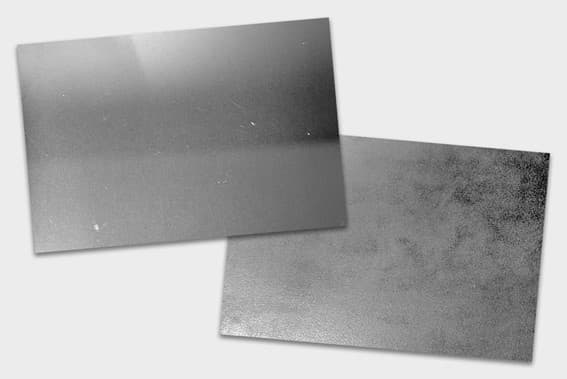
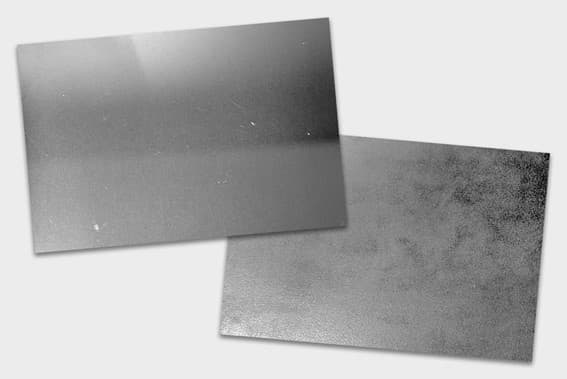
At INFINITIA, we undertake a comparative characterisation of the failure through a sequence of analyses that begins with a visual inspection of the materials to identify apparent defects, such as lack of homogeneity, inclusions or surface alterations.
Chemical, physical and mechanical characterisation techniques, such as spectroscopy, electron microscopy and hardness and impact tests, are then applied to identify any differences between the samples.
This approach does not aim to determine the definitive failure mechanism, but rather to identify critical differences between materials, which is a key step in guiding more specific follow-up studies.
A comparative analysis of failure modes in INFINITIA
At INFINITIA, we have an industrial laboratory equipped with state-of-the-art technology to carry out comparative characterisation of materials with the utmost precision.
Our approach is based on a rigorous methodology: from the initial visual assessment through to a detailed comparison of critical properties between NOK and OK samples. We tailor our approach to each individual case to provide a sound preliminary diagnosis, aimed at identifying potential causes of failure and defining the next steps for investigation.
This capability makes us a strategic partner for companies seeking technical and agile solutions to quality or reliability issues with their products.
Benefits of comparative failure characterisation
Benefits
One of the main benefits of this service we offer at INFINITIA is the ability to anticipate structural failures in industrial components, thereby improving the reliability of the end product.
For example, in sectors such as the automotive or electronics industries, detecting a variation in the chemical composition or heat treatment of a defective batch can prevent product recalls or significant financial losses. Furthermore, this technique makes it possible to assess the quality of new suppliers, validate production processes or document faults in the event of complaints.
INFINITIA adds value to the process by combining technical expertise, sector-specific experience and benchmarking.
Types of comparative failure characterisation tests
types
At INFINITIA, we carry out various comparative failure characterisation tests to identify significant differences between defective (NOK) and reference (OK) samples. These studies enable us to detect variations that may be related to the observed failure, even if the underlying mechanism of the failure is not determined.
Our aim is to provide our customers with objective and accurate information so that they can make informed decisions regarding their industrial processes.
Essays on composition and comparative chemical structure
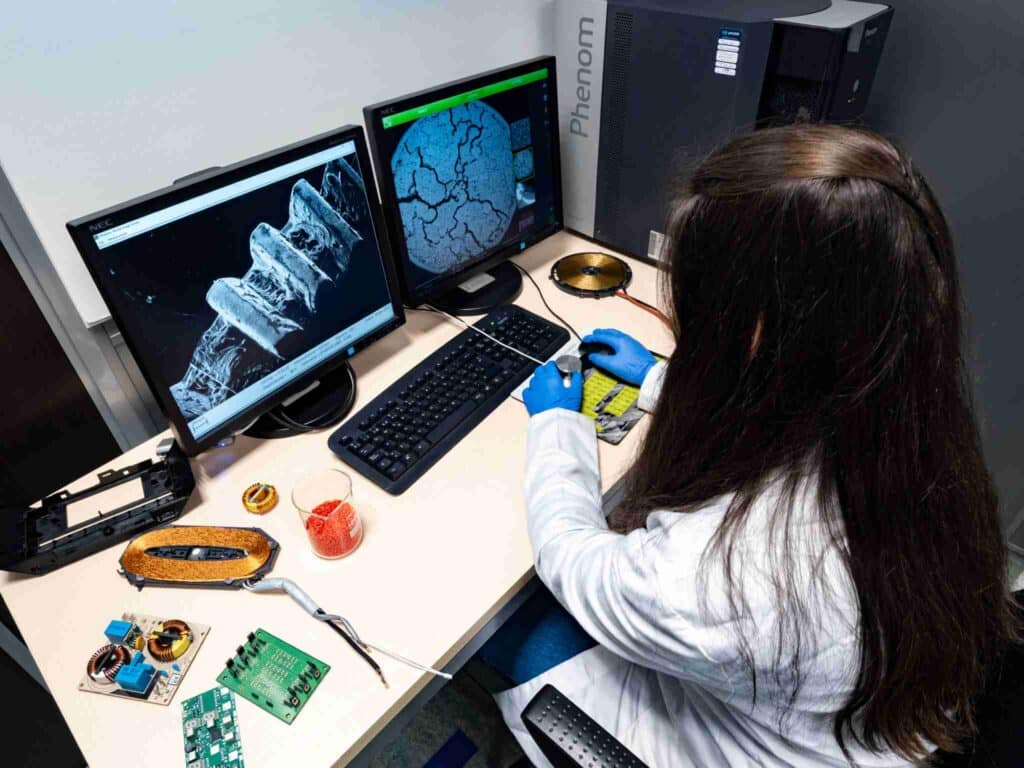
Using techniques such as FTIR, XRF, AAS or SEM-EDS, we compare the chemical composition of a failed sample with that of a reference sample to detect contamination, changes in formulation or differences in additives.
For example, in a study on plastic coatings, FTIR spectroscopy made it possible to identify unauthorised plasticisers in the defective parts, which were responsible for the loss of coating adhesion.
Morphological analysis and microscopy tests
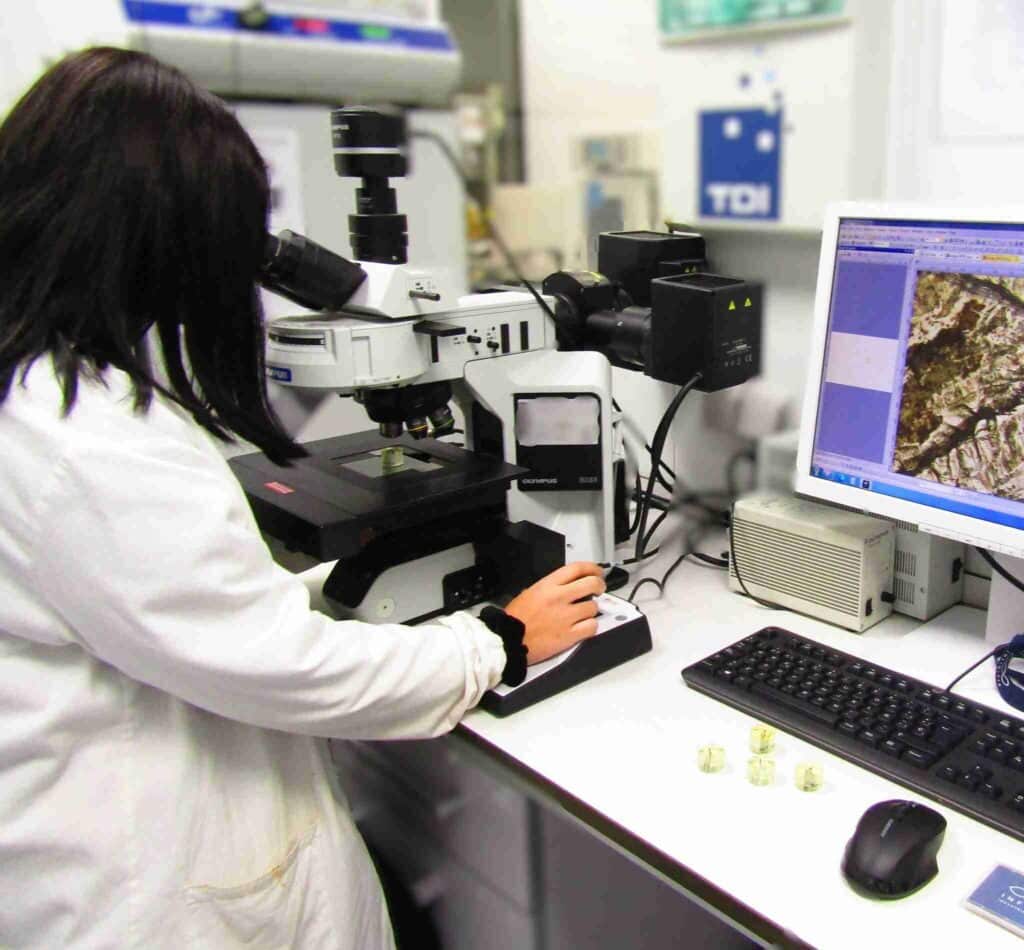
We used optical microscopy, SEM and image analysis to compare the microstructure and morphology of surfaces between OK and NOK samples. We detected defects such as microcracks, porosity, inclusions and lack of homogeneity.
A typical example was the analysis of premature cracks in hardened steel components. Microstructural comparison revealed an irregular distribution of phases due to poorly controlled heat treatment in the defective components.
Reproduction of the defect under controlled conditions
We carry out tensile, impact, hardness and flexural tests to determine whether there are any mechanical differences that might explain the cause of the failure, by comparing the behaviour of the samples under the same loading conditions.
At INFINITIA, we carry out these tests to check for differences in strength between batches of plastic casings, and we found that a batch with lower hardness values was prone to breaking under impact during everyday use.
Documentary studies and a technical literature review
Tests such as DSC, TGA and TMA enable the thermal behaviour of materials to be compared when exposed to heat, revealing differences in stability, phase transitions and degradation.
For example, in a case of failure due to thermal deformation in electronic components, DSC analysis revealed that the material in the defective sample had a glass transition temperature lower than that specified.
Accelerated corrosion and ageing tests
We simulate extreme conditions to compare the performance of coatings or materials when exposed to harsh environments (salt spray, humidity, thermal cycles). This enables us to identify defective surface treatments.
In a study for the electric mobility sector, the metallic coatings on connectors exposed to salt spray failed prematurely. A comparative analysis revealed a lack of passivation on the failed components.
Applications of comparative failure characterisation
Sectors
Comparative characterisation plays an essential role in industry by diagnosing differences between batches, validating raw materials and preventing recurring failures. Below, we outline its applications across different sectors.
Automotive industry
In the automotive sector, faults in plastic, metal or electronic components can compromise safety. At INFINITIA, we carry out comparative studies to identify causes such as material deviations, manufacturing defects or incorrect treatments.
- Comparison of metallic coatings that failed in salt spray tests.
- Identification of thermal variations in plastics subjected to temperature cycles.
Detection of microcracks in metal components using electron microscopy.
Electronics and energy
The reliability of electronic components depends on their thermal, electrical and structural behaviour. Comparative tests make it possible to identify defective batches and improve quality standards.
- Study of encapsulants with internal bubbles detected only in failed samples.
- Evaluation of differences in their structure and properties.
Comparison of epoxy resins with different resistance to thermal-operational cycling.
Food and packaging industry
In food-contact packaging and materials, the presence of undesirable migrating substances or variations in functional barriers can compromise safety. Comparative characterisation enables suppliers to be validated and non-conformities to be avoided.
- Identification of the undesirable migration of plasticisers in food-grade films.
- Comparison of sealing properties in defective films versus good samples.
Assessment of the heat resistance of packaging following pasteurisation.
Medical and healthcare sector
In medical devices, even the slightest variation in formulation, biocompatibility or purity can pose a risk. INFINITIA compares materials and manufacturing processes to detect these critical deviations.
- Comparative tests between polymers with different degradation rates.
- Chemical analysis of manufacturing residues in NOK devices.
Comparison of resistance to ageing under disinfection and sterilisation conditions.
Construction industry
Premature failures in construction materials can result in high costs. Our comparative studies enable us to identify materials that do not meet specifications or have been poorly processed.
- Comparison of façade panels showing colour fading and cracks.
- Analysis of compressive strength in batches of concrete with curing defects.
Abrasion tests on industrial flooring with varying levels of wear.
Risk reduction and continuous improvement through comparative analysis
Value
In an increasingly demanding industrial environment, comparative failure characterisation has become a strategic tool for companies seeking to control quality, reduce incidents and optimise processes.
At INFINITIA, we offer this service using a rigorous and technical approach, comparing defective samples (NOK) with reference samples (OK) to identify significant differences in their composition, structure or functional properties.
This type of analysis is particularly useful for making rapid decisions regarding supplier validation, the control of raw materials or the preliminary investigation of recurring faults. Whilst the mechanism of failure is not directly identified, key indicators are obtained which guide more detailed future investigations.
Furthermore, this service can be complemented by other studies offered by INFINITIA, such as failure mode analysis or more in-depth diagnostics, ensuring a comprehensive understanding of the problem.