
Material Characterisation
Material characterization is a key process in industry for ensuring the quality, functionality and reliability of products throughout their entire lifecycle.
At INFINITIA Industrial Consulting, we offer a comprehensive material characterization service aimed at precisely understanding the physical, chemical and mechanical behavior of any substance or component. This knowledge is essential for making strategic decisions in the design, development, manufacturing and validation processes of industrial products.
Our material inspection protocols complement this analysis, enabling a complete evaluation from raw material receipt through to final product validation.
At INFINITIA’s industrial laboratory, we have a team of material specialists and cutting-edge technology to carry out this analysis with maximum precision and technical rigor.
Talk to a specialist
Request a free initial consultation; contact a consultant from our team of specialists

What does material characterization involve?
What is it?
Material characterization consists of studying the structural, morphological and functional properties of a substance, with the aim of determining its composition, strength, durability, behavior under external stresses, and possible industrial applications.
Using advanced techniques such as spectroscopy, microscopy, thermal analysis or mechanical and corrosion testing, at INFINITIA we analyze both metallic materials and polymers, ceramics, composites or coatings. Inspecting materials using these techniques allows us to establish relationships between a material’s internal structure and its performance under real conditions of use, anticipating its behavior and reliability.
Material characterization and inspection at INFINITIA
At INFINITIA, we approach every material characterization project from a multidisciplinary angle, combining knowledge of forensic engineering, materials science and sector-specific technical regulations. Our material inspection protocols integrate seamlessly with analytical testing to offer a complete evaluation.
Our laboratory has state-of-the-art equipment to carry out everything from destructive testing to non-destructive testing, covering every phase of the analysis, including sample preparation.
Whether it involves characterizing plastics, metals, composites or innovative materials, at INFINITIA we offer a technical and consultative service tailored to the specific requirements of each client and each industrial application.
Benefits of material characterization
BENEFITS
One of the major benefits of material characterization is its ability to optimize the production process from its earliest stages. At INFINITIA, we help our clients select the best raw materials, validate suppliers, prevent possible failures from fatigue or corrosion, improve design efficiency and extend product service life.
For example, through thermal and mechanical testing we have optimized plastic formulations to achieve more resistant materials, or selected suitable metal alloys for components exposed to aggressive environments.
This type of decision-making, grounded in objective data, has a direct impact on the competitiveness of the final product.
Types of Material Characterization Tests
types
At INFINITIA, we develop different characterization tests to evaluate the physicochemical, thermal, mechanical and structural properties of materials used in industrial products. Our goal is to precisely understand the behavior of each material, optimizing its application, functionality and service life.
Chemical composition and structure testing
This testing makes it possible to identify the elements and compounds present in a sample and how they are organized at the molecular level. Techniques used include infrared spectroscopy (FTIR), atomic absorption spectroscopy (AAS), X-ray fluorescence (XRF) or nuclear magnetic resonance (NMR).
These tests are key to verifying the composition of raw materials, identifying cross-contamination and validating the purity of compounds. For example, at INFINITIA we have used FTIR to identify unknown additives in engineering polymers intended for automotive parts.
Microscopy testing and morphological analysis
Microscopy testing makes it possible to observe materials’ microstructures, detect surface defects and analyze the internal phases of metals, ceramics or composites.
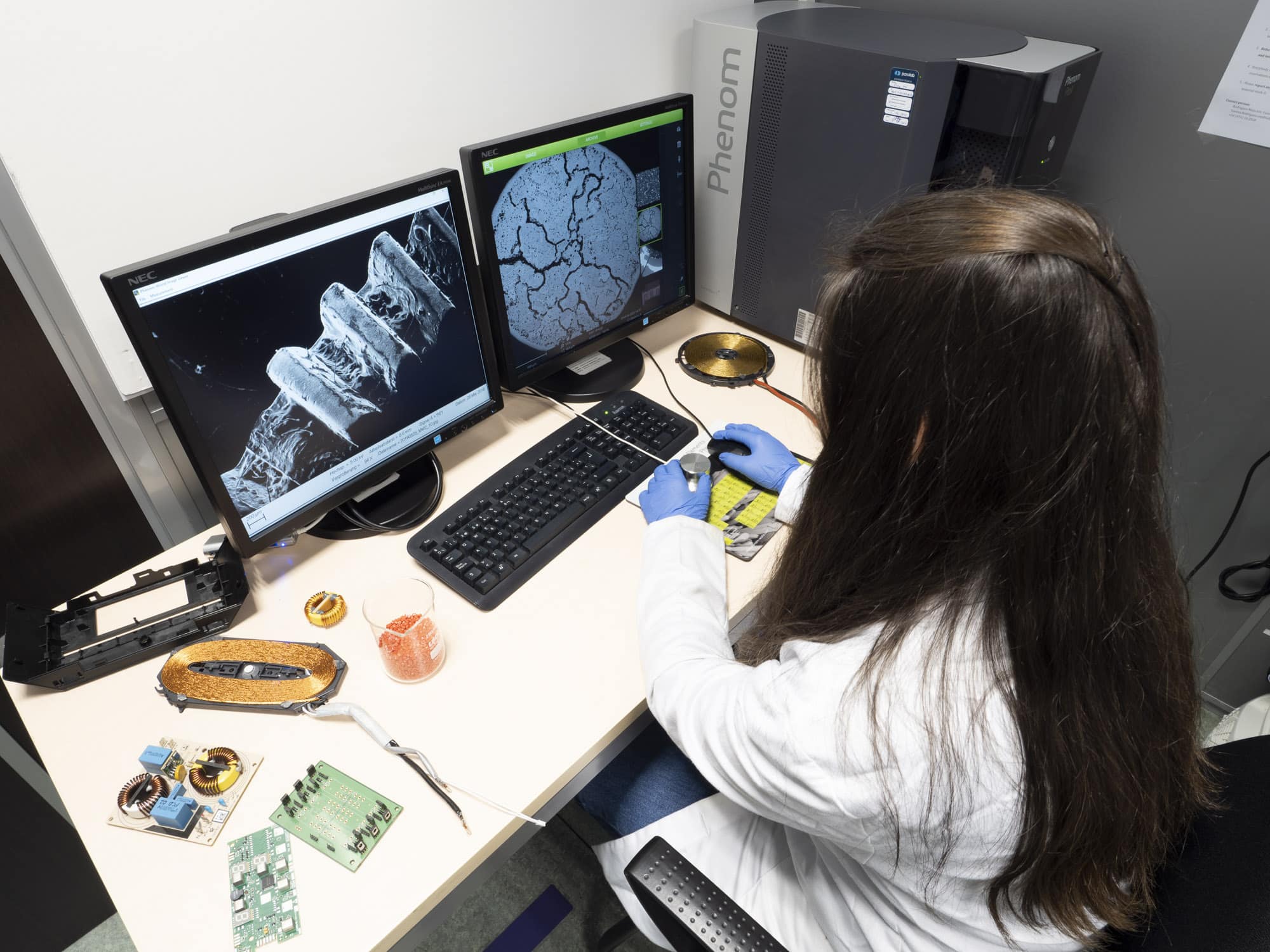
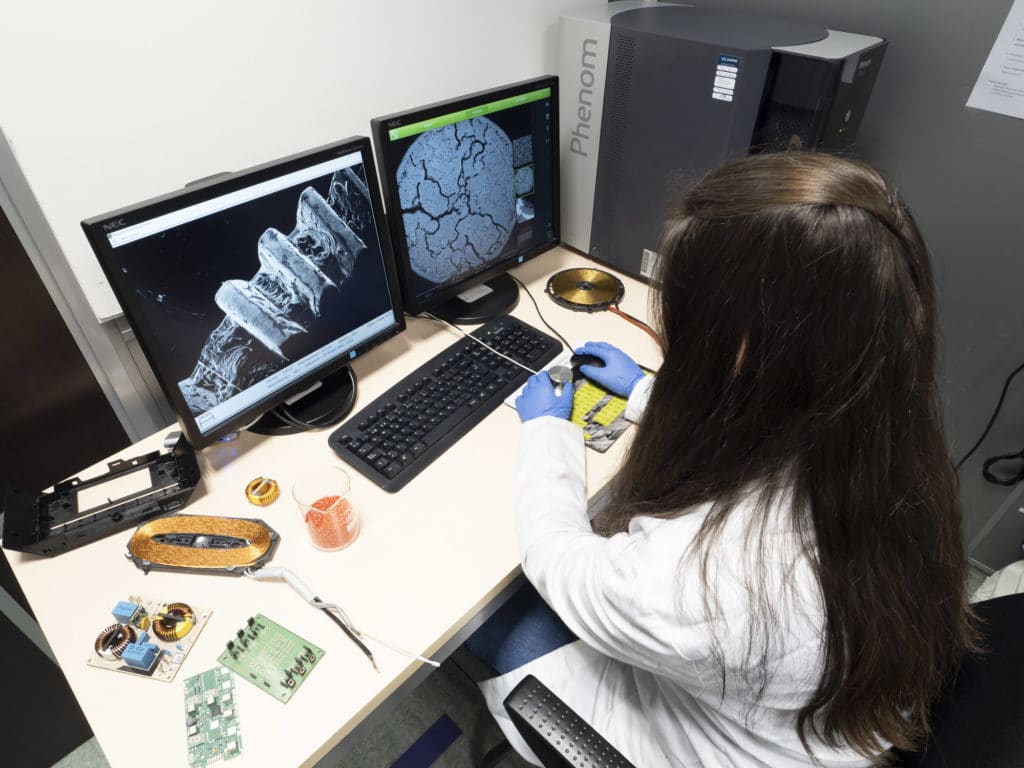
We use optical microscopy, scanning electron microscopy (SEM) and atomic force microscopy (AFM) to generate detailed images. For example, in a project for the electronics industry, microcracks were identified in critical solder joints through SEM, allowing production parameters to be optimized to reduce failures.
Mechanical testing
This testing makes it possible to evaluate a material’s behavior under stresses such as tension, compression, torsion or fatigue. At INFINITIA we carry out hardness, elastic modulus or impact resistance testing in accordance with international standards (ISO, ASTM).
A common case is validating the strength of plastic housings for certain components, where we carry out drop and impact testing to determine their durability under real conditions of use.
Thermal testing
Thermal analysis determines how a material behaves under temperature variations. We use techniques such as DSC and TGA to analyze glass transitions, thermal stability or mass loss.
For example, in the development of a new insulation material, we applied differential scanning calorimetry to ensure the polymer maintained its properties under operating conditions.
Corrosion and accelerated aging testing
This testing simulates extreme conditions to predict a material’s durability against corrosion, humidity or aging. We apply methods such as salt spray, climatic chambers, electrochemical testing and various accelerated tests to reproduce years of operating conditions within weeks.
In one component case, several metal coatings were compared by subjecting them to salt spray for 500 hours to select the best alternative in terms of oxidation resistance.
Migration and purity testing (chromatography)
Using gas chromatography (GC) and liquid chromatography (HPLC), residues, migrations and volatile compounds are analyzed. This testing is essential for materials in contact with food or in medical devices.
At INFINITIA we have used HPLC to measure plasticizer migration in food packaging films, making it possible to validate compliance with European legislation (EU 10/2011).
Sectors for Material Characterization
sectors
Material characterization has essential applications across multiple industrial sectors. Through physical, chemical, thermal or mechanical testing, at INFINITIA we help validate products, select raw materials and anticipate potential failures under real conditions of use. Below are some of the sectors where this service is key.
Automotive Industry
In automotive, materials must withstand vibration, mechanical loads and extreme climatic conditions. Characterization makes it possible to select lightweight, strong and durable solutions for structural components, plastic housings, metal coatings or fatigue-loaded parts.
- Validation of plastic housings subjected to thermal cycles and impacts to ensure their integrity over prolonged use.
- Comparison of metal coatings through salt spray testing, selecting the option most resistant to corrosion.
- Mechanical fatigue evaluation in structural parts through tensile and cyclic bending testing.
Food and Packaging Industry
Materials used in packaging must guarantee food safety and preserve the product’s properties. Characterization makes it possible to validate thermal resistance, barrier behavior and potential substance migration, complying with European and sector-specific regulations.
- Migration testing of plasticizers in food packaging using chromatography (HPLC and GC).
- Thermal analysis of films to validate their resistance to pasteurization processes.
- Measurement of barrier properties against moisture and oxygen to improve food preservation.
Medical Devices
Medical materials must withstand sterilization processes, maintain dimensional stability and not release toxic compounds. Characterization makes it possible to guarantee the safety, functionality and service life of polymers, coatings and implantable or disposable parts.
- Thermal studies to verify polymer stability after steam or gas sterilization.
- Structural characterization of polymers used in temporary implants through microscopy and mechanical analysis.
- Detection of chemical residues in devices through liquid chromatography.
Energy and Electronics Sector
In electronic and energy systems, materials must offer thermal stability, dielectric strength and predictable behavior under load cycles. Characterization ensures their reliability in encapsulants, insulators and components for power electronics or electric mobility.
- Analysis of ceramics used in batteries and power systems.
- Thermal evaluation of electronic circuit encapsulants using DSC and TGA.
- Quality control of epoxy resins applied in converters and transformers.
Construction Industry
Construction materials must retain their structural integrity against moisture, loads, abrasion and chemical agents. Characterization makes it possible to anticipate their long-term behavior and validate solutions in line with technical standards and environmental requirements.
- Compression testing of reinforced concrete in accordance with technical standards.
- Accelerated aging testing of facade panels to evaluate their response to moisture and UV radiation.
- Measurement of surface wear in industrial flooring through mechanical testing.
Technical Textiles and Functionalized Materials
Technical textiles and functionalized surfaces must retain properties such as fire resistance, antimicrobial effect or thermal comfort. At INFINITIA we characterize these materials to validate their effectiveness and durability under real conditions of use.
- Tear and fire resistance testing of technical fabrics used in workwear and transport.
- Analysis of antimicrobial coatings applied to textiles using electron microscopy.
- Thermal studies of fabrics with temperature-regulating properties to improve thermal comfort.
Why choose INFINITIA for material characterization
value
Material characterization is an essential tool for ensuring the reliability, functionality and efficiency of industrial products in highly demanding sectors. It provides in-depth insight into materials’ physicochemical, mechanical and thermal properties, detecting defects, validating suppliers and anticipating possible failure modes.
From raw material selection to manufacturing process improvement, characterization testing provides objective data that reduces technical uncertainty and facilitates strategic decisions in product development.