
Failure mode study
At INFINITIA we provide a failure mode study service to precisely identify the causes behind failures in materials, components and industrial systems. This methodology is essential for improving product reliability and processes, especially in sectors where safety and performance are critical.
At INFINITIA, our specialists apply the most advanced technologies in comparative material characterization, forensic engineering and failure analysis to determine how, when and why a failure occurred, with the goal of preventing its recurrence.
This service allows companies to anticipate future problems, optimize industrial processes and strengthen their product quality.
Talk to a specialist
Request a free initial consultation; contact a consultant from our team of specialists

What does the failure mode study involve?
What is it?
The failure mode study consists of a detailed technical investigation that analyzes defective samples (NOK) by comparing them with others operating under normal conditions (OK).
At INFINITIA, we carry out a comparative characterization of the materials involved, evaluating parameters such as chemical composition, mechanical properties and service conditions.
We complement this approach with a literature review of similar cases documented in scientific and technical literature, which allows us to contextualize the failure and establish useful correlations for its interpretation. We also request key information from the client, such as the component’s technical data sheet, its service life and operating conditions, providing a comprehensive view of the problem.
How is the failure mode study carried out at INFINITIA?
At INFINITIA we carry out failure mode analysis as part of a structured process that includes methodologies such as root cause analysis (8D), Failure Mode and Effects Analysis (FMEA) and FMECA (Failure Mode, Effects and Criticality Analysis).
We also use tools such as the Ishikawa diagram and cause-effect probability tables, widely used in quality engineering.
We have a failure analysis laboratory equipped with cutting-edge technology and a multidisciplinary team with experience across sectors such as automotive, electronics, capital equipment or food. Thanks to our rigorous, technical and personalized approach, the failure mode study at INFINITIA becomes an essential tool for improving the reliability and performance of industrial products.
What advantages does the failure mode study offer?
BENEFITS
One of the main advantages of the failure mode study is the ability to reproduce the failure under controlled conditions. At INFINITIA we design and run specific tests that simulate the failure environment to validate the hypotheses proposed.
This approach not only confirms the identified failure mechanisms, but also provides a solid basis for recommending technical solutions and preventing future incidents.
The ability to quickly and precisely diagnose functional failures in industrial components is key to minimizing operating costs and avoiding unexpected production stoppages.
Types of failure mode studies
types
At INFINITIA we develop different approaches and techniques to carry out failure mode studies on industrial components. Our goal is to precisely identify failure mechanisms through technical analysis of defective samples (NOK) compared against correct references (OK), applying advanced diagnostic and validation tools.
Comparative analysis between OK and NOK samples
This type of study makes it possible to identify differences between parts with failure and without failure. At INFINITIA we use techniques such as spectroscopy, thermal analysis or mechanical testing to detect variations in composition, microstructure or strength that may be related to the component’s functional failure.
For example, in analyzing a component’s plastic housing, we detected through infrared spectroscopy a change in the mineral filler content that negatively affected its toughness.
Failure characterization through microscopy and fractography
Fractography and microscopic analysis make it possible to study fractured surfaces and detect clear signs of the failure mechanism, such as fatigue crack propagation, brittle fracture or stress corrosion.
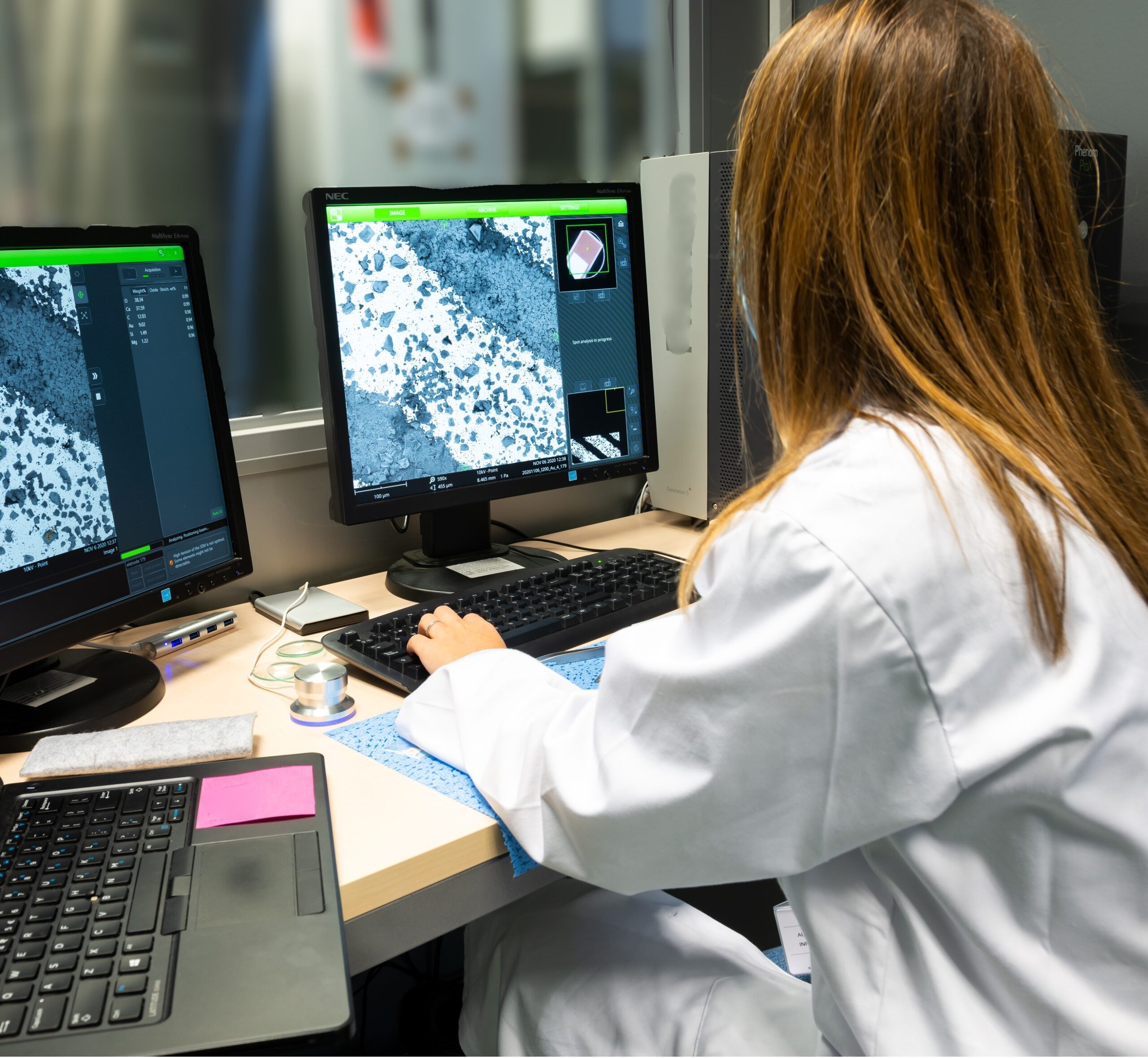
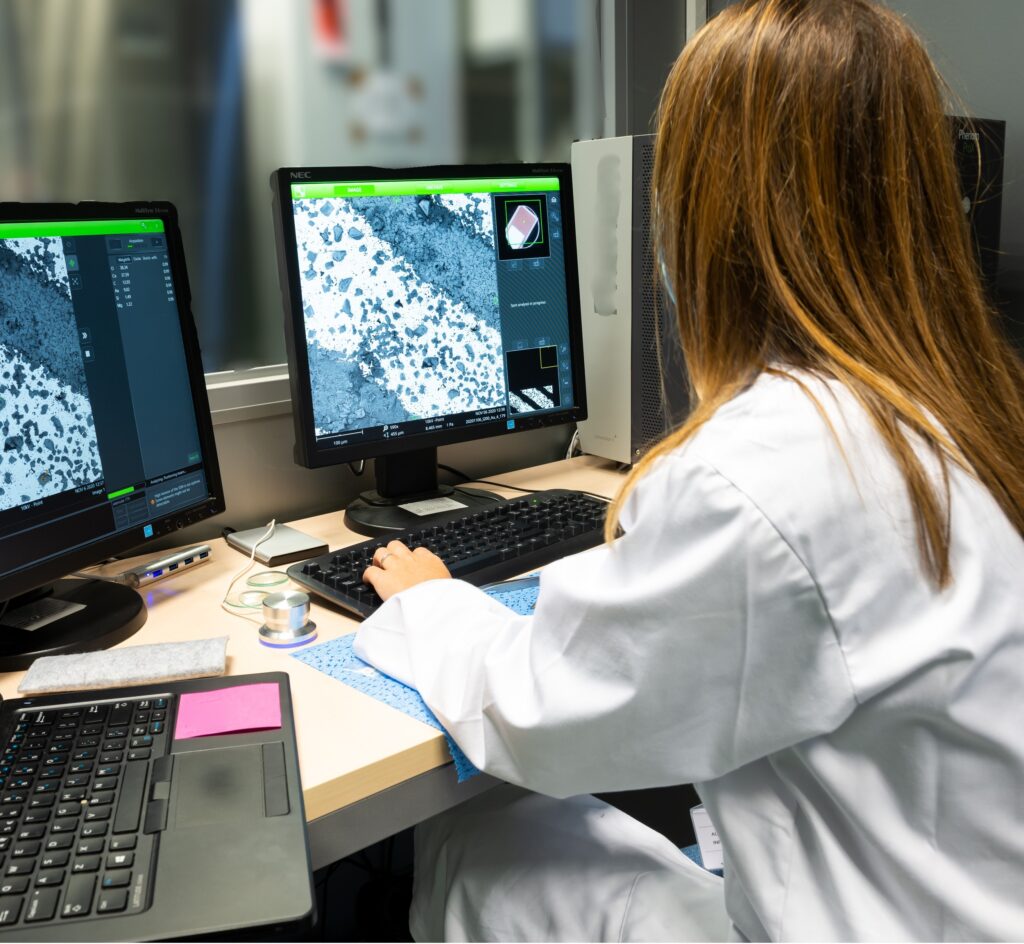
At INFINITIA we apply scanning electron microscopy (SEM) and advanced optical microscopy to study critical areas. In an automotive case, we identified a crack originating at a stress concentration point in a component that had design improvements.
Failure reproduction under controlled conditions
To validate hypotheses, at INFINITIA we design custom testing that simulates the real conditions under which the failure occurred.
This makes it possible to confirm the root cause and propose robust corrective measures. For example, in a project involving metal coatings, we reproduced thermal cycles and aggressive atmospheres in a climatic chamber to confirm an accelerated oxidation failure.
Documentary studies and technical literature review
At INFINITIA we carry out an analysis of specialized literature that helps contextualize the failure mode and compare the client’s case with similar ones. This work makes it possible to identify already-proven solutions or common failure trends in certain materials or conditions.
Application of root cause analysis methodologies
We use tools such as the Ishikawa diagram, cause-effect flowcharts, the 8D method and Failure Mode and Effects Analysis (FMEA) or its critical variant, FMECA, to structure the diagnosis. These methodologies make it possible to prioritize hypotheses based on their criticality, and propose specific validation testing.
Sectors where the failure mode study is applied
sectors
Failure mode as the starting point toward technical excellence
Value
The failure mode study is an indispensable tool for any industrial company that wants to ensure the reliability, durability and quality of its products. Understanding the failure mechanism in materials or components not only makes it possible to correct errors once they have occurred, but is key to anticipating them, preventing their recurrence and reducing costs associated with production stoppages or claims.
At INFINITIA Industrial Consulting we approach every case from a technical, rigorous perspective, combining comparative sample characterization, structural analysis, real-condition failure simulations and literature studies. This allows us to precisely determine the causes of failure and propose well-founded corrective or preventive actions.
Applying methodologies such as root cause analysis (8D), Failure Mode and Effects Analysis (FMEA) or FMECA, together with tools such as the Ishikawa diagram, allows us to prioritize hypotheses, validate solutions and generate useful knowledge for future improvements.
The demand for reliability in sectors such as automotive, electronics, medical or food continues to grow, and with it the need for advanced, personalized analysis.