
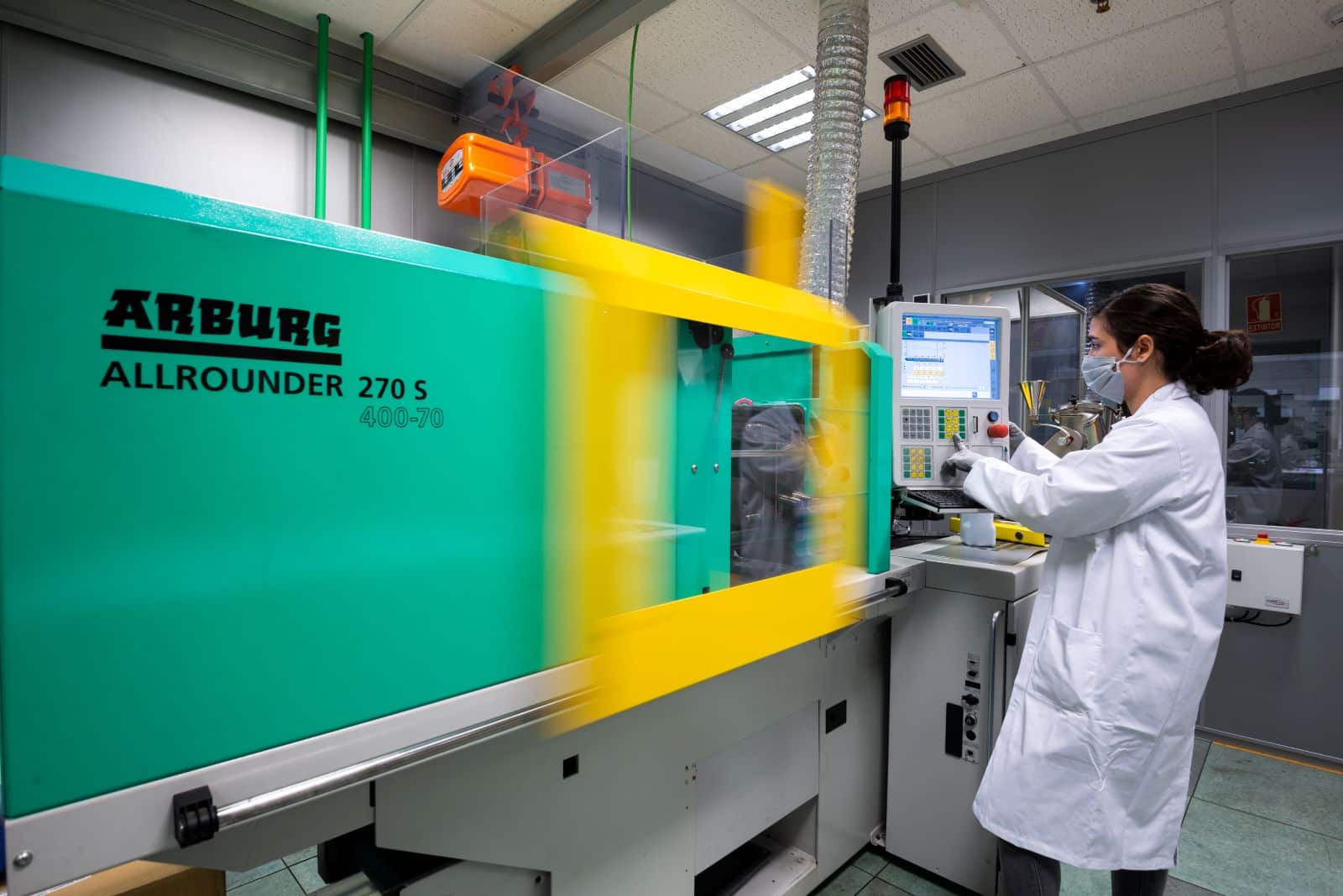

Testing of plastics and polymers
Testing of plastics and polymers is an essential service for assessing the behaviour, quality and durability of polymeric materials in demanding industrial applications. At INFINITIA we use these studies to validate materials, analyse how they respond under real conditions of use and verify that they meet the technical and regulatory requirements defined by each sector.
In our industrial laboratory we have specialists in polymer characterisation testing who work with advanced technologies to study mechanical, thermal, chemical and structural properties.
Talk to a specialist
Request a free initial consultation; contact a consultant from our team of specialists

What does testing of plastics and polymers involve?
What is it?
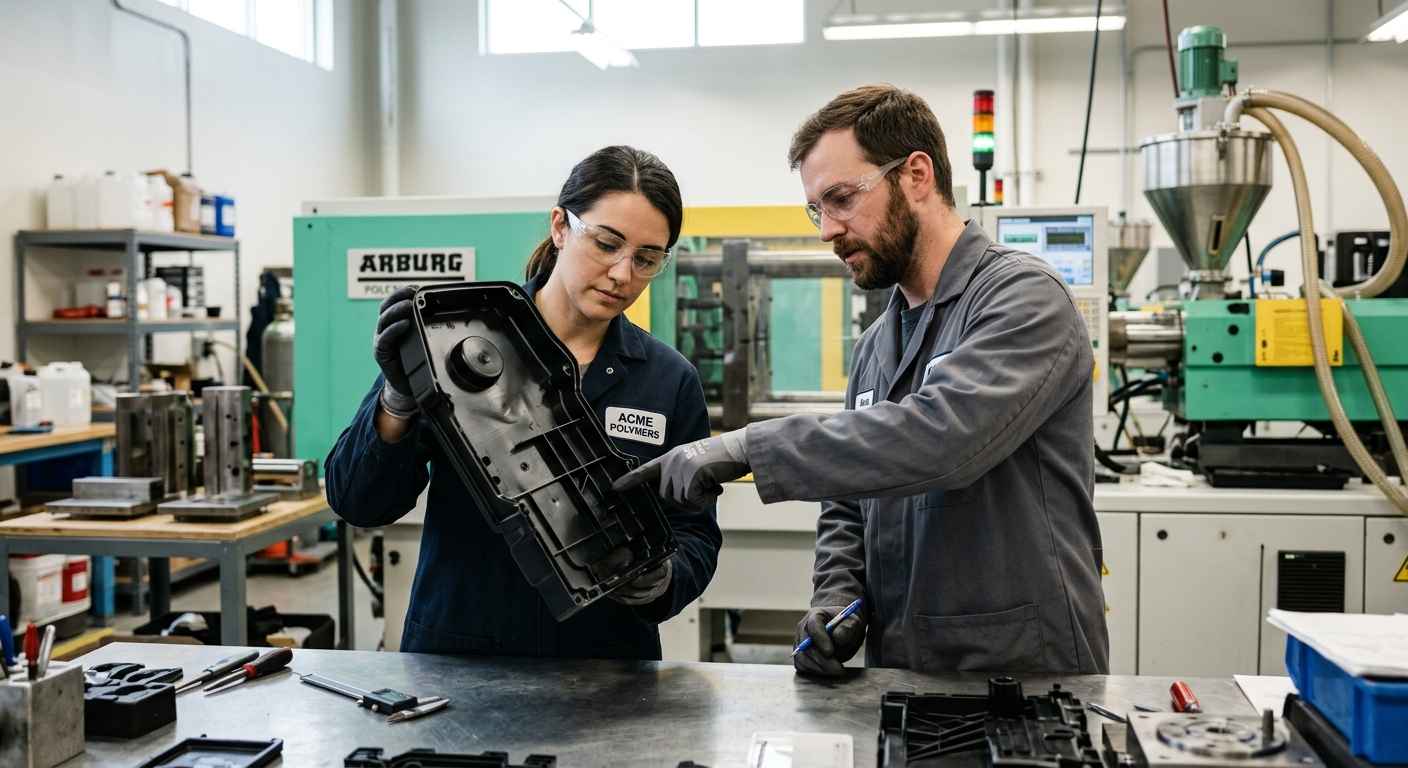
This type of analysis is particularly relevant in environments where plastic materials replace traditional metal solutions or form part of critical components, where any deviation can lead to in-service failures, financial losses or safety problems.
Testing of plastic and polymeric materials consists of a comprehensive evaluation of the material through methodologies that make it possible to understand its behaviour from several perspectives. It is not only a matter of measuring isolated properties, but of interpreting how the material responds to different loads and environments.
At INFINITIA these studies take an applied approach, adapting each analysis to the real context of the component, with an emphasis on the thermal properties of the material. We apply ISO, ASTM and DIN standards to ensure the quality of the tests, including compression physical tests. We take into account factors such as the type of mechanical load, exposure to environmental conditions, interaction with chemical substances and how the material evolves over time. This allows us to design specific protocols that reproduce real use scenarios under controlled conditions, using suitable testing equipment.
Through mechanical tests on specimens, such as tensile, impact or flexural testing, together with advanced techniques such as DSC, TGA or FTIR, we obtain detailed information on the structure, stability and behaviour of the material. These studies are complemented by analyses such as microscopy or climatic testing, which make it possible to assess progressive degradation and detect internal defects.
This approach makes it possible to anticipate in-service performance, identify deviations from specification and understand the mechanisms that can cause failure, supporting decisions based on objective data and on a proper characterisation of the material.
Plastics and polymer testing at INFINITIA
At INFINITIA we approach these studies from a comprehensive perspective that combines materials analysis, forensic engineering and comparative methodologies. Our aim is not only to obtain results, but to interpret the behaviour of the material in its real application context, in line with ISO and ASTM standards.
We have advanced equipment for mechanical evaluation, thermal analysis, spectroscopy and microscopic observation, as well as climatic chambers that make it possible to simulate accelerated ageing conditions. This lets us reproduce demanding scenarios and assess how the material evolves over time.
Our approach is based on comparing samples in different states; for example, conforming against non-conforming materials, and on designing specific tests that identify relevant deviations. This makes it easier to detect root causes, validate materials and optimise processes, providing added value compared with standard approaches.
Benefits of testing plastics and polymers
Benefits
One of the main benefits of these studies is the ability to anticipate problems before they appear under real conditions, optimising the performance of the material from the earliest stages of development or validation.
At INFINITIA we have worked with companies in the automotive sector to assess materials subjected to cyclic loads, identifying degradation processes that conventional methodologies did not detect. This type of analysis makes it possible to adjust formulations, select more suitable alternatives or redefine conditions of use.
Likewise, in electronic applications we analyse the behaviour of polymeric compounds subjected to continuous thermal variations, verifying their dimensional stability and preventing failures caused by deformation or loss of properties. We also carry out studies where chemical interaction is critical, assessing resistance to aggressive agents or specific environmental conditions.
These tests reduce incidents in the field, minimise the costs associated with failures and improve the overall reliability of the product, providing a solid technical basis for decision-making.
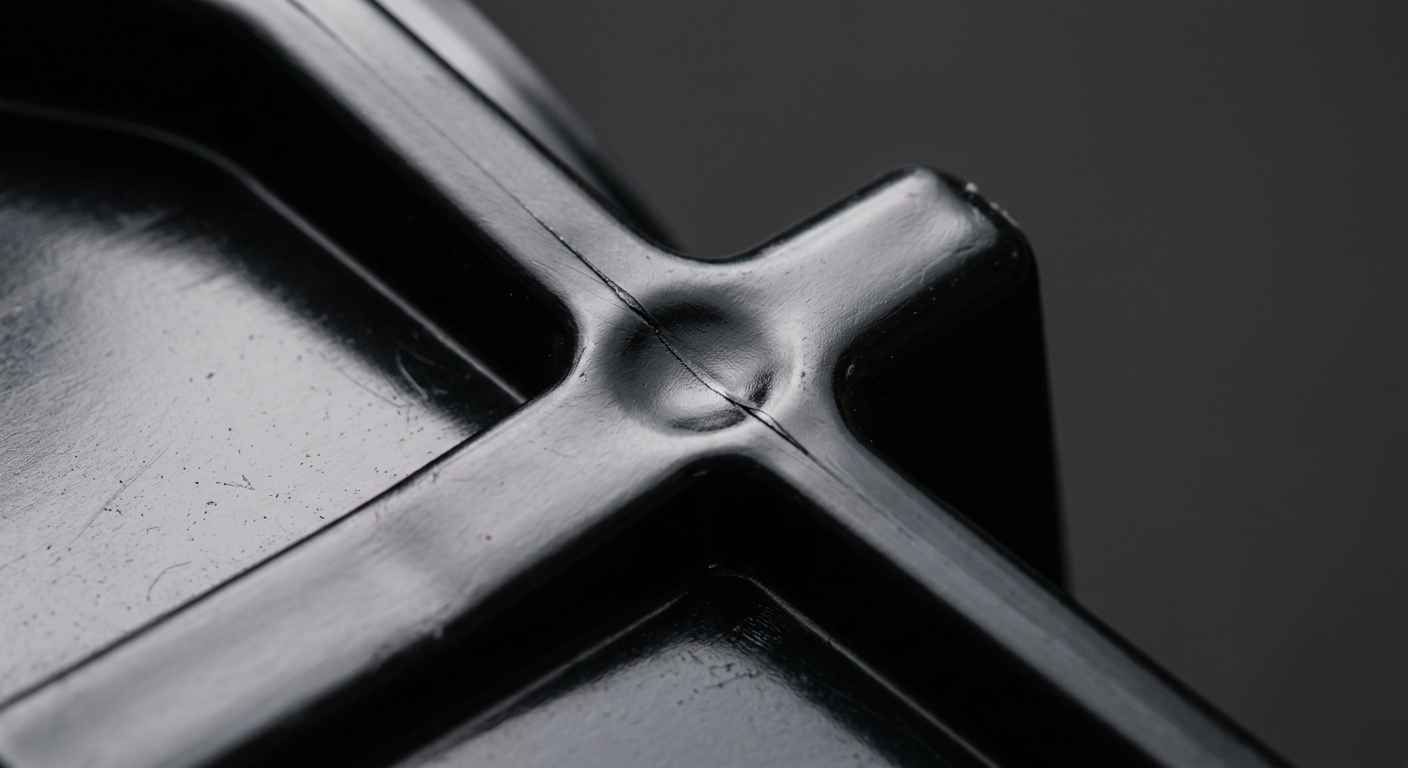
Types of tests on plastics and polymers
Types
At INFINITIA we carry out different types of tests aimed at understanding the real behaviour of materials and validating their suitability for the final application. These studies are designed taking into account not only the intrinsic properties of the material, but also the conditions of use, the manufacturing processes and the specific requirements of each sector.
These tests also make it possible to correlate the properties of the material with its performance in application, identifying relationships between composition, processing and final behaviour. This approach is key to detecting batch-to-batch deviations, optimising formulations and selecting more suitable materials, both in resins and plastics and in composite materials.
Mechanical testing on specimens or components
We assess the resistance of the material to different types of load through tensile, flexural and impact testing. These analyses determine key parameters such as elastic modulus, maximum strength, deformation and energy absorption capacity.
Fatigue, creep or stress relaxation tests can also be included to study the behaviour of the material under prolonged or repeated loads. These studies are particularly relevant in applications where the component is subjected to continuous stress or dynamic conditions.
In demanding applications, this mechanical characterisation is essential to validate materials, compare alternatives and ensure they meet design requirements without compromising the integrity of the component over time.
Thermal testing and behaviour against temperature
Through techniques such as DSC and TGA we analyse thermal stability, the transitions of the material, such as glass transition or melting temperature, and its degradation with temperature.
These studies make it possible to assess the behaviour of the material under real operating conditions, identifying structural changes, loss of properties or thermal degradation. They are also used to analyse the influence of additives, fillers or manufacturing processes on the stability of the material.
They are particularly relevant in applications where materials are subjected to continuous thermal cycles, high temperatures or sudden changes in temperature.
Chemical testing and resistance to external agents
We assess how the material responds to chemical substances, moisture or radiation, analysing degradation processes such as swelling, oxidation, hydrolysis or loss of mechanical properties.
These tests determine the compatibility of the material with its environment of use, as well as its resistance to aggressive agents present in real operating conditions.
This type of analysis is key in applications where the material is in contact with fluids, chemical products or outdoor environments, making it possible to anticipate failures and improve material selection.
Chemical and structural characterisation of polymers
Using techniques such as FTIR and optical or electron microscopy, we analyse the composition and internal structure of the material, detecting defects, inclusions, contamination or variations between batches.
These studies make it possible to identify materials, verify formulations and analyse the distribution of phases or additives. In more complex materials, aspects such as crystallinity or structural orientation can also be assessed.
This type of analysis is key both in the validation of raw materials and in failure investigation, making it possible to understand the origin of deviations in the behaviour of the material.
Accelerated ageing and durability testing
We simulate extreme conditions through exposure to UV radiation, temperature, humidity or combined cycles in order to assess how the material evolves over time.
These tests reproduce, under controlled conditions, the degradation processes that occur in service, such as loss of mechanical properties, colour changes or cracking in resins.
Thanks to these accelerated ageing studies, it is possible to estimate the service life of the material, compare alternatives and validate its long-term behaviour, reducing uncertainty in critical applications.
Applications of testing on plastics and polymers
Sectors
Testing of polymeric materials has key applications across a wide range of industrial sectors, where their behaviour directly conditions the performance, safety and service life of the final product. Unlike other materials, polymers are highly sensitive to factors such as temperature, load or chemical environment, which makes validation under representative conditions of use essential.
At INFINITIA we carry out advanced testing to characterise plastic materials, validate their in-service behaviour and optimise their selection for each application. Our approach makes it possible not only to verify initial properties, but to anticipate how they will evolve, detect deviations and reduce the risks associated with their use in demanding environments.
Automotive industry: validating polymeric materials under real conditions of use
In the automotive sector, polymeric materials make it possible to reduce weight, improve energy efficiency and optimise costs while maintaining high standards of safety and durability. Their use in interior, exterior and structural components calls for stable behaviour under multiple loads.
- Assessment of mechanical strength in components: analysis against vibration, impact and cyclic loads in parts subjected to continuous use.
- Behaviour against temperature: study of thermal stability under real conditions such as engine compartments or interiors exposed to solar radiation.
- Accelerated ageing testing: simulation of combined cycles of temperature, humidity and UV radiation to anticipate degradation.
At INFINITIA we have worked with suppliers in the automotive sector identifying premature degradation associated with formulations or processes, preventing in-service failures and rejections in the supply chain.
Aeronautics: evaluating materials in environments with high structural demands
In aeronautics, materials must guarantee reliable behaviour under extreme conditions, where factors such as temperature, pressure or humidity can significantly affect their integrity. Validating these materials is critical to ensuring safety and performance in operation.
- Impact assessment: analysis of visible and non-visible damage in materials subjected to sudden loads.
- Simulation of severe environmental conditions: exposure to humidity, temperature and pressure to assess stability.
- Structural integrity study: detection of internal defects, discontinuities or degradation of the polymer matrix.
At INFINITIA we reproduce real operating conditions to validate the behaviour of the material in line with the requirements of the aeronautical sector.
Electronics: thermal behaviour and functional stability of polymers
In electronic devices, polymeric materials play a key role in insulation, encapsulation and structural support. Their behaviour against temperature and thermal cycling is decisive in guaranteeing the reliability of the system.
- Thermal behaviour analysis: identification of transitions and degradation as a function of temperature.
- Assessment after thermal cycling: study of the effect of repeated expansion and contraction on the material and its joints.
- Dimensional stability control: verification of deformations that could affect assembly or operation.
At INFINITIA we validate materials to prevent functional failures and ensure the stability of the product in prolonged use.
Packaging: material compatibility and resistance under storage conditions
In the packaging sector, materials must protect the contents, maintain their integrity and avoid unwanted interactions throughout their service life. Factors such as storage, transport and contact with the product are decisive.
- Mechanical assessment: analysis of resistance to impact, compression and handling during transport and storage.
- Chemical compatibility: study of possible migration or interaction with the contents.
- Storage stability testing: simulation of real conditions to assess behaviour in the medium and long term.
At INFINITIA we make sure that materials fulfil their function without compromising product quality, preventing incidents in real use.
Construction: durability of materials under prolonged environmental exposure
In construction applications, polymeric materials must retain their properties over long periods in environments exposed to radiation, humidity and thermal variation. Progressive degradation can compromise both functionality and safety.
- Assessment against radiation and humidity: analysis of the effect of continuous exposure to weathering agents.
- Study of degradation processes: identification of ageing, cracking or loss of properties.
- Long-term behaviour: simulation of prolonged conditions to assess how the material evolves.
At INFINITIA we validate materials for structural applications and coatings, ensuring their durability in real environments.
Consumer goods: assessing quality, use and consistency of the material
In consumer products, polymeric materials must offer reliable and consistent behaviour, retaining their properties throughout use and meeting the quality expectations of the end user.
- Wear assessment: analysis of behaviour under repeated use or continuous contact.
- Stability under conditions of use: verification against temperature, humidity or household agents.
- Batch-to-batch variability control: analysis of consistency in properties to guarantee uniformity in production.
At INFINITIA we help to improve the quality of the final product, reducing incidents and ensuring reliable performance under real conditions of use.
The value of plastics and polymer testing with INFINITIA
Value
Testing of plastics and polymers is a fundamental tool for guaranteeing the reliability of materials in demanding industrial environments. At INFINITIA these studies make it possible not only to evaluate properties, but to understand the real behaviour of the material in service.
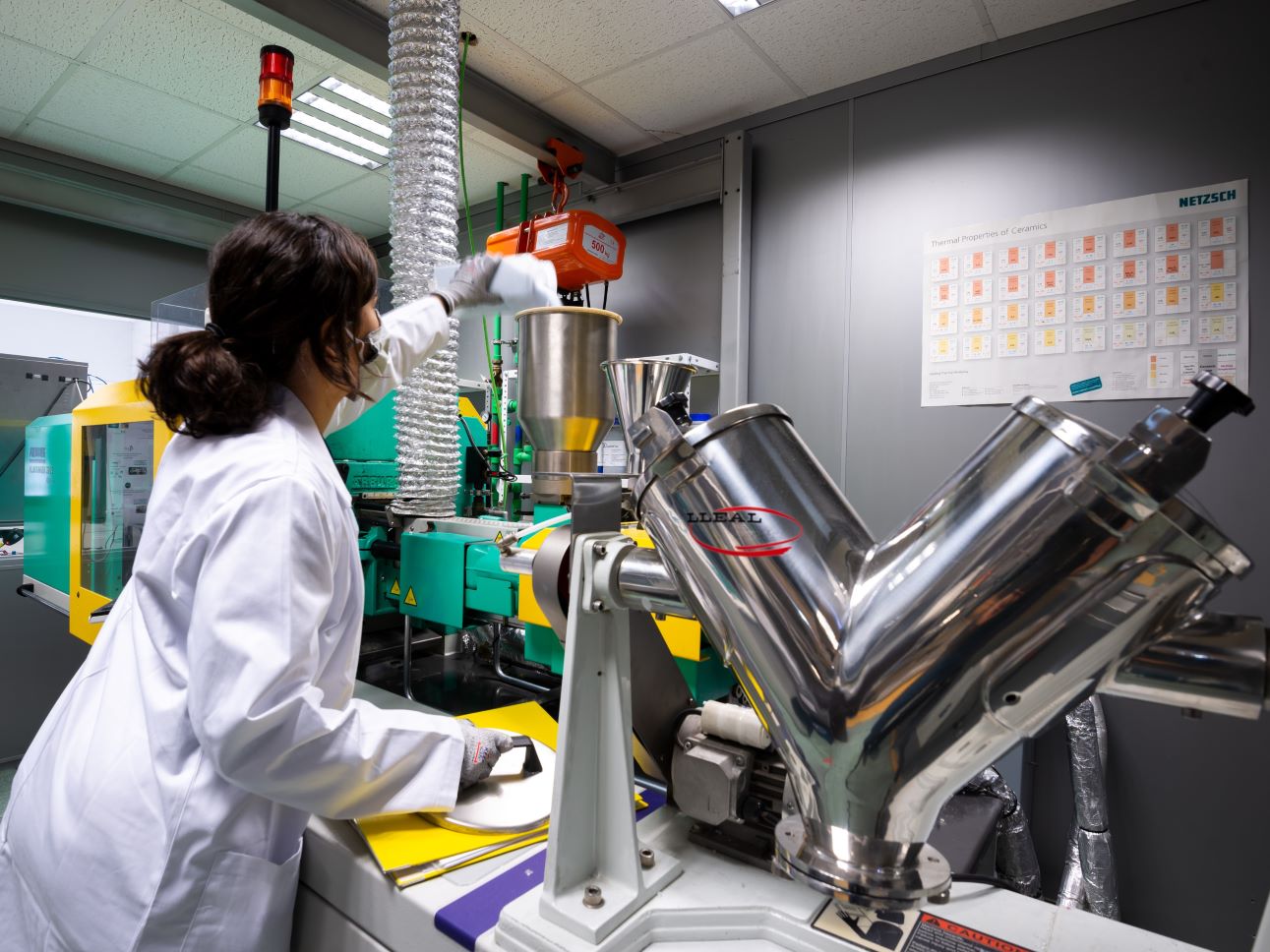
The sector is moving towards greater integration of advanced techniques, digitalisation and simulation of behaviour under real conditions. At INFINITIA we already work along these lines, developing solutions based on technical knowledge and applied experience, so that having us as a technology partner turns information into decisions, improving the quality, safety and competitiveness of products.