
Behavior against external agents
Behavior against external agents refers to how a given material will behave in situations where factors such as temperature, humidity, radiation or other conditions will exert effects on it.
Measuring parameters such as resistance to these factors is an important matter, since simulated laboratory environments make it possible to recreate the material’s response and, as a result, determine whether it meets the expected requirements.
To verify how a part behaves against external agents, at Infinitia Industrial Consulting we have specific equipment in our laboratory, along with our technicians’ extensive experience.
Talk to a specialist
Request a free initial consultation; contact a consultant from our team of specialists

What is external agent behavior analysis?
What is it?
External agent behavior analysis is the set of tests that evaluates a material’s response to the environmental, thermal and chemical conditions it will be subjected to throughout its service life. It serves to predict durability, quantify degradation and determine whether a material will maintain its performance in its real working environment.
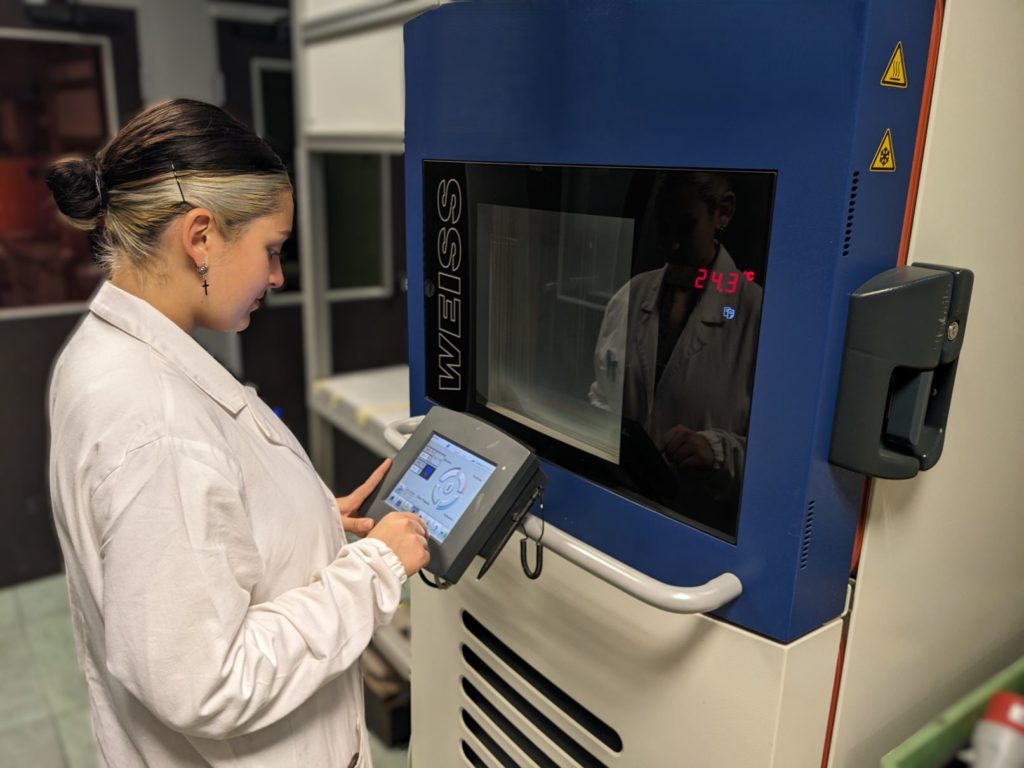
The technical approach considers multiple degradation variables simultaneously or sequentially: temperature, thermal cycles, relative humidity, condensation, ultraviolet radiation, saline atmospheres and contact with chemical substances. Each agent triggers a different failure mechanism (oxidation, hydrolysis, embrittlement, photodegradation, loss of adhesion or dimensional change) that must be identified in order to act on its cause. Comparative characterization of materials before and after exposure makes it possible to rigorously measure the extent of the deterioration, an analysis detailed in the comparative material characterization service.
As an industrial technical consultant, INFINITIA approaches this testing with a dual purpose: faithfully reproducing service conditions and, above all, interpreting why the material behaves the way it does. This reading of the degradation mechanism is what turns a test data point into an actionable technical decision about material selection, coating or design.
External agent behavior at INFINITIA. From testing to industrial decision-making
The technical value of this service doesn’t lie solely in reproducing the environment, but in explaining why the deterioration occurs. As an external technical partner, INFINITIA approaches every testing campaign starting from the real industrial question: why a component fails, how long a material will last, or which alternative better withstands specific conditions. This orientation avoids generic testing and concentrates effort on the critical variable in each case.
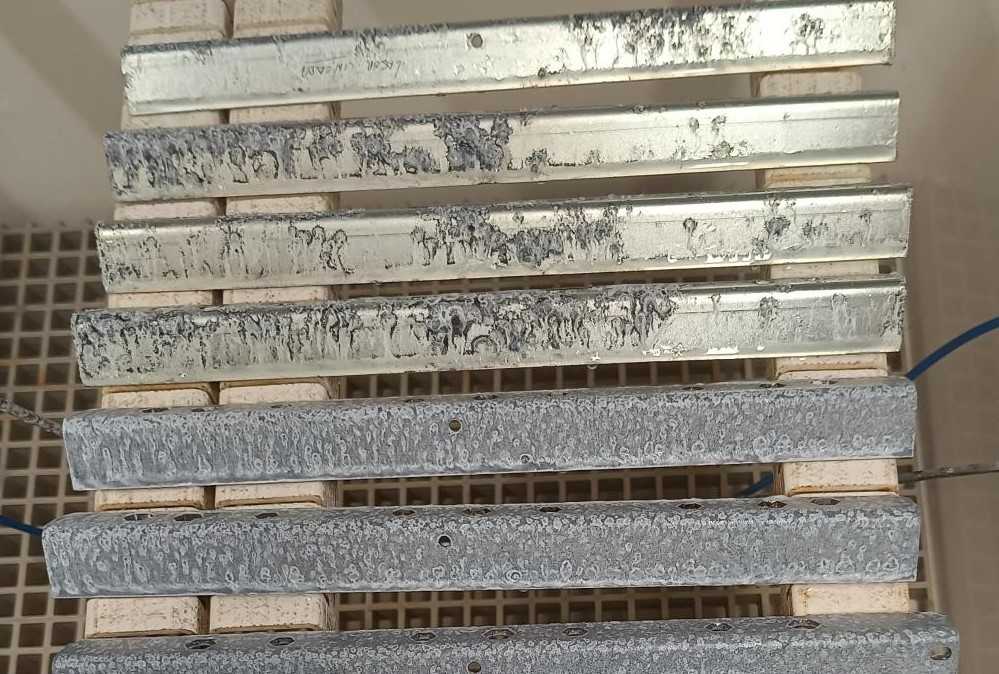
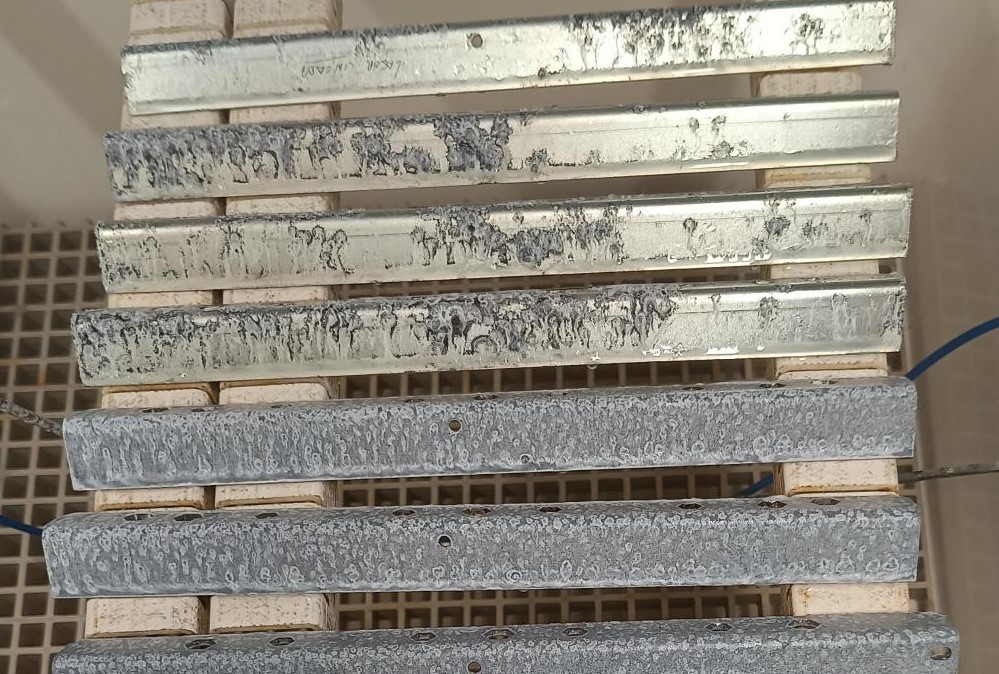
The techniques used cover the full spectrum of environmental degradation: thermal aging in an oven, humidity- and temperature-controlled climatic chambers, salt spray testing, accelerated exposure to ultraviolet radiation, thermal shock, and evaluation of resistance to staining and chemical agents. Combining this with root cause failure analysis makes it possible to connect the observed degradation with the physicochemical mechanism that causes it.
The robustness of the diagnosis comes from integrating three complementary layers: faithful reproduction of the environment, objective measurement of property changes, and interpretation of the degradation mechanism. This approach is reinforced by the preventive analysis of candidate materials, which anticipates behavior before committing to a purchasing decision or a mass-production design.
INFINITIA’s differentiator lies in combining analytical rigor with an industrial outlook. An isolated test data point indicates that a material is degrading; the specialized team’s job is to determine why it’s degrading, what it means for the application, and what scope exists to correct it through material, coating or redesign. This is how INFINITIA works: turning technical observation into a recommendation that reduces risk and cost.
Benefits of external agent behavior testing for product reliability
Benefits
Evaluating behavior against external agents detects loss of performance before a component reaches the end customer. A material can meet its technical data sheet at the time of delivery and still lose rigidity, color, adhesion or watertightness after months of outdoor exposure. Anticipating that degradation through controlled testing protects the product’s perceived quality and prevents the failure from appearing once it’s already in service.
Salt spray and humidity testing anticipates the corrosion and coating degradation that compromise the structural safety and appearance of metallic and painted parts. Predicting when rust spots, blistering or coating detachment will appear eliminates the risk of costly claims and integrity failures. Failure analysis on already-degraded parts confirms whether the origin lies in the material, the process or the exposure conditions, providing a solid basis for correcting the real cause.
Accelerated aging early quantifies the vulnerability of polymers, elastomers, paints and adhesives to ultraviolet radiation. Reproducing years of weathering in weeks makes it possible to identify yellowing, embrittlement or loss of mechanical properties before committing to a production run, reducing the risk of a component breaking in service and supporting the selection of more durable formulations.
Validating behavior against thermal cycles prevents fatigue, microcracking and seal failure in joints, gaskets and assemblies made of materials with different expansion coefficients. Knowing how an assembly responds to sudden temperature changes prevents leaks, delamination and misalignments that only appear after start-up, when correcting them is far more expensive than anticipating them. This knowledge shifts component reliability from an expectation to a verified data point.
Applications of external agent behavior testing to ensure durability
Applications
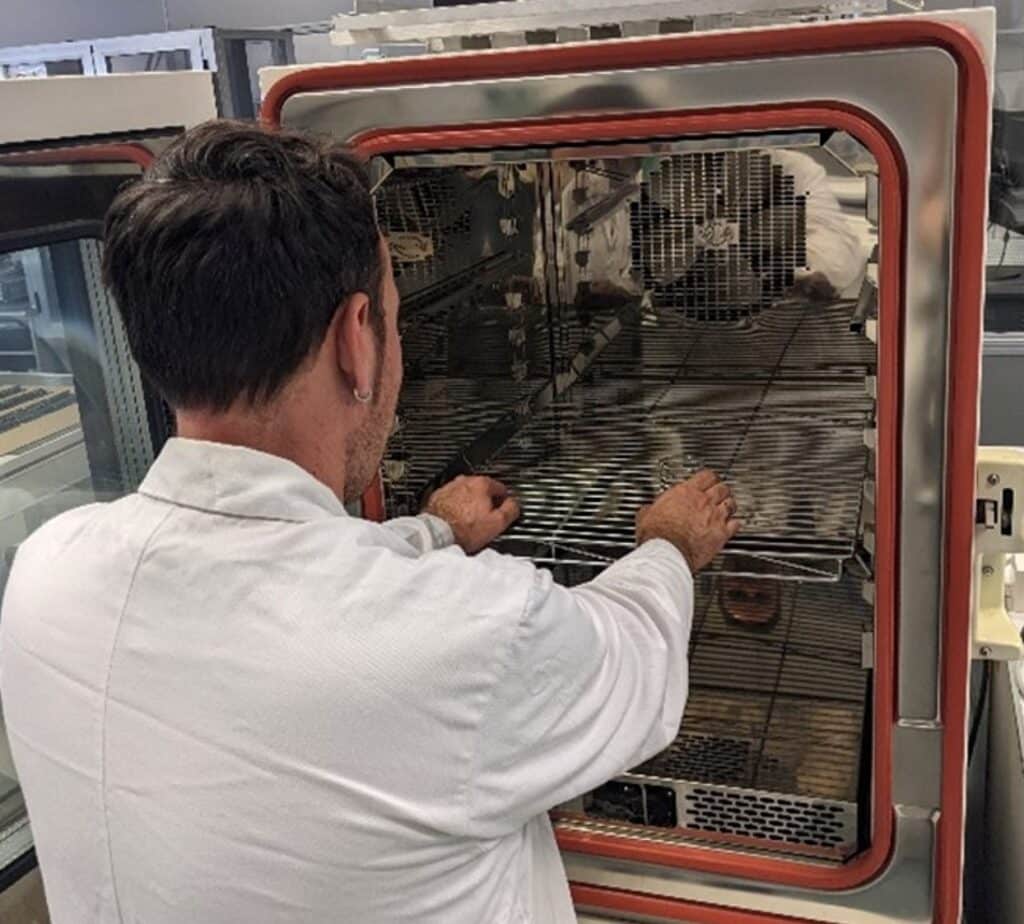
This service’s applications are relevant to any material exposed to an aggressive environment. External agent behavior evaluation is applied to metals, polymers, elastomers, coatings, adhesives, ceramics and composites, regardless of sector, because they all share the same requirement: maintaining their performance throughout their entire service life.
INFINITIA approaches these applications by selecting, in each case, the agent or combination of agents that reproduces the real service conditions. The goal is not to accumulate tests, but to isolate the variable that determines the component’s durability and precisely quantify its effect.
- Thermal aging and dimensional stability
- Climatic testing: humidity and hygrothermal cycles
- Accelerated artificial aging by ultraviolet radiation
- Thermal shock resistance
- Salt spray corrosion testing
- Staining and chemical agent resistance
Sectors where external agent behavior testing validates durability
Sectors
Behavior against external agents is decisive in any sector whose products operate exposed to severe, prolonged environmental conditions. The common requirement is ensuring that a material maintains its performance over years of service, regardless of the temperature, humidity, radiation or atmosphere of its working environment.
INFINITIA adapts the testing campaign to the real conditions of each sector, prioritizing the degradation agents most critical to each application. This sector-specific approach concentrates the analytical effort where the real risk of failure lies, rather than applying generic test batteries that dilute the diagnosis.
External agent behavior testing at INFINITIA to ensure industrial reliability
Value
External agent behavior analysis turns uncertainty about durability into measurable, actionable knowledge. It determines how long a material will hold up, what mechanism degrades it, and what scope exists to improve its performance. This technical certainty is the foundation on which material, design and process decisions with real industrial impact are built.
INFINITIA’s approach is preventive and evidence-based. Anticipating degradation through controlled testing prevents the failure from being discovered in service, when correcting it involves claims, recalls or complete redesigns. Integrating this validation early in development connects naturally with process improvement, where controlling manufacturing variables reduces the variability that compromises durability.
The economic impact of this anticipation is direct. Selecting the right material from the start, validating a more cost-effective alternative without losing performance, or ruling out an insufficient coating in time saves costs that multiply in later phases. This technical decision-making criterion feeds into product improvement, providing objective durability data where there were previously only estimates.
In regulated, high-demand sectors, INFINITIA positions itself as a strategic technical partner that combines the rigor of standardized evaluation with an industrial view of the problem. The specialized team doesn’t just deliver a test result, but an interpretation of the material’s behavior and a decision-oriented recommendation.