

Analysis of contaminants and impurities
Plastics and other materials may contain or develop impurities and contaminants for various reasons during their service life. Detecting this type of elements is a relevant issue, as it can affect quality standards or even compliance with regulations.
With this objective in mind, Infinitia offers you the possibility to perform contaminants and impurities analysis. The experience of our professionals and the technological equipment of our laboratory will offer you optimal results when identifying them.
Talk to a specialist
Request a free initial consultation; contact a consultant from our team of specialists

What is impurity analysis?
What is it?
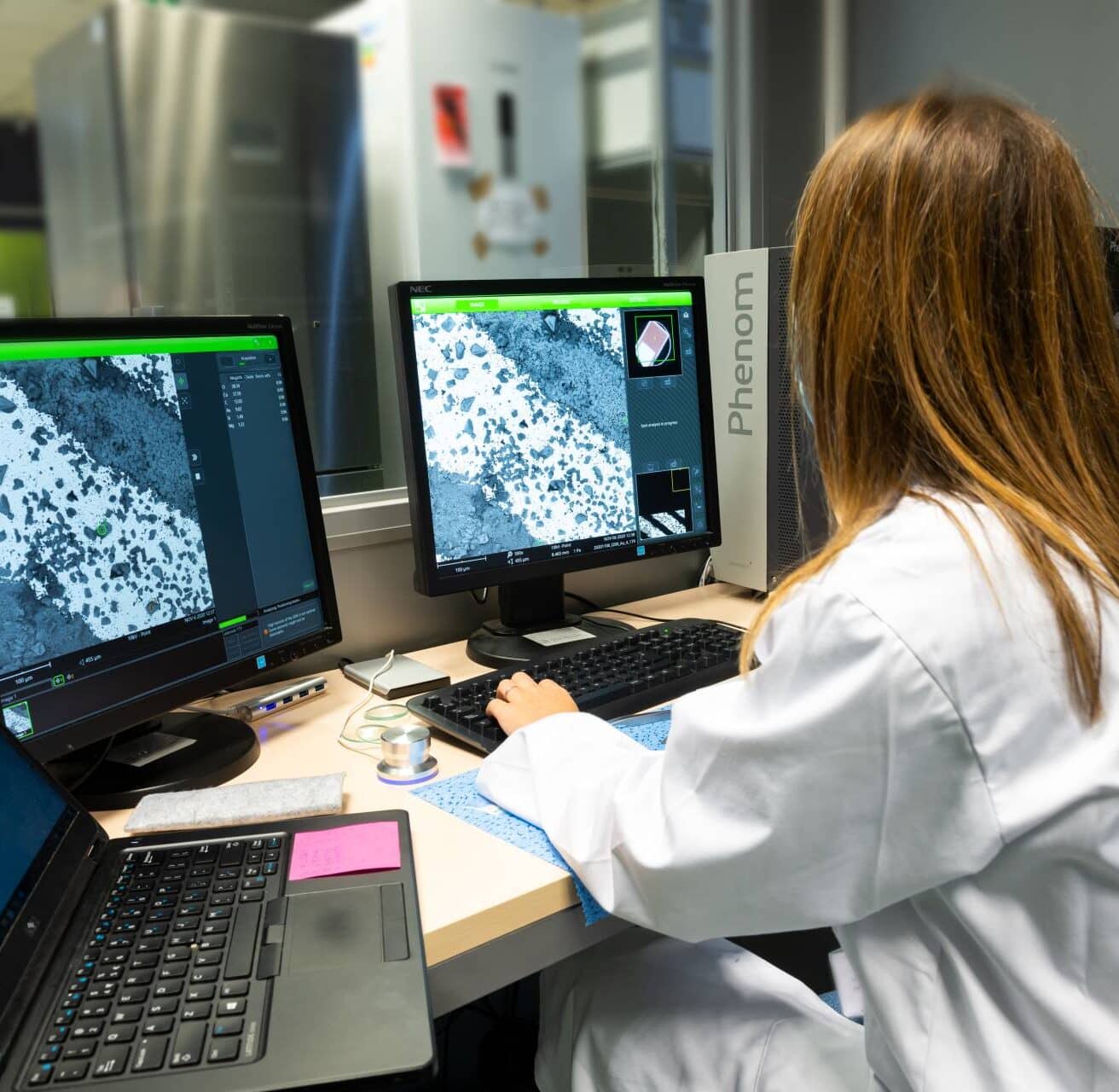
The analysis of impurities is a procedure that allows both quantifying and identifying foreign objects and other types of elements that should not be found in a given material.
Whether they are residual substances or traces resulting from an error in the production process, among other cases, their detection in the laboratory by applying various techniques will be a matter of relevance to avoid possible failures in the material or other problems related to its quality.
Benefits of contaminant and impurity analysis
Benefits
Detecting impurities and contaminants early prevents a material from reaching production with defects that will only show up later, when correcting them is far more costly. Identifying the origin of a trace or a foreign body also makes it possible to act on the process that generated it, not just on the affected batch.
With recycled materials, analysis is decisive before incorporating them into a new production process. Knowing what a recovered material actually contains makes it possible to decide whether it is suitable for the intended application.
This control also protects against two risks that go beyond the technical: failure to comply with the legislation applicable to the material, and rejection by the end consumer. Both are difficult to reverse once the product is on the market.
Whether these cases are mentioned or others, in INFINITIA you will find the proven experience of our technicians to perform an accurate analysis of impurities or contaminants, substances that our laboratory is prepared to detect in a high range of accuracy.

Types of contaminant and impurity analysis
Types
Contaminant analysis
In the case of plastic materials, particularly recycled plastics, it is advisable to apply decontamination at the end of their useful life so that they can be processed when they are produced and maintain their properties. To this end, it is essential to apply a contaminant analysis to detect the presence of this type of substances.
In addition, the importance of checking for contaminants is also a fundamental step since, if they are present, they can affect whether a material complies with legislation or whether its properties are adequate. It could even cause consumer rejection.
For this purpose, there are various analytical techniques, such as chromatography, which allow the identification of contaminants in plastics to be refined with great precision. These procedures, by the way, can be extended to other types of materials such as metallic materials, where techniques such as inductively coupled plasma will be effective in detecting contaminants.
Contaminants in recycled plastics
In the field of recycled plastics there are certain contaminating substances commonly detected, such as additives, oligomers or chemical products that are developed by the use of these materials.
Their presence can cause, for example, that they have an undesirable odor or taste, often resulting from the previous life of the material. This is the case, for example, of polyethylene terephthalate (PET) used in packaging, which may contain compounds such as limonene, whose origin derives from personal hygiene or cleaning products.
Additives and compounds resulting from their degradation may also appear, as in the case of ultraviolet light stabilizers or phthalates. And, in the case of inorganic particles, heavy materials, for example, may be found.
Likewise, these analyses will make it possible to determine whether linear or cyclic oligomers are present, the result of incomplete polymerization during the manufacturing process or caused by degradation during recycling.