

3D printing
Discover the 3D printing service we provide at the INFINITIA laboratory. We use cutting-edge technology to deliver high-quality work to our clients. Whatever your company or industry, INFINITIA can help.
In addition to a fully equipped laboratory, we are a team of professionals trained and experienced in 3D printing. Specialists from different fields work together to create prototypes that enable more efficient, practical part validation. Find out more about 3D printing at INFINITIA.
Talk to a specialist
Request a free initial consultation; contact a consultant from our team of specialists

What is 3D printing?
What is it?
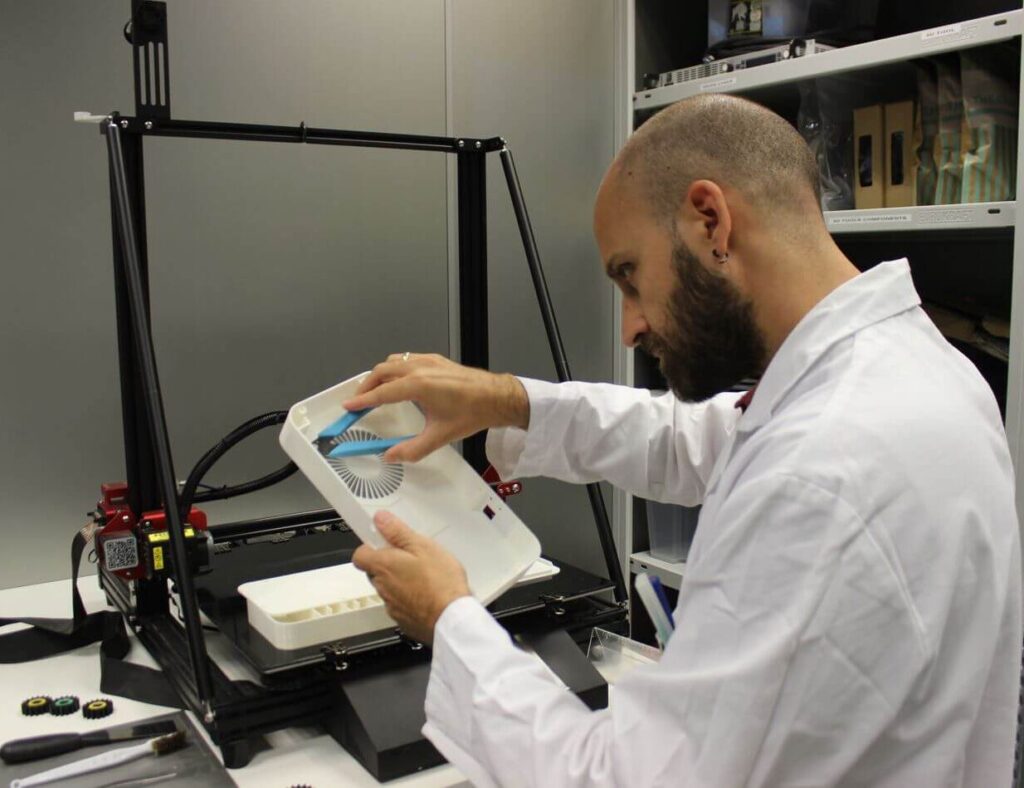
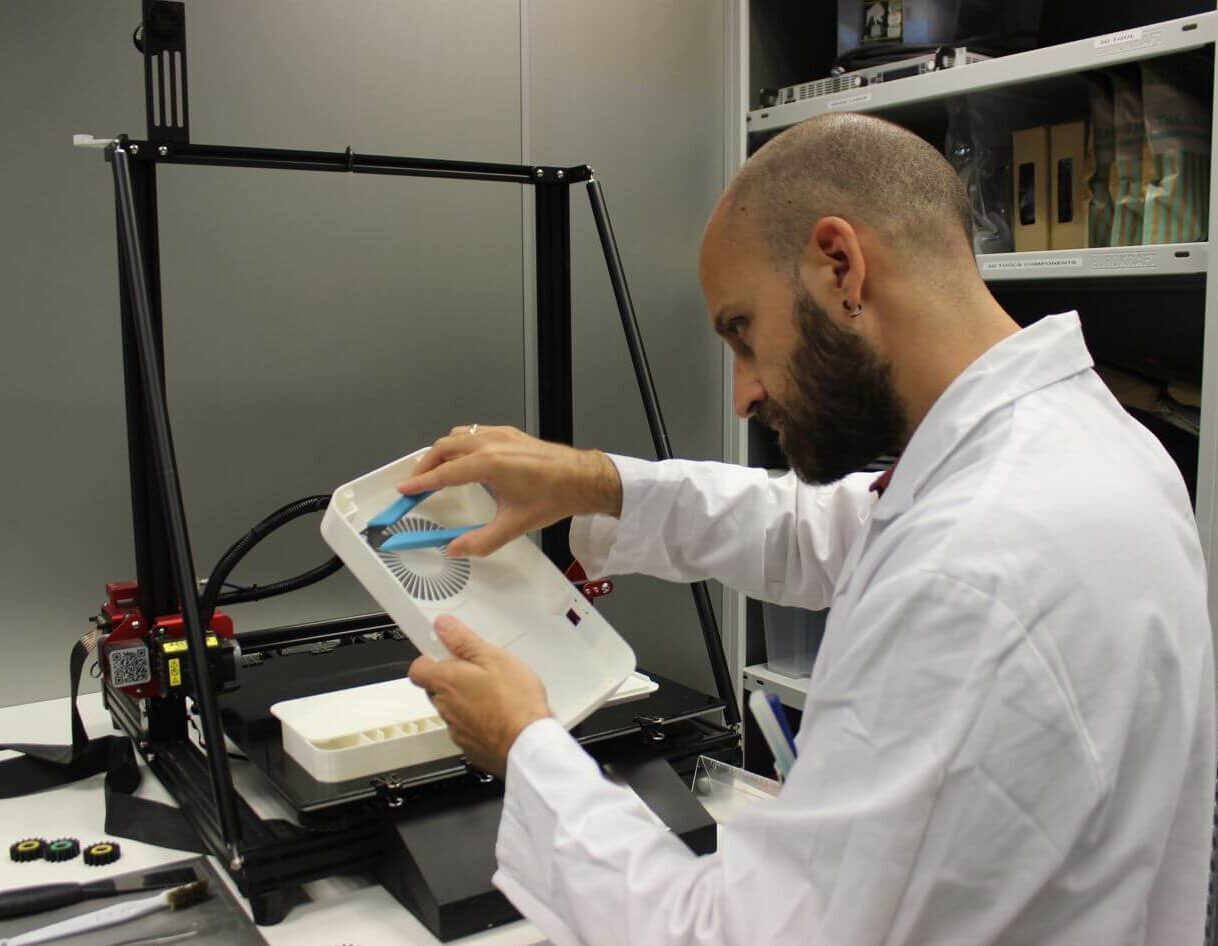
There are currently several types of prototyping. One of the most widely used is 3D printing. 3D printing is a technique used to create and adapt three-dimensional objects.
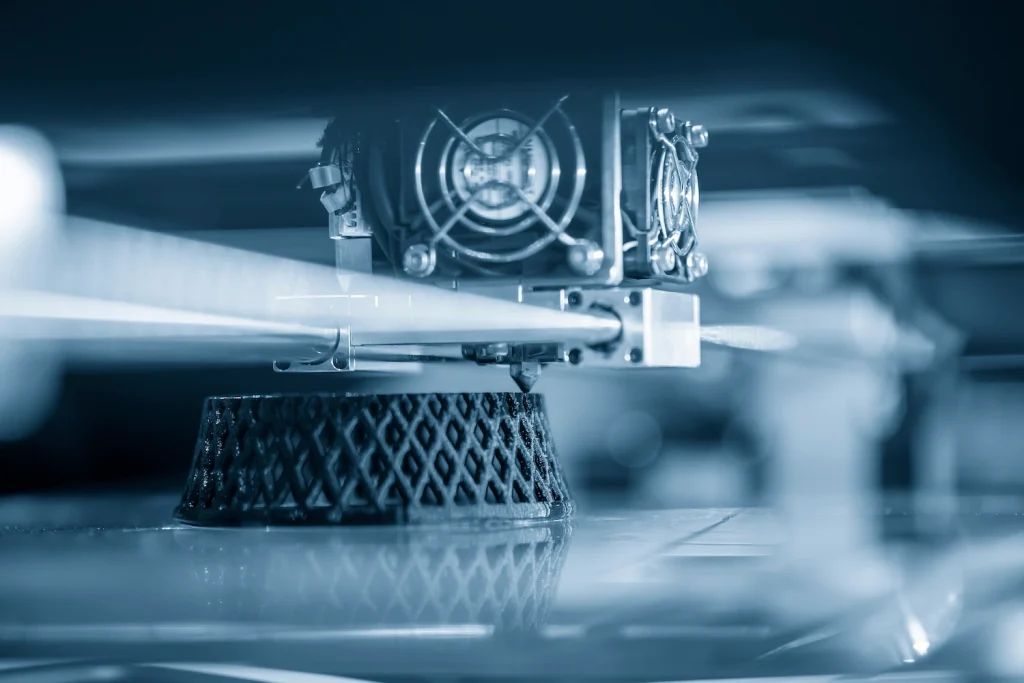
These objects are created by adding material layer by layer. The material is usually plastic or metal, although different 3D printer technologies can use other raw materials, such as living tissue or concrete.
3D printing parts to validate concepts
Using resin 3D printing or other materials such as thermoplastics, we validate and refine new concepts, model designs and even tooling. This is essential for fast, efficient product development.
At the INFINITIA laboratory, we therefore validate the future product prototype first. Only once the client has approved it do we proceed to industrial manufacturing. This saves both time and substantial financial resources.
Benefits of validating your product before manufacturing
Benefits
Why choose 3D printing? Here are some of the reasons to use this service:
- Cost reduction: Taking a part straight into industrial production carries a significant financial risk. If the part or component has a defect that was not identified during prototype validation, substantial resources may be lost.
- Quality: The iteration enabled by 3D printing delivers higher performance, efficiency and quality in the final parts and components.
- Customisation: Because costs are lower than in industrial manufacturing, 3D printing makes it possible to create custom parts and ad hoc solutions for different industries.
- Sustainability: Industrial 3D printing also helps optimise material use and therefore reduce waste.
Industrial 3D printing applications for faster technical validation
APPLICATIONS
Industrial 3D printing plays a role at many different stages of a product’s life cycle, from concept exploration to supporting equipment already in service. Its versatility stems from one unique feature: it turns digital information into a physical object without intermediate tooling, making it useful whenever a decision can only be made with the part in hand.
INFINITIA approaches these applications from the functional requirement, rather than the technology available. For each case, we define what the part must demonstrate, select a process and material consistent with that objective, and establish the verification criterion that confirms whether the result is representative. This workflow prevents prototypes from appearing valid when they are not and focuses effort on applications that deliver genuine technical value.
Industries where 3D printing shortens development cycles
INDUSTRIES
Industrial 3D printing applies to any industry whose products require physical validation before series production, regardless of company size or manufacturing volume. What varies between industries is not the technology but the primary requirement: material traceability in some cases, weight reduction in others, or the immediate availability of a spare part to prevent production-line downtime.
INFINITIA adapts its service approach to the primary requirement of each industry. The choice of technology, material and verification protocol varies substantially depending on whether the project involves a component subject to aerospace regulations, a device with biocompatibility requirements or production-line tooling that must be operational within forty-eight hours. Our experience across industrial projects in different sectors enables us to anticipate the checks required by each regulatory environment before they become an obstacle to the project.
Examples of our 3D printing projects
VALUE
Here are some examples of our industrial 3D printing projects:
3D metal printing using Binder Jetting technology: This first example involved producing three-dimensional parts using Binder Jetting, an additive 3D printing technique that forms parts by applying a binding agent.
3D printing to detect design flaws in leak-tight parts: 3D printing can also be used to redesign parts that require specific properties. In this example, the 3D-printed parts had to meet internal leak-tightness requirements to prevent leakage.
3D printing for presenting a new product at a trade fair: In record time, we produced 3D-printed parts that integrated the hardware within an aesthetic enclosure for display at a trade fair. These designs therefore served both aesthetic and functional purposes.
3D printing and testing a laser engraving robot: In this case, tight deadlines and the lack of final parts led us to use rapid prototyping to test the robot in situ.