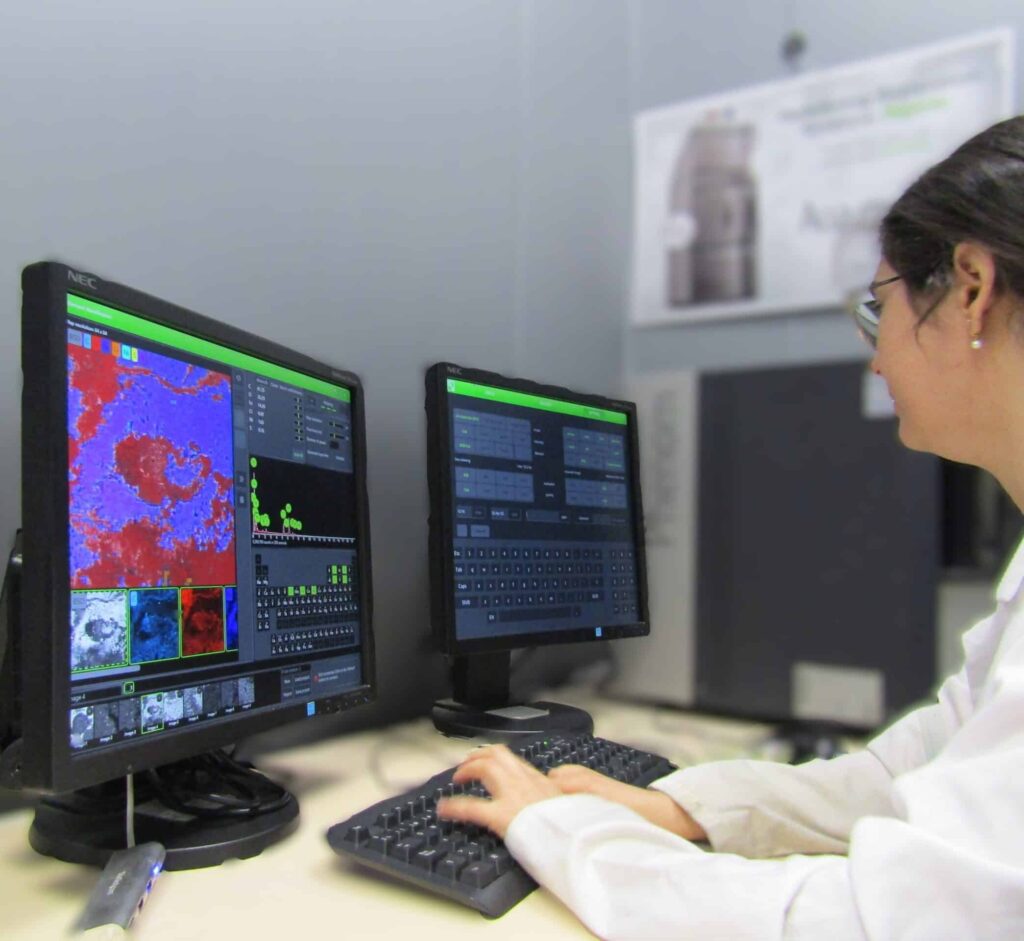
Homologation tests
Material approval testing is the process in which we evaluate the physicochemical properties of materials (such as metal, glass, plastic or paint) and the functionality of components, in order to validate whether they meet the technical requirements of the product in which they will be used.
Approval testing lets us obtain reference values for the key parameters of the material or part, which make it possible to predict its behavior throughout the product’s service life, optimize raw materials in terms of functionality and cost for the final component, and document their quality in the event of field failures — using it as evidence in claims against the raw material supplier.
We analyze and evaluate the properties of materials and components taking into account the product’s service conditions and the failure modes that may arise. At INFINITIA we specialize in the approval of materials and components. Discover how to get unique parts fully tailored to your industry.
Talk to a specialist
Request a free initial consultation; contact a consultant from our team of specialists

Material approval testing. What is it for?
What is it?
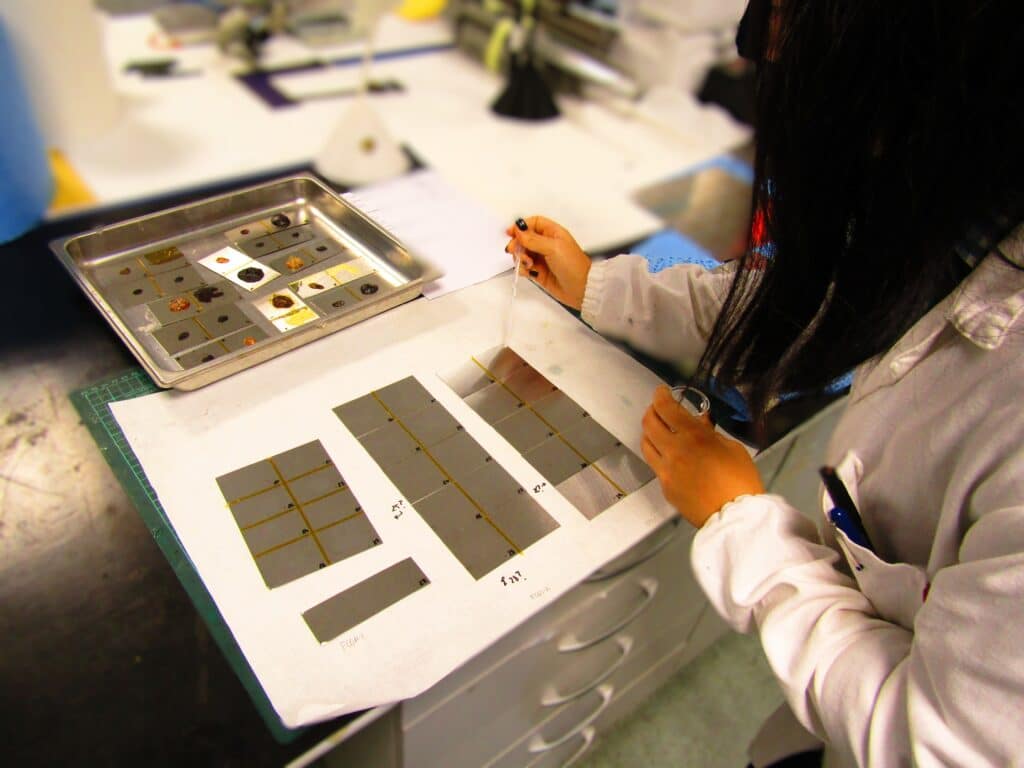
We optimize part costs and durability. Approval testing of a raw material helps us determine which material, and with what characteristics, should be used in a specific part, as well as validate more cost-effective alternatives that meet the same requirements. We select materials by checking their mechanical properties, their resistance to corrosion or wear, among others.
With scientific rigor, we characterize materials and evaluate them according to current standards at the international level and those specific to the sector or region of interest, taking into account the service conditions of the part in which the materials to be approved will be used. These approval tests also allow us to get ahead of failure mechanisms that may arise, detecting the material’s critical parameters and enabling design changes to components that prevent failure.
Specific approval testing at INFINITIA
In addition to carrying out standard-based approval testing of materials and components, at INFINITIA we also perform specific approval testing or custom testing when necessary. We adapt to you, not the other way around. Get in touch and together we’ll see how we can help you define an approval process tailored to your products’ specific requirements.
We analyze every detail, because we specialize in Forensic Engineering. We are prepared for failure mechanisms and can anticipate them. We work under the protection of knowledge and experience, with thoroughness and rigor, bringing this added value to focus on what will be critical in the material and the part.
Advantages of approval testing for parts or components
BENEFITS
Once the product’s requirements are known, we help you choose the most suitable materials for each component. In addition to being able to approve the product according to current standards, approval testing allows us to choose the optimal material for its manufacture.
We save companies costs and time, as we get ahead of failure mechanisms. Thanks to this INFINITIA service, we can stay ahead of possible future problems or failures by optimizing materials for their applications.
Another advantage of this type of testing carried out in our laboratory is the approval of new suppliers. Through this process, we advise you so that together we can find new suppliers that fully meet your needs. Find out more today!
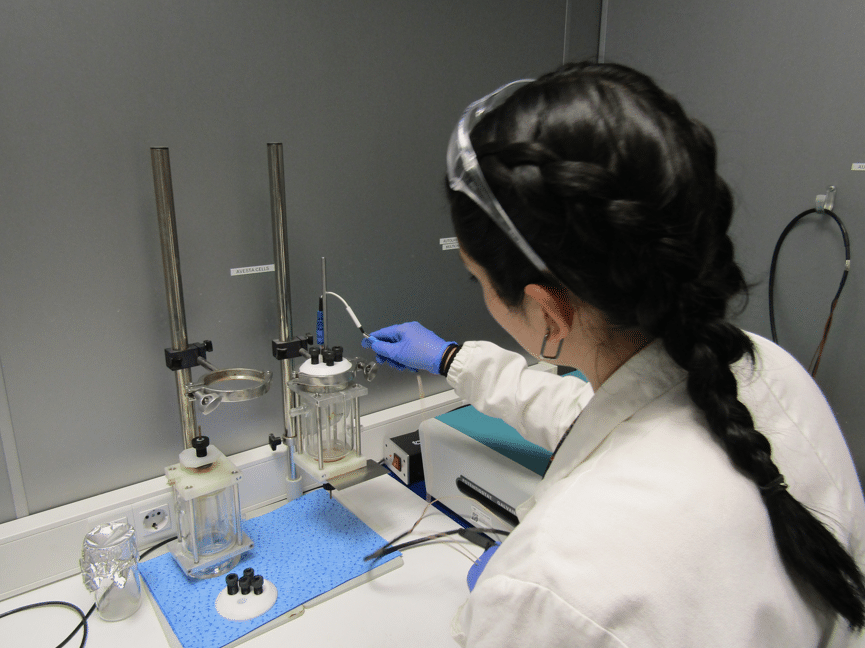
Applications of material approval testing to ensure in-service performance
types
Material approval testing is applied at any point in the lifecycle where a decision about the material must be made: initial selection, supplier change, substitution due to cost or availability, and post-failure analysis. This cross-cutting nature explains why the same service can solve seemingly different problems (choosing a polymer, validating a casting batch, justifying a claim) using a common methodology: defining the service condition, identifying the critical parameter and measuring it with the appropriate technique.
INFINITIA approaches these applications on the premise that no testing plan is generic. As an industrial technical consultant, it tailors the scope to the criticality of the component and the suspected failure mode, avoiding both underestimating risk and unnecessarily accumulating tests. In regulated sectors, this scope optimization, supported by literature review and applicable regulations, reduces lead times and cost without compromising the safety of the final product.
Validation of raw materials before entering production
Raw material validation consists of experimentally verifying that a received material has the declared composition, microstructure and properties, and that those properties are sufficient for the intended application. Chemical composition and residual elements, microstructural homogeneity, the presence of inclusions or porosity, and relevant mechanical properties are analyzed. This is the most common application for steels, light alloys, engineering polymers and elastomers, where variability between casting heats or resin pellet batches directly affects the behavior of the finished part.
This validation makes it possible to set a technically grounded purchasing specification and establish the acceptance criteria for incoming inspection. By knowing the margin between the measured property and the real requirement, it can be decided whether the specification can be relaxed, with direct savings, or whether it must be tightened to protect the component’s reliability. INFINITIA acts as an external technical partner, defining which parameters must be checked at each receipt and how often, so that subsequent control is efficient rather than merely a formality.
Validating the raw material before production turns a vague uncertainty about supply into a defined set of measurable, auditable parameters. That definition is what makes it possible, when an anomaly appears, to distinguish between a material problem, a process problem and a design problem. Without prior reference values, that distinction becomes unmanageable.
Material characterization for selection at the design stage
Material characterization applied to selection provides, at the design stage, the data that the manufacturer’s catalog does not offer: behavior under the specific combination of temperature, load and environment to which the part will be exposed. Composition, microstructure, hardness, strength, ductility and dimensional stability are determined, and complemented with tests oriented to the expected degradation mechanism. The absence of this data forces engineers to over-design out of caution or to take on an unquantified risk.
Having this characterization makes it possible to compare candidates on a consistent basis and choose the optimal material for each component based on its criticality. The decisions it enables simultaneously affect cost, weight, manufacturing process and expected service life. INFINITIA contributes here its role as external technical partner: translating the product’s functional requirements into measurable property requirements and building the selection matrix on that basis.
Material selection stops being a catalog choice when it is grounded in properties measured under the component’s service condition. That shift, from nominal data to experimental data, is the essential contribution of approval testing at the design stage, and the one that prevents most of the failures later attributed to the material.
Approval of new suppliers and supply equivalence
Industrial supplier approval determines whether the material from an alternative supplier is functionally equivalent to the approved one, beyond both declaring the same standardized designation. Two steels of the same grade can differ in grain size, heat treatment, inclusion cleanliness or surface finish, and those differences govern the component’s fatigue life or corrosion resistance. The comparative test is designed around the parameters that are critical for the specific application, not the full catalog of properties.
The results provide a solid basis for deciding whether to authorize the second source, authorize it with restrictions, limiting its use to certain part numbers, or reject it. This process reduces exposure to supply disruptions and enables cost negotiations backed by technical evidence. INFINITIA supports the client’s specialized team in defining the equivalence protocol and interpreting detected deviations, including those that only appear under simulated service conditions.
Approving a supplier means demonstrating functional equivalence under the real service condition, not nominal agreement on a data sheet. This distinction avoids the most costly scenario in industrial procurement: a seemingly equivalent source change that silently degrades product reliability and only shows up months later, in the field.
Anticipating failure modes through approval testing
Material failure modes (fatigue, creep, stress corrosion cracking, embrittlement, UV degradation, thermal aging) are anticipated through tests that accelerate reproduction of the dominant mechanism. Accelerated aging and thermal shock testing expose the material to temperature, humidity or chemical-agent cycles that compress years of service degradation into weeks, revealing the critical parameters that govern its deterioration.
The information obtained makes it possible to act on the design before industrialization: changing the material, modifying a surface treatment, removing a stress concentrator, or adjusting the raw material specification. This preventive capability is what supports the economic case for approval testing, because the cost of a test is always lower than that of a field failure. INFINITIA designs these tests as a specialized team in connecting the degradation mechanism with the component’s geometry.
Anticipating the failure mode makes it possible to correct the root cause at the design stage, while the component can still be changed without industrialization cost. Approval testing thus stops being a validation formality and becomes the most efficient preventive tool in the product development cycle.
Validation of alternative materials and specification redesign
Validation of alternative materials assesses whether a material different from the original one (more affordable, more available, with a better environmental profile, or free of restricted substances) maintains the performance required by the component. The study starts with comparative characterization of both materials and moves toward tests that reproduce the dominant load case: tensile, fatigue, creep, low-temperature impact, chemical resistance or joint behavior, where adhesion testing proves decisive in multi-material assemblies.
The result enables controlled substitution decisions and, frequently, redesign decisions. When the alternative material shows a shortfall in one specific property but advantages in others, approval testing quantifies that shortfall and allows it to be compensated geometrically (a thickness, a fillet radius, a local reinforcement) rather than discarding the alternative. INFINITIA, as an industrial technical consultant, evaluates material and component simultaneously, because fitness for purpose is never a property of the material in isolation.
An alternative material is approved when it is demonstrated that the material-geometry-process combination fulfills the function under the intended service conditions. This approach broadens the range of viable substitutions and avoids premature rejections based on the decontextualized comparison of a single catalog property.
Approval for service conditions not covered by a standard
There are applications for which no standard sets an applicable test: new materials, combined environments, or unprecedented functional requirements. In these cases, approval testing requires designing a specific protocol that reproduces the real condition (a particular thermal cycle, a specific aggressive atmosphere, a multiaxial load case) and establishing defensible acceptance criteria. The case of biocompatibility testing to approve new materials and manufacturing methods illustrates how a prior literature review defines the required testing scope.
This approach makes it possible to approve products that would otherwise be blocked due to a lack of regulatory reference, and to do so with methodological traceability equivalent to that of a standardized test. INFINITIA acts as industrial technical consultant in defining the setup, justifying the acceptance criterion, and documenting the procedure, so that the result is auditable by the client and by their own customers.
When no applicable standard exists, approval testing rests on the rigorous reproduction of the service condition and on the technical justification of the acceptance criterion. That combination is what gives the result its validity and makes it defensible before audits, regulatory bodies and end customers.
Sectors where material approval testing helps ensure industrial reliability
sectors
Material approval testing is relevant across all of manufacturing industry, but its scope and acceptance criteria change radically depending on the consequence of failure. In an automotive safety component, approval focuses on fatigue and batch-to-batch reproducibility; in a surgical implant, on the material’s interaction with the body; in energy equipment, on stability against temperature and corrosion over decades of operation. The methodology is common; the test definition is specific.
INFINITIA adapts the approval plan to each sector’s risk profile. As external technical partner, it incorporates applicable regulatory requirements, the end client’s specifications, and the known failure history for that type of component, and builds a proportionate protocol from that set. Experience accumulated across automotive, aerospace, medical devices, energy, industrial machinery and chemicals makes it possible to quickly recognize which parameter will govern behavior in each case.
Material approval testing at INFINITIA for a more reliable and competitive industry
Value
Material approval testing generates the technical knowledge that makes it possible to decide with certainty about the material, the supplier and the design of an industrial component. That knowledge is embodied in verifiable reference values: composition, microstructure, mechanical properties and response to expected degradation. From these, the organization stops managing the material as a trust-based variable and starts managing it as a controlled variable, with defined limits and known consequences.
The impact on industrial decisions is direct and preventive in nature. Knowing the material’s critical parameters makes it possible to modify the component’s design before industrialization, adjust the purchasing specification before signing the supply contract, and establish incoming-inspection criteria before the first batch enters the warehouse. When a failure has already occurred, approval testing provides the comparative baseline that failure analysis needs to distinguish between a material deviation, a process error and a design shortfall.
Economic optimization happens on three levels simultaneously. First, in the raw material: approval testing reveals whether the current specification is over-engineered relative to the real requirement and enables lower-cost alternatives with equivalent performance. Second, in the process: identifying the parameter that governs behavior makes it possible to focus control where it adds value and remove it where it doesn’t. Third, in the cost of poor quality: every failure anticipated at the approval stage avoids a corrective campaign, a customer claim, and reputational damage whose cost far exceeds that of the test.
In regulated sectors (automotive, aerospace, medical devices, energy), where material traceability is part of the product’s official record, INFINITIA positions itself as a strategic technical partner rather than a one-off service provider. The combination of analytical rigor, regulatory knowledge and understanding of manufacturing processes allows approval testing to stop being perceived as a documentary requirement and to be used for what it is: an engineering tool to reduce risk, control cost and sustain product reliability throughout its entire service life. Support as an external technical partner extends from defining the test plan to interpreting its consequences for the design.