Elemental analysis and chemical composition
Elemental analysis and determination of the chemical composition of materials are key tools in reverse engineering processes, enabling an in-depth understanding of a substance’s nature and helping to predict its behaviour in industrial applications.
At INFINITIA, we provide this service through a rigorous scientific and technical approach, using advanced technologies to deliver precise, relevant results. Our specialists work in our industrial laboratory to solve complex challenges involving quality, reliability and new product development, based on detailed knowledge of composition.
This type of analysis can detect both major elements and traces, identify contaminants, verify raw-material quality and compare formulations.
At INFINITIA, we use a broad range of analytical techniques (including ICP-OES, ICP-MS, AAS and CHNS-O spectrometry) tailored to each project’s requirements.
Thanks to our multidisciplinary approach, elemental analysis becomes a strategic tool for sectors such as automotive, electronics, packaging, metallurgy and food, where chemical composition directly affects product functionality and safety.
Talk to a specialist
Request a free initial consultation; contact a consultant from our team of specialists

What do elemental analysis and chemical composition determination involve?
What is it?
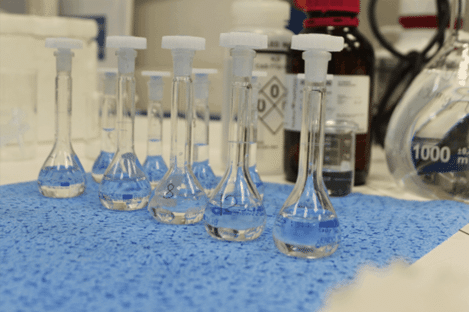
Elemental analysis involves quantifying the chemical elements present in a sample, whether at high concentrations or trace levels. The aim is to obtain a complete compositional profile that supports informed decision-making during the development, validation or quality control of materials.
The analysis may focus on inorganic elements (metals and non-metals) or organic elements such as carbon, hydrogen, nitrogen, sulphur and oxygen (CHNS-O).
At INFINITIA, we combine techniques including optical emission spectrometry (ICP-OES), mass spectrometry (ICP-MS), atomic absorption spectroscopy (AAS), combustion analysis (CHNS-O), X-ray fluorescence (XRF) and LIBS spectroscopy.
Each technique addresses different needs: from the characterisation of metal alloys through to polymer analysis, waste materials, soils or biocompatibility. We also apply rapid, non-destructive methods when the sample must be preserved.
Elemental analysis at INFINITIA: technology and specialist expertise
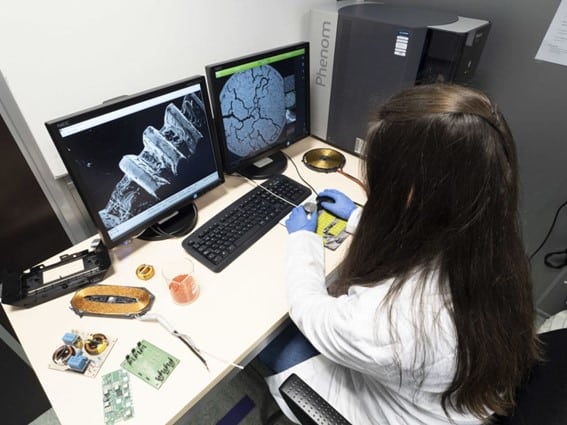
At INFINITIA, our industrial laboratory is equipped with state-of-the-art technologies for chemical and elemental analysis. Our team includes specialists in analytical chemistry, materials science and engineering, enabling us to adapt each analysis to the client’s requirements and the material’s functional context. We provide everything from routine characterisation to complex studies, including SEM-EDS microanalysis and the assessment of residual elements in metals.
Our processes follow quality and traceability protocols, and we work closely with clients in demanding sectors such as automotive and component and machinery manufacturing.
We can also complement the analyses with studies of performance, ageing, compatibility and approval testing, and counterfeit detection, depending on the project requirements.
Ultimately, elemental analysis and chemical composition characterisation are an essential part of INFINITIA’s technical approach to solving industrial challenges with objective data, interpreted from an applied perspective.
At INFINITIA, we approach construction-material testing from a multidisciplinary perspective, combining advanced characterisation, materials engineering and applied research.
Benefits of elemental chemical analysis for industry
Benefits
The main value of chemical composition analysis is that it provides objective, quantitative information about materials, which is essential for decision-making in industrial processes.
This service enables companies to validate the quality of their raw materials, ensure product compliance with standards or specifications, and even detect deviations that could lead to in-service failures. At INFINITIA, we also apply this type of analysis in forensic engineering, to investigate the origin of defects or contamination.
Real-world examples include controlling steel composition for critical applications, detecting contaminants in recycled plastics, and verifying trace elements in electronic circuits.
Thanks to our scientific approach and technical interpretation aligned with the industrial context, our reports enable fast, precise action on quality issues, process optimisation and the development of innovative products.
Types of Elemental Analysis and Chemical Composition Testing
Types
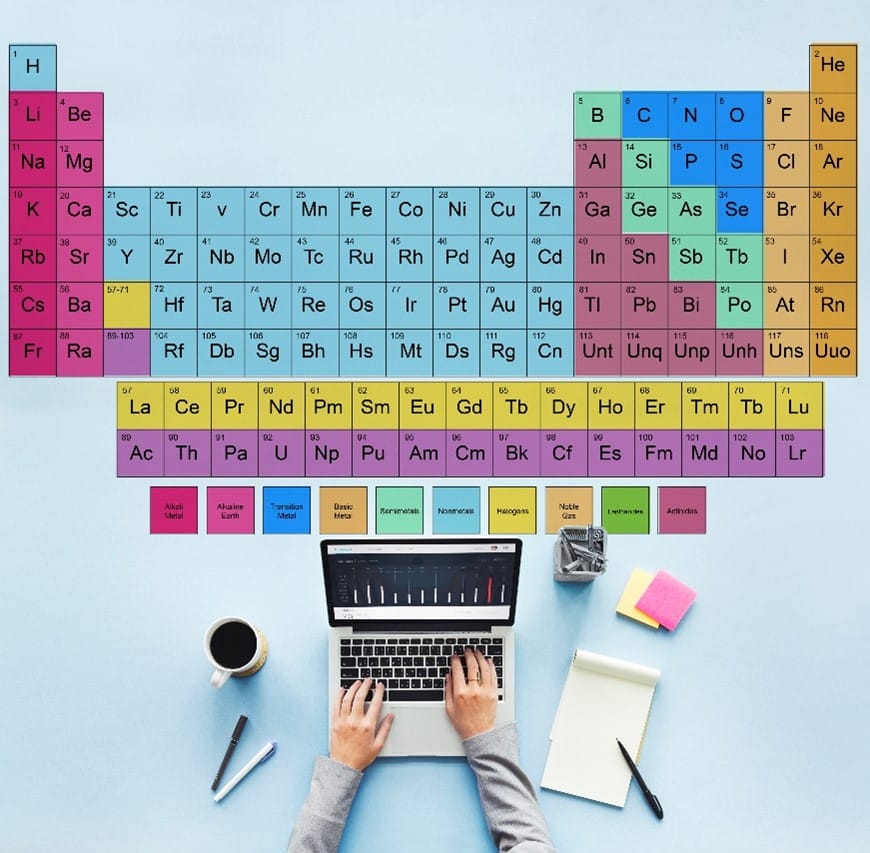
At INFINITIA, we perform different types of elemental analysis and chemical composition studies to characterise materials used in demanding industrial processes.
Our aim is to accurately identify the elements present, their proportion, distribution and effect on the functional properties of the final product. This enables us to optimise formulations, validate raw materials, detect contamination or investigate the origin of a failure.
Analysis of major elements and inorganic traces
These tests make it possible to quantify metals and non-metals at concentrations ranging from the percentage range down to trace levels (ppm, ppb or even ppt).
We use techniques such as inductively coupled plasma optical emission spectrometry (ICP-OES), inductively coupled plasma mass spectrometry (ICP-MS), atomic absorption spectroscopy (AAS) and X-ray fluorescence (XRF).
These techniques are essential for verifying the composition of metal alloys, validating mineral raw materials and detecting impurities in engineering polymers.
For example, at INFINITIA we have used ICP-MS to identify contaminating elements in electronic components that were affecting their functionality.
Elemental analysis by combustion (CHNS-O)
This type of analysis focuses on determining the proportion of carbon, hydrogen, nitrogen, sulphur and oxygen in organic materials, polymers, soils, biomass and food compounds.
We use automatic analysers such as Elementar or LECO. CHNS analysis is crucial in industries that need to determine a product’s elemental formula or validate its stability under thermal processes.
In one project for the energy sector, we applied this technique to characterise waste and assess its potential recyclability.
Residual gas analysis (O/N/H) in metals
We determine oxygen, nitrogen and hydrogen in high-purity metals using specific analysers based on inert fusion or thermal reduction. This information is critical for stainless steels, titanium and superalloys, where these gases directly affect ductility, corrosion resistance and mechanical performance.
At INFINITIA, we perform this type of testing for high-performance component manufacturers.
Rapid, non-destructive analysis
We use technologies such as LIBS (laser-induced breakdown spectroscopy) and portable XRF to perform rapid chemical analyses without dissolving the sample.
These techniques are ideal for field inspections, in-line production validation and sorting recycled metals.
In a project for an industrial machinery manufacturer, sampling was not possible. These analyses enabled us to determine the type of alloy, resolve a failure and prevent it from recurring.
Chemical and surface microanalysis
Using techniques such as SEM-EDS and EPMA, we analyse the local chemical composition of samples at the micrometre scale.
This capability is essential for investigating contaminating particles, functional coatings and failure mechanisms at the microstructural level.
At INFINITIA, for example, we have used SEM-EDS to identify metal inclusions responsible for cracks in plastic components.
Oxidation and stability testing and complementary thermal analysis
Using techniques such as TGA (thermogravimetric analysis), DSC and loss-on-ignition analysis, we determine the indirect presence of elements such as oxygen or volatile components.
This type of testing is useful for analysing thermal stability, mineral content and residual composition.
At INFINITIA, we have applied it in reverse engineering processes where it was necessary to verify that the batches supplied by the provider were correct.
Applications of Chemical and Elemental Analysis
Sectors
Elemental analysis and chemical composition characterisation are essential for ensuring the quality, functionality and regulatory compliance of materials used in industrial products.
At INFINITIA, we apply these analyses as an integral part of validation, quality control, formulation optimisation and failure diagnosis processes.
Thanks to our analytical capabilities and applied perspective, we provide precise, tailored solutions to sectors that require high standards of reliability and traceability.
Automotive industry
In the automotive sector, requirements for structural strength, durability, weight and safety demand thorough control of the chemical composition of every material used.
From high-strength steels to engineering thermoplastics, elemental validation helps prevent premature failures and ensure regulatory compliance.
At INFINITIA, we work with manufacturers and suppliers to verify alloys, detect contaminants and validate new materials that are lighter and more sustainable.
- Trace-element analysis in critical components.
- Chemical validation of engineering polymers.
- Conformity assessment of metal parts to international standards.
Food and packaging industry
The food and packaging industry requires strict control of the chemical safety of materials in contact with food. Through elemental analysis, we can detect potentially migrating substances, confirm the absence of heavy metals and verify the actual composition of plastics, films and inks.
At INFINITIA, we develop tests to optimise more sustainable packaging solutions without compromising safety.
- Heavy-metal detection in packaging by ICP-MS.
- Chlorine and fluorine analysis in plastics using combustion IC
- Barrier-film validation using CHNS and thermal analysis.
Medical Devices
Materials used in medical devices (whether implantable, disposable or intended for long-term use) must meet rigorous requirements for biocompatibility, chemical stability and absence of toxicity.
Through elemental analysis, we can detect metal traces, halogen residues and unwanted additives that could compromise patient safety or device effectiveness.
At INFINITIA, we work with manufacturers to validate batch composition, identify critical deviations and ensure compatibility with sterilisation processes.
- Oxygen analysis in implantable steels.
- Verification of the absence of residues in devices.
- Study of organic materials using CHNS-O and microscopy.
Electronics and energy
In electronics, energy-storage systems and connected devices, the materials used must be electrically stable, thermally resistant and chemically reliable.
Elemental chemical analysis is key to validating formulations of solders, conductive pastes, encapsulants and dielectrics. It also enables the detection of metallic or halogenated impurities that could compromise performance, service life or system safety.
At INFINITIA, we perform these checks during both development processes and production validation.
- Metal analysis in PCBs using ICP-MS.
- Detection of residues in components using AAS and XRF.
- Residual-gas control in high-performance components.
Chemical and pharmaceutical industry
In electronics, energy-storage systems and connected devices, the materials used must be electrically stable, thermally resistant and chemically reliable.
Elemental chemical analysis is key to validating formulations of solders, conductive pastes, encapsulants and dielectrics. It also enables the detection of metallic or halogenated impurities that could compromise performance, service life or system safety.
At INFINITIA, we perform these checks during both development processes and production validation.
- Metal analysis in PCBs using ICP-MS.
- Detection of residues in components using AAS and XRF.
- Residual-gas control in high-performance components.
INFINITIA as a strategic partner in chemical analysis: precision, reliability and applied insight
Value
Elemental analysis and chemical composition determination are essential tools for ensuring the quality, safety and functionality of materials used in complex industrial processes.
From raw-material validation and failure investigation to the development of new products, these analyses enable decisions based on objective, accurate data. In an increasingly demanding and regulated industrial environment, reliable chemical information is essential to ensure traceability, regulatory compliance and competitiveness.
At INFINITIA, we approach chemical and elemental analysis from an applied, scientific and multidisciplinary perspective. Our ability to select the right technique (ICP-OES, ICP-MS, CHNS-O, SEM-EDS, XRF, among many others), interpret results according to the context of use and provide technical recommendations makes us a strategic partner for companies seeking to optimise materials, minimise risks and accelerate innovation.
We adapt every project to the client’s specific needs, integrating our expertise in analytical chemistry, materials engineering and forensic engineering.
Looking ahead, chemical analysis will continue to evolve through faster, more automated and more sensitive techniques, enabling in-line controls, full traceability and predictive analysis. In this context, having a partner such as INFINITIA, capable of combining advanced technology with expert knowledge, provides a competitive advantage for any industrial company.
If you are looking for a laboratory specialising in elemental analysis and chemical composition that can solve real-world challenges in quality, innovation or reliability, INFINITIA has the tools, team and experience to support you.