What was the challenge or problem to be solved?
In industrial and construction applications exposed to intense solar radiation, the thermal behavior of surfaces can directly influence the energy consumption of installations. Certain technical coatings are designed to reflect part of the incident radiation, thereby reducing material heating and contributing to improved energy efficiency in the systems where they are applied.
In this context, an industrial company was developing different paint formulations with the aim of increasing their reflective capacity. To validate the performance of these solutions and properly guide product development, it was necessary to obtain reliable experimental data on their optical behavior and their actual ability to reflect radiation.
Reflective paints to improve the thermal behavior of surfaces
The development of reflective paints aimed at improving the thermal behavior of surfaces is based on the coating’s ability to reflect a significant portion of incident solar radiation. This property reduces the amount of energy absorbed by the substrate and, consequently, lowers the surface temperature during periods of high solar exposure.
In industrial applications, these solutions can help limit the heating of roofs, metal structures, or construction elements exposed to outdoor conditions. The reduction in surface temperature can lead to lower heat transfer into facilities, which in certain contexts helps reduce the energy demand associated with cooling systems.
However, the performance of these paints largely depends on their formulation. Factors such as pigment type, particle distribution, and coating matrix composition can significantly influence the optical properties of the material.
For this reason, when developing new formulations aimed at improving reflectance, it is essential to carry out tests that objectively evaluate their performance. Only through proper experimental characterization can it be determined whether the developed paints meet the intended functional objectives.
High reflectance coatings for energy savings
High reflectance coatings are specifically designed to reflect a large fraction of incident solar radiation, especially in regions of the spectrum where a significant portion of thermal energy is concentrated. This capability can be critical in applications where heat accumulation on surfaces represents an operational or energy-related issue.
In industrial environments and certain construction solutions, the use of these coatings makes it possible to modify the thermal behavior of surfaces without introducing structural changes to the base materials. Applying a surface layer with specific optical properties can significantly influence how much energy is absorbed or reflected by the system.
High reflectance coatings can reduce surface heating by reflecting a significant portion of incident solar radiation.
The growing interest in these solutions is linked to the need to improve the energy efficiency of facilities and infrastructures. Reducing surface heating can help decrease energy consumption associated with cooling, particularly in environments with prolonged solar exposure.
However, to validate the real potential of these solutions, it is necessary to accurately measure the reflectance of the developed coatings. Without proper experimental evaluation, it is difficult to determine whether the proposed formulations achieve the expected reflectance levels.
In the analyzed case, the client needed to compare different paint formulations developed internally in order to identify those with the most favorable reflectance performance. This required reliable experimental data obtained through appropriate characterization techniques.
Technical challenges in coating characterization
Evaluating the optical properties of a coating can be more complex than it may initially seem. Although the ultimate goal is to determine how much radiation a surface reflects, the way the material interacts with radiation depends on multiple factors related to its composition and microstructure.
The presence of different pigment types, variations in particle size, or changes in the distribution of components within the coating matrix can modify the interaction between incident radiation and the surface. These factors influence both the reflected and absorbed radiation.
Additionally, the physical characteristics of the coated surface can affect measurement results. Aspects such as surface roughness, coating thickness, or application heterogeneities may introduce variations in optical behavior.
Coating composition, pigment particle size, and surface roughness can significantly influence measured reflectance.
For this reason, coating characterization requires analytical methodologies that ensure comparable results between different samples. The selection of appropriate measurement techniques and control of experimental conditions are key to ensuring reliable data.
In this case, the technical challenge consisted of evaluating several paint formulations developed by the client and determining which one offered the most favorable reflectance performance. This analysis needed to be carried out rigorously to provide useful information for guiding product development.
How was it addressed or what was the solution?
To address the study, a coating analysis was carried out to experimentally characterize the optical properties of the different formulations developed by the client. The objective was to obtain quantitative data to compare their behavior in terms of reflectance.
This type of characterization is especially useful during material development, as it allows different formulations to be evaluated comparatively. Through systematic analysis of the samples, INFINITIA’s forensic engineering team was able to identify the configurations with the most favorable performance and guide the coating optimization process.
Coating analysis approach through optical characterization
The first step of the study was to define an appropriate experimental methodology to evaluate the optical behavior of the coatings. The selection of analysis techniques was aimed at obtaining reliable information about the interaction between radiation and coated surfaces.
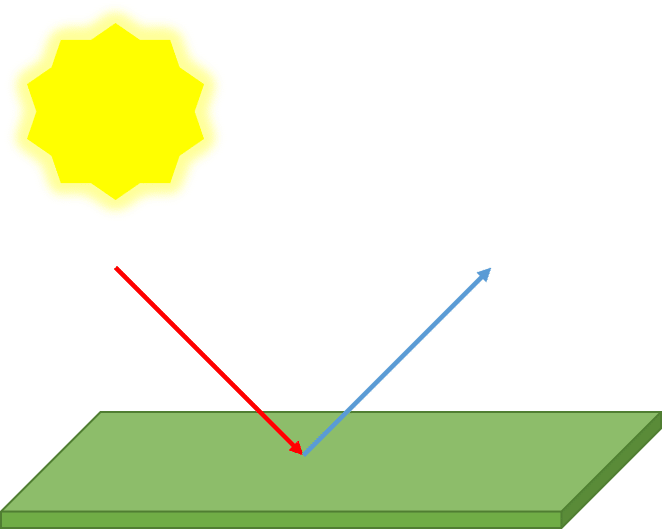
From an optical standpoint, coating characterization allows the analysis of how incident radiation is distributed among different physical processes occurring at the material surface. A portion of the radiation may be reflected, another absorbed, and in some cases, part may be transmitted depending on the nature of the system.
Analyzing these interactions provides key insights into the functional behavior of coatings. In the case of paints designed to improve reflectance, the focus is primarily on the fraction of radiation reflected by the surface.
Through the experimental study, it was possible to evaluate how the different formulations developed by the client responded to incident radiation. This analysis made it possible to identify relevant differences between samples and establish direct comparisons among them.
Application of reflectance measurement techniques in materials
A key part of the study involved measuring the reflectance of coated surfaces. These tests make it possible to quantify the proportion of radiation reflected by a material when exposed to a controlled radiation source.
Reflectance measurement provides a direct indicator of the coating’s optical behavior and allows different materials to be compared under equivalent experimental conditions. In this case, several paint formulations were evaluated to determine which one showed the most favorable performance.
The comparative approach made it possible to analyze how formulation variations affected reflectance behavior. Changes in composition or component distribution could lead to significant differences in measured reflectance.
The results provided the client with a solid technical basis to evaluate the performance of their formulations. This made it possible to identify the configurations with the most promising reflectance behavior.
Evaluation of infrared reflectance and its impact on coating performance
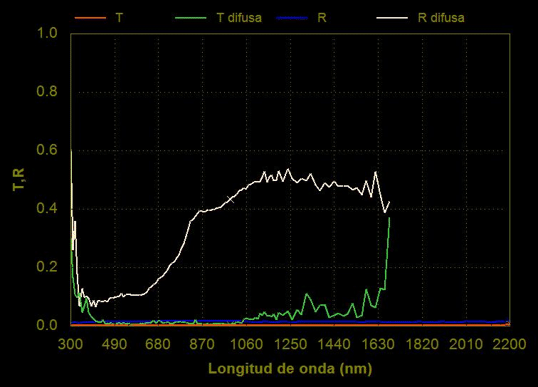
In addition to reflectance in the visible range, the study included the evaluation of infrared reflectance, a region of the spectrum closely related to thermal energy transfer. A coating’s ability to reflect radiation in this region can directly influence surface heating.
Solar radiation contains a significant portion of energy in the near-infrared range. When this radiation is absorbed by a material, it is converted into thermal energy, increasing surface temperature.
Near-infrared reflectance is a key parameter for assessing the potential of a coating in energy efficiency applications.
In contrast, a coating capable of reflecting a large portion of this radiation can limit the amount of energy absorbed by the system. This behavior is particularly relevant in applications where reducing surface heating is a priority.
The analysis made it possible to evaluate how different formulations responded in this spectral region and compare their relative performance. This provided the client with a more complete understanding of the coatings’ behavior.
Thanks to the results obtained, product development could be directed toward formulations with greater potential for applications where thermal behavior control is critical.