
What was the challenge or problem to be solved?
In many industrial processes, functional or protective coatings play a key role in material performance. When adhesion between surfaces is inadequate, delamination or defects may occur, directly affecting product quality and production stability.
In the case analyzed, a company detected adhesion issues after introducing new coated components into its supply chain. The lack of information about the composition of these coatings made it difficult to identify the root cause of the problem, making it necessary to carry out a technical study to understand the origin of the observed behavior and avoid rejects or production disruptions.
Adhesion defects in industrial coatings
Adhesion failures in coatings are a common issue in industrial processes involving multiple materials, surface treatments, and assembly conditions. Proper adhesion between surfaces depends on factors such as the chemical nature of the materials, surface energy, the presence of contaminants, and compatibility between layers.
When any of these factors is altered, defects such as partial delamination, loss of bonding between layers, or failures in the interaction between coatings and adhesives may occur. These phenomena are not always visible to the naked eye and are often only detected once components have already been integrated into the production process.
Adhesion failures often originate from seemingly minor changes in coating composition or surface treatment.

In the analyzed case, the client had identified recurring issues during the assembly of certain components, where bonding between parts did not reach the expected adhesion levels. This behavior led to quality issues and required a review of the process to prevent defects from recurring in series production.
Adhesion issues in industrial processes
Adhesion problems in industrial processes can arise from multiple causes, especially when new suppliers, materials, or surface treatments are introduced. Even small variations in coating composition or application methods can significantly alter their behavior when interacting with adhesives or other materials.
In many cases, manufacturers receive components with coatings whose exact composition is not fully documented. This makes it difficult to assess compatibility with existing processes and increases the risk of unexpected interactions between surfaces.
Lack of information about coating composition can hinder compatibility assessment within the production process.
In the project addressed, the company was precisely in this situation. Some of the components introduced into the process had coatings whose chemical nature was not clearly defined. This lack of information made it difficult to determine whether the problem was related to the coating itself, the interaction between materials, or possible surface contamination.
Under these conditions, a technical analysis was required to understand how the involved surfaces were interacting and whether the coating could be acting as a limiting factor for adhesion.
Diagnosis of adhesion issues in materials
The analysis of adhesion failures requires understanding not only the behavior of the materials involved but also the context in which the problem occurs. Factors such as surface preparation, the presence of intermediate layers, or coating composition can have a decisive influence on bonding performance between components.
In this case, the main challenge was to determine whether the origin of the problem was linked to the nature of the coating applied to the components. Since the exact composition of these layers was unknown, the analysis had to focus on surface characterization and the detection of substances or compounds that could affect adhesion.
The study needed to determine whether elements present in the coating could be interfering with bonding between materials. Additionally, it was necessary to generate sufficient technical information to support decision-making in the production process and prevent recurrence of the issue.
To address this challenge, the expertise of INFINITIA Industrial Consulting was leveraged, whose technical team has advanced capabilities in materials characterization, surface analysis, and failure investigation in industrial environments.
How was it addressed or what was the solution?
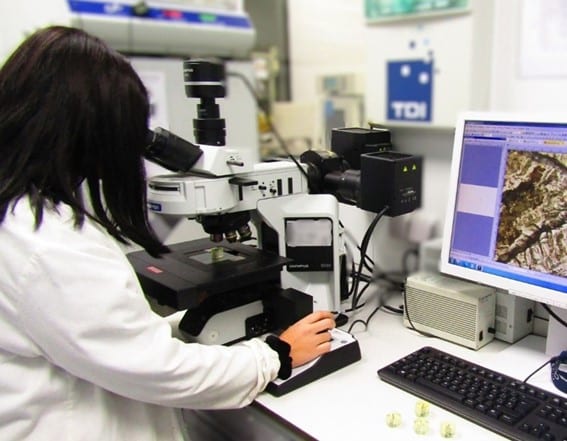
To understand the origin of the problem, INFINITIA’s technical team designed an analysis approach aimed at identifying the nature of the coatings present on the components and evaluating their potential influence on the adhesion behavior observed in production.
The objective was not only to detect the presence of specific substances, but also to understand how they could affect material interactions within the assembly process. To achieve this, a study based on surface characterization and the identification of compounds present in the coatings was carried out.
This approach made it possible to generate objective technical information that helped clarify the origin of the detected issues and support decision-making within the production process.
Coating characterization in industrial environments
Industrial coating analysis is a key tool for understanding how surface layers applied to materials behave. These layers can serve various functions, such as corrosion protection, aesthetic improvement, or modification of surface properties.
However, when introduced into processes involving adhesives or other bonding systems, their composition can directly influence adhesion performance between surfaces. Certain compounds present in coatings may reduce surface energy or create interfaces that are poorly compatible with the materials used in assembly.
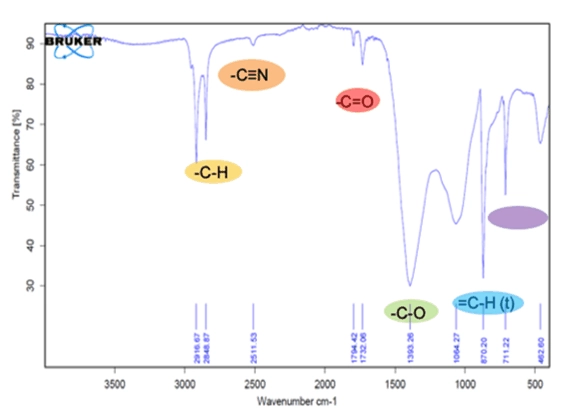
During the project, a study of the surfaces present in the involved components was carried out to identify the coating composition and detect substances that could interfere with adhesion. This analysis provided relevant information about the nature of the layers and their potential relationship with the issues observed in production.
Reverse engineering applied to coatings
Reverse engineering of coatings is a particularly useful methodology when working with materials whose composition is not fully documented. Through materials characterization techniques and chemical analysis, it is possible to identify the components present on a surface and understand its structure.
Reverse engineering enables the identification of coating composition when supplier technical information is not available.
In the analyzed project, this approach made it possible to study the coatings applied to the components and determine which substances were part of the surface layer. This information was essential to understand whether the coating composition could be affecting interaction with other materials in the process.
The work carried out by INFINITIA’s forensic engineering team provided a solid technical basis for evaluating material behavior and guiding potential adjustments in the production process. This approach made it possible to identify relevant elements within the coating that could explain the observed adhesion issues.
Identification of unknown coatings
Identifying unknown coatings is particularly important when new components or suppliers are introduced into an industrial supply chain. Without proper characterization, it is difficult to anticipate how these materials will behave in contact with other elements in the process.
The study carried out made it possible to identify the nature of the layers present on the components and analyze their potential influence on adhesion between materials. This information helped to better understand the interactions taking place within the assembly process.
Thanks to the analysis performed by INFINITIA, the client obtained technical data that enabled informed decisions regarding the use of the coatings involved. This helped reduce technical uncertainty related to material behavior and minimize the risk of adhesion failures recurring in production.
This type of study is especially useful when recurring defects are detected in industrial processes, as it allows for understanding the material causes of the problem and establishing technical criteria for prevention.