

What was the challenge or problem to solve?
At INFINITIA we developed an innovation project related to artificial intelligence, designing and materialising a computer vision system to carry out tasks of detection, location and collection of parts in a production line.
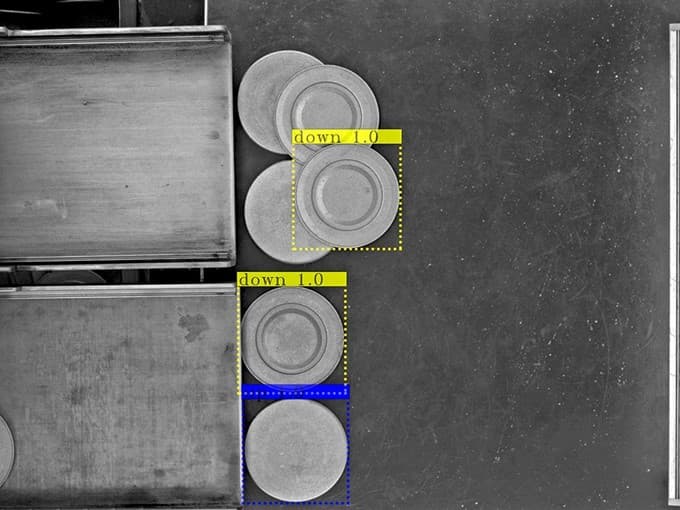
This artificial vision system had to recognise metal caps for subsequent pick-up by a robot with a magnet. To do this, the system had to detect the caps, locate them on the drawing and classify them.
 The pieces arrived at a specific point on the production line by sliding from ramps, so that they were in random positions and orientations, causing problems for the robot. For this reason, an artificial vision system was installed to detect the lids, allowing the robot to operate correctly.
Therefore, from the Product Development area, we developed a system that uses deep learning applied to computer vision for object detection. Through the design of neural networks, we were able to successfully detect the position and orientation of all the lids on the tray with a hit rate of over 99%, meeting the objectives set by the client and successfully overcoming the considerable challenges posed by this case.
 How was it addressed or what was the solution? After visiting the customer’s premises to inspect the production line station in situ and learn about the technical specifications, the use case study was undertaken. To do so, the objective of the project was established, different available neural networks were investigated and the procedure to be followed was specified, as well as the tools to be used.
This project required complex development, which was carried out on several levels. Our team programmed the camera management software, the deep learning software using neural networks and the system’s user interface software. All of these used the Python programming language, the most widely used language for artificial intelligence and computer vision, and various camera management and neural network training libraries, such as TensorFlow and PyTorch.
The last step was to implement the artificial vision system on the production line, using industrial cameras, a computer with a GPU to run the inference calculations on the captured images and speed up the computation time, and screens to visualise the results. Once the assembly was completed, we proceeded to start up the system, checking its correct operation and correcting any possible incompatibilities with the final hardware.