

What was the challenge or problem to solve?
The identification of microorganisms that degrade plastics consists of isolating, purifying and recognising the species able to use a polymer as a nutrient source, so they can later be used in biotechnological processes. That was the goal of a technological innovation project combining microbiology and sustainability: obtaining, from an environmental sample, microorganisms with this specific function to use them later in bioreactors.
INFINITIA’s Food Technology team approached the work as a project for implementing new materials and technologies, with a clear premise: detecting activity on the plastic was not enough. The method had to deliver isolated and precisely identified strains, rather than a mix of organisms with an activity that is hard to attribute. The work falls within technological innovation.
NEW MATERIALS AND TECHNOLOGIES
Are you looking for a biological route to degrade the plastic waste from your process? Discover our new materials and technologies service

Plastic-degrading microorganisms in a sustainability project
Plastic biodegradation is the process by which certain microorganisms break down a polymer and use part of it for their metabolism. Whether a material degrades in this way, and to what extent, is checked through biodegradability, compostability and recyclability testing. Most microorganisms in the environment do not have this ability, so finding the ones that do is the first step of any application based on it. Interest in biodegradation is growing alongside interest in materials designed for a more sustainable end of life, such as bioplastics and their different types.
The selected microorganisms were intended for bioreactors, equipment in which they are grown under controlled conditions to carry out a specific transformation. For that use to make sense, it is first necessary to know exactly which organism is introduced into the system and what function it performs.
That is why the project was not set up as a simple degradation test, but as the development of a reproducible procedure: a method able to start from a complex sample and end with specific organisms, identified and ready to work with.
Isolating only the microorganisms with the target function
An environmental sample contains a wide variety of bacteria and fungi that coexist and compete with each other. The first challenge was to isolate only the microorganisms able to degrade the plastic, discarding the rest, which is the vast majority.
The second challenge was to obtain pure cultures, that is, populations made up of a single type of microorganism. While several organisms grow together, the function cannot be attributed to any one of them, nor can their genetic material be analysed separately.
Detecting activity on the plastic is not enough: without a pure culture identified at species level, it is impossible to know which organism does the work.
The third challenge, which gives meaning to the other two, was to identify the species of each isolated microorganism. The three steps were linked: a failure in isolation or purification would invalidate the final identification.
Why identifying the species determines its use in bioreactors
Knowing the genus and species of a microorganism makes it possible to compare it with the available scientific information and assess whether it is suitable for the intended use. An unidentified organism is, in practical terms, a black box inside the process.
Identification also makes it possible to work with the same organism again in the future, compare it with others and document the process rigorously, which is essential when the aim is to take it into production equipment such as a bioreactor. The same logic of isolating and recognising the responsible organism was applied in the identification of the fungus that contaminated a bakery product, although there the aim was to eliminate it.
Integrating a living organism into an installation is also a matter of industrial process improvement: the behaviour of the bioreactor depends on which microorganism works inside it and how it responds to the operating conditions.

TELL US ABOUT YOUR CASE
Do you want to explore the biodegradation of a specific plastic? Send us information about the material and the process and we will propose how to approach it
How was it addressed or what was the solution?
The solution was a method in three linked phases: selecting and isolating candidate microorganisms from the environmental sample, purifying them through subcultures and, finally, identifying them with molecular sequencing techniques, cross-checking the results against databases.
Each phase acts as a filter on the previous one, so the number of organisms decreases while certainty about what is in hand increases. It is a way of validating each result step by step before taking it into a real process.
Culturing with plastic as a nutrient source
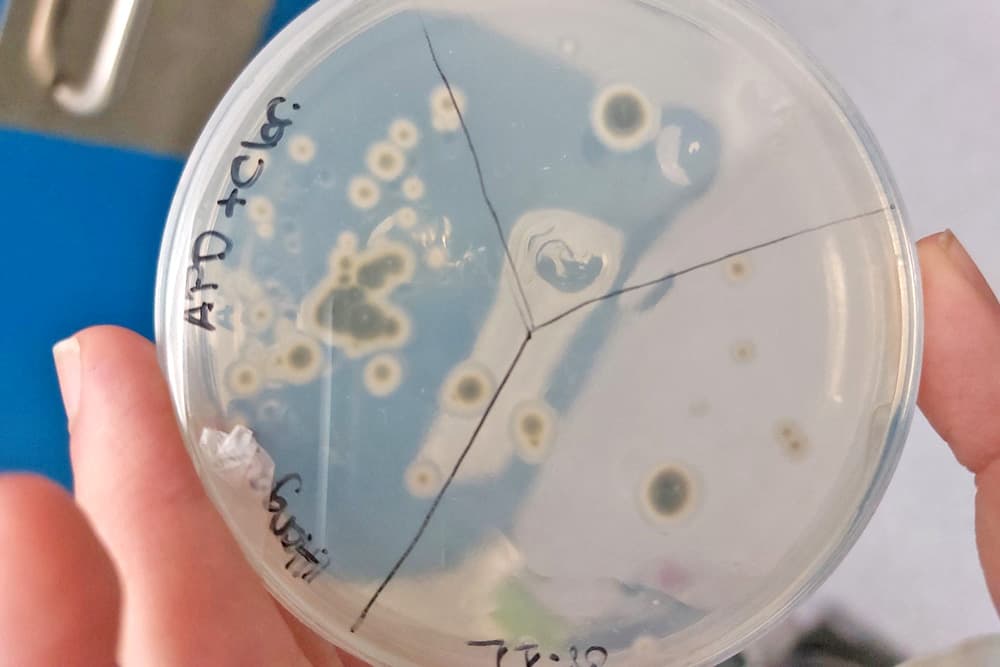
The work began by selecting and isolating a series of microorganisms that might be able to degrade the material. To do this, environmental samples in which candidates with this function were likely to be found were processed.
The samples were then cultured in media in the presence of plastic, so that the microorganisms would use it as a nutrient. This approach acts as a biological filter: under these conditions, mainly the organisms able to use the polymer thrive, while the rest are at a disadvantage.
The result of this phase is not yet an identified species, but a selection of candidates that have already shown they can grow in the presence of plastic and that move on to the purification stage.
Subcultures to obtain pure cultures
Several successive subcultures were then carried out, a technique that consists of transferring a small part of a culture to a fresh medium in order to gradually separate the different organisms until only one remains.
A pure culture is the precondition for any reliable identification: if several organisms coexist, the DNA sequence cannot be attributed to any of them.
Obtaining pure cultures of the different microorganisms was a key step in order to sequence each culture separately. Without this purification, the subsequent identification would have mixed information from several organisms.
The value of this phase is traceability: each strain that comes out of the process is a single organism, which can be worked with again and whose function is linked to it without ambiguity.
Identification by DNA sequencing and databases
The isolated microorganisms were identified through DNA sequencing. Sequencing determines the order of the units that make up each organism’s genetic material, a fingerprint that makes it possible to recognise it.
Once the DNA sequence of each microorganism had been obtained, it was entered into a database that was cross-checked against others. Comparing several sources reduces ambiguity and made it possible to determine the exact genus and species of each microorganism.
Cross-checking the DNA sequence against several databases made it possible to move from a plastic-degrading organism to a precisely identified species.
This project successfully developed a procedure for isolating microorganisms able to degrade plastic and identifying them at genus and species level, ready for later use in bioreactors.
Beyond the strains obtained, the real asset is the method itself, designed to find microorganisms with a given function and applicable again to other searches, in line with other work on microorganisms in this type of equipment, such as the genetic modification of bacteria to increase enzyme production in bioreactors.
