

Chemical analysis of plastics and polymers
Chemical analysis of plastics and polymers is an essential service for gaining a detailed understanding of the composition, behavior, and quality of these materials, which are widely used in sectors such as automotive, packaging, construction, and electronics.
At INFINITIA, we offer companies an industrial laboratory equipped with the latest technology and a multidisciplinary team of specialists who work on the characterization and validation of plastics and polymer composites.
Thanks to our scientific and applied approach, we support both innovation in the development of new products and the resolution of incidents and analysis of failures in manufacturing processes, as well as compliance with international regulations.
Talk to a specialist
Request a free initial consultation; contact a consultant from our team of specialists

What does chemical analysis of polymers involve?
What is it?
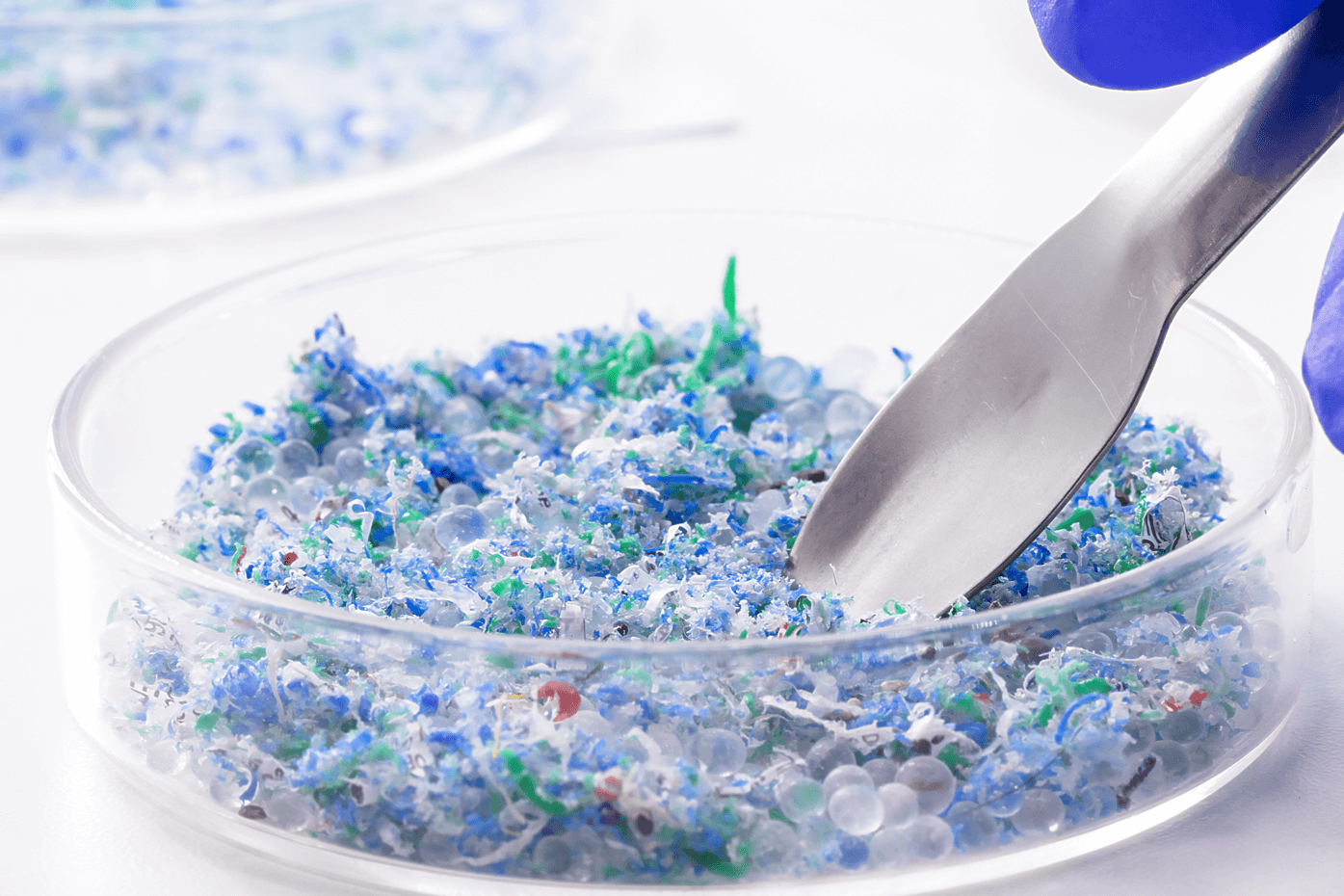
At INFINITIA, we carry out a wide variety of tests aimed at identifying the chemical nature of plastics, their composition, the additives present, and possible contaminants.
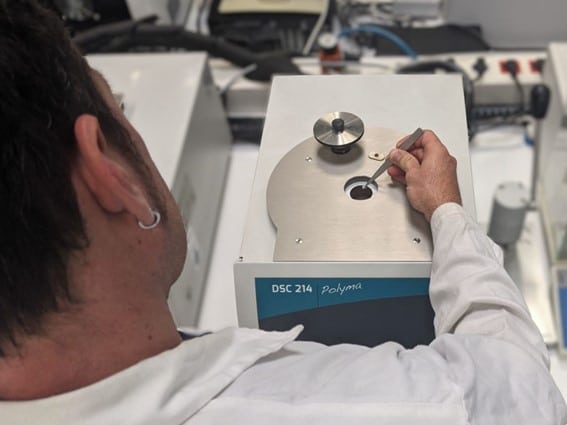
We use advanced techniques such as FTIR (Fourier transform infrared spectroscopy) to identify molecular bonds, GC-MS (gas chromatography-mass spectrometry) to detect volatile organic compounds and monomer residues, and DSC and TGA to evaluate the thermal behavior and stability of materials.
We also integrate methods such as NIR for the rapid classification of plastics in recycling processes and SEM-EDX for surface and microstructure analysis. This set of techniques allows us to offer a complete overview of each polymer and its applications in industry.
Chemical analysis of polymers at INFINITIA: equipment and applied approach
At INFINITIA, the chemical analysis of plastics and polymers is carried out using an applied engineering approach. Our laboratory combines state-of-the-art equipment with expertise in forensic engineering, which allows us not only to characterize samples, but also to detect failure mechanisms, identify contamination, and propose improvements in formulations or production processes.
We have quality control procedures, regulatory validation, and testing adapted to the specific needs of each sector, from automotive to food packaging.
This gives our clients the security of working with a technical partner capable of solving complex challenges and anticipating problems before they appear on the market.
Benefits and advantages of chemical analysis in plastics and composites
Benefits
Among the main benefits of chemical analysis of plastics and polymers is its ability to guarantee product quality and safety, optimize raw materials, and improve process sustainability.
At INFINITIA, we have applied this service in projects aimed at complying with regulations such as REACH and ROHS, evaluating emissions and additive migration, as well as in the analysis of recycled plastics to validate their viability in demanding industrial applications.
In this way, we support companies seeking to ensure the traceability of their materials, comply with international regulations, and, at the same time, respond to the growing demands of sustainability and the circular economy.
Types of Chemical Analysis of Plastics and Polymers
Types
At INFINITIA, we develop different chemical analysis tests to study the composition, structure, and behavior of plastics and polymers used in industrial applications. Our goal is to accurately understand their characteristics, optimizing their selection, functionality, and useful life in each product.
Chemical composition and structure tests
These tests allow us to identify elements and compounds present in a polymer and how they are organized at the molecular level. Techniques such as infrared spectroscopy (FTIR), gas chromatography coupled with mass spectrometry (GC-MS), and SEM-EDX elemental analysis are used.
At INFINITIA, we have used FTIR to identify unknown additives in technical polymers intended for automotive components, avoiding incompatibility issues in production.
Microscopy testing and morphological analysis
Microscopy testing allows us to observe microstructures, surface defects, and variations in the formulation of plastics and composites. At INFINITIA, we use scanning electron microscopy (SEM-EDX) to obtain detailed images and determine the elemental composition of inclusions or contaminants.
For example, in a plastic packaging project, this technique allowed us to identify foreign particles responsible for a line failure.
Thermal testing
Thermal analyses determine how a polymer behaves when exposed to temperature variations. We use techniques such as DSC (differential scanning calorimetry) and TGA (thermogravimetry) to study glass transitions, degradation, and thermal stability.
In a materials development project for electronics, INFINITIA validated that a polymer resin maintained its thermal integrity up to 180 °C, ensuring its use in real operating conditions.
Migration and purity testing (chromatography)
Gas chromatography (GC-MS) and liquid chromatography (HPLC) allow the analysis of volatile compounds, monomer residues, and migrations in plastics. These tests are key in food packaging and medical products.
At INFINITIA, we have applied HPLC to measure the migration of plasticizers from polymers in contact with food, ensuring their compliance with European legislation (EU 10/2011).
Rapid identification and classification tests
For recycling and circular economy applications, we use NIR (near infrared), a non-destructive technique that allows plastics to be sorted and separated quickly and efficiently.
This methodology is particularly useful in validating recycled plastics before reincorporating them into the industrial production chain.
Applications of Chemical Analysis of Plastics and Polymers
Sectors
Chemical analysis of plastics and polymers has applications in a wide variety of industrial sectors. At INFINITIA, we support our clients in material validation, fault resolution, and compliance with technical and regulatory standards.
Automotive Industry
Polymers in the automotive industry must withstand vibrations, thermal loads, and exposure to chemical agents. At INFINITIA, we perform:
- Validation of plastic housings subjected to thermal cycles and impacts.
- Emissions testing and analysis of volatile compounds for vehicle interiors.
- Comparison of recycled polymers versus virgin polymers in non-structural parts.
Food Industry and Packaging
Plastic packaging must guarantee safety and barrier performance. At INFINITIA, we perform:
- Migration testing of plasticizers and residual monomers.
- Thermal analysis of films to validate sterilization and pasteurization.
- Studies of barrier properties against moisture and oxygen.
Medical Devices
Medical plastics must be safe, stable, and resistant to sterilization. At INFINITIA, we perform:
- Chromatography tests to detect chemical residues.
- Post-sterilization thermal studies to validate polymer stability.
- Analysis of medical components using microscopy.
Electronics and Energy
In electronic components and energy systems, plastics must provide insulation and thermal resistance. At INFINITIA, we perform:
- Thermal analysis of polymer encapsulants using DSC and TGA.
- Evaluation of dielectric stability in epoxy resins and insulators.
- Accelerated aging tests on plastics.
Construction
Plastic construction materials must withstand moisture, radiation, and mechanical loads. At INFINITIA, we perform:
- Accelerated aging tests on plastic panels exposed to UV radiation.
- Mechanical strength analysis on reinforcement composites.
- Validation of plastic pipes and conduits against aggressive chemical agents.
Recycling and Sustainability
Chemical analysis is key to the validation of recycled and biodegradable plastics. At INFINITIA, we perform:
- Rapid classification of recycled polymers using NIR.
- Analysis of contaminants in recycled materials using FTIR and GC-MS.
- Biodegradability testing on plastics for sustainable packaging.
INFINITIA as a strategic partner in polymer chemical analysis
Value
Chemical analysis of plastics and polymers has become an indispensable tool for modern industry. Through advanced techniques of spectroscopy, chromatography, microscopy, and thermal testing, it is possible to accurately identify the composition of materials, guarantee their quality, and anticipate possible failures under real service conditions.
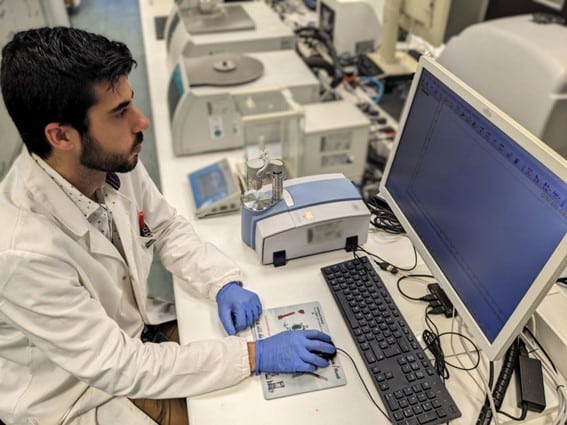
In sectors such as automotive, packaging, medical devices, electronics, construction, and recycling, having detailed information about the polymers used makes the difference between a reliable product and one with a risk of failure or regulatory non-compliance.
At INFINITIA, we offer a unique approach that combines scientific rigor, forensic engineering expertise, and a vision tailored to each client’s needs. Our industrial laboratory is equipped with state-of-the-art technology to characterize polymers at the chemical, thermal, and structural levels, offering comprehensive support ranging from raw material quality control to regulatory validation in frameworks such as REACH, ROHS, and FDA.
In addition, thanks to our ability to detect contamination and evaluate recycled plastics, we help companies integrate sustainability and the circular economy into their innovation processes.
Looking ahead, trends in polymer analysis point towards further development of biodegradable plastics, certification of recycled materials, and the use of faster, non-destructive analysis techniques for Industry 4.0. In this scenario, INFINITIA is positioned as a strategic partner capable of supporting companies in their quality, sustainability, and innovation challenges.
Relying on INFINITIA for the chemical analysis of plastics and polymers means ensuring accuracy, reliability, and added value in every project. Our commitment is to offer technical solutions that not only solve immediate problems but also drive our clients’ competitiveness and innovation in an increasingly demanding market.