
What was the challenge or problem to be solved?
Across various industrial sectors, the management of gaseous emissions has become a key factor in ensuring proper process performance and minimizing environmental impact. The presence of odor-generating gases or volatile compounds can lead to both environmental and operational issues, especially when facilities are located near populated areas or must comply with strict regulatory requirements.
In this context, identifying effective technologies for industrial odor removal and emission reduction becomes a technical priority. The project developed by INFINITIA focused on evaluating the feasibility of filtration systems incorporating catalytic materials to improve the treatment of gases generated in industrial processes.
Industrial odor removal in processes with gaseous emissions
In many industrial processes, gaseous emissions contain compounds capable of producing strong or unpleasant odors. Although these emissions do not always represent an immediate toxicological risk, they can cause discomfort, coexistence issues with surrounding areas, and difficulties in meeting increasingly strict environmental requirements. Therefore, industrial odor removal becomes a relevant aspect for both operational performance and regulatory compliance.
In this context, companies seek solutions capable of effectively reducing odor-causing compounds without introducing overly complex or costly systems. Technologies such as conventional filtration or certain absorption systems may be useful in some cases, but they do not always provide sufficient performance when dealing with persistent compounds or complex mixtures of gaseous substances.
Industrial odors are often associated with complex mixtures of volatile compounds, making them difficult to eliminate using conventional filtration solutions.

The project arose from the need to explore new strategies to address these emissions using more efficient technologies. The objective was to assess the feasibility of using catalytic materials integrated into filtration systems capable of transforming or degrading odor-causing compounds before their release into the environment.
Industrial emissions control through advanced solutions
Beyond odor-related issues, gaseous emissions generated in certain industrial processes may include compounds that are undesirable from an environmental or regulatory standpoint. In this sense, industrial emissions control has become a priority for companies aiming to improve process sustainability and reduce their environmental footprint.
Traditional gas treatment strategies are typically based on capture, absorption, or physical filtration techniques. However, these solutions present limitations when the compounds in the gas stream have low affinity for adsorbent materials or when concentrations are variable and difficult to manage using conventional methods.
In this scenario, the incorporation of catalytic processes can provide an effective alternative. Unlike technologies based solely on pollutant retention, catalytic technology enables the chemical transformation of certain molecules into less harmful species or the direct elimination of compounds responsible for odors and unwanted emissions.
The challenge was to determine whether this approach could be effectively implemented through the development of filtration systems incorporating catalytic materials capable of acting on process gas streams.
Volatile organic compounds (VOCs) as the root of the technical problem
A significant portion of industrial odors is associated with the presence of volatile organic compounds (VOCs). These molecules, released during various industrial processes, exhibit high volatility and can easily disperse in the air, contributing both to odor generation and environmental impact.
VOCs can originate from a wide range of industrial sources, including chemical processes, surface treatments, handling of organic substances, and drying or curing stages of materials. Due to their chemical diversity, removing these compounds using conventional methods is not always straightforward.
Additionally, the composition of emissions may vary significantly depending on process conditions, introducing further complexity when designing robust and effective gas treatment solutions.
In this context, the development of solutions based on catalytic materials capable of promoting the transformation of these compounds emerged as a promising approach. The technical challenge involved designing a system that could integrate such materials into a functional filtration device suitable for real industrial environments.
How was it addressed or what was the solution?
To address the identified problem, INFINITIA’s materials innovation team proposed a strategy based on combining filtration technologies with applied catalysis processes. This approach aimed to leverage the properties of specific catalytic materials to promote the transformation of compounds present in gas streams responsible for odors and unwanted emissions.
The work focused on studying how to integrate these materials into functional filtration systems, evaluating their ability to act on different gaseous compounds. Based on this approach, a research line was developed focused on the design and validation of catalyst-based filters capable of contributing to catalytic gas treatment in industrial applications.
Catalytic gas treatment as a technological approach
To tackle the problem, INFINITIA explored the use of catalytic gas treatment as the main strategy. This approach is based on materials capable of accelerating chemical reactions that transform compounds present in a gas stream.
The application of catalytic processes in gas treatment allows direct action on molecules responsible for odors or undesirable emissions. Rather than simply capturing or retaining these substances, the catalyst promotes their conversion into less harmful chemical species, which is particularly useful when dealing with volatile organic compounds.
The project aimed to analyze how such materials could be integrated into filtration systems for potential industrial implementation. This required studying both the behavior of catalysts and their interaction with the filter support and the gas stream.
This approach enabled the development of a potentially more active solution than conventional filtration systems, combining physical filtration principles with the benefits of catalytic technology applied to gas treatment.
Catalyst-based filters integrated into gas treatment systems
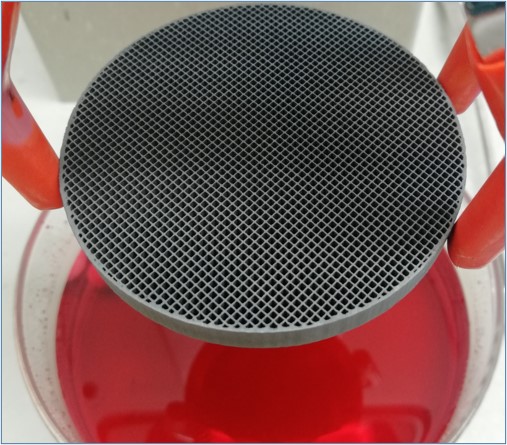
The main line of work focused on developing catalyst-based filters capable of acting on compounds present in gaseous streams. These devices combine a filter support with catalytic materials that promote the degradation or transformation of specific molecules.
INFINITIA’s team worked on designing and evaluating different catalytic materials that could be effectively integrated into filtration systems. This process involved analyzing various configurations and studying how the presence of the catalyst influenced filter performance against compounds present in the gas.
The combination of filtration and catalysis enables not only the capture of gaseous compounds but also their chemical transformation into less harmful substances.
A key aspect of the project was ensuring that catalyst integration did not compromise the overall performance of the filtration system. It was necessary to guarantee that the catalytic material maintained its activity while the filter continued to perform its structural and support functions effectively.
Based on this approach, different solutions based on catalytic filters were evaluated, analyzing their ability to act on gases responsible for odors and emissions.
Catalytic filters for gas removal and odor reduction
The work carried out enabled progress in the development of catalytic filters for gas removal, demonstrating the feasibility of integrating catalytic materials into filtration systems designed to treat gaseous emissions.
Catalytic filter-based systems represent a promising alternative for improving emissions control and odor removal in industrial environments.
The results indicated that this type of solution can contribute to improving gaseous emission reduction and decreasing the presence of odor-causing compounds in certain process streams. Although performance depends on factors such as compound nature and operating conditions, the approach showed significant potential as a tool for industrial gas treatment.
In addition to evaluating catalytic material performance, the project generated technical knowledge on the interaction between the catalyst, the filter support, and the compounds present in the gas stream. This information is key for the future development of more efficient systems adapted to different industrial applications.
The work developed by INFINITIA’s materials innovation team contributes to exploring new possibilities in industrial emissions control, combining filtration technologies with solutions based on applied catalysis. This type of approach opens the door to more advanced systems for industrial odor removal and gas treatment in production processes.