What was the challenge or problem to be solved?
In industrial environments where electronic components are part of products with high quality requirements, the appearance of visible defects can compromise not only the perception of the end customer but also the reliability of the system. In this case, aesthetic defects in electronic components were detected affecting critical surfaces, generating uncertainty about their origin and potential functional impact.
This type of situation requires going beyond simple visual inspection. Identifying the origin of the defects is key to determining whether it is an isolated or structural issue, as well as to preventing recurrence. The objective was not only to classify the defects but to understand their cause and assess their technical relevance within the overall product.
Characterization of aesthetic defects in electronic components
The client was facing the recurrent appearance of surface anomalies in certain electronic components, manifested as visual irregularities, color changes, or alterations in surface finish. These defects led to rejection during quality control processes, directly affecting product acceptance in the market.
Although at first assessment they could appear to be purely aesthetic defects, there was concern that they might be associated with deeper issues, such as material alterations or deviations in the manufacturing process. This uncertainty made decision-making more difficult, particularly regarding batch validation or rejection.
Aesthetic defects in electronic components can be early indicators of material degradation or process instability, requiring deeper technical evaluation.
Additionally, the variability in the occurrence of these defects complicated the identification of clear patterns. Not all components showed the same type or intensity of anomaly, making a systematic analysis approach necessary to distinguish between acceptable and critical defects.
In this context, it was essential to carry out a rigorous characterization to understand the nature of the defects and their possible relationship with internal or external factors of the production process.
Functional evaluation associated with aesthetic defects in precision electronics
Beyond visual appearance, the client needed to determine whether the observed defects could compromise the functionality or durability of the components. In many cases, aesthetic defects in electronic components can indicate phenomena such as surface contamination, coating degradation, or thermal alterations.
The objective of the project was to establish a clear technical criterion to differentiate between purely aesthetic defects and those with functional implications. This distinction is critical to avoid both unnecessary rejections and the release of potentially defective products.
Furthermore, the client aimed to reduce uncertainty in their quality control processes by establishing acceptance limits based on technical evidence rather than subjective visual criteria. This would enable cost optimization and improve consistency in product evaluation.
Therefore, the project had a strong decision-oriented focus, providing information directly linked to final product quality and the client’s operational efficiency.
Multivariable analysis of defect causes in electronic manufacturing processes
The main technical challenge was identifying the origin of the defects within an environment involving multiple variables: materials, manufacturing processes, environmental conditions, and post-processing handling. Each of these factors could contribute, either individually or in combination, to the appearance of the observed defects.
The complexity increased due to the nature of electronic components, where small variations in surfaces or coatings can significantly affect both performance and reliability. Moreover, the lack of an evident direct correlation between cause and effect made it difficult to determine the origin of the problem.
Defects in electronic manufacturing processes are typically driven by multiple interacting variables, making isolated analysis insufficient to determine their origin.
From INFINITIA’s perspective, the challenge was to approach the analysis without predefined assumptions, applying a structured methodology to objectively narrow down potential causes. This involved combining characterization techniques with a critical analysis of the manufacturing process.
In this regard, INFINITIA’s intervention focused on providing independent technical criteria, capable of breaking down the problem and guiding the client toward identifying the key factors involved in the generation of the defects.
How was it addressed or what was the solution?
To address the problem, an approach based on comparative technical analysis and detailed characterization of the observed defects was proposed. This approach allowed not only the description of anomalies but also an understanding of their origin and their relationship with manufacturing processes and the materials involved.
The work was structured so that each phase provided relevant information for decision-making, avoiding unnecessary analyses and focusing efforts on areas with the highest potential impact. In this way, both time and resource optimization were ensured.
Analysis strategy for aesthetic defects in electronic components
An analysis strategy was defined to compare defective samples with others without apparent defects, aiming to identify significant differences. This approach allowed isolating variables and detecting possible correlations between the observed anomalies and specific factors.
The key to this methodology was not to limit the work to superficial inspection, but to delve into the nature of the defects using characterization techniques adapted to the type of component. This enabled a more precise understanding of the mechanisms involved.
Additionally, priority was given to obtaining results that were interpretable from an industrial perspective, avoiding overly theoretical conclusions that would not provide practical value to the client. The goal was to translate findings into clear action criteria.
This approach made it possible to build a solid knowledge base on aesthetic defects in electronic components, aligned with the client’s real needs.
Physicochemical characterization and surface analysis of electronic materials
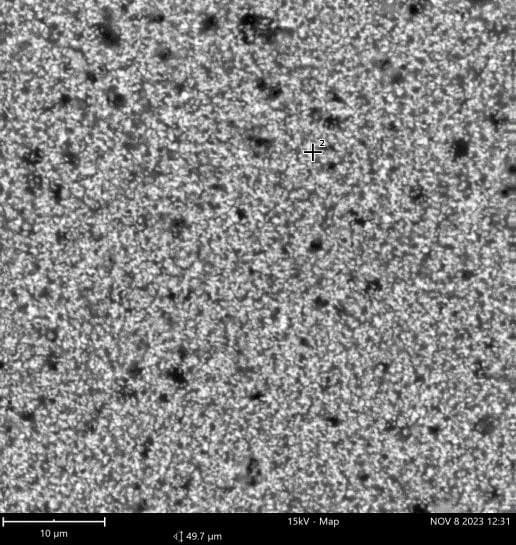
The team carried out a detailed characterization of the affected materials and surfaces, using techniques capable of identifying alterations at both microscopic and compositional levels. This analysis was key to understanding the nature of the defects.
Through surface evaluation, phenomena such as contamination, coating variations, or defects associated with thermal processes were identified. These findings allowed initial hypotheses to be discarded while reinforcing others.
Advanced surface and physicochemical characterization techniques enable the detection of subtle defects not visible through standard inspection methods.
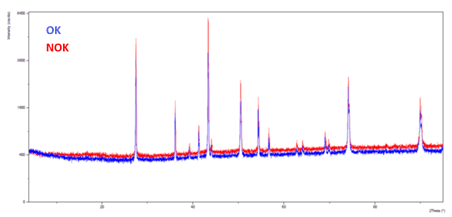
Comparative analysis between OK and NOK samples facilitated the identification of relevant differences, providing objective evidence of the origin of the defects. This approach helped reduce uncertainty and move toward a well-founded interpretation of the problem.
The involvement of the INFINITIA team was essential in integrating the obtained results and linking them to potential deviations in the manufacturing process.
Correlation between observed defectology and quality criteria
Based on the results obtained, conclusions were established to assess the real impact of the defects on product performance and quality. This enabled the client to differentiate between critical and non-critical defects.
The analysis facilitated the definition of acceptance criteria based on technical evidence, reducing reliance on subjective evaluations. This improvement in quality processes contributed to greater consistency in decision-making.
Additionally, guidance was provided on potential improvement actions within the manufacturing process, aimed at minimizing the occurrence of the identified defects. These recommendations were formulated from a practical and applicable perspective.
Overall, the project transformed a diffuse problem into a controlled scenario, where the client now has the tools and knowledge to efficiently manage aesthetic defects in electronic components.