
What was the challenge or problem to solve?
Detergent analysis consists of checking, through controlled tests, whether a product removes stains and respects materials under the conditions in which it will actually be used. A client needed exactly that for batches of detergent made by different suppliers, and the work was approached as a forensic engineering case: the data sheet of each product was not enough, its real behaviour had to be measured.
The need was to ensure the quality and efficacy of the detergent in everyday use, considering washing temperature, stain type, water hardness and interaction with materials. With that approach, the project was framed within product quality control and testing, with a very specific final goal: knowing which supplier delivered the best detergent. This type of problem is addressed from forensic engineering, in the technical consulting area, specifically through the prospecting and validation of suppliers service.
PROSPECTING AND VALIDATION OF SUPPLIERS
Do you buy the same product from several suppliers and do not know which performs best? Discover our supplier prospecting and validation service

Detergent efficacy under real conditions of use
The efficacy of a detergent is not a fixed value: it depends on the conditions in which it is used. The same product may perform well with soft water at a high temperature and lose capacity with hard water, in a cold wash or against a specific type of stain. That dependence is precisely why testing of detergents and cleaning products measures performance under the specific conditions in which each product is used.
That is why the challenge required an exhaustive analysis simulating the usual conditions of an average user. Evaluating the detergents under ideal conditions would have produced results of little use, because they would not reflect what happens when the product reaches the consumer.
Variables such as temperature, stain type and water hardness had to be part of the test design from the start, so that differences between suppliers were due to the detergent and not to favourable test conditions.
Detergent compatibility with the materials it cleans
The analysis was not limited to stain removal. It was also necessary to check the compatibility of each detergent with the materials it acts on, that is, its effect on the surfaces that are washed over and over again.
This second criterion connects with the study of material behaviour against external agents: a detergent that is very effective against dirt can, at the same time, damage the components it should protect.
A detergent is not better just because it cleans more: it must also respect the materials it is applied to in every wash.
The balance between cleaning efficacy and component protection is the same one studied in another project on the effect of detergents on industrial surfaces, where interaction with the material was the main focus.
Comparing suppliers with an exhaustive, repeatable test
The final goal was to determine which supplier delivered a product meeting the highest standards of quality and effectiveness, discarding those that showed deficiencies in the tests.
For that comparison to be fair, all detergents had to be subjected to exactly the same conditions. Any variation in the method would have turned differences in results into an artefact of the test rather than a real difference between products.
That repeatability requirement shaped all the subsequent work: rather than a one-off test, the client needed a reliable methodology with which to choose between suppliers based on data.

TELL US ABOUT YOUR CASE
Do you need to compare detergents or cleaning products under real conditions? Send us the products and the materials they are used on and we will propose how to test them
How was it addressed or what was the solution?
The solution was an experimental approach custom-designed by the INFINITIA materials team, which reproduced real conditions of use and objectively measured both stain removal and component protection.
The work was organised in successive phases, from method design to interpretation of results, with custom tests designed for this product instead of a generic procedure.
Test design with standardised stains and real materials
The project began with the design of an experimental testing mode. Samples made from the same materials present in operating conditions were used, so that the test reproduced the real surfaces.
Standardised stains were applied to those samples in accordance with the relevant standards. Using standardised stains ensures that all detergents face the same soiling, with controlled composition and quantity, and allows results to be compared with each other.
Using standardised stains on the product’s real materials is what allows detergents from different suppliers to be compared on equal terms.
The design criterion was to simulate real conditions of use, seeking both maximum effectiveness in stain removal and protection of the components.
Prototype and sample holder to simulate real washing
The next phase consisted of mounting the samples in an adapted sample holder, which allowed the different stained materials to be placed in an orderly, reproducible way.
With the stains made to standard and deposited on the different materials, the experiment was carried out in a prototype designed to simulate the real operating conditions of the wash.
Working with a dedicated prototype makes it possible to control every variable of the test and repeat it as many times as needed, something that would not be possible relying only on uncontrolled household use trials.
Measuring efficacy with scales and photographic control
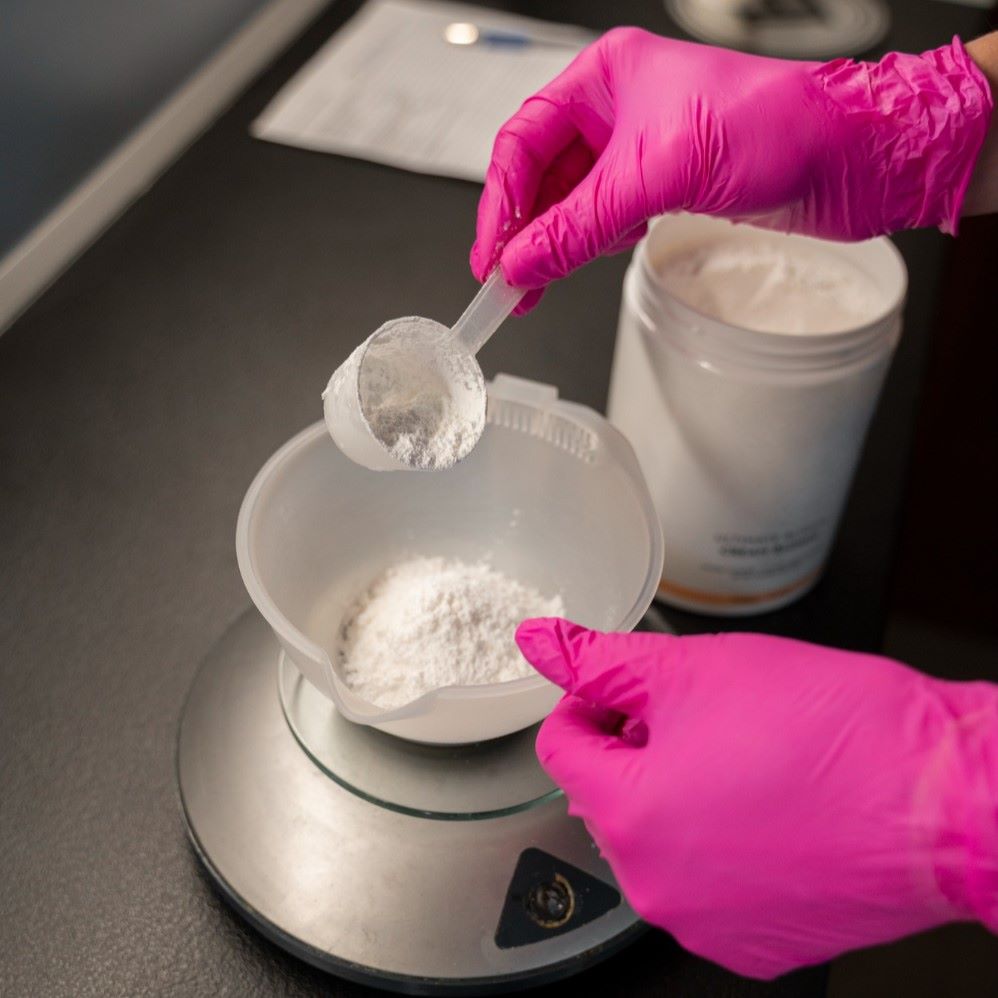
To guarantee accurate results, the behaviour of each detergent was checked and effectiveness measurements were taken with scales and with photographic visual control before and after the washes. Combining scale measurements with the photographic record makes it possible to compare each wash objectively and document the result visually.
This stage was decisive in establishing a reliable, repeatable methodology. Weekly evaluation and interpretation of the results gave the client a clear view of the efficacy of each detergent and made it possible to verify the performance of each supplier, highlighting those that consistently performed better.
Measuring before and after each wash turns the efficacy of a detergent into comparable, repeatable data, not just a visual impression.
The result was the identification of the most effective and suitable detergent for the client’s needs, along with new internal standards for evaluating future suppliers, a foundation for quality control in production processes that goes beyond this purchase, in line with other comparative studies such as the benchmarking of cleaning products against electrolysed water.