


What was the challenge or problem to solve?
The client, a company in the industrial sector, informed us of their need to perform a gas analysis inside a hydrogen cell in order to detect the presence of potentially polluting substances for its correct operation and, thus, meet the specifications of ISO standards.
A number of new materials had been used in the manufacture of the prototype hydrogen cell, but the effect of these materials on the composition of the air inside the cell was unknown. The efficiency of the cell was highly sensitive to certain pollutant gases, such as NOx, H2S, SO2, hydrocarbons, CO, toluene, benzene and O3.
Our Materials Innovation team, in charge of this case, faced the challenge of testing a large number of different analytes, which were also expected to be in very low concentrations. The combination of several analytical techniques made it possible to adjust the method to the maximum and to cover as many analytes as possible, so we were able to meet our customer’s requirements. reduced.
 How was it addressed or what was the solution?
After a preliminary search of the available analytical techniques, a methodology was designed to suit the characteristics of the project.
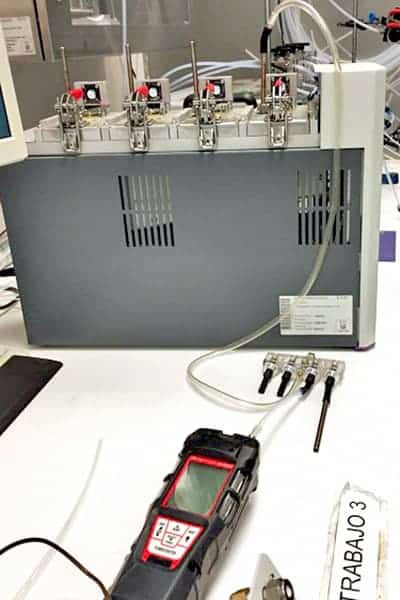
Then, a set-up was built to allow multiple sampling of the gases generated in a hermetic furnace equipped with an inert atmosphere. The objective was to analyze the gases emitted by each material using several selective analytical techniques and taking samples simultaneously.
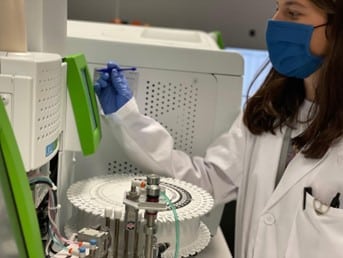
Different analysis techniques were used, such as gas sensors, gas chromatography coupled to mass spectrometry (GC-MS) and specific reagents that were sensitive to specific analytes.
This analysis made it possible to detect for each material analyzed the presence, within the detection limits of each technique, of the gaseous analytes and other gases generated that were not initially listed as contaminants.
The study of the gases detected during the heating process of each of the prototypes made it possible to relate the new materials with the presence of potentially polluting gases for the operation of the hydrogen cell.