What was the challenge or problem to be solved?
In industrial environments where electronic products are distributed in large volumes, the occurrence of field failures can quickly lead to electronic market claims that affect both perceived quality and internal decision-making. In these scenarios, one of the main issues lies in the lack of detailed technical information about defective electronic boards, especially when dealing with proprietary designs, obsolete components, or non-transparent supply chains.
This lack of knowledge limits the ability to identify the origin of the failure, assess its impact, and define effective corrective actions. In this context, reverse engineering of electronic boards emerges as a key tool to recover critical technical information and reduce uncertainty in analysis, validation, and redesign processes.
Reverse engineering of electronic boards in environments without technical documentation
In many industrial contexts, especially in market claim situations, organizations must analyze electronic products without having access to reliable technical documentation. This situation is common when working with external suppliers, proprietary designs, or products that have evolved without full traceability of changes. As a result, defective electronic boards arrive at the laboratory without electrical schematics, without detailed bills of materials, and without information on design criteria.
This lack of information creates a highly uncertain technical environment. Quality, R&D, or production teams are limited to interpreting symptoms without knowing the real architecture of the system, which makes it extremely difficult to identify the root cause of the problem. In addition, the absence of reliable references prevents comparison between expected and observed behavior, reducing the ability to validate hypotheses.
The lack of technical documentation does not prevent analysis;
information can be reconstructed directly from the product.
Reverse engineering of electronic boards makes it possible to overcome this limitation by reconstructing technical knowledge from the physical product itself. Through component identification, analysis of electrical paths, and functional interpretation of the circuit, it is possible to build a solid technical foundation on which to structure further analysis.
This process not only provides descriptive information, but also enables understanding of how the system is designed and what functional logic it follows. In this way, an unknown product is transformed into an interpretable system, which is key to advancing toward a well-founded diagnosis.
Electronic failure analysis oriented toward industrial decision-making
In the context of electronic market claims, analysis cannot be limited to identifying isolated defects, but must be oriented toward generating useful information for decision-making. This involves understanding the failure from a global perspective, considering both system behavior and real field operating conditions.
Field failures in electronics are often influenced by multiple variables, such as environmental conditions, manufacturing variability, or interactions between components. Therefore, an effective electronic failure analysis approach must integrate different levels of analysis, from physical observation to functional evaluation.
The objective is not only to identify the failure,
but to generate useful information for technically sound decisions.
Additionally, it is necessary to establish a clear relationship between reported symptoms and possible technical causes. This requires not only identifying anomalies, but also assessing their relevance within the system and their ability to explain the observed failure. In this sense, the analysis must prioritize the generation of objective evidence over unverified interpretations.
The ultimate objective is to provide a solid basis for industrial decision-making, whether in terms of redesign, supplier validation, or implementation of corrective actions. Therefore, the value of the analysis lies both in identifying the problem and in its ability to guide concrete actions.
Technical complexity in the diagnosis of defective electronic boards
The diagnosis of defective electronic boards presents high complexity due to the nature of modern electronic systems. The miniaturization of components, the use of advanced assembly technologies, and the integration of multiple functions within a single circuit make access to and interpretation of information more difficult.
In addition, failures are not always visible to the naked eye nor do they occur consistently. In many cases, they are intermittent or dependent on specific conditions, which complicates their reproduction and analysis. Furthermore, the degradation of materials or components after failure may alter the available evidence.
Another relevant factor is the possible coexistence of multiple contributing causes. Rather than a single obvious root cause, it is common to find combinations of deviations that together lead to failure. This requires adopting a systematic and structured approach that allows different hypotheses to be evaluated in an orderly manner.
From INFINITIA’s perspective, this type of project requires integrating knowledge in electronics, materials, and manufacturing processes, as well as selecting the most appropriate analysis techniques in each case. The challenge lies not only in identifying anomalies, but in interpreting their impact within the overall system.

How was it addressed or what was the solution?
To address this type of problem, an approach was defined based on the combination of reverse engineering of electronic boards and failure analysis of electronic boards, with the aim of reconstructing the system’s technical information and evaluating the differences between defective units (NOK) and functional units (OK).
This approach made it possible to structure the analysis around the acquisition of objective evidence, avoiding subjective interpretations and facilitating the identification of failure patterns. The work was carried out by the INFINITIA team, integrating capabilities in characterization, inspection, and functional analysis.
Methodological approach to PCB reverse engineering for functional reconstruction
The project was approached through the application of a structured PCB reverse engineering methodology, aimed at reconstructing the functional architecture of the analyzed boards. This approach made it possible to transform a set of physical components into a system that is technically understandable.
In an initial phase, a detailed characterization of the boards was carried out, including the identification of electronic components and the observation of interconnections. This information made it possible to establish a first approximation of the circuit structure and the potential functions of each block.
Subsequently, the analysis progressed toward the functional interpretation of the system, examining how the different components interact and what role they play within the overall assembly. This step is key to understanding not only how the board is built, but how it should behave under normal conditions.
The adopted approach avoided focusing exclusively on circuit description, prioritizing the understanding of its functional logic. In this way, a reference framework was generated that allowed the observed failures to be contextualized and the analysis to be directed toward the most relevant areas.
Execution of OK vs NOK comparative analysis in electronic boards
Once the technical basis of the system had been reconstructed, an OK vs NOK comparative approach was applied, analyzing functional and defective units in parallel. This approach made it possible to identify significant differences that could be related to the failure.
The comparative analysis focused on detecting deviations at different levels, including the presence or absence of components, variations in their arrangement, or possible anomalies in their behavior. This type of analysis is particularly effective in identifying subtle differences that would not be evident in an isolated analysis.
Comparison between OK and NOK samples allows critical differences to be isolated that are not detected in individual analyses.
The INFINITIA team integrated different inspection and measurement techniques to validate the proposed hypotheses. This approach enabled progression from an initial observation to a more rigorous evaluation of possible failure causes.
Furthermore, direct comparison between samples made it possible to establish correlations between detected differences and the symptoms observed in the field. This strengthened the consistency of the analysis and facilitated the identification of critical factors.
Results of electronic failure analysis and value delivered
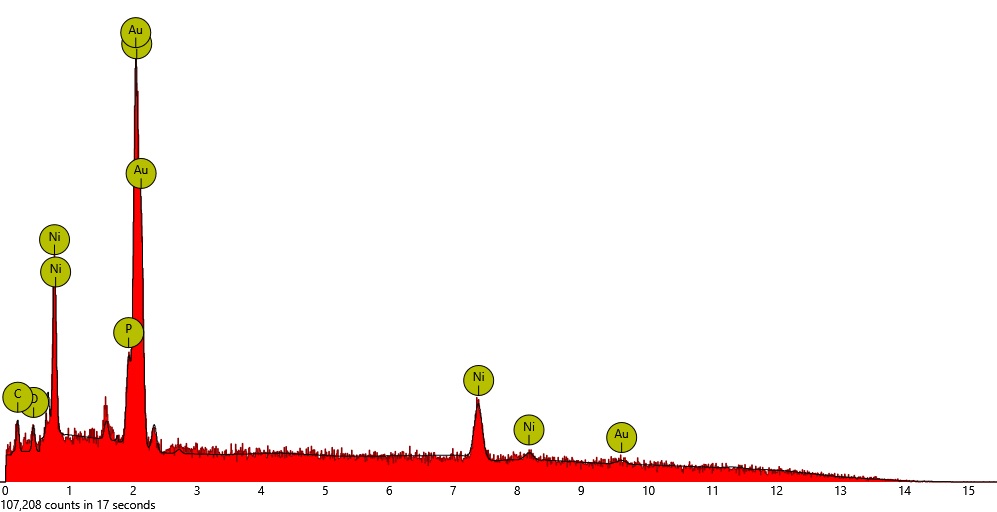
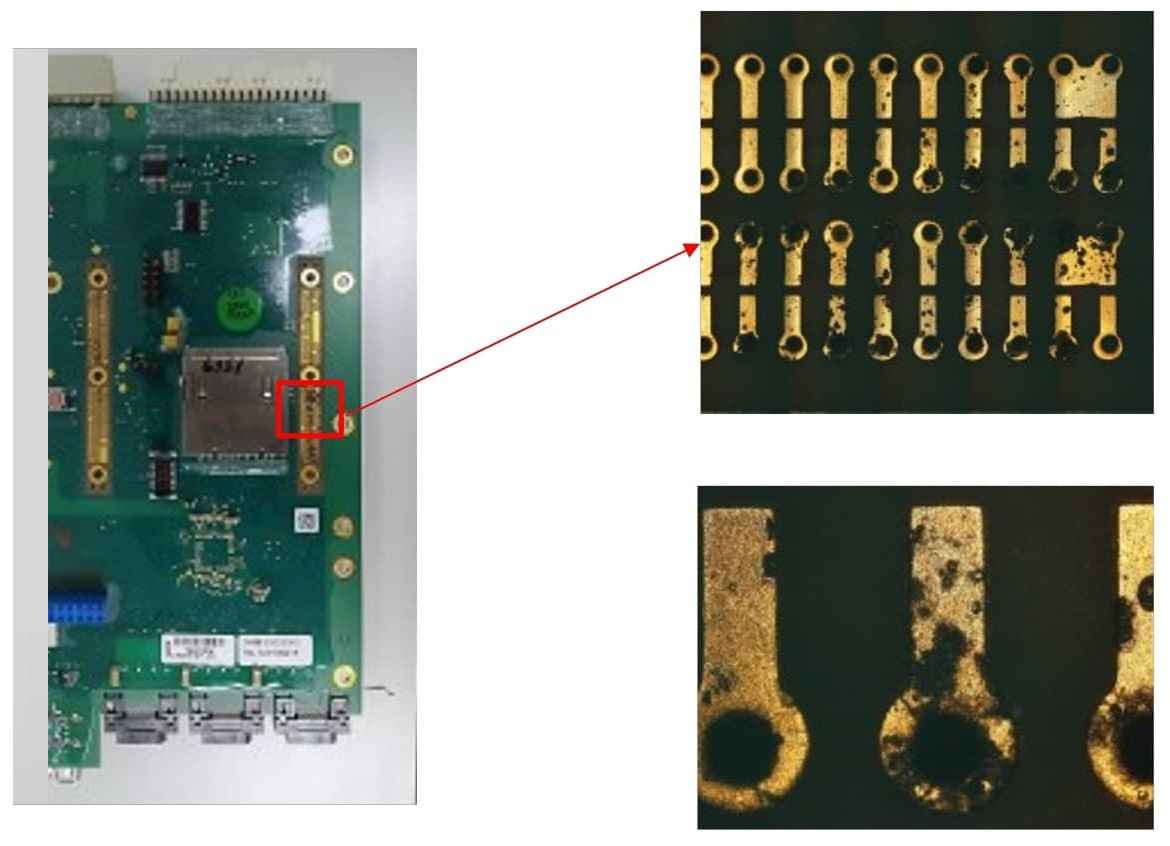
As a result of the project, a detailed reconstruction of the technical information of the analyzed boards was obtained, including component identification, understanding of the functional architecture, and detection of relevant deviations.
This knowledge made it possible to significantly reduce the uncertainty associated with electronic market claims, providing an objective basis for decision-making. In particular, it facilitated the evaluation of potential issues related to design, manufacturing, or component supply.
From an operational standpoint, the client was able to access structured information that enabled prioritization of actions and reduction of the risk of failure recurrence. These types of results are especially relevant in environments where field failures have a direct impact on costs and reputation.
The value delivered by INFINITIA lies in the ability to transform a product without documentation into a source of useful technical knowledge. Through reverse engineering of electronic boards and electronic failure analysis, the understanding of complex problems is facilitated and well-founded decision-making is enabled.