
What was the challenge or problem to solve?
Bioinspired design consists of transferring to a technical solution a working principle observed in nature, not its appearance. In this project, INFINITIA’s product development team, through a product design and innovation process, turned a natural mechanism into a parametrised functional prototype and validated it in a real use scenario, with the aim of reducing technical uncertainty before deciding the next step of the development.
The starting point was an industrial company that had identified a principle based on a natural mechanism and already held favourable preliminary results. The first indications pointed to a possible performance improvement when applying that technique, but they were not enough to commit a development investment, because three key uncertainties remained open: the real influence of the design parameters, the robustness of the solution and its behaviour when integrated into real operating conditions.
The challenge INFINITIA took on was to turn that observation into measurable evidence. It meant extrapolating the design of the natural mechanism to a physical setup capable of reproducing the principle, parametrising the assembly to explore its effect and obtaining the best-performing configuration, with enough control for the conclusions to be attributable to the design and not to the test conditions.
Bioinspired design, from the natural mechanism to the industrial product
Bioinspired design, also called biomimetics, is the discipline that analyses structures, mechanisms or strategies present in living organisms and extracts from them functional principles transferable to a product or an industrial process. The difference from a formal imitation is substantial: the shape is not copied, rather it is identified why that shape works and what variables govern its behaviour.
This biomimetic concept has an approach of its own that separates three notions: the biological finding, the abstraction of the principle and its technical implementation. That sequence explains why a project of this kind always requires a phase of experimental validation, since the abstracted principle only becomes a solution when it proves that it works outside its original context.
The industrial interest of biomimetics lies in performance. Natural mechanisms operate under very demanding energy and material constraints, which makes them a reasonable source of efficient solutions for problems of flow, adhesion, dissipation or movement. In sectors such as consumer goods, automotive or machinery, that efficiency margin translates into lower consumption, less wear or a longer service life.
The difficulty appears when changing scale, material and environment. A natural mechanism works under specific conditions of size, medium and load, and nothing guarantees that it keeps its advantage when reproduced in a manufactured component. That is why an initiative of this type is not resolved at the conceptual level, but within a structured product design and innovation process, where each hypothesis is contrasted with a prototype and a test before advancing.
Proof of concept, when a preliminary result is not enough
A proof of concept is an initial test that verifies whether an idea is technically viable before investing in its full development. Its function is not to define the final product, but to check that the principle it relies on holds up in the physical world and to delimit under what conditions it does so.
The project arrived precisely at that point. A preliminary result reports that the phenomenon occurs, but not which variable governs it, with what margin it holds, nor what happens when some condition deviates from the ideal. The three uncertainties of the case follow that logic: the influence of the parameters determines which design variable rules the result, robustness indicates whether performance holds up against manufacturing or use variations, and integration in real conditions checks that the advantage survives when the element is no longer isolated.
Advancing without resolving these three questions moves the risk to much more expensive phases, when tooling, production runs and deadline commitments already exist. Tackling them through prototyping at an early stage makes it possible to correct the approach when the cost of rectifying is still low.
A favourable preliminary result indicates that the principle works, not under what conditions it stops doing so. That boundary is exactly what a proof of concept delimits.

Bioinspired design transferred to a test setup
The design observed in a natural mechanism never appears isolated: it comes accompanied by a scale, a material, a medium and certain boundary conditions. Transferring it to a product forces a decision on which features carry the function and which are a consequence of the organism that hosts it, a decision that conditions everything that can be concluded afterwards.
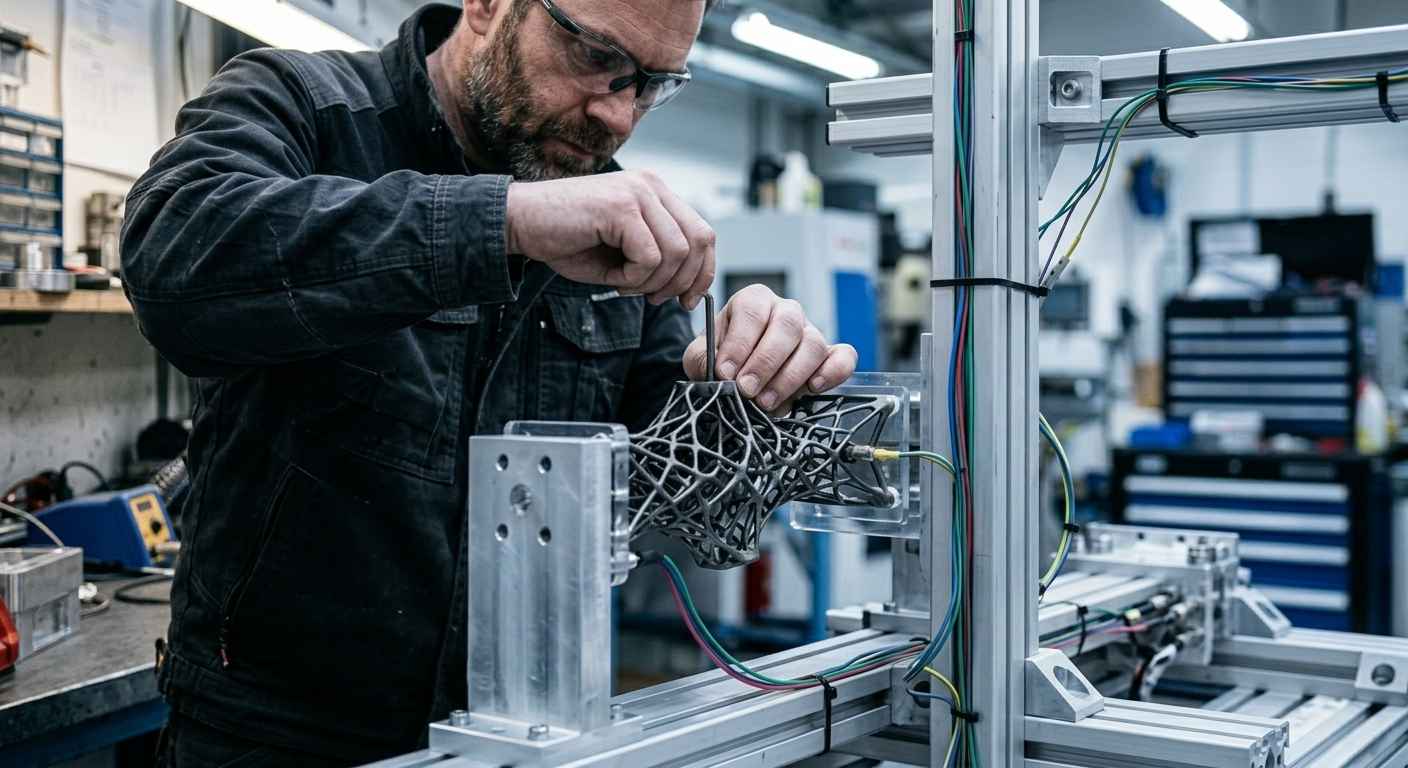
The vehicle of that transfer was the test setup, the physical assembly formed by the element under evaluation, its support, the instrumentation and the imposed boundary conditions, which serves to reproduce a phenomenon in a controlled and repeatable way. Without that control, two consecutive tests are not comparable and no data is conclusive.
Added to that requirement was parametrisation, that is, that each relevant variable could be modified independently without remaking the assembly. Only then is it possible to isolate the effect of each parameter and reach an optimal configuration by evidence and not by trial and error. Moreover, the setup had to anticipate the final integration of the element into a real product, a balance between experimental freedom and realism of use characteristic of mechanical development, where design, tolerances and service conditions are defined at the same time.
How was it addressed or what was the solution?
The work was structured into three consecutive phases, each aimed at answering a specific question: whether the prototype and its setup could faithfully represent the principle, which parameters governed performance and whether the best configuration kept working inside a real product. INFINITIA’s team tackled the three as a closed loop of design, testing and redesign.
The prioritisation of parameters was agreed with the client before touching the 3D model. That prior agreement avoids the most common mistake, which consists of testing everything testable and ending up with a lot of data and no decision. Fixing which variables matter is what turns a test campaign into a development tool.
Redesign of the prototype and its setup with parametric modeling
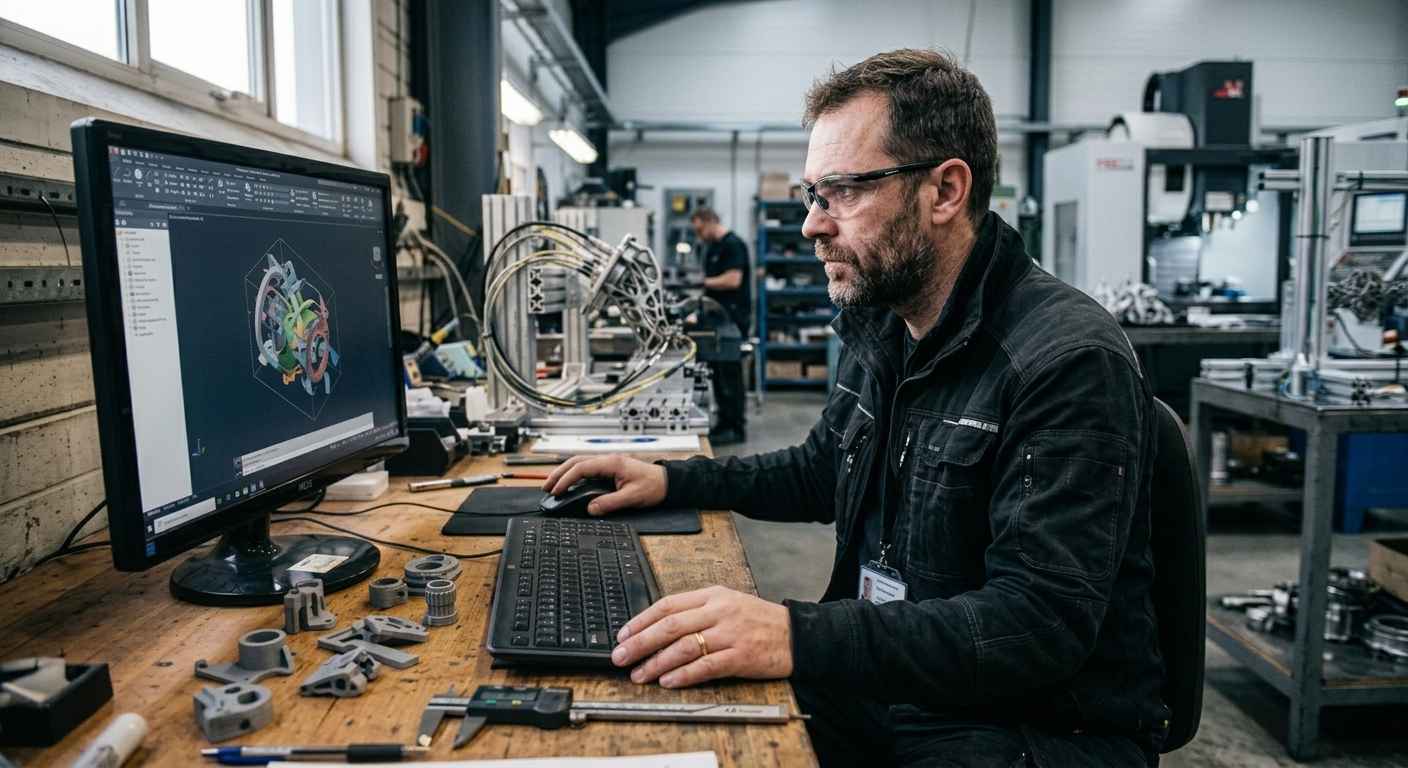
The first phase consisted of a redesign of the prototype according to the prioritised parameters. The mechanical development team used professional 3D CAD design software, that is, computer-aided design, to generate the three-dimensional files of the prototype and of the bench on which it was to be tested.
The advantage of working with parametric modeling is direct. Each dimension is linked to a design variable, so that modifying a value automatically regenerates the assembly and keeps all the geometric relationships consistent. This makes it possible to introduce changes quickly while keeping control over all the parameters, which is what an iterative campaign needs.
The redesign was not limited to the bioinspired element. The setup was also modified to adapt it to the new product design and to the new test conditions, adjusting supports, interfaces and dimensional fits. The 3D files obtained acted as the basis for materialising each version of the functional prototype and taking it to the bench.
Parametric modeling makes it possible to modify one variable of the prototype and regenerate the complete assembly without remaking the design, which lowers the cost of each test iteration.
Performance tests to parametrise the functional prototype
The second phase consisted of performance tests on the redesigned prototypes. The effect of the modifications to the parameters agreed with the client was tested, measuring the behaviour of each configuration under the same conditions so that the observed differences would be attributable to the design.
The objective was strictly experimental: to verify whether each modification proved beneficial or whether, on the contrary, others were needed to reach the expected result. Each round of tests fed the CAD model and returned a new version of the prototype, so that the design advanced supported by measurements and not by forecasts.
This type of campaign relies on an elementary principle of experimentation: vary in an orderly and controlled way in order to attribute the effects. Modifying two parameters at once and observing an improvement leaves unanswered which of the two produced it, and that order is what separates a structured validation from an accumulation of tests. The result of the phase was a specific configuration identified as the best-performing among those evaluated, a conclusion that only a dedicated bench adapted to the phenomenon allows, as shown by the design of a custom test bench in other INFINITIA projects.
Validation in a real use case integrating into a final product
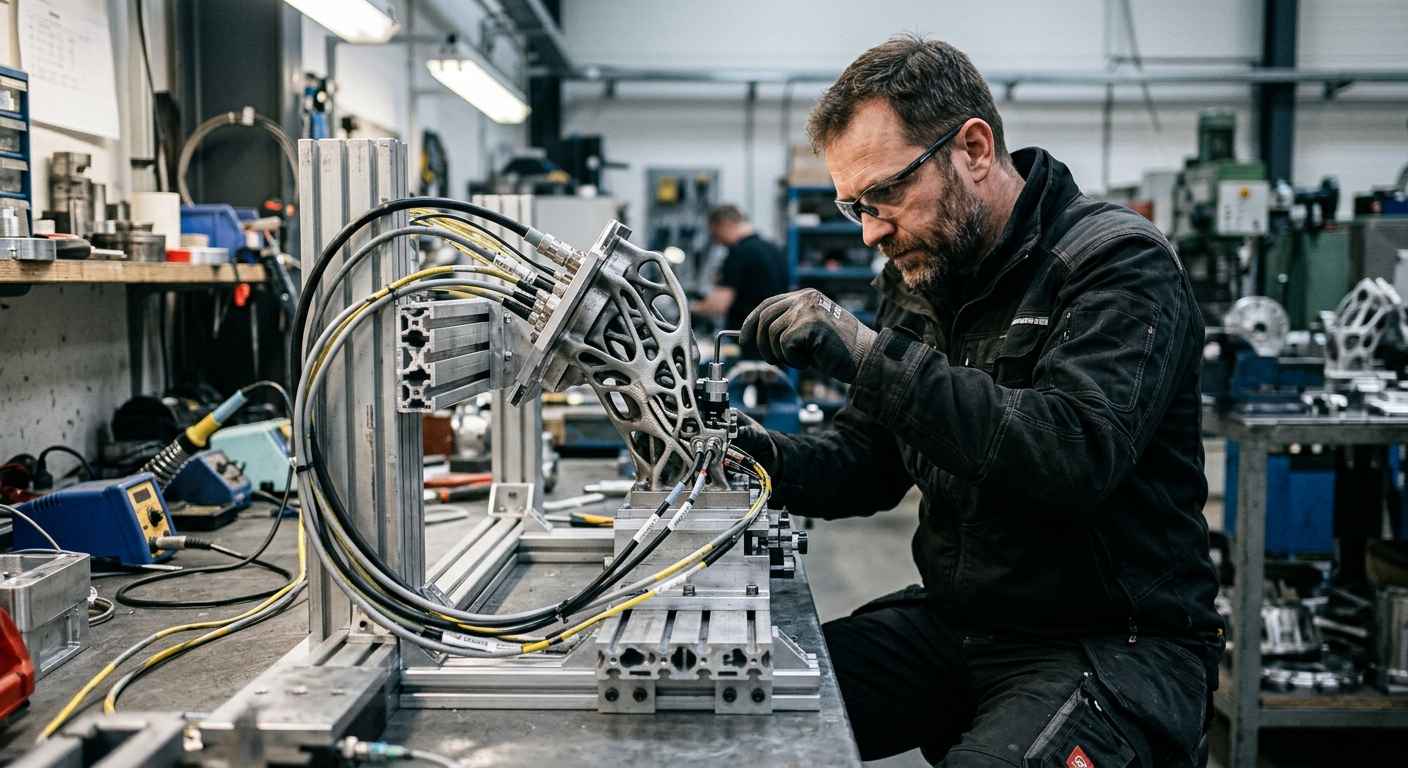
The third phase took the winning configuration out of the bench. It was tested in a semi-real use scenario, coupling the element to a final product, to check whether the advantage measured under controlled conditions was kept inside a working product.
The adaptation to that final product’s system was mechanical and functional at the same time. The integration constraints, the dimensional compatibility with the available space and interfaces, and the operating conditions of the device itself all had to be resolved. It is precisely that fidelity to the context of use that makes it possible to draw reliable conclusions from the test, because an isolated element and the same element integrated rarely behave the same way.
The advantage measured on the bench only counts if it survives integration in real conditions, with its dimensional constraints and its operating regime.
The project is considered a success for the process, not for a figure. A structured validation was completed that reduced the initial technical uncertainty and replaced a promising intuition with a set of evidence on parameters, performance and integration. That is the real value of transferring a bioinspired principle to a prototype that can be measured: it turns an attractive hypothesis into a solid basis for deciding whether the development should scale and in which direction to do so.