
What was the challenge or problem to solve?
Emerging technology testing consists of checking, through controlled tests, whether that technology delivers real improvements inside the specific device into which it is to be integrated. It is an early stage of product development that, within product design and innovation, decides whether a technology is worth incorporating before the design is committed. That was the starting point of this project: an industrial client wanted to study whether adding a new technology inside one of its devices produced improvements sizeable enough to incorporate it into future implementations of the product.
The question was not theoretical. Tests had already been run with an initial setup, but the client needed to know the influence of that technology inside the specific device it was intended for, with its geometry, its electronics and its operating conditions. Answering that question required designing a custom experiment, and that was the assignment INFINITIA’s Product Development team took on.
Validating an emerging technology before integrating it into a product
An emerging technology is one that has demonstrated its working principle but does not yet have a consolidated application record in a specific use. On the TRL scale (Technology Readiness Level), which classifies a technology’s maturity from the basic principle observed to the system validated in a real environment, these solutions sit at intermediate levels: they work, but it is unknown how they behave once integrated into a specific industrial product.
That distance between “the technology works” and “the technology works in here” is exactly the gap the client needed to close. The objective was not to prove the physical principle, already known, but to check what it actually contributed inside the device before committing the design of future versions.
Validating before integrating reduces the risk of carrying a wrong decision into later phases. Incorporating an untested technology forces redesigning housings, wiring or control systems when the first adverse results appear, at a cost far higher than a prior test. That is why, in product development, technology validation is addressed before the design is frozen.
The approach was framed within industrial product development, where mechanical design, electronics, technology selection and experimental validation coexist. That multidisciplinary approach was essential, because the answer demanded both mechanical criteria to house the components and electronic criteria to control and record the test.
Initial setup versus validation in the real device
A test setup is the set of structures, supports, instrumentation and control systems that makes it possible to reproduce certain test conditions in a stable way. The client already had an initial one, enough to check the technology’s principle in isolation, but not to anticipate its behaviour inside the device.
The difference is relevant. An isolated rig makes it possible to observe the effect of the technology in an open, unrestricted environment, whereas the real device imposes a limited volume, specific materials and specific working conditions. Any of those factors can modify the result, amplifying or cancelling it.
In engineering, the environment is part of the experiment. The same technology can perform differently depending on the position of its components or the presence of nearby elements that interfere with its operation. Simply transferring the conclusions of a free rig to a closed product is an extrapolation that rarely holds.
This logic is what underlies a proof of concept: checking that an idea works under the conditions in which it will be applied, and not only in the most favourable scenario.
Emerging technology testing is only conclusive when carried out inside the real device, not in an isolated rig that ignores its constraints.
Integrating electronics and physical design in a reduced space
The technical challenge for INFINITIA was not the technology itself, but taking it inside the device. The team had to resolve the integration of the electronics and the physical design of the assembly in a reduced space and under specific operating conditions, without that integration altering the very behaviour that was to be measured.
A reduced space conditions the whole experimental approach. It limits the size and position of the supports, restricts the routing of the wiring, forces the selection of electronic components compatible with the available volume, and complicates placing the sensors at the points where the measurement is representative.
There is also a less obvious requirement: the measuring system must not disturb what it measures. Each support and each sensor introduced occupies a volume that did not exist before inside the device. If that intrusion modifies the behaviour of the whole, the results stop describing the real product and start describing the rig.
Added to those constraints was a methodological requirement: the assembly had to allow the tests to be repeated as many times as necessary, always obtaining the same starting conditions. Without that guarantee, the differences observed between tests could not be attributed to the technology, but to the setup itself.
How was it addressed or what was the solution?
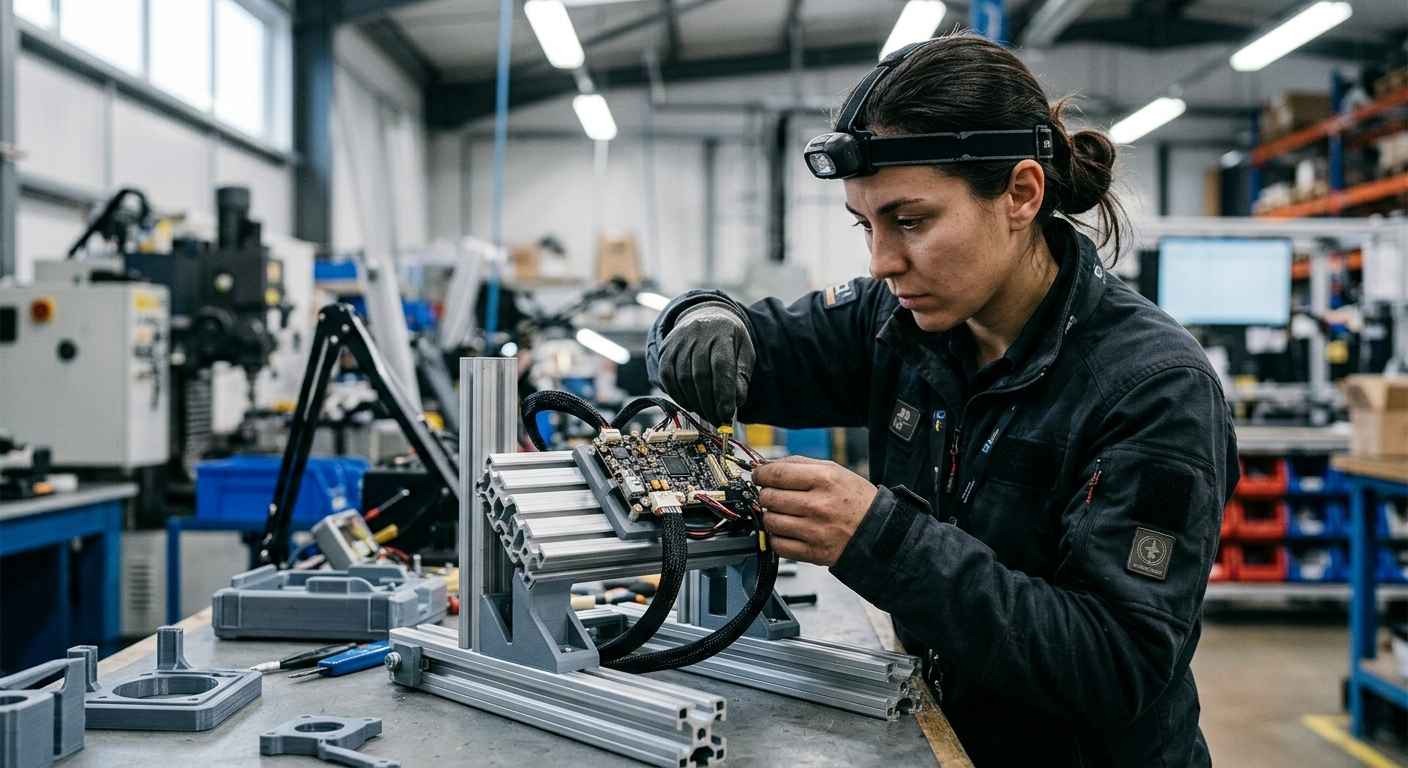
The solution consisted of designing, manufacturing and commissioning a test setup specific to this device, capable of integrating the technology, the control electronics and the monitoring systems needed to draw reliable conclusions. The work was organised into consecutive phases, each aimed at resolving a specific unknown before advancing to the next.
INFINITIA’s Product Development team approached the project by combining a prior technical study, 3D design and electronic integration up to testing in real conditions. This sequence makes each decision rest on the previous one and the final result traceable back to the initial requirements, a usual criterion when the objective is not to manufacture a part but to produce technical evidence.
Prior study of the technology to define requirements
The first phase consisted of a study of the technology to ease its integration into the device. An information search was carried out to understand in depth what the technique consisted of, how it behaves and what conditions it needs to work correctly.
Studying the technology before designing anything has a very concrete purpose: to identify the requirements the setup must meet and to detect the limiting factors of the test. A limiting factor is a variable that, if not controlled, determines the result above the effect that is meant to be measured.
This prior work avoids the most common mistake in technology validation: building first and discovering afterwards that the rig does not allow the intended question to be answered. Remaking a setup mid-project not only consumes time, it invalidates the tests already run, because the conditions stop being comparable.
At the end of this phase, the team had a list of requirements and constraints that would condition the whole later design. That document, barely visible in the final result, is the one that determines whether the setup will be able to decide something or only to generate data.
3D design of the experimental setup to guarantee repeatability
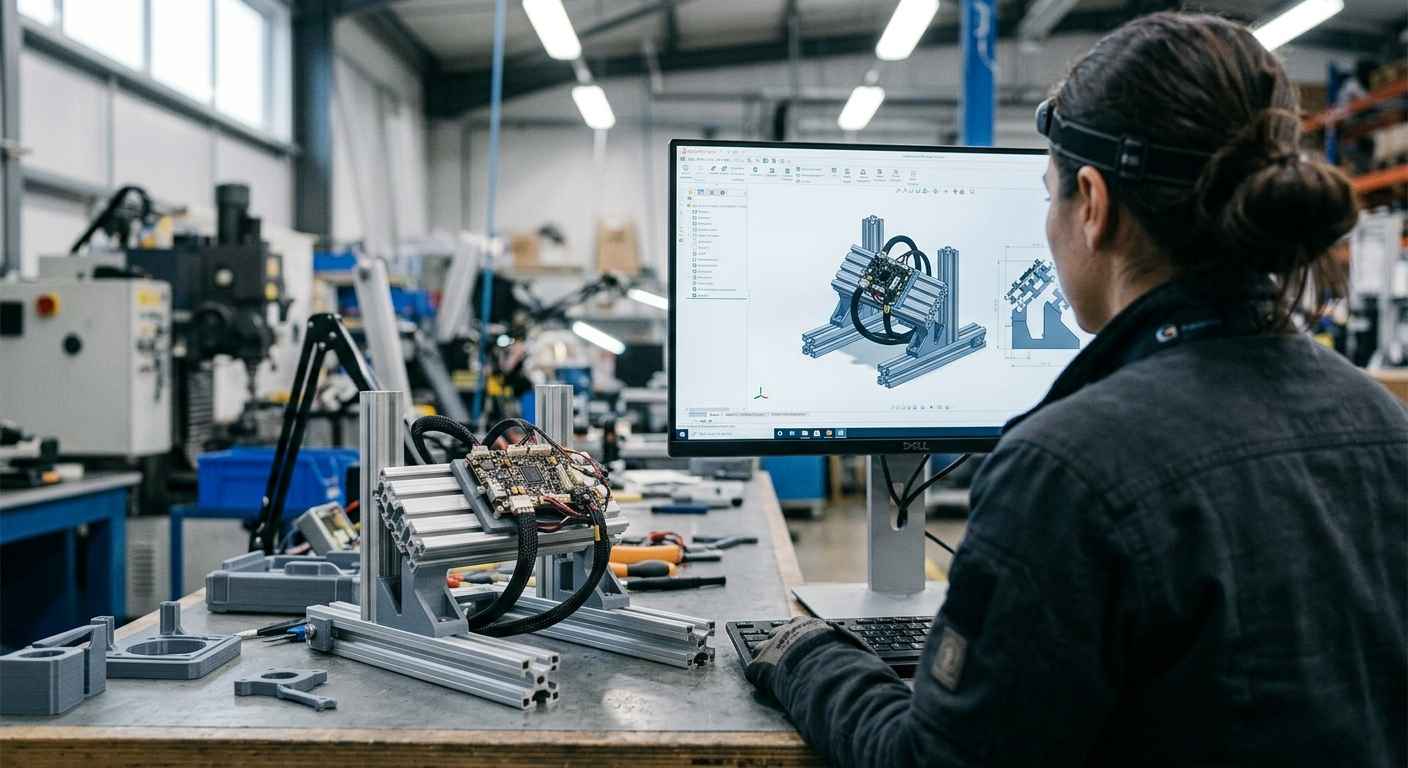
With the requirements defined, the team proceeded to the design, manufacture and assembly of the experimental setup. Using 3D design software, all the structures and supports needed to integrate the electronics were modelled, adapting each element to the space available inside the device.
3D design and CAD modeling make it possible to check interferences, routings and housings before manufacturing any part, something especially valuable when the dimensional margin is scarce. Each support was conceived to position the components always in the same location, test after test.
That is the central criterion of the phase: the setup had to allow the repeatability of the tests, avoiding any kind of variability in the results.
Without repeatability there is no possible decision, because the differences between tests cannot be attributed to the technology instead of to the assembly itself.
Materialising the assembly through prototyping to test under controlled conditions follows the same approach applied in the design of custom test benches, where the architecture of the assembly directly determines the quality of the data obtained.
Integrating the electronics and testing in real conditions
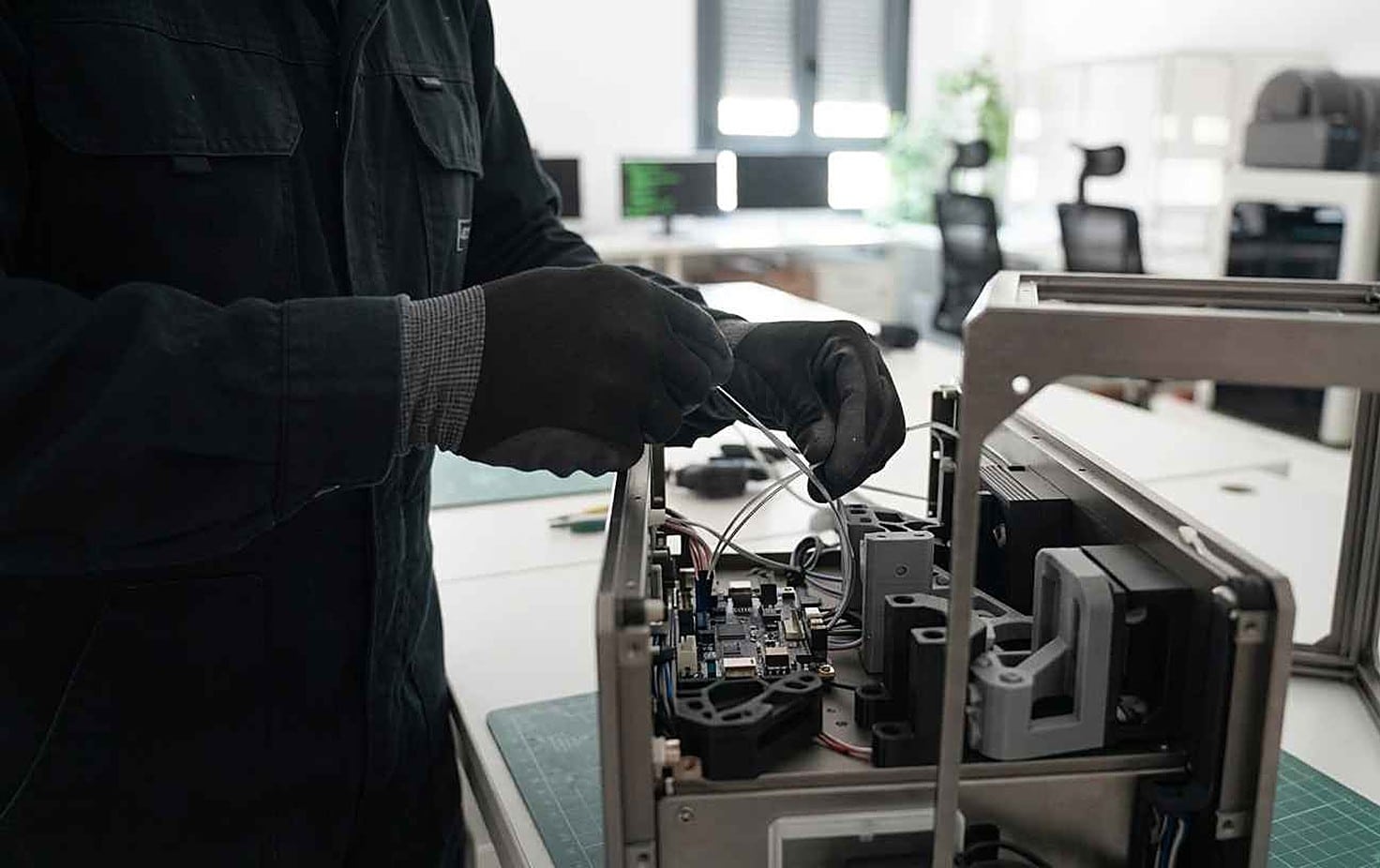
The next phase consisted of defining and integrating the test electronics. It was programmed to control the necessary test parameters, so that the conditions of each test were known and reproducible, and the sensors and monitoring systems were integrated to track the results of each one.
This integration of electronics, sensors and control inside a product relies on a process of technology selection and testing, and here it proved decisive: the same assembly had to govern the test conditions and capture their results without occupying more space than available, which turns a mechanical assembly into a measuring instrument.
In the last phase all the elements were integrated inside the device to test in real conditions, with the parameters fixed by the electronics and an evaluation through visual monitoring that makes it possible to compare behaviour between successive tests. Thanks to the setup design, the technology was validated in line with the client’s expectations: not an isolated data point, but a set of repeatable tests that made it possible to decide, with technical criteria, on its incorporation into future implementations of the product.
Validating a technology inside the real device makes it possible to decide on its incorporation into the product with experimental evidence, not with hints.
When an emerging technology must prove its value inside a specific product, the quality of the answer depends on the experimental approach. A well-designed setup does not change the behaviour of the technology, but it does determine whether the data it produces is useful for deciding. That is, ultimately, the work that turns a promising hypothesis into a well-founded product decision.