
What was the challenge or problem to solve?
Electronic product development is the technical process that transforms an undefined idea into a complete, validated design ready for a manufacturer to industrialise. This project started exactly from that point: a company with a clear idea of what it wanted to achieve, but without technical specifications, without a prior design and without any earlier development to build on.
The client’s need was not to solve a one-off engineering problem, but to travel the whole path that separates a concept from a manufacturable product. It was looking for a specialist in product development able to take on all the phases of product design and innovation, from the initial study to the final documentation, without fragmenting the project among different suppliers. INFINITIA stepped in as an external technical partner with an industrial outlook.
Electronic product development from an undefined idea
A product idea is not an engineering project. The client had a solid intuition about the function the device had to fulfil and the gap it could occupy, but not the technical information that makes it possible to start designing: no quantified requirements, no candidate technologies, no geometry, no electronic architecture.
That situation is more common than it seems in the industrial field, especially when the product combines mechanics, electronics and user interaction in a single object. Each of those disciplines conditions the others, and tackling them separately usually leads to late redesigns that force already-closed work to be redone.
Without specifications, without a design and without prior development, there was no technical starting point from which to advance safely. That is why the decision was not to commission a specific part, but to bring in a team specialised in product development to take on the complete process. The stated objective was to reach a design ready to industrialise, ready to hand to a manufacturer to produce in series, and that destination conditioned every decision in the project.
What product design specifications are and what they are for
Product design specifications (PDS) are the set of technical, functional, aesthetic and use requirements that a product must meet, expressed in a concrete and verifiable way. They work as the technical contract between what is to be achieved and what is going to be designed.
Their absence is the real starting problem when only an idea exists. Without a PDS there is no criterion to choose between two geometries, to discard an electronic component or to decide whether a mechanism meets its purpose. Any decision becomes a preference, not a technical answer, and the risk accumulates until it appears, far more expensively, as a failure in the prototype or on the production line.
Product design specifications translate an idea into measurable requirements: without them, every later decision in the project rests on an unverified hypothesis.
Defining those specifications requires prior information. They are not drafted in a meeting; they are deduced from the analysis of the market, of existing products, of the available technologies and of how the user will interact with the device. That is why the project did not begin by drawing, but by studying.
Industrialisable design, the challenge of covering every phase
The technical challenge the Product Development team took on was to cover the complete process, from a poorly defined idea to a validated, industrialisable design. It was not a single difficulty, but a chain of linked decisions in which each phase conditions the next and an early error propagates to the end.
An industrialisable design is one that not only works, but can be manufactured repeatably with real production processes, available materials and affordable costs. That condition is built from the first design phase, not at the end: a geometry that does not respect draft angles or the minimum walls of injection moulding forces the whole model to be redone.
The added difficulty in an electronic device is the coexistence of four planes that must be solved at the same time: the functional, the aesthetic, the electronic and that of user interaction. A housing conditions the layout of the board, the board conditions the space for the mechanisms, and user interaction conditions the ergonomics of the whole. Maturing those four planes at once, without losing sight of later manufacturing, was the real challenge of the project.
How was it addressed or what was the solution?
INFINITIA’s Product Development team structured the project into linked phases, each with a verifiable objective before advancing to the next. The approach avoids the most frequent mistake in electronic product development: designing on assumptions and discovering the incompatibilities when a mould is already manufactured or a board already closed.
Each phase answered a specific question: what the product should be, what shape and technology it adopts, whether the geometry works, whether the electronics meet their purpose and what the manufacturer needs to produce it. Functional prototyping acted as a verification tool throughout the whole path, not as an isolated stage at the end.
Market study and product conceptualisation step by step
The project started with a study of the initial information and a market study divided into sections: aesthetics, product typologies, electronics, mechanisms and user interaction. Segmenting the study makes it possible to look for specific information in each area and extract conclusions applicable to the design, instead of a generic portrait of the sector. From that analysis came the product design specifications by typology, which set the technical framework of the development.
This work is framed within product design and innovation, where the prior study determines what is going to be designed before deciding how it is designed.
With the conclusions on the table, the team tackled the product conceptualisation phase divided into four parts: functional, aesthetic, user interaction and technological. Working by types ensures that no key point is left uncovered, because each concept is evaluated on the four planes and not only on the most visible one. Through analysis and brainstorming processes, three matured lines of work were proposed, presented to the client with graphic material that made them understandable. Offering three concepts, and not one, makes it possible to decide with technical criteria among options that are already viable.
Mechanical design and custom electronics up to the functional prototype
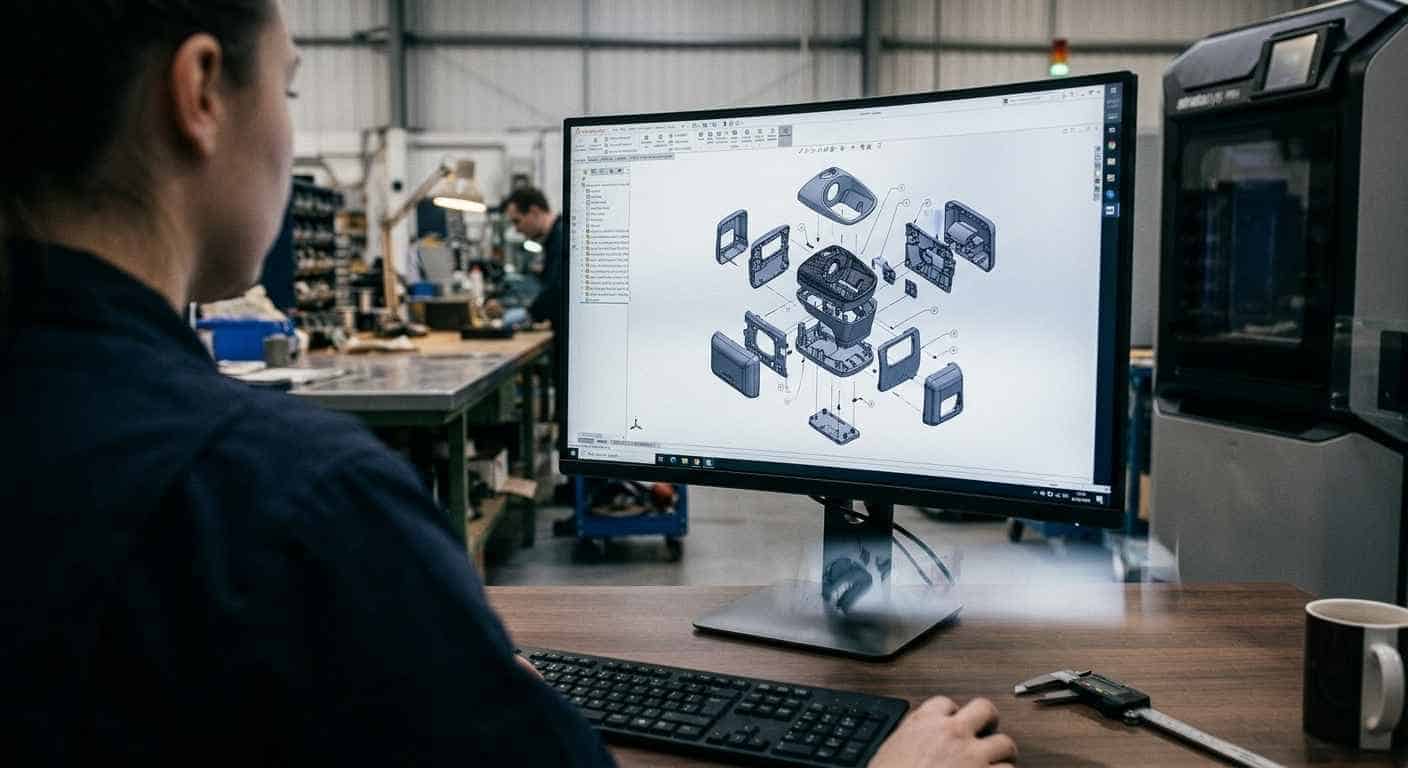
From the selected line of work, the team tackled the mechanical design of the parts with professional computer-aided design (CAD) software, which makes it possible to model each component in three dimensions and control geometry, fits and relationships between parts parametrically. The 3D design and modeling using CAD incorporated the industrialisation constraints from the start, with drawings based on standardised representation and dimensioning conventions that ensure any manufacturer interprets the same geometry.
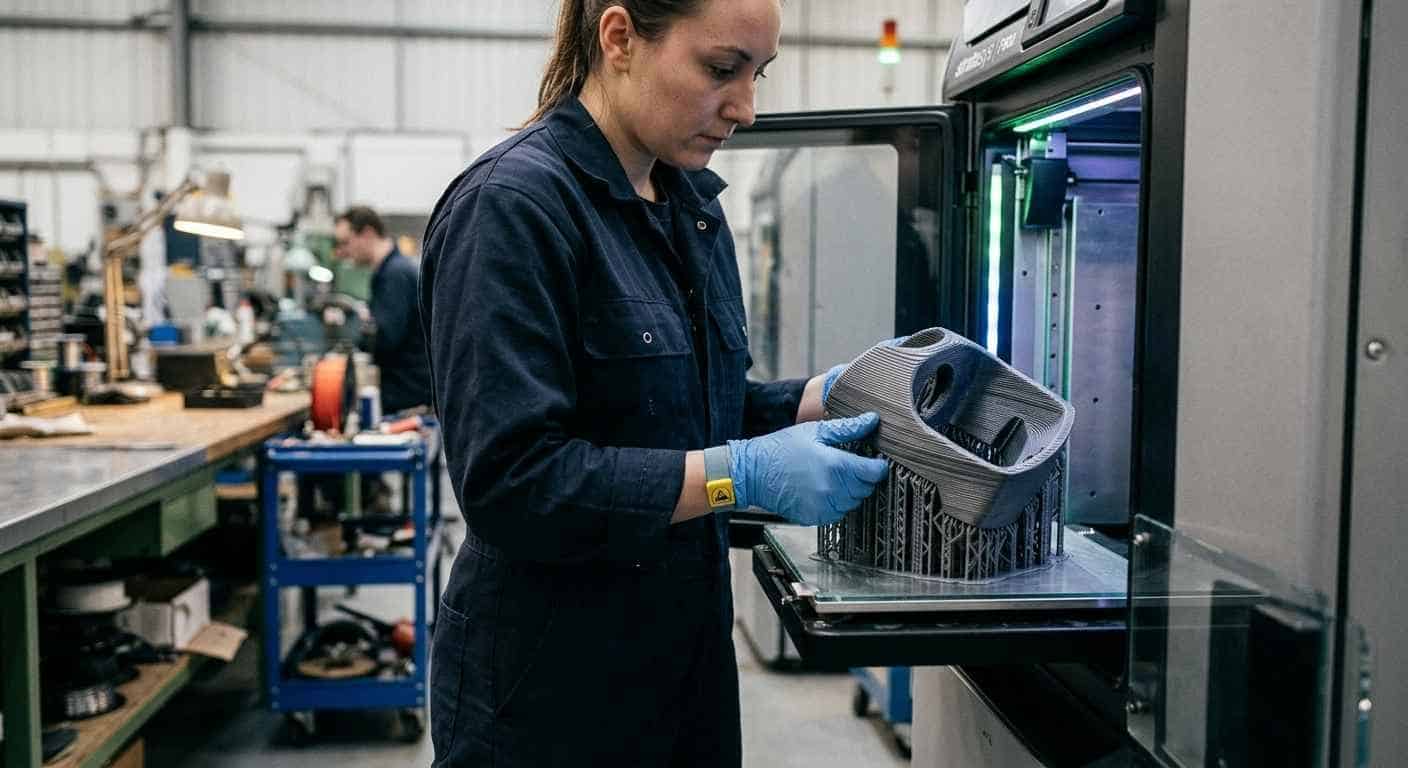
During this phase, tests were run with physical parts manufactured mainly through additive manufacturing, the set of processes that build a part by adding material layer by layer from the digital model. Printing a part during design makes it possible to verify real mechanisms and geometries, and to spot improvements that go unnoticed on screen, such as a path that rubs or a fit that is too tight.
Additive manufacturing during the design phase turns a geometric doubt into a physical answer in a matter of hours, not weeks.
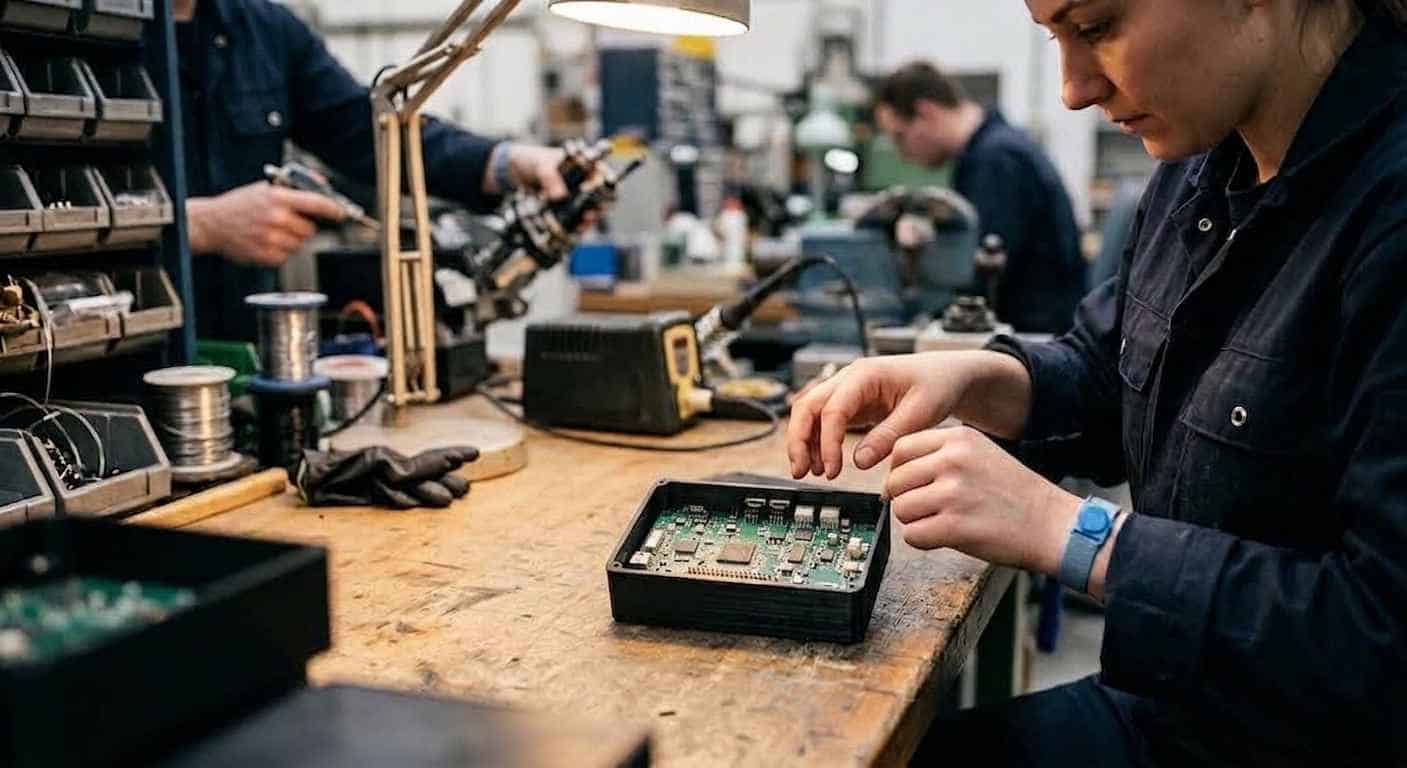
In parallel, before closing the definitive electronics, the necessary electronic components were selected and tested together on an earlier prototype. A component can meet its datasheet and fail when integrated with the rest due to interference, consumption or temperature, so prior testing avoids redesigning a whole board over an incompatibility detected late. Once the assembly was verified, it was integrated into custom electronics that covered all the functions and served as the basis for the version to be industrialised; this electronic development relies on recognised frameworks, such as the IPC-2221 standard for printed circuit board design.
With the mechanical parts defined and the electronics developed, everything was integrated into a functional prototype, which reproduces the real behaviour of the device and not only its appearance, for the testing and validation of the product before considering the design closed.
Documentation to industrialise, drawings, schematics and BOM
The project was closed by preparing all the documentation to industrialise the product, the client’s final objective. This phase turns a validated prototype into a product transferable to a third party: without it, the design knowledge stays in the team that developed it and not in the documents that describe it.
For the mechanical part, the individual technical drawings of each piece and the assembly drawings, which define how they relate and assemble together, were prepared. For the electronic part, the schematics were generated, the representation of the electrical connections between components, along with the files that serve as the basis for manufacturing the hardware.
A product is not ready to be manufactured when it works, but when the technical documentation that lets a third party reproduce it without ambiguity exists.
The BOM (Bill of Materials) was also prepared, the structured list of all the components, materials and quantities that make up the product. The BOM allows the manufacturer to budget, source and plan production, and its level of detail directly conditions the viability of the product manufacturing phase. With that documentation delivered, an idea without technical definition was matured across the functional, aesthetic, electronic and interaction planes, and ready to make the leap to series production.