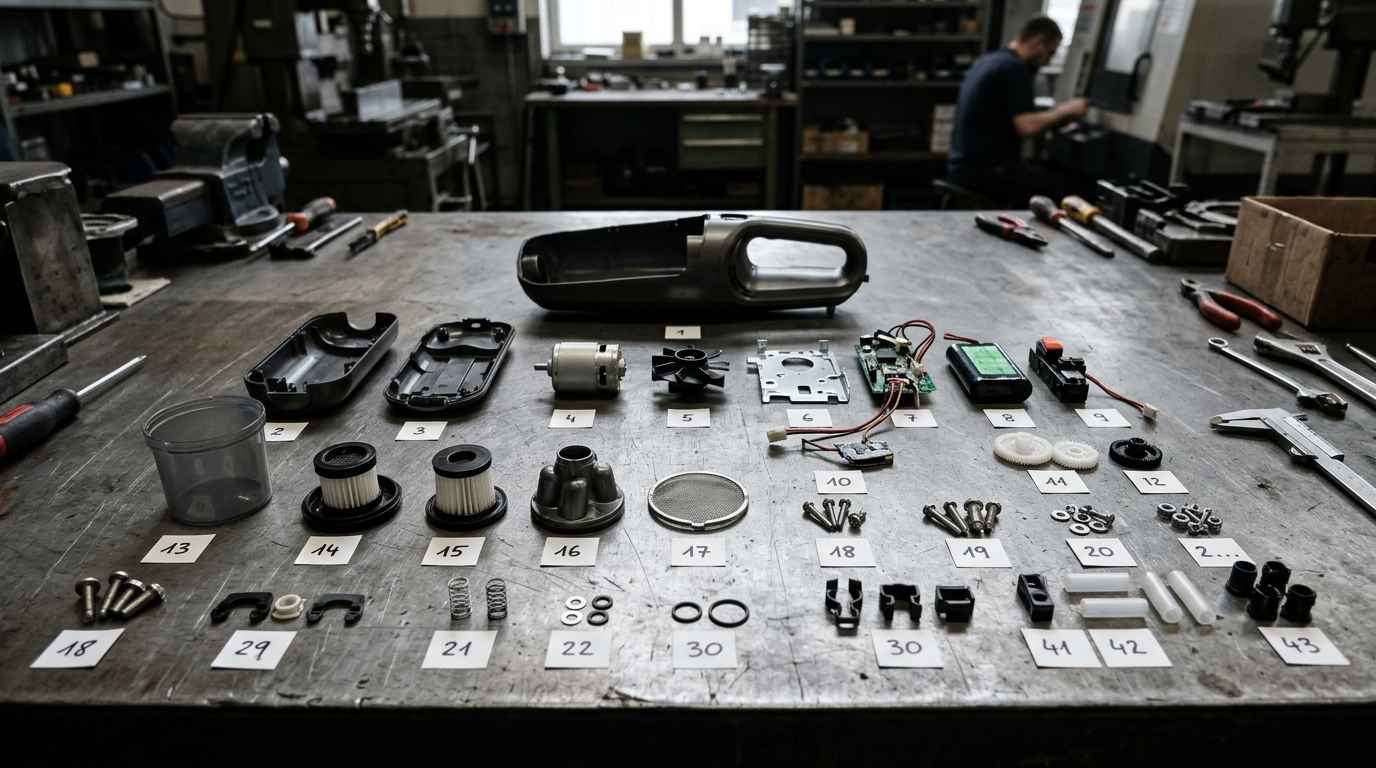

Competitive product teardown means buying the competitor’s product, taking it apart and measuring it with the same methods you would apply to your own, to obtain comparable data on materials, dimensions, finishes and performance instead of impressions.
The difference from commercial benchmarking is the type of data it produces. One compares prices, positioning and sales arguments. Industrial benchmarking and comparative trials compare real thicknesses, alloys, treatments and test results on the same measurement basis, which is what allows you to decide what to change in your design.
It is one of the applications of reverse engineering within forensic engineering, and the one that turns into decisions fastest. It does not aim to copy a part, it aims to understand why the competitor’s part costs less, weighs less or lasts longer.
INDUSTRIAL BENCHMARKING AND COMPARATIVE TRIALS
Do you need to know why your competitor’s product costs less or lasts longer? Take a look at our industrial benchmarking and comparative trials

What a competitive product teardown answers and what it does not
A competitive product teardown answers closed questions about the competitor’s product, what material each component is made of, what thicknesses and tolerances it works to, what surface treatment it carries, how the joints are solved and how it behaves in the tests that define its performance. With that, a comparison table against your product is built, component by component.
What it does not answer is why they took those decisions or how much it costs them to make it. The cost is estimated from the material, the process the geometry requires and the number of operations, but it remains an estimate. Mistaking a cost estimate for the competitor’s real cost is the error that most often invalidates the conclusion.
There is a third family of answers that comes almost for free and is usually ignored, the process one. Injection marks, ejector pin marks, draft angles and parting lines show which process each part was made with and, indirectly, what production volume the mould was designed for. A part with several slides and a fine finish reveals a tooling investment that only pays off with long runs, and that alone explains part of the price difference.
Competitive product teardown, scope and the questions that justify it
The scope is defined before buying anything, starting from the decision that has to be made. A teardown to reduce cost looks at material, thicknesses and number of parts. One to match a performance looks at the chain that produces it, and one to resolve a recurring sales objection looks at exactly the point the customer mentions.
Without that prior question, the teardown produces an inventory of data that nobody uses. That is why benchmarking fits well as a step before defining the product requirements and specifications, when numerical values have to be set and it pays to know where the market really is and not where it is assumed to be.
The conceptual framework of benchmarking as a management tool, with its types and its comparison logic, is developed in how to use benchmarking to improve your product. What follows here is the physical part, what is done with the part on the bench.
What you can legally do with a product bought on the market
Observing, studying, disassembling and testing a lawfully acquired product is a lawful way of obtaining technical information. Directive (EU) 2016/943, on the protection of trade secrets, expressly lists among the lawful means of acquisition the observation, study, disassembly or testing of a product that has been made available to the public or that is lawfully in the possession of whoever acquires the information. The Spanish trade secrets act that transposes it keeps that same provision.
There are two limits worth being clear about from the start. The first is contractual, because that lawfulness applies unless there is a contractual prohibition, and a supply contract, a licence or terms of use can prevent disassembly. The second is that understanding is not the same as being able to manufacture, since a patent in force, a registered design or a trade mark remain protected even if you have worked out how the part is made.
On the practical side, keep the purchase traceable. Keep the invoice, the packaging, the serial number and the date, and photograph the sealed product before opening it. If the result ends up in a dispute, the first thing questioned is where the analysed unit came from, and that documentary chain is what supports that the product was obtained through a normal market channel.
Disassembling and measuring a product bought on the market is a lawful means of obtaining technical information, unless there is a contractual prohibition. What that information does not grant is freedom to manufacture, which depends on the patents, registered designs and trade marks in force.
The practical consequence is that the teardown and the freedom to operate analysis are two different jobs in different hands. The laboratory establishes what material, what geometry and what performance the part has. Determining whether you can incorporate a specific solution into your product is a legal assessment that belongs to your intellectual property advisers, based on the list of rights in force.

How a competitor’s product is taken apart
The teardown follows a sequence that cannot be reversed, which is why it is documented before anything is destroyed. First the product is recorded as it arrives, then it is separated into components without altering them, then everything that can be measured without destruction is measured, and only at the end are parts sacrificed for destructive tests and material analysis.
Inspection of the closed product
Before opening anything it is worth inspecting the closed assembly. In sealed or potted products, or products with embedded electronics, radiography or tomography shows the internal layout, the number of components and the joining points without breaking the part. That avoids the typical error of blind disassembly, which is to destroy on the first attempt exactly the joint that had to be characterised. It also gives the correct disassembly order, which is not always the intuitive one.
Documented breakdown and weight per component
The documented breakdown is the basis for everything else. Each step is photographed, the components are numbered, each one is weighed separately and a note is made of how each joint was solved, screwed, welded, snap fitted or bonded. The weight per component is more revealing than it seems, because it shows at once where the competitor has cut material.
| What you want to find out | What is measured | Technique | Data it delivers |
|---|---|---|---|
| Where the cost sits | Weight and material per component | Breakdown with individual weighing and composition analysis | Actual material and quantity per part |
| Why it weighs less | Thicknesses and internal geometry | Dimensional metrology and digitisation | Dimensions that govern function and cost |
| Why it lasts longer | Properties of the material and the joint | Mechanical tests on extracted specimens | Comparable strength between products |
| Why it looks better with use | Coating and surface finish | Coating characterisation and abrasion tests | Thickness, nature and durability of the finish |
| Whether you can match it | Process that this geometry requires | Manufacturability analysis on the breakdown | Operations required and their feasibility |
TELL US ABOUT YOUR CASE
Do you have two products on the table and the question is why the competitor’s one costs less? Send us two or three units of each and we will propose what to measure to answer it
Measuring and analysing the materials of the competitor’s product
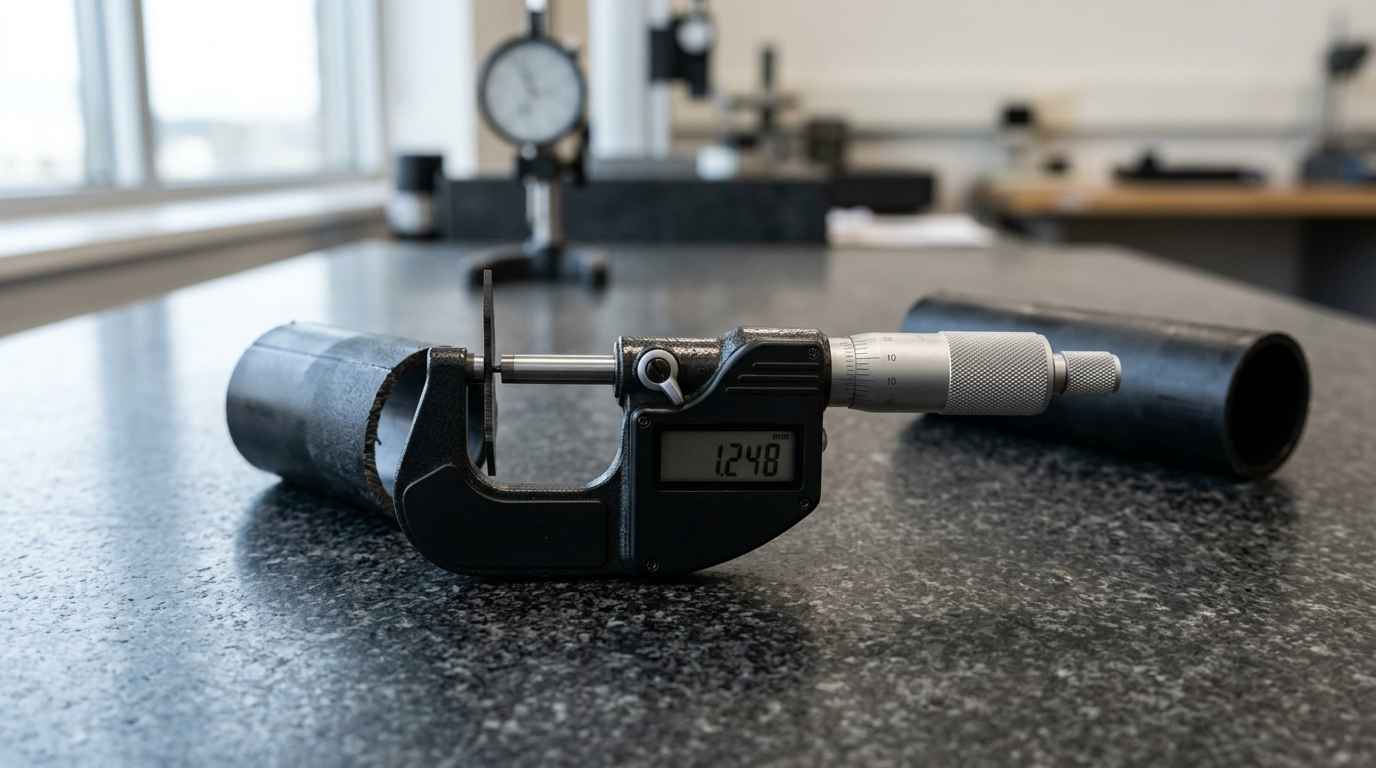
Dimensional characterisation is done with contact metrology or by digitisation, depending on the geometry. What matters is not the full drawing of each part, but the dimensions that govern function and cost, wall thicknesses, radii, ribs, assembly clearances and surface finish. The procedure is the same one used to replicate a component without drawings through reverse engineering, with a different purpose.
Tolerances versus the competitor’s nominal dimensions
A word of warning about dimensions. From a single unit you get dimensions, not tolerances. Tolerance is a property of the process and only appears when several units from different batches are measured, so claiming that the competitor works to a given tolerance on the basis of one part is a leap the data does not support. What you can conclude from one unit is the nominal value it is aiming at and whether your own design is asking for a precision the market does not need.
Materials and finish analysis in a competitive teardown
Material identification is where the difference that explains the cost appears most often. The composition of metals and alloys is determined by elemental analysis and chemical composition, along with the polymer family and its fillers, and the thickness and nature of the coatings. An alloy with less alloying element or a polymer with more mineral filler changes the cost without it showing in the finished product.
In polymers, identification goes in layers. Infrared spectroscopy gives the material family, thermal analysis places its transitions and confirms whether it is the grade it appears to be, and the determination of filler and ash content says how much mineral filler it contains. That last figure is the one that most often explains a price difference, because a filler makes the compound cheaper and changes stiffness and impact resistance without the outer appearance giving it away.
The alloy analysis of competitors’ products to optimise performance and costs illustrates the usual pattern, the difference was not in the design but in the material specification. In consumer products the same happens with finishes, as in the comparison of cooking utensils for product improvement, where the coating set the perceived durability.
From comparative data to a product decision
Benchmarking data is only useful if it is measured on the same basis. Two thicknesses obtained with different methods are not comparable, and neither are two performance figures measured on different specimens. Consistency of method is what turns a collection of numbers into an argument.
With the breakdown and the materials identified, the bill of materials of the other product is rebuilt, component by component, with its material, its weight and the process that produces it. From there the cost is estimated, but the estimate has to be normalised to your own volumes, your suppliers and your plant. The same component costs differently depending on the annual quantity and the country of manufacture, so the valid comparison is not against the competitor’s cost but against what it would cost you to make that same part.
Comparative tests on the same measurement basis
A valid comparative test requires the same conditions for all samples, the same prior conditioning, the same specimen geometry when material is extracted and the same end of test criterion. If your own product is tested freshly made and the competitor’s has spent months in a warehouse, the measured difference includes ageing and can no longer be attributed to the design.
The number of units also matters. A single sample of each product gives a difference that may be process scatter and not a real difference. With three or more units of each, the systematic difference can be told apart from variability, and that distinction is what decides whether it is worth changing anything.
Cost, performance and what to change in your design
The useful output of a teardown is a short list of changes ranked by the ratio between saving or improvement and difficulty of implementation. Changing a material specification is usually the cheapest change and the one that can be validated soonest. Redesigning a geometry means touching the tooling, and that moves the decision to a different time horizon.
It pays to separate what the competitor does better from what it simply does differently. Not every difference is an advantage, and some decisions respond to a market or a production volume that is not yours. A thinner wall is a saving if the part still complies, and a warranty risk if it is not checked first.
No change taken from a competitor goes into production without being validated on your own product. That a two millimetre wall works in their design does not mean it works in yours, because stiffness depends on the complete geometry, on the ribs and on how the part is supported. The route is to make samples with the proposed change and put them through the same test you used to measure the competitor. Copying a dimension without that step transfers to your warranty a risk you have not measured.
A properly closed teardown does not deliver a list of differences, it delivers a list of changes with their estimated saving and their implementation cost. Without that order, the data stays in the report.
What a well executed teardown leaves on the table
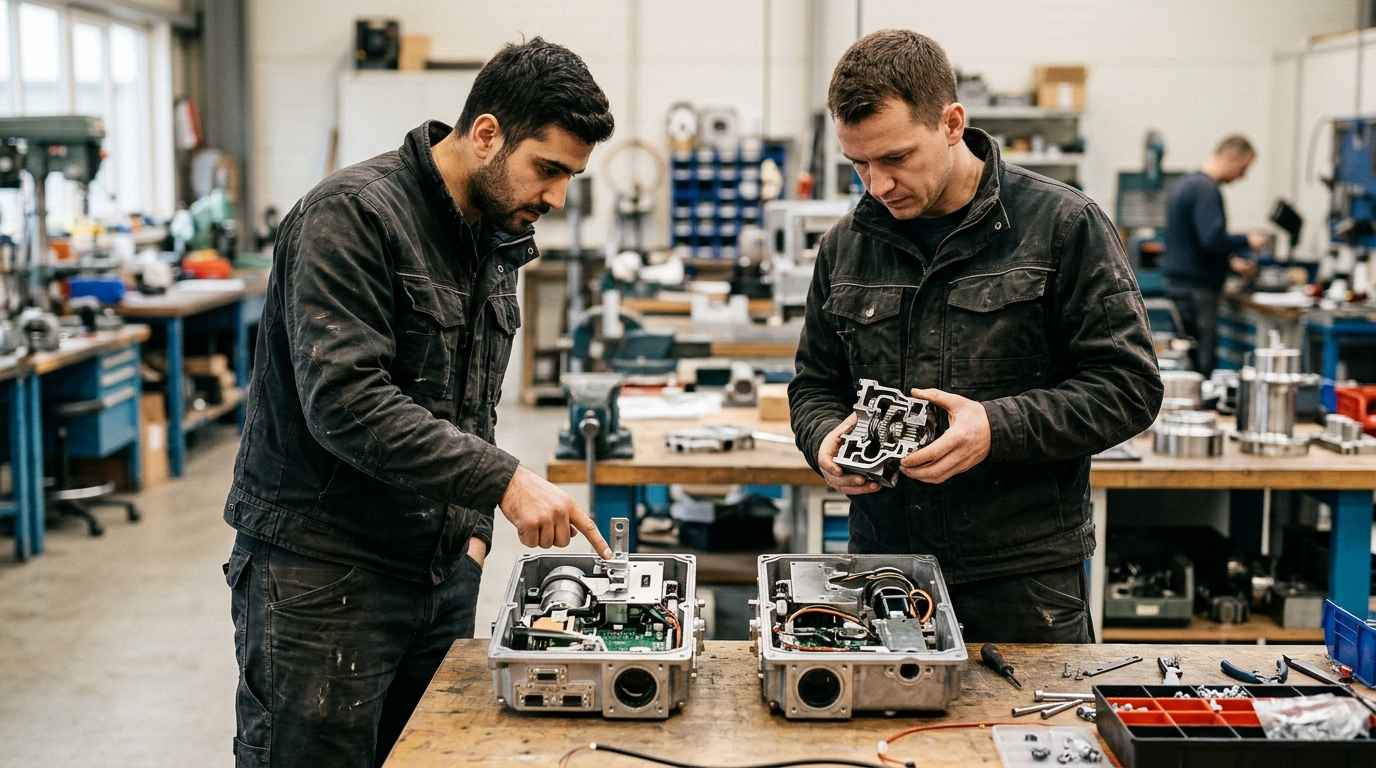
A competitive teardown replaces the conversation about impressions with a comparison in units. You know what each component of the product you compete with is made of, what thicknesses it works to, how it solves the joints and how it responds to the tests that define the performance your customers mention.
The part that adds most value, and the one most often neglected, is defining the question before buying the product. A teardown with no associated decision generates data that ages in a folder. With a clear question, the same work delivers three or four specific changes in order of priority.
It is worth repeating it periodically on the products that really take orders from you. A teardown is a snapshot, and competitors also redesign, change suppliers and adjust specifications. Keeping the documented breakdown and the data from each round shows the direction in which they are moving, which is usually more useful than the isolated snapshot.
Gather two or three units of the competitor’s product, the same number of your own and the list of questions you want to close. With that material the documented breakdown is carried out, the material of each component is identified, the tests are run on the same basis and you receive a component by component comparison with the proposed changes and their estimated effect.
Frequently asked questions about competitive product teardown
How many units of the competitor’s product are needed?
At least three units of each product are needed, from the same batch if possible, because with only one a design difference cannot be told apart from normal manufacturing scatter. One unit is enough for the documented breakdown and to identify materials, which do not depend on the sample, but not to claim that one product is stronger than another. If the aim is only to understand how it is built, as when you need to rebuild a component without drawings, one unit in good condition is enough.
Can a product that is under patent be taken apart?
Yes, taking it apart and studying it is different from manufacturing it. A patent in force prevents exploiting the protected invention, it does not prevent analysing a lawfully acquired product, unless there is a contractual prohibition that limits it. The practical separation is clear, the technical analysis establishes what material and what geometry the part has, and the assessment of whether you can incorporate a solution into your product belongs to your intellectual property advisers, based on the list of rights in force.
What factors determine the cost of a competitive product teardown?
The cost depends on the number of components in the breakdown, how many materials have to be identified and which comparative tests the performance under discussion calls for. A product with few parts and two materials to confirm is the most contained scenario. It rises with multi-component products, with coatings that have to be characterised separately and with mechanical tests that require extracting and preparing specimens from each unit.
What do you lose if you decide without a teardown?
You lose the chance to know whether your extra cost comes from the material, from the number of operations or from an inherited specification that nobody has reviewed. The usual outcome is cutting where it is visible, which is almost never where the cost is, and finding out later that the competitor was saving on an internal component. You also lose the data to answer a repeated sales objection, which without measurement is answered with arguments and not with figures. That data is also the natural input to set the requirements of your next version.
How long does a competitive product teardown take?
Typical lead times range from one to four weeks depending on the number of components and tests. The documented breakdown and material identification are closed at the lower end of that range. Comparative tests with specimen extraction and several units per product move to the upper end, because they require sample preparation and prior conditioning. For cases with a purchasing decision or a launch under way there is an urgent 24 to 72 hour option covering the scope that can be closed in that time.