
Hydrogen embrittlement in fasteners is the loss of ductility a steel suffers when atomic hydrogen enters its crystal lattice, concentrates in the stressed regions and causes a brittle fracture under a load the part was already carrying.
A batch of property class 10.9 bolts is tightened to torque, and on the third day there are loose heads under the assembly. Proving it combines chemical resistance tests, which reproduce the medium able to charge hydrogen, with the rest of the quality control and testing that goes with incoming inspection of fasteners.
Telling this mechanism apart from an overload or a fatigue failure decides who pays and which step of the process gets fixed. Forensic engineering applied to a broken fastener chases three answers, what the mechanism was, when the hydrogen got in and which step allowed it.
CHEMICAL RESISTANCE TESTS
Are high strength bolts breaking days after you fit them? Take a look at our chemical resistance tests

What hydrogen embrittlement is and the three conditions it needs
Hydrogen embrittlement in fasteners needs three conditions at once, a susceptible steel, available hydrogen and a sustained tensile stress.
Hydrogen embrittlement, diffusible hydrogen and traps in the steel lattice
The hydrogen that embrittles is atomic, not molecular. A hydrogen atom is small enough to move between the iron atoms and travel the whole length of a bolt at room temperature.
Inside the steel it gathers at traps, the sites where the lattice is distorted, namely dislocations, grain boundaries, carbide interfaces and inclusions. Reversible traps release it on moderate heating, and that mobile hydrogen is the diffusible fraction. Irreversible traps hold it with far more energy.
The diffusible fraction is what causes the failure and the only one that can be removed. Under sustained tension it migrates towards the point of maximum hydrostatic stress, the root of the first loaded thread and the head to shank fillet, and builds up there until cohesion between grains gives way.
Diffusible hydrogen moves to wherever the stress calls it. That migration makes delayed fracture the expected behaviour rather than an anomaly, because the time a bolt takes to break is the time hydrogen takes to reach the root of the loaded thread.
Why the risk threshold drops as the strength class of the bolt goes up
Susceptibility rises with the strength of the steel and becomes pronounced above roughly 1,000 MPa tensile strength.
Property classes 10.9 and 12.9 have minimum tensile strengths in the order of 1,040 and 1,200 MPa that put both inside the sensitive band. ISO 4042, which covers electroplated coating systems for fasteners, orders its requirements by hardness and separates fasteners up to 360 HV from those above that value and from those over 390 HV.
Moving from 8.8 to 10.9 to gain preload margin introduces hydrogen sensitivity where there was none, and without reviewing the finish the margin won on paper is lost in the plating bath. Cases such as failures of metal parts picked up during industrial assembly show that when a failure happens points to the cause as much as what it looks like.
Where the hydrogen comes from, from acid pickling to sour service
Hydrogen gets in by two routes, manufacturing and service, and telling them apart changes the corrective action.
Internal hydrogen clusters the failures into the first hours or weeks after assembly and affects parts from the same treatment batch. Service hydrogen spreads them over time and concentrates them in the most exposed positions rather than in one batch.
Manufacturing hydrogen, acid pickling and electroplating
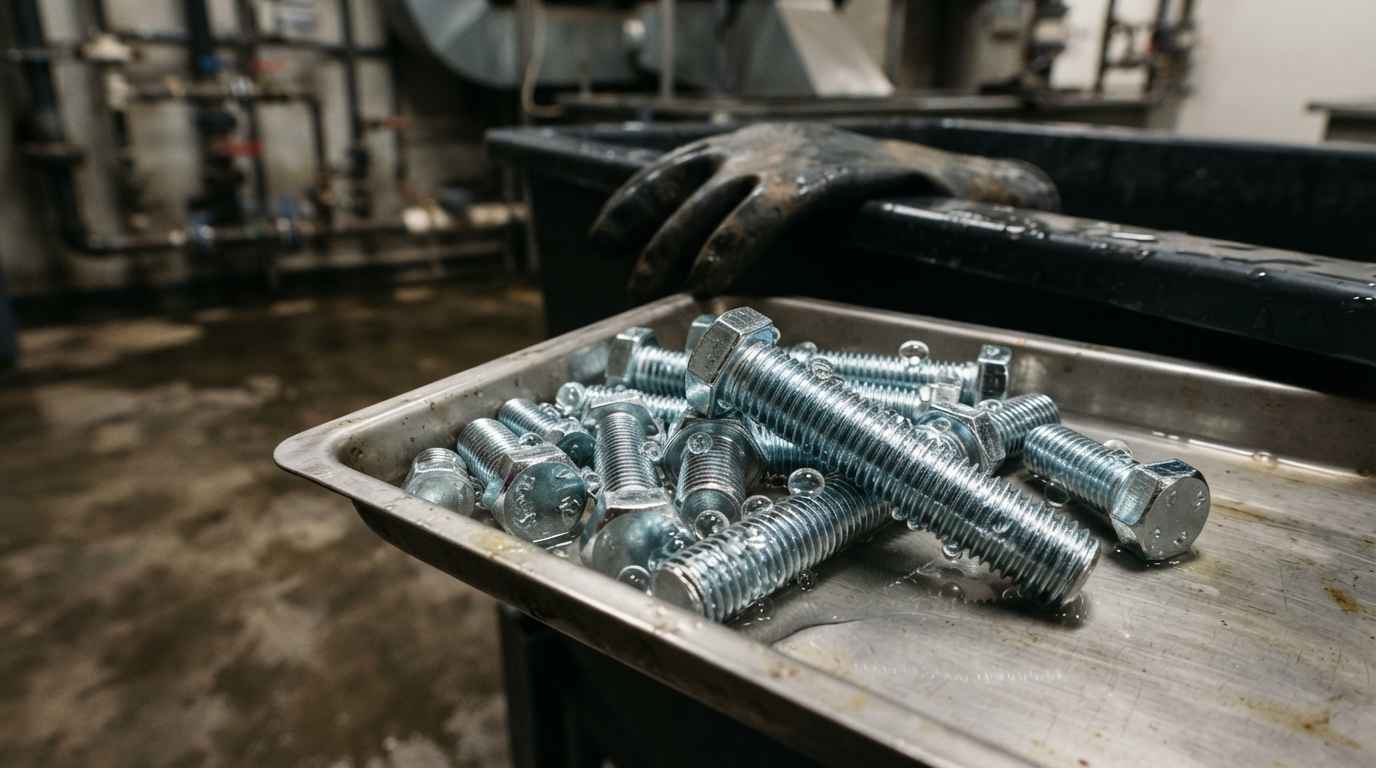
The processes that charge hydrogen are the ones that generate atomic hydrogen on the steel in an aqueous medium. Acid pickling and electroplating are the two main ones and they sit back to back on the same finishing line.
Pickling in hydrochloric or sulphuric acid strips the scale by dissolving iron, and the cathodic reaction that goes with that dissolution produces atomic hydrogen at the surface. Inhibitors cut the fraction that enters, they do not eliminate it.
Electroplating with zinc, cadmium or nickel repeats the mechanism more intensely, because the part is the cathode and whatever does not deposit metal goes into hydrogen evolution on its surface. The freshly deposited coating seals in whatever already got through.
That is why zinc flake coatings, cured in an oven with no electrolytic step, are specified for the higher classes. The case of production failures caused by different batches of galvanised steel components shows that traceability of the treatment batch is what bounds the scope.
Service hydrogen, cathodic protection and hydrogen sulphide environments
Service hydrogen is generated on the part once it is fitted, whenever a cathodic reaction takes place in contact with the steel. Three scenarios produce it in a recognisable way, cathodic protection set too negative, crevice corrosion under heads and washers, and environments containing hydrogen sulphide.
Cathodic protection, whether by sacrificial anodes or impressed current, polarises the steel to a potential at which it does not corrode. If the polarisation is taken more negative than it needs to be, the dominant surface reaction becomes hydrogen evolution.
A sour environment does not supply more hydrogen, it supplies more absorbed hydrogen, because it poisons the recombination of atoms into molecules. That is why material criteria for sour service cap the hardness of carbon steel at values in the order of 22 HRC, well below a property class 10.9.
A steel carrying manufacturing hydrogen fails early and by batches. A steel taking in service hydrogen fails late and by positions. That difference in pattern, read against the assembly record, steers the failure analysis before the first specimen is cut.
Material compatibility with hydrogen as a process fluid is a separate problem and it is settled at the selection stage. For a component that will work in contact with pressurised hydrogen, the relevant reading is material selection for the new energies.
TELL US ABOUT YOUR CASE
Do you have a batch of bolts blocked by fractures with no obvious cause? Send us the parts uncleaned and the finishing sheet and we will propose the test plan that pins down the hydrogen source
Baking after plating and how it is verified on receipt
Baking is the low temperature heat treatment applied after plating so that diffusible hydrogen leaves the steel before the part goes into load.
What baking removes and why it has a time window
Baking removes diffusible hydrogen, the hydrogen in the lattice and in reversible traps, and it recovers neither what sits in irreversible traps nor a decohesion that has already started.
Coating specifications for high strength fasteners put the treatment between 190 and 230 degrees Celsius, with a minimum soak in the order of 8 hours for 10.9 and 12.9. The range answers two limits, below it diffusion is too slow, and above it you move into the tempering range.
The window starts the moment the part leaves the bath, and the practice written into those specifications is to begin the treatment within the first hour and never later than four. The reason is twofold, the coating is a diffusion barrier, and hydrogen does not sit still, it redistributes towards the more stable traps.
There are two families where baking works less well, case hardened parts and cold formed parts such as rolled threads or self drilling screws. ISO 4042 deals with them in clauses of their own, and the sensible criterion there is to avoid charging hydrogen rather than trying to remove it afterwards.
Which test clears the fastener on receipt and which one qualifies the process
Incoming inspection clears the part, qualification clears the process, and they are two different tests.
For the part, the reference is ISO 15330, which specifies a room temperature preloading test able to detect hydrogen embrittlement in steel fasteners, from bolts and studs through to self drilling screws, nuts and washers. It holds the fasteners in sustained tension against hardened parallel bearing surfaces for a specified soak time, and the criterion is whether the part cracks or breaks.
For the process, the reference is ASTM F519, which evaluates whether a plating process or a service environment is capable of embrittling, using notched specimens in 4340 steel heat treated to very high strength. Its sustained load test keeps the specimen loaded for 200 hours, with an accelerated incremental step loading variant of 24 hours or less.
With broken parts in hand, two direct measurements are added, hydrogen content by thermal desorption, and verification of mechanical properties and microstructure on the actual part. Diffusible hydrogen escapes at room temperature, so a part analysed weeks later can return a low content without that ruling anything out.

Delayed fracture and how it is identified on the fracture surface
Hydrogen delayed fracture has a recognisable signature, it appears without warning and without plastic deformation, it starts at the root of the first loaded thread or at the head fillet, and it shows an initial zone with a brittle intergranular appearance.
Delayed fracture, why the bolt breaks days after assembly
The delay is the time hydrogen needs to migrate to the zone of maximum stress and reach the critical concentration there. At a normal tightening preload that time runs to hours or days, and the usual window for failures to appear extends to a few weeks.
| Mechanism | Mark on the fracture | What else has to be true | Evidence that settles it |
|---|---|---|---|
| Hydrogen embrittlement | Intergranular origin along prior austenite boundaries, secondary cracking, no plastic deformation | Steel above roughly 1,000 MPa, an identifiable hydrogen source and sustained tension | Finishing record and baking log, hydrogen content by thermal desorption |
| Temper embrittlement | Intergranular along the same boundaries, but across the whole section and with no localised origin | Holding or slow cooling between 350 and 550 degrees Celsius | Impact transition shifted upwards and phosphorus segregation at grain boundaries |
| Stress corrosion cracking | Branched crack with corrosion product inside it | Electrolyte continuously present at the crack tip while it grows | Composition of the deposit inside the crack and a corrosive medium at that position |
| Liquid metal embrittlement | Clean intergranular facets, very close in appearance to hydrogen | Contact with molten zinc during hot dip galvanising or later heating | Zinc detected on the grain facets by elemental analysis |
| Fatigue | Beach marks and striations, an extensive propagation zone and a ductile final fracture | Cyclic loading with enough cycles and amplitude | Striation count, position of the origin and the real duty of the assembly |
| Overload | Ductile dimples, shear lip and visible necking | A load beyond the capacity of the fastener in a single event | Applied torque, marked class and hardness verification |
Fractography and elemental analysis, what separates hydrogen from other embrittlement
Scanning electron fractography is the technique that decides, because each mechanism leaves a different relief. Hydrogen in a tempered martensite produces an intergranular origin zone, with facets following the prior austenite grain boundaries and no striations.
The two rows that cause the most trouble are temper embrittlement and liquid metal embrittlement. The first is separated by thermal history and by the fact that it affects the whole section, the second by elemental analysis on the facets. That cross reading is the core of fractography and microscopy testing applied to a fastener.
Two further distinctions. The difference between brittle and ductile fracture is the first cut and rules out overload, and identifying a fatigue fracture settles the case of bolts under variable load, where hydrogen and fatigue coexist and the question becomes which of the two started the crack.
Fractography tells you what shape the fracture took, elemental analysis tells you what was inside the crack, and the manufacturing record tells you what could have put the hydrogen there. Hydrogen embrittlement is proven when all three point to the same place.
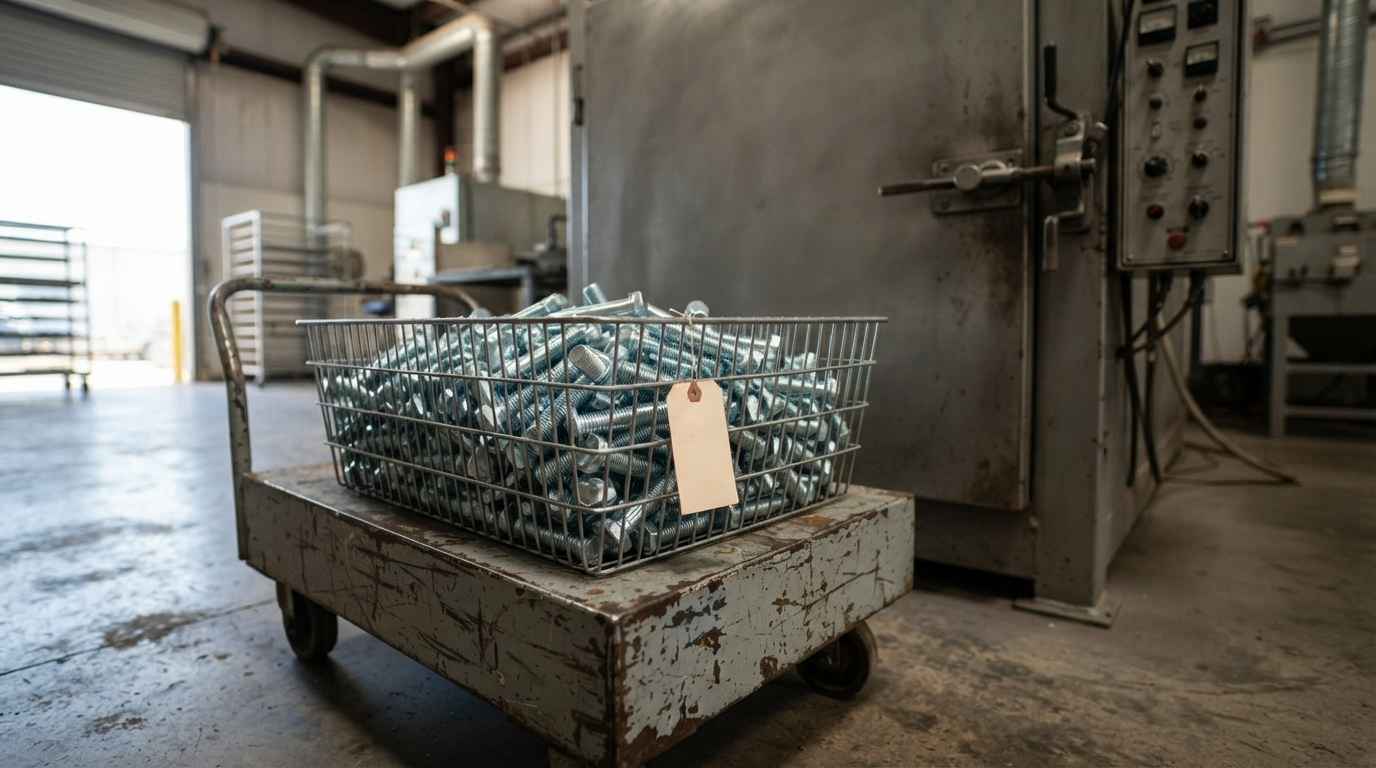
Hydrogen does not change the steel, it changes the margin you thought you had
An embrittled bolt keeps its hardness, its composition and its class marking. What it has lost is the stress at which it separates, and that does not appear on a conventional incoming certificate.
Prevention fits into three lines of the purchase specification. Set the class you actually need, choose a finish without cathodic hydrogen charging for 10.9 and 12.9 wherever the design allows, and if the finish is electrolytic, write down the baking temperature, soak time and maximum delay with a record per batch.
If you have a batch under suspicion, send the failed parts uncleaned, several sound bolts from the same packaging, the delivery note with the batch code and the finishing sheet with the bath and oven times. With that you will know whether the mechanism is hydrogen, whether the source is manufacturing or service and which part of the batch is compromised.
Frequently asked questions
Can an already embrittled batch of bolts be recovered or does it have to be scrapped?
A late bake recovers part of the batch, but it is not a guarantee on its own. The treatment draws out diffusible hydrogen that has not yet acted, so applied to parts that have never been under load it genuinely reduces the risk. What it does not do is reverse a decohesion that has started or empty the irreversible traps, so a batch baked outside the window can only be released if it then passes a preloading test on a representative sample and the remainder is traced. If the batch has already been tightened in service, replacement is the reasonable route, because the parts that have not broken may carry unopened cracks that no treatment closes.
How do you tell a hydrogen failure from overtightening when the head comes off either way?
The criterion that separates them is the time between tightening and fracture, confirmed afterwards by the fracture relief. Overtightening breaks during the operation or in the minutes after it, leaves plastic deformation in the shank or the thread and shows ductile dimples with a shear lip. Hydrogen breaks hours or days later, with no appreciable deformation, and leaves intergranular facets. Where no torque record exists, hardness verification on the broken part helps, because a bolt of correct hardness that breaks without deforming was not beaten by load.
Which parts and which documents do you need to send for the analysis to conclude anything?
Send the failed parts exactly as found, uncleaned and without unscrewing the nut if it stayed on, each one identified with its position in the assembly and the date it was found. Add at least three sound fasteners from the same batch and packaging, which are the comparison reference, and a part from an earlier batch that performed well if you have one. On paper, the delivery note with the batch code, the purchase specification with class and finish, the plater’s sheet with bath and oven times, and the specified torque alongside the recorded one. Without the sound reference and the finishing sheet, the analysis describes the fracture and never reaches the cause.
What drives the cost of a hydrogen embrittlement analysis?
Cost is driven by the number of parts studied, the depth of the fractography and whether hydrogen content has to be determined or a preloading test run on a sample of the batch. A mechanism diagnosis on two or three parts with electron microscopy, elemental analysis of the origin zone and hardness verification sits at the low end of the budget. Moving up to a decision on the whole batch multiplies the scope. What cuts the spend most is arriving with the finishing sheet in hand, because it allows a direct run at the hypothesis instead of sweeping every mechanism. If the aim is to make a claim, decide at the outset whether the report has to meet the formal requirements of an expert report, because that governs how the parts are kept in custody.
How long does the analysis take with the line stopped and the batch blocked?
Usual lead times run from one to four weeks depending on scope, with an urgent route in 24 to 72 hours when a line is down. The mechanism diagnosis on the broken parts sits at the low end of that range, because fractography and elemental analysis need little preparation. The preloading test on a sample and the hydrogen determination take the high end, because the first needs its soak time under load. If you have the batch blocked and a delivery date committed, request an assessment with the broken parts, three sound ones from the same batch and the finishing sheet, and you will get the test order and the schedule before any work starts.