
What was the challenge or problem to solve?
The design and prototyping of a coupling makes it possible to check, before committing resources to industrialisation, whether a new component really improves the way a person uses a device. That was the starting point of this product development project: a company wanted to incorporate a new component into an existing device and needed to know whether that incorporation was feasible and whether it improved the user experience of the end user.
The company had detected that the system used until then was not comfortable. The problem was not in the device’s performance or in its manufacturing, but in the interaction: the gesture of use was perceived as uncomfortable. To solve it, it was looking for an external product engineering team able to analyse different components and mechanisms and to translate that analysis into a first physical prototype with which to make well-founded decisions.
Uncomfortable user experience: the signal that triggers a redesign
The user experience is the set of perceptions and responses of a person when using a product, and it includes the effort required, the precision of the gesture, postural comfort and the ease of understanding what to do without instructions. A product only works when it responds to the real context of use, not only to its technical specifications: it can meet all its requirements on paper and still be uncomfortable in the hand.
In this project, the discomfort detected by the client acted as a warning signal. A company rarely decides to redesign a system that fulfils its mechanical function, unless it perceives that this system conditions the acceptance of the product. On identifying that the user did not find the existing mechanism comfortable, the company assumed that the improvement was not about optimising what it already had, but about studying the incorporation of a different component.
That change of approach marks the difference between a specific adjustment and a product development project. Incorporating a new component requires reviewing the available space, the travel of the mechanism, the forces involved, the materials and the associated manufacturing processes. The comfort perceived by the user is, in reality, the visible result of all those chained technical decisions.
Feasibility analysis: does the component fit in the device?
Technical feasibility analysis consists of verifying, before designing in detail, whether an idea can be materialised with the available materials, components, technologies and constraints. It answers a specific, binary question: can this be done, and under what conditions? It is the phase that prevents advancing towards manufacturing with unverified hypotheses.
The client was not asking for a finished product. It was asking for an answer: whether the component it had in mind could be integrated into its device and whether, in doing so, the interaction was better than that of the previous system. That formulation conditions the whole project, because the objective is not the part itself, but the decision the part makes possible.
Verifying that feasibility requires working on several planes at once. The geometric plane determines whether the component fits and whether its travel does not interfere with the rest of the assembly. The functional plane checks that the mechanism does what it should with the appropriate force and precision. The production plane confirms that the resulting parts can be manufactured with real processes and at a reasonable cost.
Feasibility analysis does not look for the best possible part, but for the most reliable answer as to whether the concept holds up technically before investing in it.

Design of coupling mechanisms for an intuitive interaction
The technical challenge taken on by the Product Development team was to propose different systems that would allow a simple and optimal user interaction. The difficulty of this type of assignment is counterintuitive: the simpler a gesture must seem to the user, the more engineering work the mechanism that makes it possible requires.
A coupling is the element that joins two components in a controlled way, guaranteeing their relative position and, where appropriate, allowing them to be assembled and disassembled repeatably. Designing it involves managing the play between parts, the dimensional tolerances, the guiding during assembly and the feedback the person perceives on completing the gesture.
That is why the approach was not to propose a single solution. It was to open several lines of work, each with a different mechanism, so that the client could compare real alternatives before committing to one. This approach is characteristic of the product design and innovation service: first the range of viable options is widened and then it is narrowed, with technical criteria and with the client at the table.
How was it addressed or what was the solution?
The project was approached in chained phases, so that each one solved a specific unknown and provided information to the next. INFINITIA’s Product Development team worked by providing an independent engineering criterion and the industrial vision that makes it possible to go from a need expressed in terms of comfort to a manipulable physical prototype.
The logic of that sequence is simple: first understand what is needed and what solutions already exist, generate and filter concepts until materialising the chosen one in a digital model and, finally, manufacture it, assemble it and put it in the client’s hands. Each step reduces uncertainty and prevents the final prototype from arriving loaded with unverified decisions.
Preliminary study and benchmarking: from the need to the real requirements
The first task consisted of analysing the information provided by the client about the selected components and about the different needs the project had to cover. This preliminary study and maturation of the idea makes it possible to order the assignment before drawing anything, distinguishing between what is a real requirement and what is a preference subject to discussion, and identifying the critical components, those whose behaviour conditions the operation of the whole and on which it is worth concentrating the technical effort.
On that basis, a study was made of the technologies, components and mechanisms present in the commercial devices that already use the type of component the client was looking for. Technical benchmarking consists of analysing existing solutions to extract requirements, limits and proven good practices, instead of starting from a blank page. It reveals requirements that do not appear in the initial brief but that the market has already solved, and it anticipates limitations: if all the solutions share a constraint, that constraint usually responds to a physical or production reason.
Observing how the market solves the same problem reduces design risk, because each commercial solution is a requirement already validated in real use.
Both phases together defined the playing field before designing: what was negotiable, what was fixed and what had to be verified experimentally. Analysing consolidated technologies does not limit innovation, it guides it, because it makes it possible to know what ground is explored and where there is real room to propose something different. That is exactly the information a team needs before entering the ideation phase.
Ideation, 3D CAD design and additive manufacturing of the parts
With the requirements and the technological map on the table, the team tackled ideation and concepts. Through a brainstorming process, different concepts were proposed for each mechanism and system, each as a different way of solving the same interaction, and all evaluated against the same criteria: whether they meet the requirements, whether they are manufacturable and whether they solve the comfort of the gesture. The evaluation and the selection of the most suitable concept were carried out together with the client, which ensures that the subsequent development responds to all the requirements, including those the company knows from experience and that are not always written down.
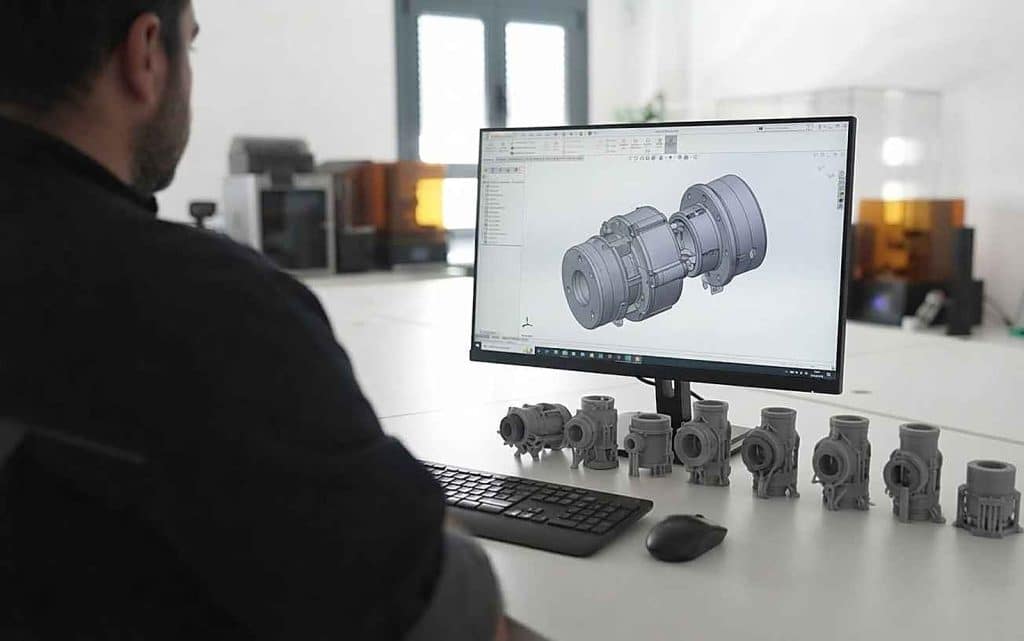
Once the concept was defined, the 3D development of the different parts was carried out with professional CAD design software, that is, computer-aided design tools that make it possible to build a parametric three-dimensional model of the assembly, check interferences between parts and anticipate how the mechanism will behave before manufacturing anything. In this same phase the materials, components and manufacturing processes of the final prototype were established, so that each decision of form was made knowing with which material and with which process it was going to be materialised.
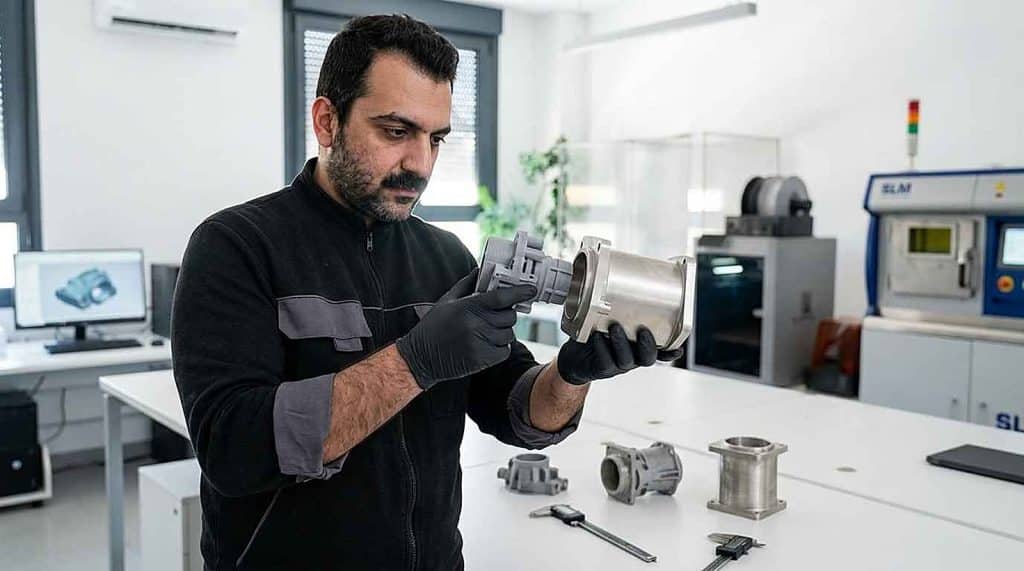
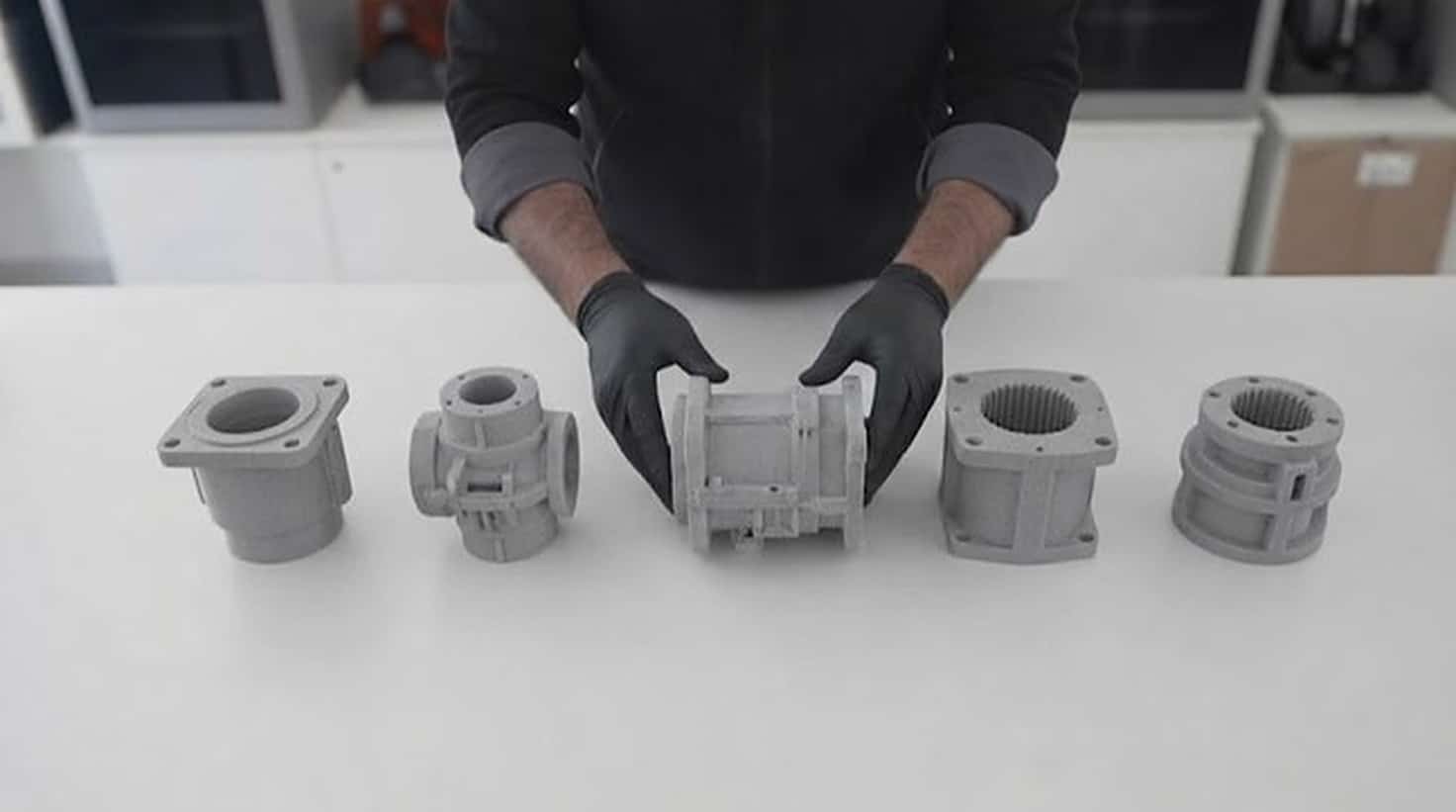
The designed elements were tested by manufacturing different parts through additive manufacturing. That short cycle between design and physical part is what turns industrial 3D printing into a verification tool, and not only a representation one: each iteration discards or confirms a hypothesis, and the CAD model incorporates the learning of the previous one before manufacturing the final prototype.
Manufacturing to test, and not only to show, is what makes it possible to correct a mechanism while the change still costs hours and not weeks.
Functional prototype: assembly and testing at the client’s premises
The last phase consisted of the manufacture of the prototype, its assembly and its testing. The final parts were also manufactured through additive manufacturing, which kept the coherence between what was verified during the iterations and the definitive assembly. A functional prototype is one that reproduces the real behaviour of the product, so that it can be handled and evaluated as the finished product would be evaluated.
After internal testing, the team travelled to the client’s premises to show the prototype in its environment. Explaining first-hand the complete operation of the product allows the company to understand the design decisions and, once the project is finished, to carry out internally the tests it deems appropriate with its own criteria. The knowledge is transferred with the part.
The result of the project answers the question it started with. With this first prototype the client was able to determine the feasibility of incorporating the new component and validate the interaction with the system, that is, to check with its hands whether the gesture of use was effectively simpler. That is the function of industrial prototyping in the early phases of a development: to turn an intuition about comfort into manipulable evidence.
When the starting doubt is whether a component fits and whether it improves the way a device is used, a well-planned prototype resolves in weeks what an internal debate does not close in months.