
What was the challenge or problem to solve?
IP testing for large-dimension equipment consists of verifying the degree of protection that a large enclosure offers against the ingress of dust and water, following an international standard. The difficulty is that most standard test chambers and equipment are designed for small- or medium-sized components, so verifying a bulky piece of equipment becomes a complex problem to solve.
That was the starting point. A manufacturer needed to check whether one of its pieces of equipment, far larger than usual for this type of test, met the requirements of an IP5X test. The difficulty was not in the acceptance criterion, which the standard defines precisely, but in having a setup capable of subjecting that equipment to the required conditions without distorting the result. That is where INFINITIA came in, designing a custom rig for this large piece of equipment.
IP testing according to IEC 60529: what degree of protection it verifies
The IP protection rating (Ingress Protection) is a standardised code that classifies how much protection a product’s enclosure provides against external agents. The first digit indicates protection against solid bodies and dust, and the second, protection against water. When one of the two is not evaluated, it is replaced by an X: that is why IP5X designates equipment tested only against dust, with no assessment of its behaviour against water.
The IEC 60529 standard defines both the procedure and the conformity criterion. At level 5 of the first digit, the enclosure is considered protected against dust when the amount that may penetrate does not interfere with the equipment’s operation or compromise its safety, without requiring absolute tightness. Level 6, on the other hand, does require the total absence of ingress. That difference conditions how the result is evaluated, because level 5 requires inspecting the interior and interpreting what is observed, not giving an automatic pass.
Understanding this logic is the first step of any IP or tightness tests project. The IP classification does not describe a generic quality of the product, but the result of a specific test executed under specific conditions. To go deeper into reading the code, it is worth reviewing what each IP protection rating means and which products each level applies to.
IP5X testing in large-dimension equipment: the limit of conventional tests
The dust-tightness test is carried out in a chamber where sifted talc dust is kept in suspension, distributed homogeneously by pressurised air for a set time. The standard fixes the amount of talc according to the volume of the chamber and distinguishes two categories of enclosure depending on whether the equipment generates internal depression during its normal use, which determines whether the test is carried out with or without forced suction.
This approach works normally with small-sized products, such as electronic components, luminaires, connectors or device housings, for which commercial chambers are dimensioned. The problem appears when the equipment does not fit in any available setup, when its geometry prevents uniform exposure or when its volume alters the relationship between equipment and test space that the procedure assumes.
An IP test is only valid if the exposure conditions reproduce what the standard requires. In large equipment, ensuring this depends on the setup, not on the chamber.

For the manufacturer, this limitation was a dead end. Without a suitable setup there was no way to obtain technical evidence about the equipment’s behaviour against dust or to decide with criteria whether its design of seals and closures was sufficient. The real need was not “to run a test”, but to first resolve the means that would make it possible.
Custom test setup: designing without a previous reference
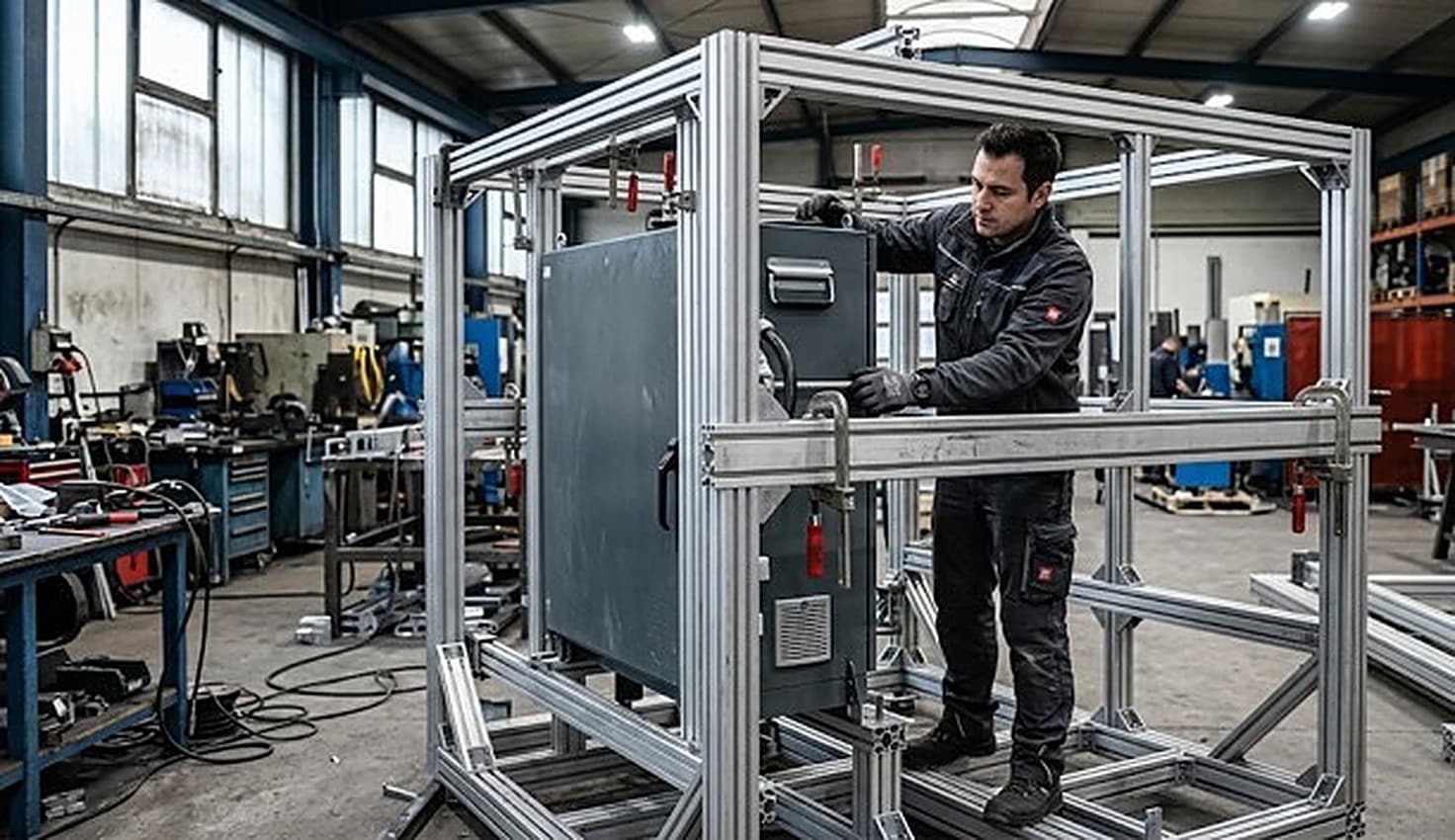
The challenge INFINITIA took on was to conceive and manufacture a custom test setup that would allow the standardised procedure to be applied to equipment for which no standard solution exists. A test setup capable of reproducing the standardised conditions of the test.
The difficulty of such an assignment is twofold. On one hand, there is a non-negotiable normative constraint: any design decision that alters the exposure conditions invalidates the test. On the other, there is a physical constraint, since the setup must support a bulky piece of equipment, allow it to be handled and guarantee that the entire enclosure is subjected to the same test environment.
This kind of project sits squarely in the field of mechanical product development, where the geometry, the materials and the manufacturing feasibility are defined from a demanding functional requirement.
How was it addressed or what was the solution?
The project was approached as a complete and orderly development, not as a workshop improvisation. INFINITIA’s Product Development team worked in three chained phases: study of the standard and conceptual design, manufacture and validation of the setup, and execution of the IP5X test with the subsequent documented analysis of the results.
The result was a setup manufactured entirely to measure and prepared for the specific test, with which to verify whether or not the equipment met the requirements needed to pass an IP5X test. That answer, a yes or a no backed by evidence, was precisely what the client could not obtain by its own means.
Analysis of the applicable standard and conceptual design of the setup
The first task was to study in depth the standard applicable to the test. Knowing in detail what conditions it requires makes it possible to ensure that the setup meets them at all times, instead of discovering deviations once the test is already underway and the result lacks validity.
With that framework defined, the work moved to the conceptual level. Through a process of research and brainstorming, several setup design options were generated, instead of a single closed proposal. Raising alternatives in an early phase is a common practice in product development because it allows solutions to be compared before committing material, time and budget to a specific direction.
Each concept was evaluated against the same criteria: normative compliance, ability to hold the equipment, uniformity of exposure and real manufacturing feasibility. This filter reduces the risk of later redesign, which in a test setup is especially costly because it forces the whole test to be repeated.
Manufacture of the setup and validation with an accredited certifier
Once the concept was selected, the setup was manufactured taking into account all the established requirements. The phase included the purchase of the necessary material and, once acquired, the assembly of the whole.
Validation of the setup by an accredited certifier turns a custom setup into a testing means defensible before third parties.
Once the setup was assembled, it was verified with the accredited certifier that it conformed to what was required. This step separates a functional setup from a valid one. A test whose means has not been externally verified may give a technically coherent result and still not serve as proof before a client, a body or a claim.
The experience accumulated in tailored tests and in projects such as the design and manufacture of a custom setup for testing metal parts makes it possible to anticipate at this phase the points that usually generate incidents, from the fixing of the sample to the control of the conditions throughout the whole cycle.
How an IP5X test is executed and its results analysed
With the setup manufactured and verified, it was calibrated together with the equipment to be tested. Calibration adjusts the setup to the real part: it checks that the fixing is correct, that the position of the equipment is the intended one and that the exposure conditions remain stable before the test is considered started. Next, the IP5X test was carried out, with the equipment subjected to the dust environment under the conditions and for the time set by the procedure, without interventions that could alter the result.
Once the test was finished, the analysis of results was carried out in accordance with the conformity criterion. To do so, the different housings of the equipment were opened and it was verified whether or not dust ingress had occurred inside. This inspection is the core of the IP5X criterion, because conformity is not deduced from the outside, it is checked by opening the enclosure and observing what has happened inside.
Documenting the before and after by zones turns a tightness test result into actionable information for the redesign.
With the data obtained, the before and after of the equipment was documented graphically, showing the different inspected zones, in a report useful for the client that needed to determine whether or not the equipment complied. A visual record by zones provides something that a written conclusion does not give on its own: it makes it possible to locate where the dust ingress concentrates and, if the result is not compliant, to steer the redesign of seals, closures or cable glands towards the exact point that causes it.
The project is considered a success because it made it possible to manufacture a setup entirely to measure and prepared for the specific test, with which to verify whether the equipment met the IP5X requirements. For the manufacturer, that meant going from an apparently insurmountable limitation, the lack of a testing means compatible with its product, to a well-founded technical decision. When a product falls outside the reach of conventional testing equipment, the way forward is usually not to give up on verification, but to design the means that makes it possible.