
What was the challenge or problem to solve?
A company had a patent on a product idea and needed to take it a step further; it required a product feasibility study. Its objective was twofold: to reach a workable design to launch the product on the market or, alternatively, to offer it to potential buyers interested in exploiting it. In both scenarios, the prior condition was the same: to demonstrate that the idea could be manufactured.
To support that idea, the client had graphic material that gave the product a defined aesthetic look and was useful for conveying the concept to investors. But the client itself identified a gap: that material covered only the aesthetic plane, without going into the constructive or functional level. This is where INFINITIA stepped in, commissioned to carry out a feasibility analysis that would yield an industrially achievable design taking into account aesthetics, manufacturing processes and materials.
How to turn intellectual property into a manufacturable product
Intellectual property protects an idea, a concept or a technical solution, but it does not describe how to build it. A registration delimits what is protected and against whom; manufacturing demands completely different information: defined geometries, thicknesses, tolerances, joints between parts, assembly sequence, specific production processes and materials with verifiable properties. Between the two extremes there is a technical distance that can only be covered through engineering.
That distance conditioned the client’s two paths. To launch the product on its own it needed a design with a level of definition sufficient to be manufactured; to offer it to third parties it needed a credible technical asset, capable of demonstrating that the idea does not stay on paper. A concept without constructive backing is hard to value and complicated to negotiate.
In industrial product development, a design is considered achievable when it can be manufactured with available processes and materials, fulfils the intended function and keeps the original aesthetic intention. That triple condition is what transforms a registered idea into a product. The challenge, therefore, was neither aesthetic nor conceptual, but technical and about decisions: determining which parts of the idea were viable as posed, which required a constructive alternative and what implications each option had on cost, process and the final result.
Why renders and graphic material are not enough to manufacture
Product graphic material (sketches, renders and photorealistic images) fulfils a real and valuable function: to communicate. It allows an investor, a partner or a potential customer to understand at a glance what is proposed, what it will look like and what place it could occupy in the market. It is a tool for alignment and communication, not a manufacturing document.
A render communicates how the product will look. Only a constructive design explains how it is manufactured, with what material and why it works.

The difference is substantial. A photorealistic image can depict continuous surfaces without indicating where the parts separate, show mechanisms that have no internal space to house them, or suggest finishes that no process reproduces at a reasonable cost. These are not errors of the graphic material: it simply answers a different question. When it is taken as the basis for manufacturing, the problems do not disappear, they are postponed to the most expensive phase of the project. That is why the request was not to improve the product’s image, but to check whether behind that image there was a possible product, avoiding one of the most frequent errors: confusing aesthetic validation with technical validation.
Technical feasibility analysis of an industrial design
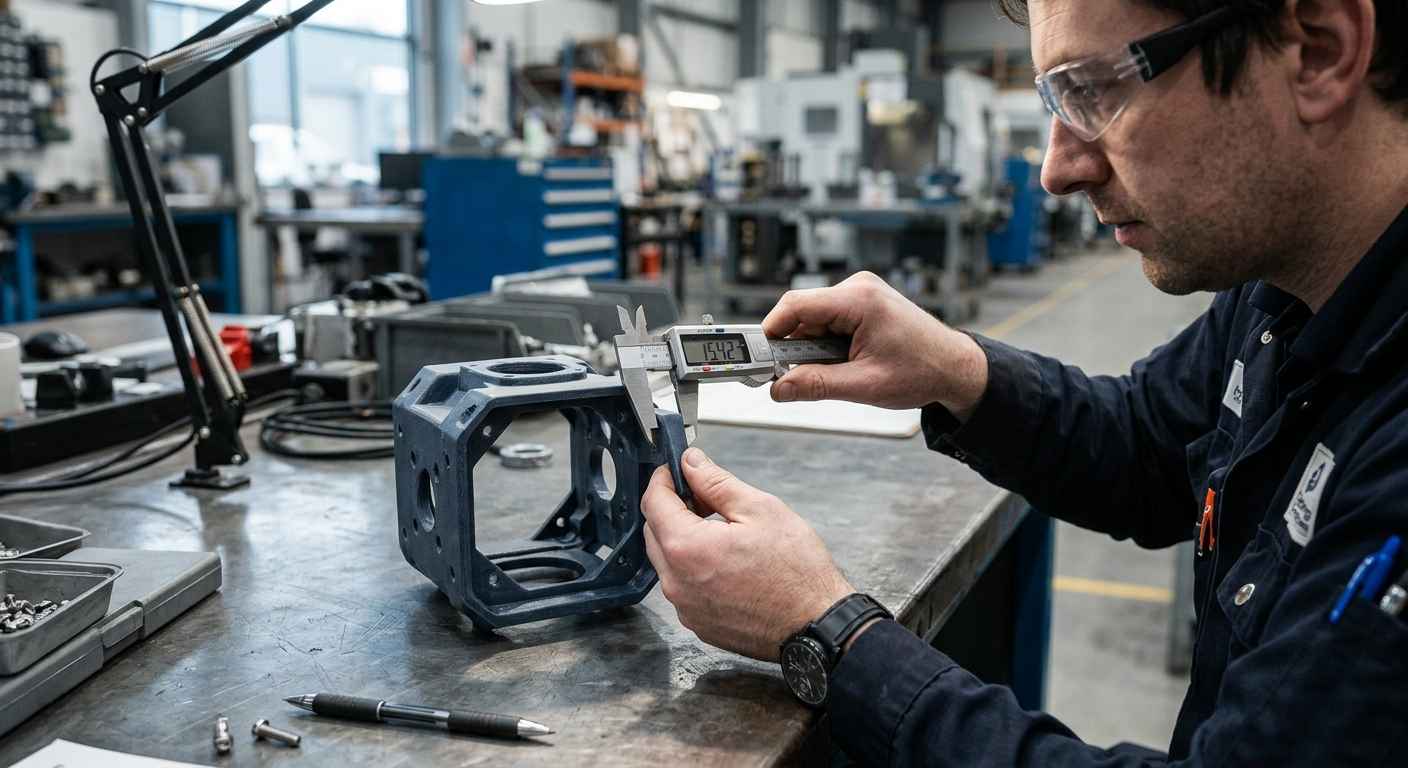
Technical feasibility analysis is the process by which it is determined whether the design and specifications of a product are achievable, identifying technical obstacles and adjusting the design when necessary. It is not an after-the-fact approval report: it is a work phase that acts on the design itself and conditions the project’s later decisions.
In this case, the challenge taken on by INFINITIA’s Product Development team was to reconcile three requirements that tend to pull in opposite directions: aesthetics, because the already-defined look was part of the value proposition; manufacturing processes, because each technology imposes its own geometric restrictions; and materials, because the function, durability and much of the cost depend on them.
Reconciling them means deciding with an industrial criterion, not always choosing the technically most brilliant solution. A geometry can be resolved in several ways, and the right one respects the design intention, is manufactured with accessible processes and uses materials that meet the requirements. The technical feasibility analysis of a product makes it possible to anticipate those conflicts at the design stage, when correcting them costs engineering hours and not tooling modifications.
How was it addressed or what was the solution?
The project was approached as an orderly process in four chained tasks, in which each one resolved a specific question before enabling the next: what the product had to meet and how to resolve its design problems; how the chosen solution was materialised in a complete model; and what regulatory framework and what materials were suitable to manufacture it.
That order is not accidental: advancing towards modelling before fixing the requirements multiplies the iterations, and selecting materials before knowing the real geometry leads to decisions that have to be redone later. The team worked in direct collaboration with the client throughout the whole path, so that the redesign advanced aligned with its interests and not only with internal technical criteria.
Product requirements and mechanism study for the redesign
The first task was to establish a series of product requirements to serve as a starting point. To do so, the team got in direct contact with the client to learn first-hand its needs and real objectives. Requirements are the set of needs, functionalities, restrictions and performance criteria that a product must satisfy, and defining them in writing turns an expectation into a verifiable criterion: instead of discussing whether the design is correct, it is checked whether it meets what was agreed.
Working them together with the client also provides a benefit beyond the document, because it makes it possible to understand its objectives in depth, including those that are not strictly technical, such as the planned route for exploiting the intellectual property. The definition of product requirements and specifications is, for this reason, the phase that sustains all the later decisions.
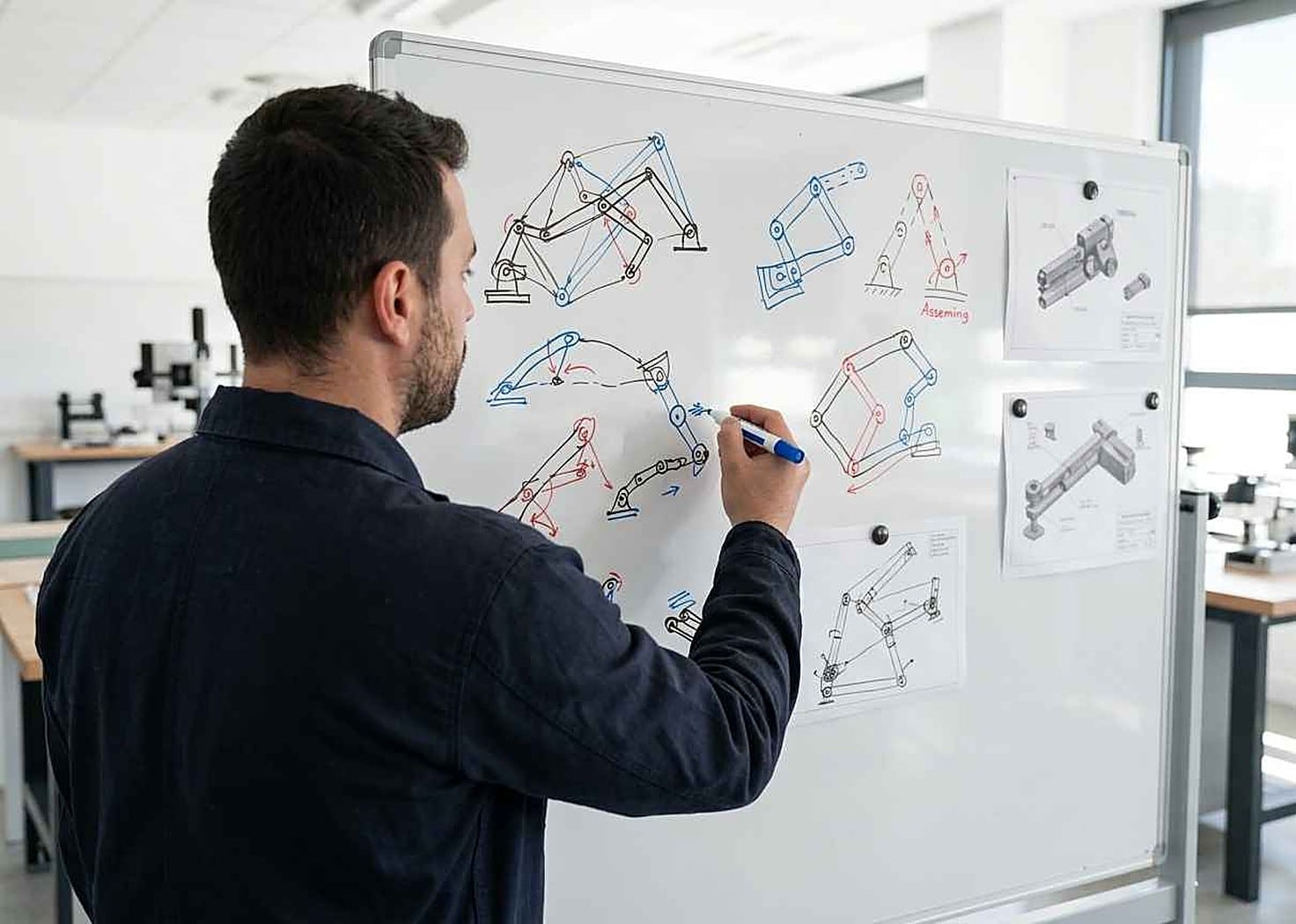
With the requirements fixed, the team put forward improvement proposals focused on viability, obtained through research and brainstorming sessions, and studied in parallel possible mechanisms that would solve the design problems.
Exploring several mechanism alternatives before modelling reduces the risk of redesign when the product advances towards manufacturing.
The result of this stage was the definition of the line of work to develop. This way of working is characteristic of the product ideation and concepts phases, in which the controlled divergence of ideas precedes a reasoned convergence towards the solution that best balances function, aesthetics and manufacturability.
Full 3D CAD modeling of all the parts
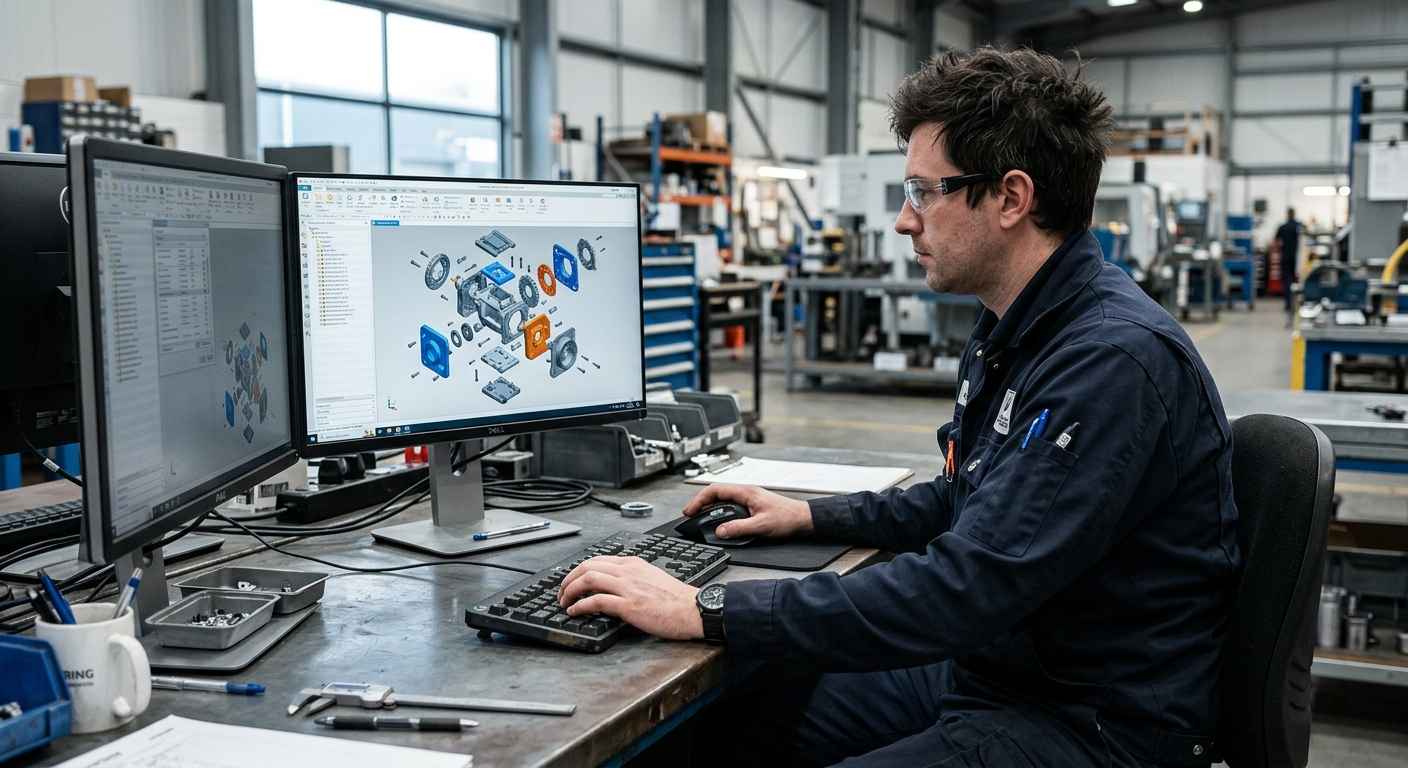
Once the line of work was defined, the complete design of the product was carried out to a sufficient level of definition. For this, professional 3D CAD design software was used, with which all the three-dimensional models of the redesigned product’s parts were obtained.
Computer-aided design (CAD) makes it possible to generate precise three-dimensional models of each part and of its assembly. Its value is not only in representing the geometry, but in allowing complete control of the design: checking interferences between parts, verifying internal spaces, evaluating the assembly and anticipating how the whole will behave before manufacturing anything.
The decisive advantage of modelling is the ability to iterate: modifying a dimension, changing a thickness or reorganising a subassembly does not entail an appreciable loss of time, whereas the same modification on an already-manufactured mould implies cost and lead time. The 3D design and modeling using CAD service relies on this logic of controlled iteration. Reaching a sufficient level of definition means that the model no longer describes an intention, but a product: each part has a concrete geometry, an assigned function and a defined relationship with the others.
Product regulations and material selection for manufacturing
The last task consisted of a search and analysis of the possible regulations applicable to the product typology, studying the requirements that the materials had to meet for manufacturing, with a clear objective: to select the materials that best suited the requirements defined at the start.
This order deserves attention, because it is often forgotten. The applicable regulations are not a step subsequent to design, but a source of technical requirements: the reference industrial frameworks (ISO, UNE or ASTM depending on the typology and sector) set conditions on composition, performance, safety or required tests. Knowing them before deciding the material prevents a technically correct product from becoming unfeasible for breaching a condition that was known in advance.
Material selection stops being an open choice when the regulatory requirements are identified before deciding, and not after designing.
With that information, material selection becomes a bounded and traceable decision: the necessary properties, compatibility with the manufacturing process, expected behaviour in use and applicable regulatory restrictions are contrasted, and the option that best balances that set is chosen. In this way, the client went from having an idea to having an industrialisable design, contrasted against requirements, processes and regulations. That design is the asset that turns intellectual property into a solid base on which to decide: manufacture, look for a buyer or advance towards the industrial prototyping and industrialisation phases. A feasibility study does not eliminate all the uncertainty, but it moves it to the moment in the project when correcting is still cheap.