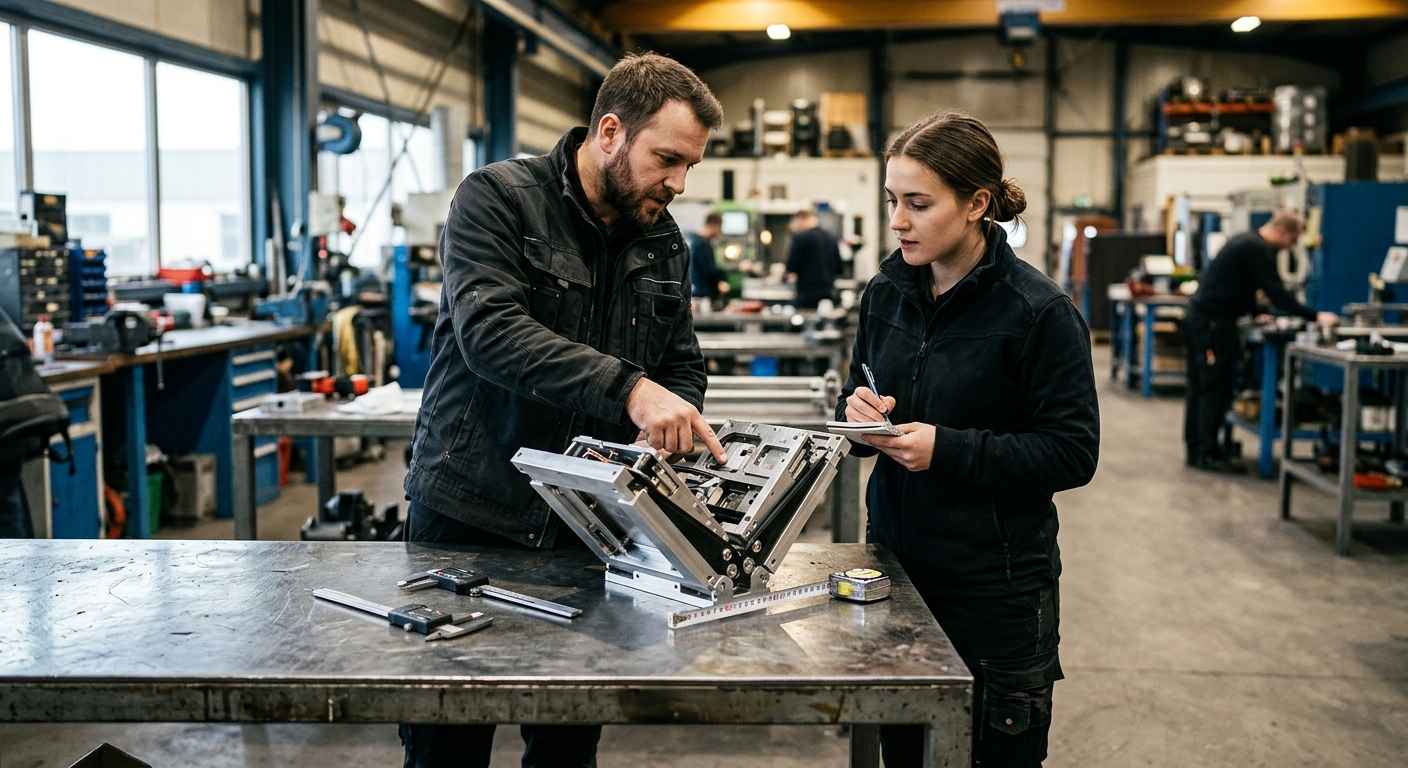

What was the challenge or problem to solve?
Product redesign is the engineering phase in which an already-conceived product is rethought in its form, its structure and its mechanism before facing full development. It is not about redrawing what already exists, but about reviewing what works, what limits and what is worth changing while modifying it is still cheap.
A company approached INFINITIA with an already-protected idea and a very specific doubt about how to continue. It had a registered utility model and needed a partner to help it map out the next steps of product development and to carry out its redesign.
What to do with an already-registered utility model
A utility model is an industrial property title that protects industrially applicable inventions consisting of giving an object or product a configuration, structure or composition from which a practically appreciable advantage for its use or manufacture results.
That title certifies that the invention exists and that it provides a functional advantage, but it does not solve development. A registration protects the configuration; it does not select materials, does not set tolerances, does not describe how the product will be manufactured nor ensure that its appearance convinces the end user. Between the registered document and a product ready to manufacture lies an engineering path that begins by defining product requirements and specifications.
It is worth underlining a distinction that completely conditioned this project: what was protected was the practical utility of the configuration, while what had to be improved was the appearance, which the registration did not cover. The client had the first dimension covered and needed to work on the second without compromising what was already registered.
That is why the question it brought to INFINITIA’s Product Development team was not only aesthetic. It was a roadmap question: what to do next, in what order and with what technical criteria, so that the decisions taken in this phase would not force the work to be redone in the next.
Why address resting aesthetics before full development
The client identified a specific weak point. The product performed its function, but its appearance when not in use did not match: the structure was left exposed and the assembly took up more space than desired. In a product that remains in view for much of its useful life, that resting state matters as much as the working state, because it is the one the user has in front of them most of the time.
The decision was to tackle the aesthetic redesign before full development, and not after. That order is decisive. When aesthetics are addressed at the end, on an already-closed mechanical architecture, the room for manoeuvre is reduced to adding casings or trims, which almost always add volume, weight, parts and cost without solving the underlying problem.
Improving a product’s aesthetics at rest is rarely a matter of finish: it forces a rethink of the folding architecture and the space it occupies.

Addressing it in the product design and innovation phase allowed the opposite: treating appearance as a consequence of the product’s architecture and not as a superimposed layer. If the structure folds in on itself and disappears from view, the aesthetic result is obtained by design, with fewer added elements and less volume.
Integrating the technical, structural and aesthetic
The challenge INFINITIA took on was to reach a point that would serve as the basis for future development, taking into account, at the same time, the technical, structural and aesthetic aspects. Each of those three planes pulls in a different direction and the real difficulty lies in solving them together, not separately.
The tension is easy to describe. Hiding the structure requires folding it away, and folding it requires joints, guides or pivot points that introduce new clearances and stresses in areas that did not bear them before. Reducing the space occupied forces compaction, and compacting restricts the travel of the moving elements. Any proposal that ignored one of the three dimensions would have produced concepts that were attractive but unfeasible, or feasible but indifferent.
Added to this was an unusual starting constraint: the work had to respect what was already registered. A redesign in this context does not start from a blank sheet, but from a protected configuration on which one must innovate without blurring what constitutes its practical advantage, which is precisely what the title protects.
The commission, moreover, was not to produce a closed design nor to move directly to the mechanical development of the parts. It was to generate a contrasted base on which to decide. That nuance changes the type of deliverable: the aim was not a single finished solution, but alternatives that were understandable, comparable and mature enough to support an investment decision.
How was it addressed or what was the solution?
The project was structured as a process of ideation and conceptual design, the phase of product development in which alternatives are generated and evaluated before committing resources to detailed engineering. INFINITIA’s Product Development team worked in four chained stages, from the general to the specific.
The logic of the chaining is simple: first understand the context, then explore the mechanism, then explore the appearance and, finally, decide together with the client. Each stage narrowed the uncertainty of the next and none advanced on unverified assumptions, which is the way to prevent an initial planning error from propagating to the expensive phases of the project.
Market study and benchmarking as a starting point
The work began with a preliminary market study and of the current trends of the product typology. This type of analysis, also known as benchmarking, consists of systematically examining the existing products in a segment to understand what solutions are being adopted, with what technical resources they are solved and where their limits are.
The team analysed by parts the different aspects that affect the product and drew from it a series of conclusions. Breaking down the analysis into blocks, instead of assessing each reference as a whole, makes it possible to compare specific solutions between products that at first glance are very different and to draw lessons from neighbouring segments.
The study provided both aesthetic and functional information on the main products involved or related in some way to the product being developed. That double reading was essential in this case: the challenge mixed appearance and mechanism, and observing only one of the two sides would have left out half the problem.
This preliminary study and idea maturation fulfils a function that goes beyond compiling references. It places the development against the real state of the art, avoids reinventing already-surpassed solutions and provides objective criteria to justify, later, why one path is discarded and another chosen.
Generating folding and aesthetic concepts with illustrations
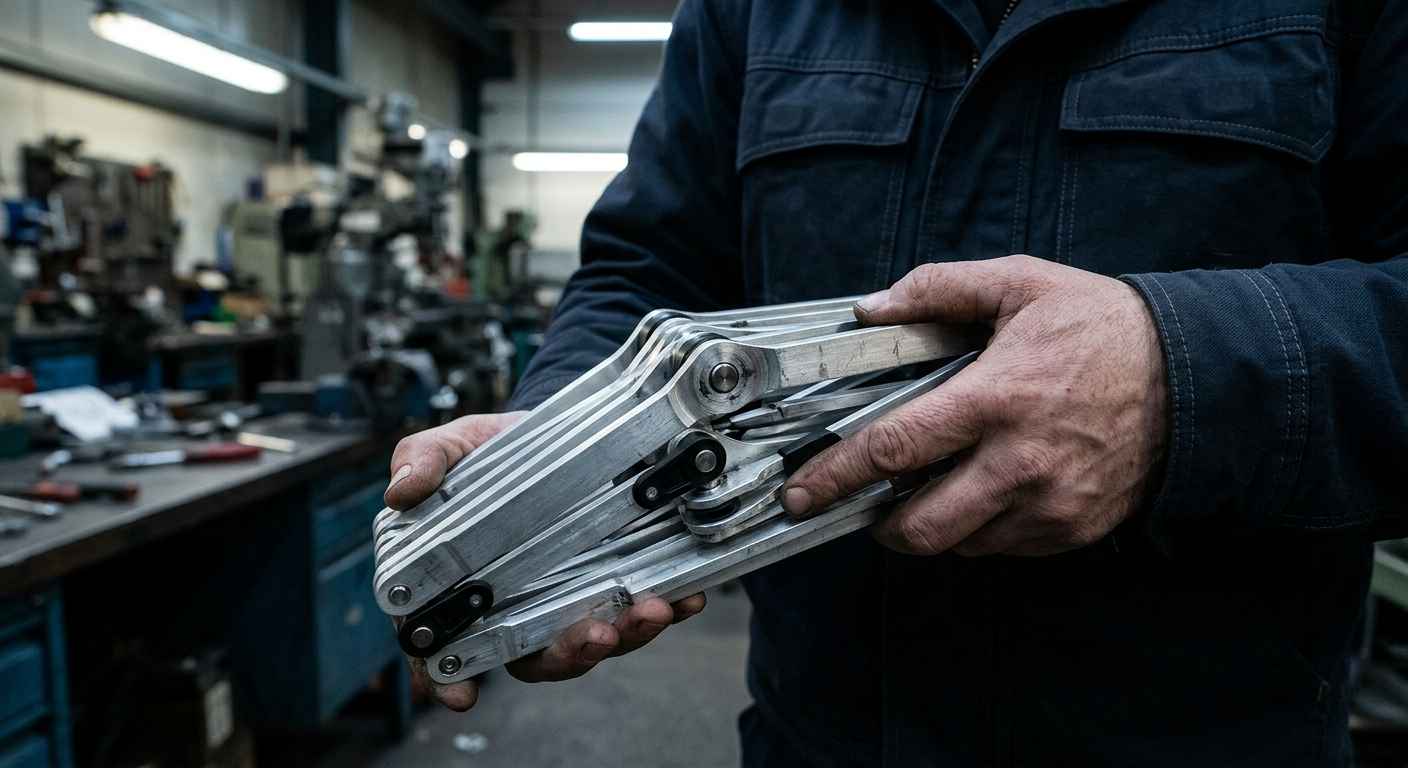
The second stage tackled the core of the challenge: a conceptual proposal of folding systems to hide the product’s structure when not in use. A folding system is the set of articulated elements that allows a product to move from its working configuration to a folded configuration, and vice versa, in a repeatable and controlled way.
Through a brainstorming process, different mechanism options were proposed at a conceptual level. The idea-generation session does not seek the definitive solution, but deliberately broadens the range of possibilities before starting to discard, which is the moment when technical criteria are applied most demandingly.
The choice of folding mechanism at the conceptual stage conditions the cost of every engineering decision that comes after.
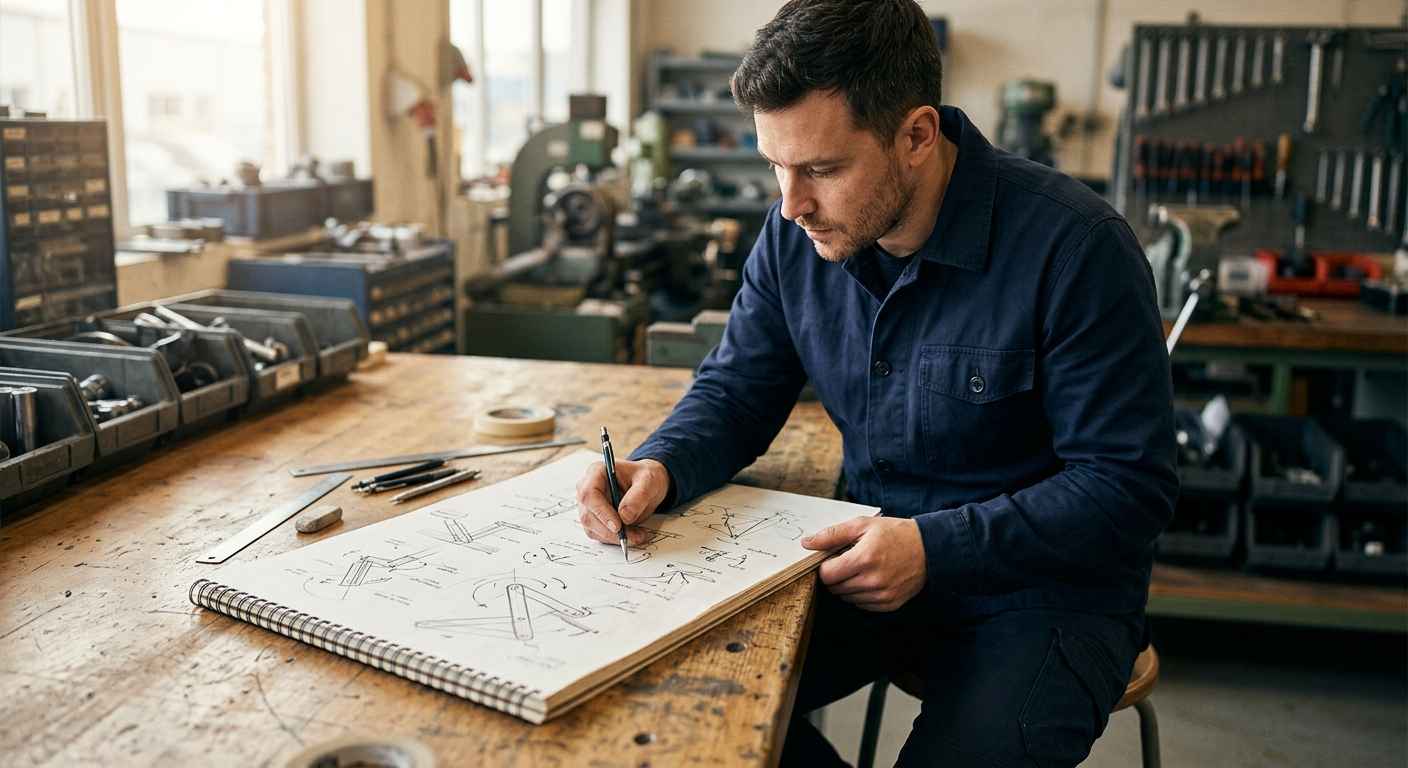
For each option, diagrams and illustrations were produced. Producing diagrams helps to better understand the idea without going deep into mechanical development, and therein lies their value: they represent how the mechanism moves and in which direction, at a cost in hours far lower than that of a complete modelling and without yet closing geometries or components. A concept discarded on a diagram costs a few hours; the same concept discarded after detailed engineering costs weeks and drags along decisions already taken.
With the mechanism plane resolved at a conceptual level, the team generated a series of conceptual aesthetic proposals for the product. Here too a brainstorming process was used, from which came different proposals made up of high-quality illustrations.
The level of finish of the graphic material is not a minor detail. An aesthetic can only be assessed by seeing it, and a poor representation conditions judgement: good ideas that are badly drawn are discarded and mediocre ideas that are well presented are approved. High-quality illustrations neutralise that bias and allow the decision to fall on the proposal and not on its representation.
These proposals made it possible to have a view of the possible aesthetics that could be interesting for the definitive development of the product. The aim was not to close an image, but to open a range of formal directions coherent with the folding systems explored in the previous stage, so that each aesthetic proposal was compatible with at least one of the folding architectures proposed and no visual direction was left without a mechanical solution capable of sustaining it.
Choosing the concept to develop together with the client
From the results obtained in the concept generation, three lines of work were proposed, which were presented to the client to determine which of them to develop. Presenting a limited number of alternatives, instead of a single option or an unmanageable catalogue, is what makes it possible to truly compare and decide with criteria.
With the client’s collaboration, the best option was selected according to its needs and, in this way, the next steps for the product’s development could be defined. No one knows their commercial priorities, their deadlines and their industrial capacity better than the client, and those variables weigh as much as the technical ones when choosing a path.
Presenting several lines of work and deciding together with the client prevents product redesign from advancing on an unvalidated aesthetic hypothesis.
The project is considered a success because it managed to improve the product’s aesthetics when not in use, which was the client’s objective, reducing the space it occupies and improving the folding mechanism. These are results already obtained on the concept, before committing the investment of full development and subsequent prototyping.
With the chosen line of work and the next steps defined, the product was ready to face the later development phases with an already-contrasted technical and formal base.