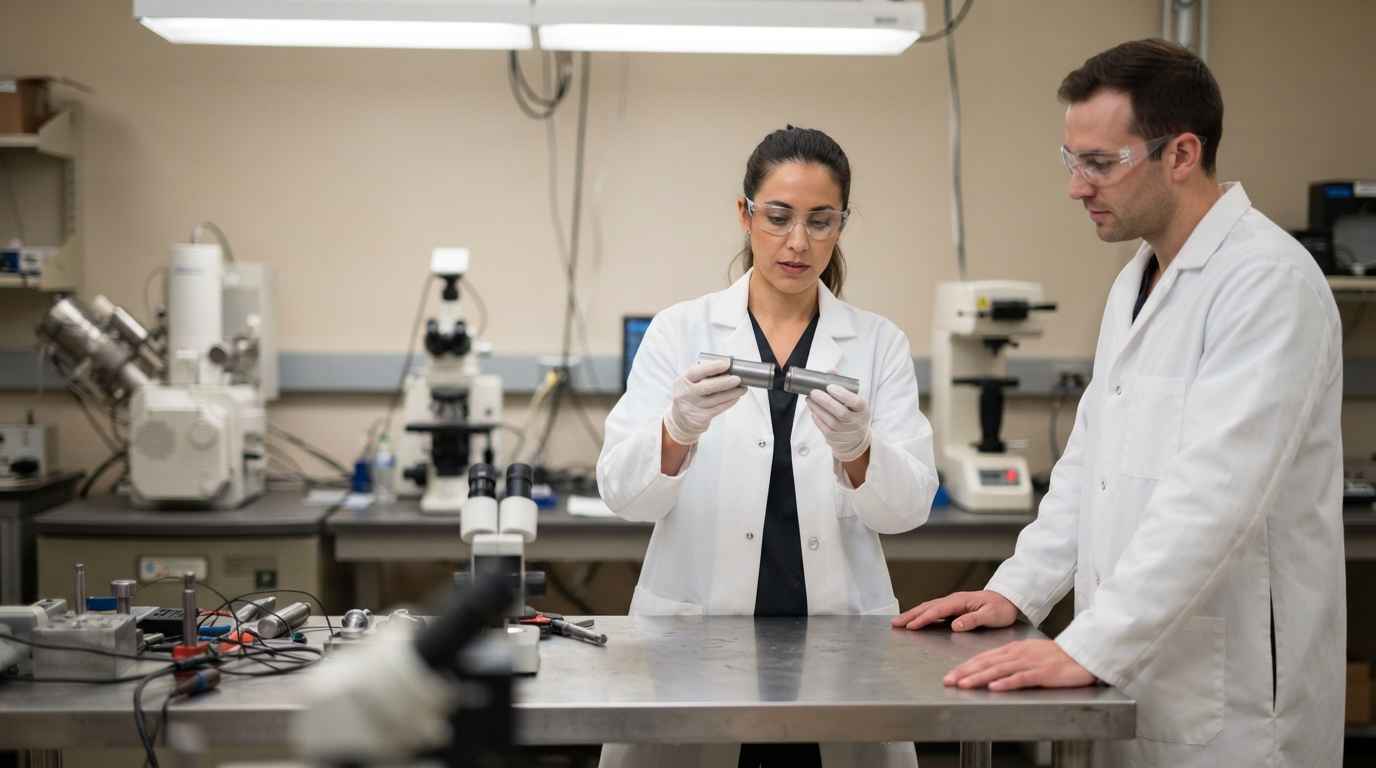

An industrial expert report is the document in which an independent engineer determines the cause of a failure or of damage and records it so that it holds up before a third party. What separates it from an advisory technical report is not the technique it uses, it is the trail it leaves of every step.
That difference shows up when the report stops being an aid to decide and becomes a document somebody is going to contest. An incident with damage to third parties, a warranty the supplier rejects. There you need more than the diagnosis, you need the proof of how it was reached, and that is what expert reports are built around.
The starting techniques are the same as in any failure investigation, and forensic engineering applies them identically in both assignments. What changes is the constraint, because technical consulting aimed at an expert opinion assumes from the first call that every decision taken on the sample will be reviewed by someone arguing the opposite case.
EXPERT REPORTS
Do you have a failure that may end in a claim? Discover our expert reports service

What sets an industrial expert report apart from an advisory report
An industrial expert report and an advisory report differ in who reads them. The advisory report is written so that you decide; the expert report, so that a third party who was not there can check that the conclusion holds.
An advisory report can afford a well argued hypothesis. An expert opinion can only state what a documented test demonstrates on a sample whose route has been recorded since it came off the machine.
What each document is for, deciding or substantiating
The advisory report answers an operational question, what is happening and what you do tomorrow. It allows you to drop lines of enquiry on cost grounds and to leave two compatible causes open if that is enough to correct the process.
The expert opinion answers a different question, what can be stated and on what support. It does not allow a probable cause to be presented as the cause, and it forces you to separate what was observed from what was interpreted and to declare the certainty of each statement. If two mechanisms remain compatible with the evidence, the report says so.
What changes in the method when the report will be contested
When the report will be contested, four things change: how the part is received, what is recorded about its initial condition, in what order the tests are run and how much sample is set aside untouched. All four are decided at the start, because none of them can be recovered later.
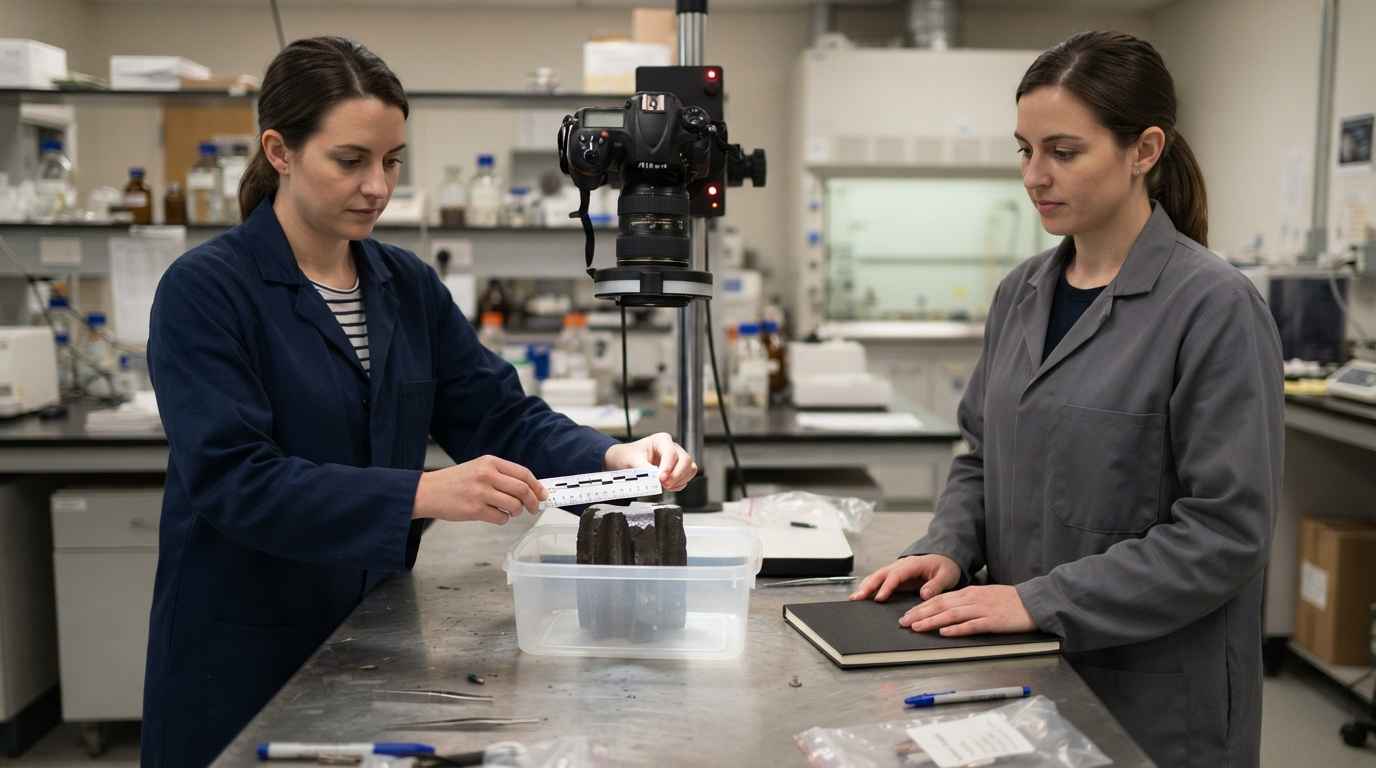
The test sequence cannot be undone. The investigation begins with whatever does not alter the part (visual inspection with a scale, photography, dimensional record, non-destructive methods) and only then cuts, polishes, etches or breaks. In an expert opinion that order is not relaxed, because a destructive test run before the initial condition is documented erases the evidence the other side will want to see.
The initial fault diagnosis carries a different weight here. In an expert report it is also the record of the condition in which the part arrived. Any later damage (a clamp mark, rust that appeared in storage) has to be attributed to whoever caused it, and that can only be answered months afterwards if there is scaled photography and a written description taken beforehand.
What gives an industrial expert report its validity
The validity of an industrial expert report does not come from the equipment used, it comes from the possibility of reconstructing it. An expert opinion is solid when another engineer, without having been present, can follow the whole path from the part to the conclusion.
Chain of custody of the sample and test traceability
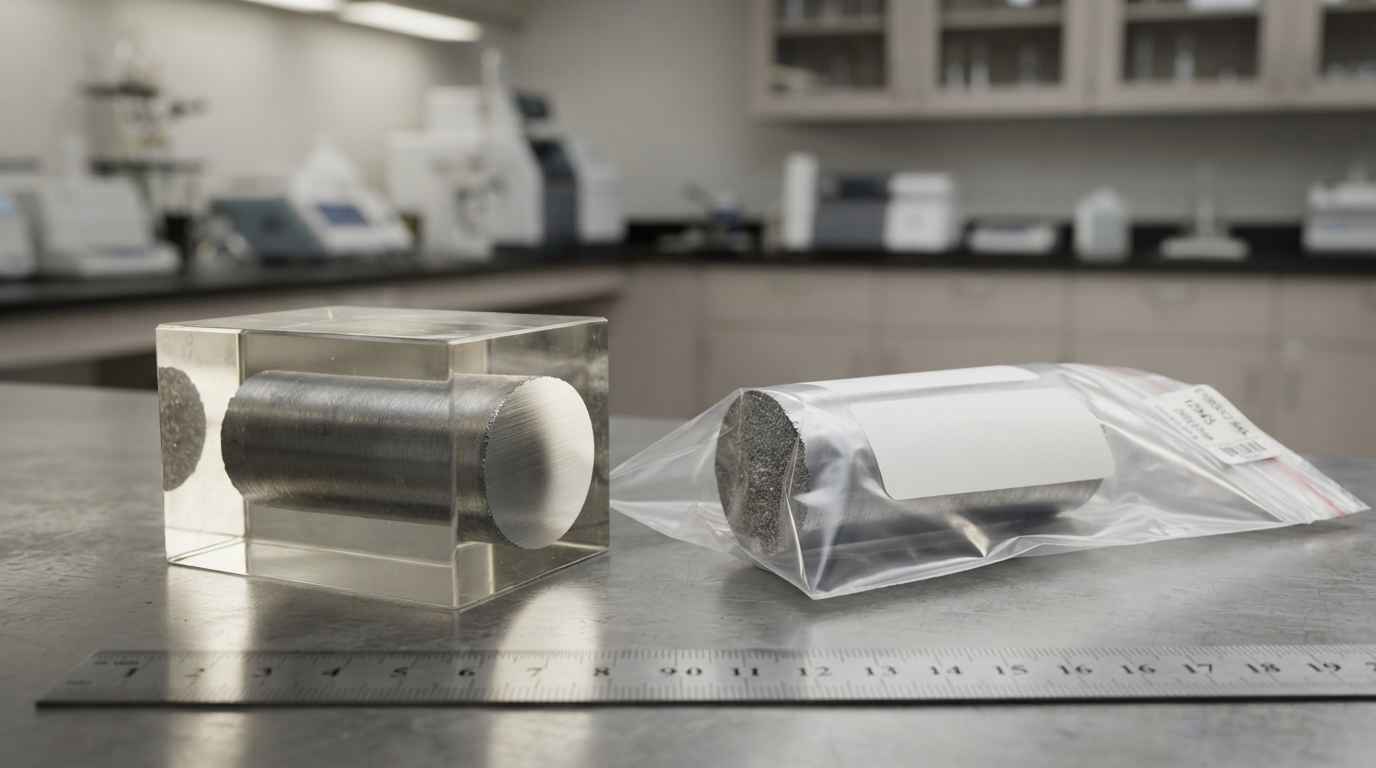
Chain of custody is the continuous record of who has held the sample, from the moment it is removed from the equipment to the end of its retention, with no gaps in the record. It takes the form of a receipt record with a date, individual identification of each part, an arrival photograph, a description of the packaging and the signatures of whoever hands over and whoever receives.
The ASTM E1188 practice describes how a technical investigator collects and preserves the information and the physical items of a case. It sets no acceptance criterion, it provides the procedure that makes the sample under test demonstrably the same one removed from the machine, and in the same condition apart from the alterations the report itself declares.
Test traceability is the other half. Every measurement carries the equipment it came from, its current calibration, the procedure applied, the date and the operator. In the failure analysis of polycarbonate pipes in a market claim, that documentation is what turns a laboratory finding into an argument you can use with the supplier.
Independence of the expert and declared scope
The independence of the author is a formal requirement with substantive effects. A report written by whoever made the part carries an interest in the outcome that the other side will point out before getting into the technical content. Commissioning it from someone who took no part in the design, the manufacture or the maintenance removes that line of attack.
The declared scope is the second piece. A serious expert opinion states on its first page what it was asked, what material it was given, what tests it ran and what falls outside for lack of sample, of data or of technical competence. A report that answers more than its material allows becomes vulnerable.
The deciding criterion is not the severity of the failure or the money at stake. It is whether there is another party with an opposing interest who will read the report, because that changes how the sample is handled from day one.
TELL US ABOUT YOUR CASE
Do you have an incident or a claim with a failure behind it? Send us the part unwashed and the dates and we will propose a test plan with the sample divided
The tests that support an expert opinion and what each one can substantiate
The tests in an expert report are chosen for what they can substantiate, not for what they can suggest. Each technique answers one specific question and fails at answering others, and mixing those limits takes apart a technically correct opinion.
Accredited tests and custom tests, what each one contributes
A standardised, accredited test has its uncertainty evaluated, its procedure audited and its result expressed on a scale any third party recognises. It is the backbone of the opinion whenever a standard covers the case, as with composition, mechanical properties or hardness.
The problem appears when the failure does not fit any standardised method, as soon as a specific geometry and specific service conditions come into play. That is where customised test setups come in, designed to reproduce the real loading on the component. Their validity rests on three things documented, why the setup represents service, what was measured and with what traceability, and how much room for interpretation is left.
Elemental analysis and chemical composition illustrates the other end well. Comparing the composition of the part with that of the specified material is an objective, repeatable measurement that is hard to argue with. What it does not settle is whether that deviation caused the failure, because that requires tying it to a mechanism and to a load.
| Aspect | Advisory technical report | Expert opinion | What happens if they are confused |
|---|---|---|---|
| Reader | Whoever has to decide and act | A third party who was not present and will review the reasoning | The report answers a question nobody asked it |
| Sample receipt | Identification good enough not to mix parts up | Record with date, arrival photograph and handover signatures | You cannot prove the part tested is the one that failed |
| Test sequence | Flexible, whatever closes the decision soonest goes first | Non-destructive work and documentary record before any cut | An early destructive test erases the initial condition |
| Reserved sample | Optional, depending on cost and availability | Untested material is set aside for a later check | The other party cannot repeat anything and the figure stands uncontrasted |
| Handling of uncertainty | Can be closed with the most reasonable cause | Observation is separated from interpretation and certainty is declared | A hypothesis presented as fact invalidates the rest |
| Retention | Until the problem is corrected | Planned for the multi-year horizon of proceedings | The sample is gone before anyone asks for it |
Destructive tests on a single part and the problem of the counter-test
When the part that failed is the only one available, the tests that explain why it failed consume it. Resolving that contradiction is a decision of method taken at the start.
The approach that works is to divide the part before touching it. It is documented complete, a cutting plane is defined that leaves representative material in both halves, and one half is tested while the other is kept intact under recorded custody. With the reserved half, any third party can repeat the metallography, the hardness or the composition analysis.
When the part cannot be divided, the alternative is to invite the parties to the test or to record the whole process step by step. In comparative characterisation of the failure there is also a resource that saves arguments, testing in parallel a sister part that has not failed, from the same batch and with the same service, which gives the reference for what is normal without consuming the part in dispute.
What is documented about each test so the opinion is repeatable
A test is repeatable when the report records what is needed to run it again, the position of the specimen in the part, the preparation applied, the equipment and its calibration, the parameters, the result with its unit and its uncertainty, and the raw record that figure comes from.

When your company needs an expert report and when an internal one is enough
You need an expert report when the outcome of the analysis will determine who bears a cost against another party. An internal report is enough when the outcome will only determine what you change in your process.
Incidents, rejected warranty claims and disputes with a supplier
There are four situations in which the expert report stops being optional. An incident where an insurer is involved with its own engineer. A warranty rejected by the manufacturer, with the argument framed on whether the failure comes from the product or from the use. A dispute with a supplier over the conformity of a batch already fitted. And a contractual penalty whose technical cause is under discussion.
Asking for a second technical opinion when a report does not convince you is the intermediate step that narrows the disagreement. The other party’s report is reviewed on its methodology, on the correspondence between the tests cited and the conclusions it draws, and on what it did not test.
What an internal report does well and what it cannot support
The internal report is the right tool for correcting a process, and it is faster and cheaper because it skips the documentary side. It works well on a recurring production failure or a quality drift at incoming inspection, with direct access to the process data and to the people on shift.
What it cannot support is an attribution of liability. Its three weak points are well known: the part arrives with no record of provenance, the tests are run in whatever order suits the schedule, and the author belongs to one of the two organisations in dispute.
One case remains, the failure with no history. When there are no operating records, no batch traceability and no earlier measurements, the work starts with the part alone, and how an industrial failure is investigated when there is no historical data sets out that sequence. It is also where the expert-report method pays off most, because the whole burden of proof rests on the sample, as in the reverse engineering and expert reports to clarify responsibilities in a patent dispute.
An internal report and an expert opinion can reach the same root cause and still carry very different weight. The difference is not in the technical accuracy, it is in whether the path to that cause was recorded so that someone else can walk it.
What decides the weight of an opinion is what can be reconstructed afterwards
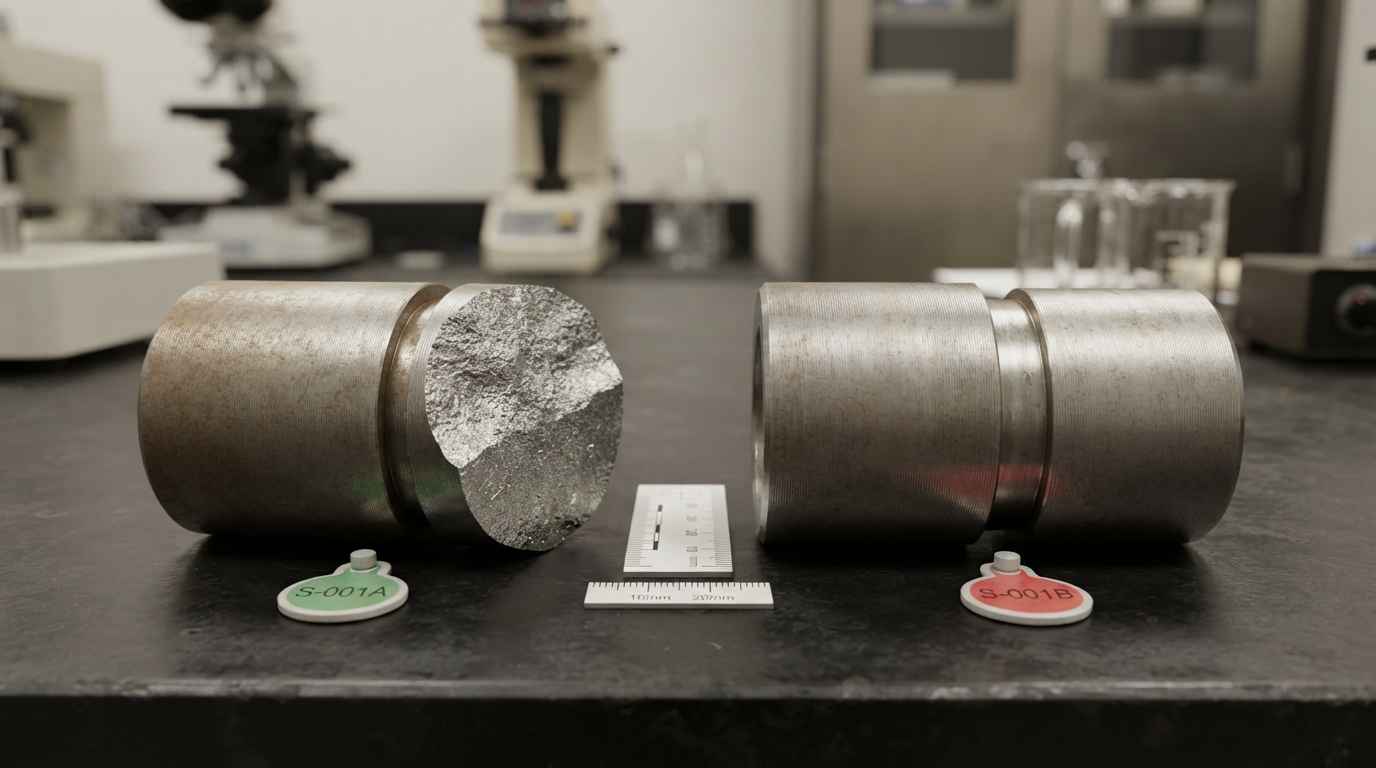
An industrial expert report brings three things an advisory report is not built to bring: a sample with a documented route since it came off the equipment, tests whose results can be repeated on reserved material, and an explicit separation between what was measured and what was interpreted.
If you have a failure with a claim or an incident attached, send the part exactly as it came off the equipment, unwashed, together with a sister part that has not failed, photographs of the installation and the dates of commissioning and of the breakdown. You get the receipt record, the test plan with the division of the sample and the scope of what each test will substantiate before any specimen is spent.
Frequently asked questions
What evidence is lost if the part is cleaned or disassembled before sending it?
Almost everything that is not the metal is lost. Cleaning the fracture surface removes the corrosion products, the product residues and the particles that indicate which agent was present, and one pass with solvent or a wire brush erases in seconds the layer that was going to identify the mechanism. Disassembly also adds new marks, from spanners, clamps or pullers, which afterwards are indistinguishable from those of the failure. If it has already been cleaned or taken apart, the analysis is still possible and the report records it as a prior alteration, but photograph the assembly before touching it and keep any residue, dust or detached fragment in a separate identified container.
What validity does an industrial expert report have if the other party brings an opposing opinion?
When two opinions contradict each other, what separates them is what each one can demonstrate, not what each one asserts. The comparison is made on four specific points: whether the sample behind each report has a documented route, whether the tests cited actually answer the conclusions they support, whether reserved material remains with which to repeat a measurement, and whether the author has an interest in the outcome. An opinion that wins on those four points does not need to rebut the other sentence by sentence. Nobody can anticipate how each report will be weighed, because that depends on the proceedings and on whoever resolves them, but a report that fails on any of the four is vulnerable in its form before its technical content is even discussed.
Can an opinion be produced if the part has already been tested by another laboratory?
Yes, and it is the scenario that appears when the argument starts after a first report. The work is reframed in two parts. The first is to document what is left of the sample and to extract from the earlier report what was cut, what was consumed and what was altered, in order to define what can still be checked directly. The second is a methodological review of that report, which is done without touching the part and consists of checking whether the tests cited answer the conclusions it draws, whether the standard matches the test it is attached to, and whether there are measurements missing. That review adds value even when no material is left to test.
What factors determine the cost of an expert report and how can it be adjusted?
The cost is driven by the number of tests, the need for specific setups to reproduce service and the volume of documentation the assignment demands. An opinion on a narrow cause, with standardised tests on a well preserved part, sits at the low end; reproducing the real loading with a custom setup, or analysing several parts from different batches, takes it to the high end. The way to adjust it is to define the question precisely before starting and to limit the scope to what will actually be in dispute, instead of commissioning a full characterisation of the material. Sending a sister part that has not failed also reduces work, because it gives the reference for normal without having to reconstruct it.
How long does an opinion take and when should you ask for one?
Usual turnaround runs from one to four weeks depending on scope, with an urgent route in 24 to 72 hours when a plant is down or a deadline is closing. The documented receipt, the non-destructive inspection and the test plan are closed in the first days; metallography, mechanical testing and the diagnosis of the root cause of failure take up the rest. The time to ask for it is before the first intervention on the part, not after the matter escalates. If you have a failure that may end in a claim, request an assessment with the photographs of the assembly and the dates, and you get the test plan and the scope before the sample is opened.