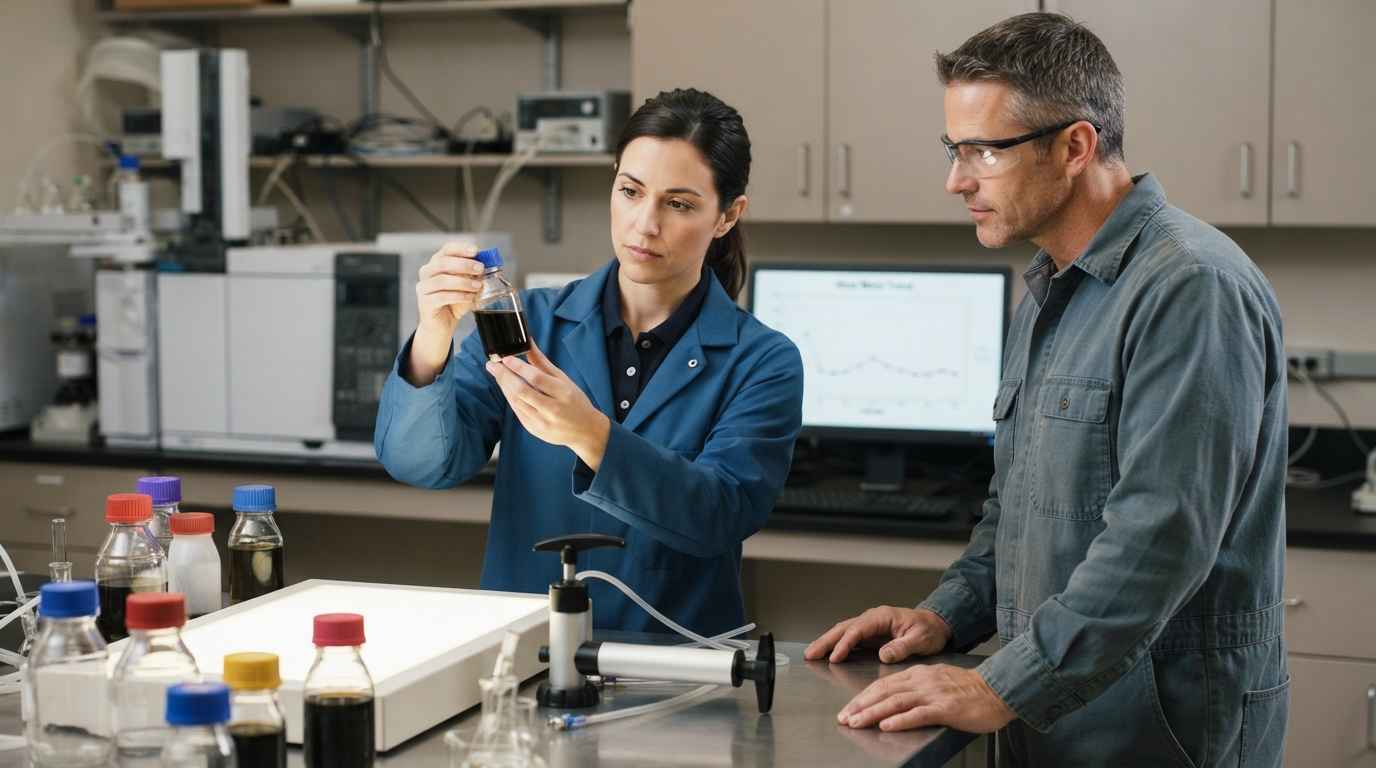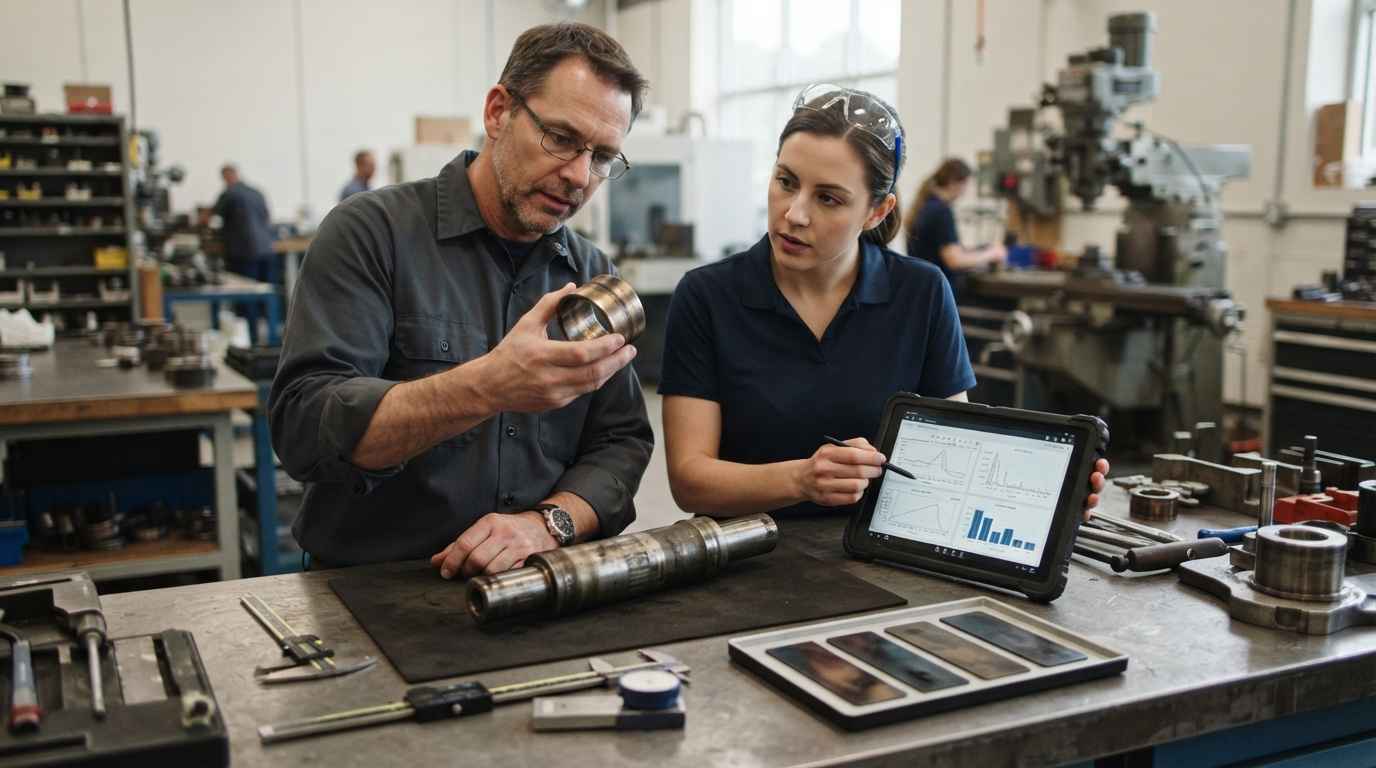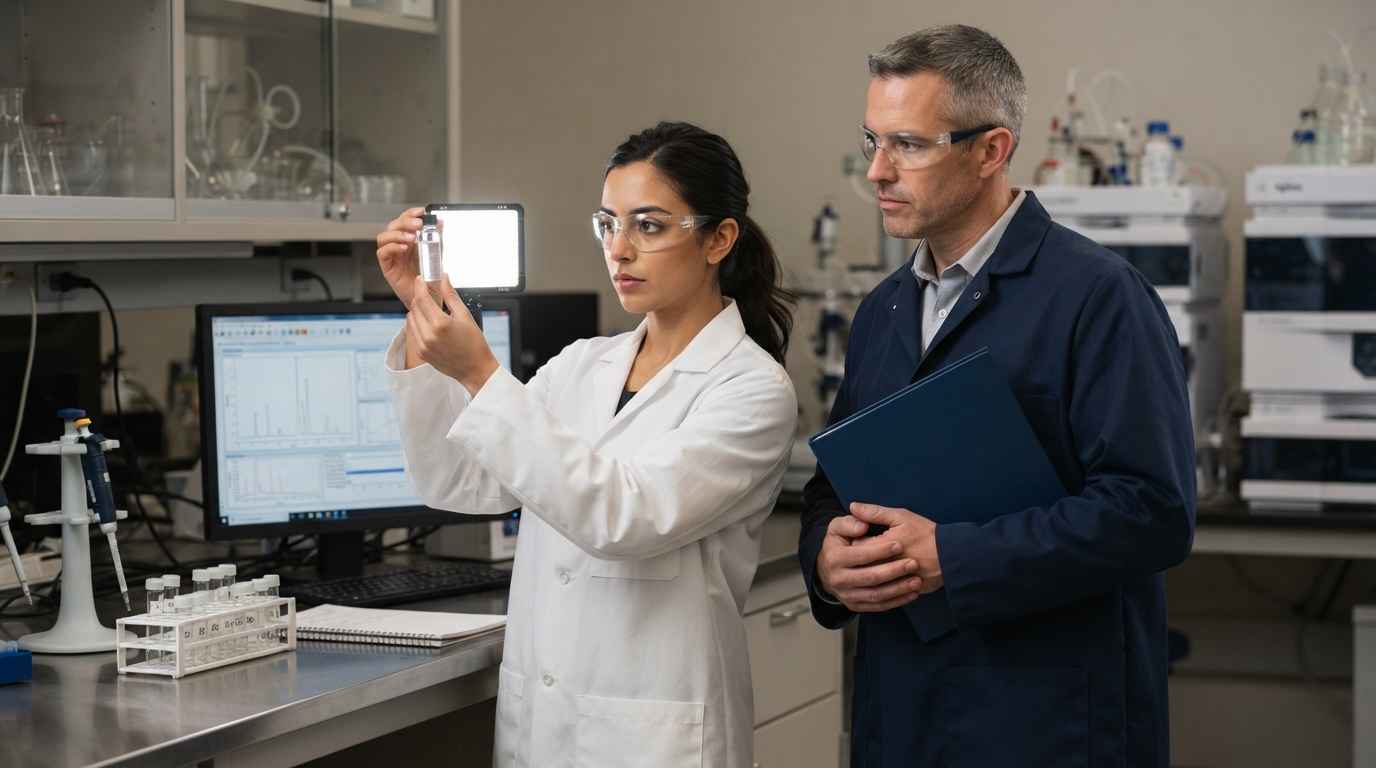

Contaminant analysis in chemical manufacturing is the analytical work that identifies a substance that should not be in a batch, quantifies it and ties it to a specific point in the process that introduced it.
In a chemical plant, the problem is putting a name to what has appeared and deciding whether it comes from the raw material, the synthesis route, the equipment or the packaging. That is the question resolved by the analysis of contaminants and impurities on a real sample.
The rest of the job is process engineering with analytical support, which is why an industrial engineering laboratory needs the plant diagram as well as the sample. The difference between an irrelevant trace and a blocking one is set by the specification, not by the chromatogram.
ANALYSIS OF CONTAMINANTS AND IMPURITIES
Do you have a batch on hold because of a substance you cannot identify? Discover our analysis of contaminants and impurities

What makes contaminant analysis in chemical manufacturing different from other sectors
Contaminant analysis in a chemical process stands apart because the product is a reactive mixture that already contains dozens of expected compounds, and the contaminant has to be separated from that background. In a metal part any substance is foreign by definition; in a reactor it is not.
That inverts the approach. Before looking for the contaminant you have to describe what you expect to find, because only against that known background does the thing that should not be there stand out. It is the same criterion behind process improvement in the chemical industry.
Synthesis impurity and external contaminant, two different problems
A synthesis impurity is a compound the reaction generates, and an external contaminant is a substance that enters from outside the intended process. The first is corrected by changing reaction or purification conditions and the second by closing an ingress path.
The criterion that separates them is correlation. A route impurity scales with conversion, temperature or reaction time, and appears in every batch. An external contaminant appears abruptly, concentrates in the batches from one particular piece of equipment or campaign.
A synthesis impurity is corrected in the process and an external contaminant is corrected in the installation. Deciding which group your finding belongs to is the first conclusion the analysis has to deliver, because it changes entirely who has to act.
What process information changes the analytical plan
The analytical plan is built from the synthesis route, the list of contact materials and the equipment campaign history, not from the sample alone.
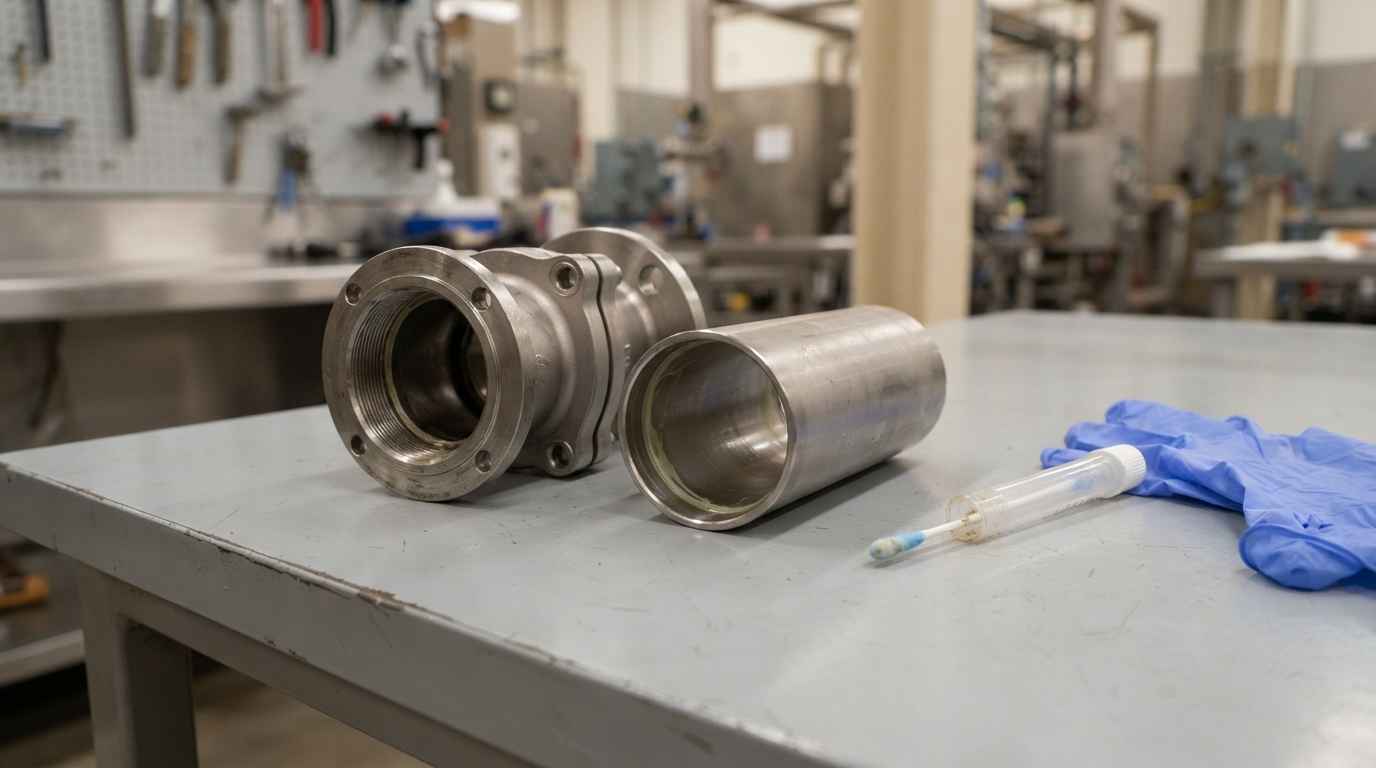
The routes by which a contaminant enters a chemical batch
A contaminant enters a batch through a limited number of routes, and walking them in order is faster than analysing without a hypothesis. The four usual ones are carryover between batches in shared equipment, residues from the synthesis route, particles from equipment and environment, and whatever the contact materials release.
Cross contamination is the transfer of product from one campaign to the next through equipment that has not been left clean. It is recognised because the full profile of the previous product appears, with its own impurities, in a low and constant proportion.
The hygiene maps and critical point analysis locate where to sample before the next campaign, and analysis of the swab or the final rinse water quantifies the residue. In the identification of unknown contaminants during the manufacturing process, that sequence made it possible to name the substance and place its point of entry.
Catalyst traces and metal residues from the synthesis route
Catalyst traces are residues of the metal or complex used to accelerate the reaction that remain in the product after purification. They appear at very low concentrations and are regulated in pharmaceutical, food or electronic applications, so quantifying them is the critical test of the batch.
Ruling them out most directly means analysing the catalyst and the equipment material separately and comparing their profiles with that of the batch. The catalyst tests also describe whether the catalyst has degraded, which turns an expected residue into contamination out of specification.
Process particles, equipment wear and foreign matter
Particles in a chemical product come from equipment wear, from the plant environment or from the filtration and packaging materials themselves. They are the visible contaminant, because they are detected by looking, and that is why they reach the customer as a complaint even when their chemical impact is minor.
Identifying the material of the particle is what locates the point of entry. Stainless steel points to impellers, agitators or screens; cellulose or glass fibre to a filter medium; polymer to a gasket or the container lining; and siliceous mineral to the air in the hall. In the analysis of contaminants in components to validate manufacturing processes, characterising the particle made it possible to validate the process.
TELL US ABOUT YOUR CASE
Is a contaminant appearing batch after batch and you cannot tell where it gets in? Send us the samples and the synthesis route and we will propose a sampling plan to locate the source
Leachables from contact materials, the contaminant that shows up later
A leachable is a compound that a material in contact with the product releases into that product under conditions of use. It is not seen in the first control because it needs time, temperature or an aggressive medium to migrate, and it tends to appear at the customer before it appears at the plant.
What a gasket, a lining or a hose releases into the product
Polymeric contact materials release plasticisers, antioxidants, processing aids, chain oligomers and the products of their own degradation. That is not a defect of the material, it is its formulation, and the supplier can change it without notice because they rarely appear on the technical data sheet.
An attacked lining stops being a barrier and becomes a source, first of its own components and then of the metal it protected. In the evaluation of materials to reduce corrosion in chemical reactors, testing the candidates in the real medium avoids discovering that sequence with the plant running.
How a representative migration test is designed
A migration test is representative when it uses the real medium or a justified simulant, the real contact temperature and time or a defensible acceleration, and the same ratio of material surface to product volume as the installation has.
The test is set up at two levels. The first is forced extraction, with an aggressive solvent and high temperature, which returns the list of extractable compounds. The second is the test under use conditions, which quantifies how much reaches the product and allows comparison with the specification.
A leachable is not ruled out because it fails to appear in the batch release control. It appears once the product has spent weeks in contact with the material, so the test that detects it is accelerated migration and not release testing.
Which technique identifies and which technique quantifies each contaminant
Identifying and quantifying are two different jobs, and each one is resolved by a measurement of its own. Identification answers what the compound is and relies on techniques that give structural information; quantification answers how much there is and requires a standard and a method calibrated for the matrix.
The first analysis of an unknown contaminant is identification work with a qualitative or semi-quantitative result, and the defensible figure arrives in a second phase. A discrepancy between two laboratories is judged against the reproducibility limit of the method, in the terms of trueness and precision that ISO 5725 defines.
| Contaminant | Technique that identifies it | Reference or scope | What the result resolves |
|---|---|---|---|
| Solvent residue | Headspace with gas chromatography and mass spectrometry | Limit by class per ICH Q3C, standard to quantify | Confirm whether the residue comes from the previous step or from cleaning |
| Synthesis by-product | Gas or liquid chromatography coupled to mass spectrometry | Identification by spectrum, with the route profile as reference | Separate a route impurity from an external contaminant |
| Trace metal or catalyst residue | Inductively coupled plasma mass spectrometry | Requires a method blank, trace grade acids and decontaminated labware | Attribute the metal to the catalyst, the equipment or the packaging |
| Particle or foreign matter | Electron microscopy with X-ray microanalysis | Spot analysis on the isolated particle | Identify the material and with it the point in the plant |
| Water | Coulometric titration | Measures the total water in the sample at trace level | Decide whether the batch is dried, reworked or rejected |
| Leachable from a contact material | Forced extraction and analysis of the extract | Test designed around the material and the real medium | Know what the gasket or the lining releases |
Identification of organics by chromatography coupled to mass spectrometry
Chromatography separates the components of the mixture and the coupled mass spectrometer identifies each one by its spectrum. It is the reference combination for organic contaminants, with the choice between gas and liquid phase determined by the volatility and thermal stability of the compound.
Volatile compounds and solvent residues are approached with headspace, which carries to the chromatograph only the fraction that evaporates. That separation allows a solvent trace to be seen in a product that is itself an organic liquid, and in the gas chromatograph the resolution of the column decides whether that peak separates from the main solvent.
Residual solvents are classified by their toxicity into classes 1, 2 and 3 of ICH Q3C, which sets a permitted daily exposure limit for each class and makes the classification of residual solvents the step before deciding whether a trace is admissible. Compounds with low volatility or poor thermal stability go through liquid chromatography coupled to mass spectrometry.
Trace metals, blanks and analytical grade water
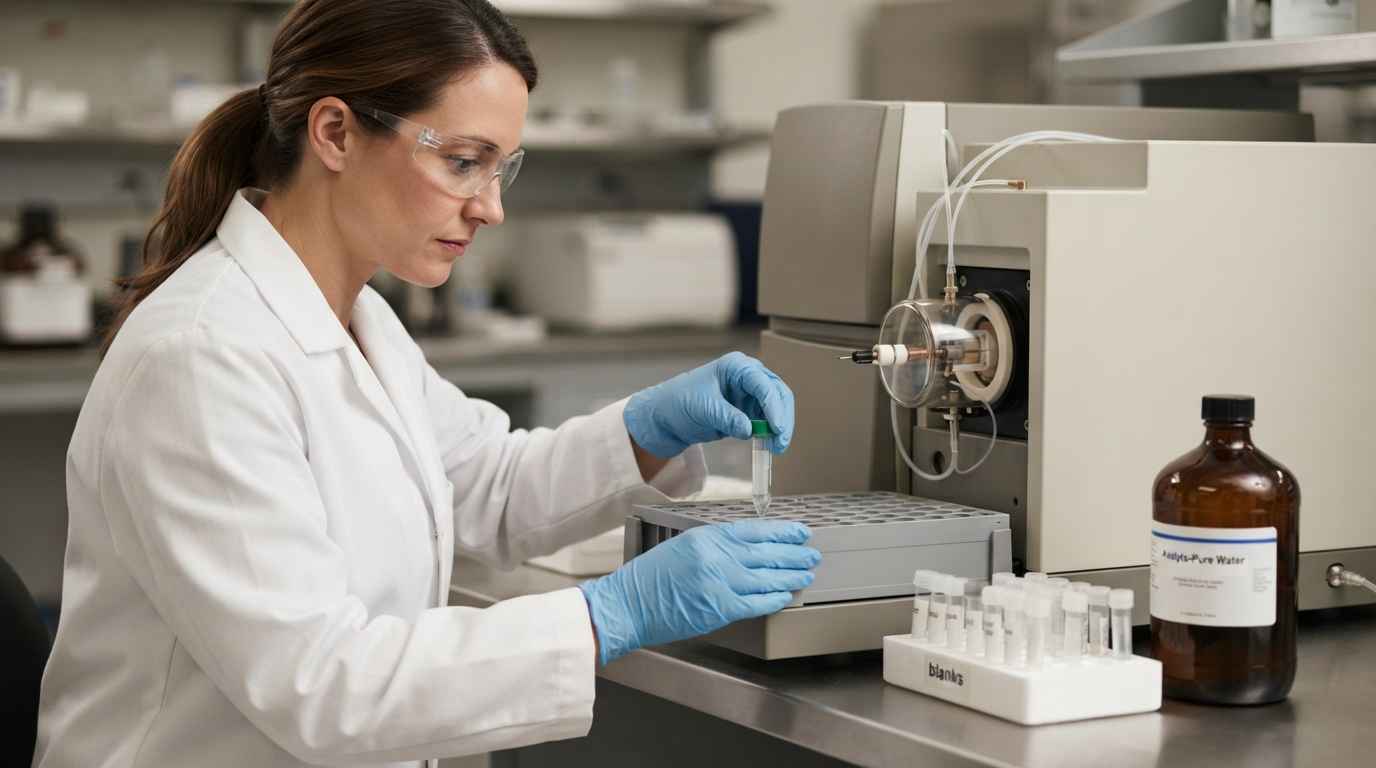
Trace metal quantification is done by inductively coupled plasma mass spectrometry, which brings the detection limit down to parts per billion on a dissolved sample. At that scale the risk is not instrument sensitivity, it is that the preparation contributes the metal being measured.
The blank is part of the method. The digestion acids, the labware, ambient dust and the water all contribute traces comparable to those in the sample: the acids have to be trace metal grade, the labware decontaminated, the water ultrapure and the handling done in an environment free of metallic dust. What closes the set is the method blank, processed in parallel through the same sequence of reagents and labware as the sample.
When the question is whether the metal comes from the catalyst or the equipment, the full profile weighs more than the individual value, and comparing the result with the chemical analysis of metals of the reactor closes the attribution. Two steels with the same nickel are told apart by molybdenum or copper.
Particles and foreign matter, from the material to the point of entry
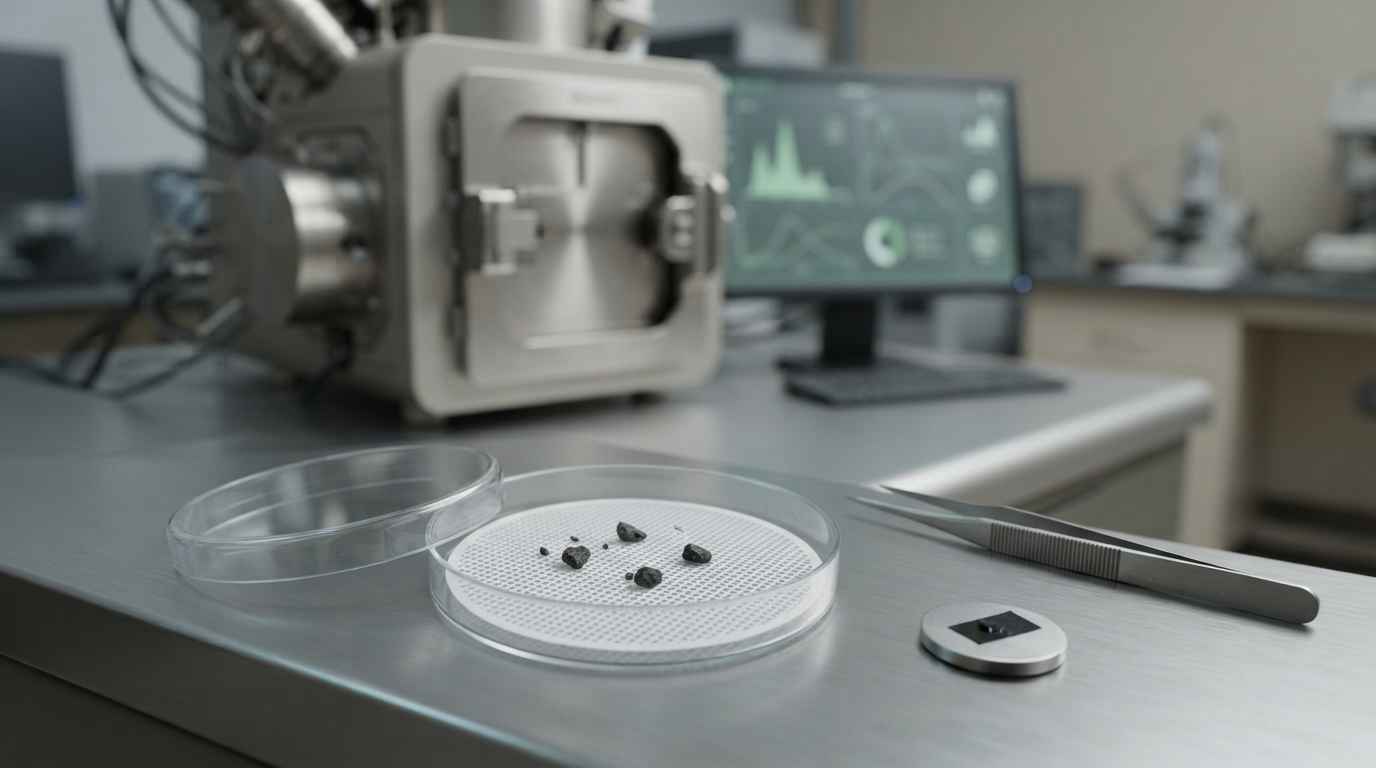
A particle is identified by isolating it and measuring its composition on the particle itself, not on the product that contained it. Electron microscopy with X-ray microanalysis gives the elemental composition of a volume a few micrometres across, and that settles whether it is metallic, mineral or organic. For steel and mineral that composition is already the identification; for an organic particle it returns carbon and oxygen and does not tell an EPDM from a polyamide, so the name of the matrix comes from infrared spectroscopy.
The next step is comparison against the candidates in the plant. If the particle is steel, its alloying profile points to which contact part (screen, agitator or pipework) to inspect. If it is polymer, infrared identifies the matrix and pyrolysis coupled to chromatography describes the additives.
That comparison method turns a finding into a corrective action, and it is the same one described when explaining how to detect contamination in industrial processes. Without candidates to compare against, the identification remains a description.
Identifying a contaminant does not close the case, it opens it. The analytical result only becomes a corrective action when it is compared with the materials and the products that have been in contact with the batch, and that comparison needs reference samples from the plant.
A contaminant with a name stops being an open complaint
Putting a name to a contaminant changes the nature of the problem. With the compound identified, quantified and attributed to a point in the process, the conversation becomes one about a corrective action.
If you have a batch on hold or a trace that has appeared since you changed supplier, gather the affected sample, one from a good batch, the suspect raw material and the list of materials touching the product, and tell us the specification to be met. We return the identification of the compound, its concentration and the ingress hypothesis with the tests that support it.
Frequently asked questions
What does contaminant analysis in chemical manufacturing not tell you?
Contaminant analysis in chemical manufacturing does not on its own tell you when the contaminant entered or who is responsible. It identifies the compound and quantifies it, and with the right reference samples it attributes it to a compatible source, but the date of entry and the chain of custody are reconstructed from plant records, not from the chromatogram. It also does not tell you whether the trace is admissible, because the limit is set by the product specification and its end application, not by the method. And a concentration measured in one sample does not describe the whole batch when the contaminant is not homogeneous, and with particles and carryover the distribution is heterogeneous by the very mechanism of entry, so there the sampling plan weighs more than the technique.
Can the source be located from a single sample of the affected batch?
A single sample can identify the contaminant, and locating its source takes references to compare it against. Attribution is comparison work, and it needs at least a sample from a correct batch to fix the expected background, the raw material from the same incoming lot and a sample of the suspect contact materials. When carryover between campaigns is suspected, the previous product and the swab or rinse water from the equipment are needed too. Sending only the defective batch forces the laboratory to work by elimination across an open list of candidates, which is slower and more expensive than comparing against three or four references.
What drives the cost of a contaminant analysis?
The cost depends above all on whether the contaminant is known or unknown. Quantifying an identified compound in a known matrix is a bounded test; identifying an unknown substance is a screen that combines several techniques and whose scope is set by the process information you provide. After that come the number of reference samples, the concentration level required, because moving from parts per million to parts per billion changes the technique and the blank control, and the matrix, since a polymer or a complex formulation calls for specific preparation, as happens in the chemical analysis of plastics and polymers. On a limited budget, the sequence that pays is to identify first with one sample and quantify afterwards only what has appeared.
What do you risk by closing a complaint without identifying the contaminant?
Closing a complaint without naming the substance leaves the ingress path open, so the real risk is recurrence in a later batch and with another customer. On top of that, the corrective action is written blind, reinforcing cleaning or changing a filter without knowing whether that was the route, and when the contaminant reappears there is no technical argument left to offer the customer. The cost does not stop at the rejected batch, because it drags in the hold on every batch made in the same campaign, the customer audit and the review of cleaning validation. And if the contaminant shows up again months later, the customer reads the first complaint as a warning you did not act on and not as an isolated incident.
How long does the analysis take and what samples should you send?
Quantifying an already identified contaminant is usually resolved in one to two weeks, and identifying an unknown substance with source attribution in two to four, with an urgent option in 24 to 72 hours when a batch is on hold or a delivery is committed. Send the affected sample with its batch identification, a sample from a correct batch, the raw material involved and, if you have them, a piece of each suspect contact material. State the synthesis route, the solvents used, the specification to be met and what was made before in the same equipment. If you would rather agree first which samples make sense and how to share the process information, tell us about the case and we will define it before you send anything.