
A second technical opinion is an independent assessment of a recurring failure, commissioned from an outside party when your own team or your supplier cannot close the root cause. You request one when the same defect returns after every corrective action and the internal diagnosis has stalled.
The decision is rarely about competence. Your engineers know the product, and your supplier knows the process, yet a failure that keeps coming back often survives precisely because everyone looking at it shares the same assumptions. An external technical consulting engagement brings a different starting point: no ownership of the design, no commercial stake in the answer, and a method built around evidence rather than around who is to blame.
That method belongs to the wider discipline of failure analysis and forensic engineering, where the goal is not to describe a defect but to prove, with physical evidence, why a component or a process fails and under what conditions it will fail again. When a defect recurs across batches, returns from the field, or reappears after a change nobody expected to matter, that evidence-first approach is what moves the problem from opinion to conclusion.
TECHNICAL CONSULTING
Do you need an independent second technical opinion? Discover our technical consulting service

What a second technical opinion is and when to request one
A second technical opinion is an independent technical judgment on the cause of a failure, produced by a party with no role in the original design, manufacture, or supply. It exists to test the diagnosis you already have, not to repeat it.
The distinction matters. Re-running a test tells you whether a result reproduces; a second opinion asks whether the result was ever measuring the right thing. When a recurring failure resists correction, the problem is usually not that a test was done badly, but that the diagnosis rests on an assumption nobody has challenged. An outside reviewer starts by questioning that assumption, then designs the evidence needed to confirm or reject it.
How a second technical opinion differs from re-testing
Re-testing repeats a measurement under the same premise; a second technical opinion re-examines the premise itself before deciding what to measure. If your internal report concluded that a fracture was caused by fatigue, repeating the fatigue test confirms only that the part can fail by fatigue, not that fatigue is what happened in service.
An independent review reconstructs the failure from the physical evidence outward: the fracture surface, the microstructure, the loading history, the environment. It treats the internal conclusion as one hypothesis among several and holds it to the same standard as the alternatives. That reframing is often what exposes a root cause the original analysis had ruled out too early.
When to request an external technical consultancy
You should bring in an external technical consultancy when a failure has recurred despite at least one corrective action, when internal and supplier diagnoses disagree, or when the outcome carries warranty, safety, or contractual exposure. Those three triggers cover most cases where an outside opinion pays for itself.
The clearest signal is repetition after correction. If you have already implemented a fix, closed the 8D, and seen the same defect return, the corrective action addressed a symptom rather than the cause. A second opinion is also justified when the failure is intermittent and refuses to reproduce on demand, because intermittent defects are where internal teams lose the most time chasing hypotheses they cannot test.
A second technical opinion is worth requesting the moment a corrective action fails to hold: recurrence after a fix is direct evidence that the root cause was never identified, only masked.

Why a recurring failure stalls internal diagnosis
A recurring failure stalls internal diagnosis when the people investigating it share the assumptions that allowed the failure in the first place. The obstacle is structural, not a matter of skill, and it explains why capable teams can circle the same defect for months.
Three forces tend to freeze an internal investigation: an unconscious bias toward the existing design and process, a lack of the specific instrumentation needed to see the failure mechanism, and a supplier-customer relationship in which the cause is also a question of liability. Each one narrows the set of hypotheses that get seriously tested.
Manufacturer bias and the limits of internal instrumentation
Manufacturer bias is the tendency to protect the current design and process by looking for causes that lie outside them, such as misuse, transport, or a bad batch of raw material. It is rarely deliberate, but it steers an investigation away from the parts of the process the team is closest to.
Instrumentation is the second limit. Confirming a mechanism such as intergranular corrosion, hydrogen embrittlement, or subsurface porosity requires failure analysis techniques (fractography under scanning electron microscopy, metallographic sectioning, elemental microanalysis) that most production sites do not keep in-house. Without them, a team is left inferring the mechanism from indirect signs, which keeps several competing explanations alive at once and prevents any of them from being closed.
Supplier-customer conflict and stalled root-cause diagnosis
Supplier-customer conflict stalls a diagnosis when the answer to “why did it fail” is also the answer to “who pays”. Once the cause carries liability, each party has an incentive to defend the boundary of its own responsibility rather than to converge on the physical truth.
In that situation the two internal root-cause diagnosis efforts often produce two irreconcilable reports, each technically defensible and each stopping exactly where it would implicate its author. The investigation does not fail for lack of data; it fails because no party is positioned to follow the evidence past its own commercial interest. An independent reviewer has no such boundary to defend.
What an independent external consultancy adds
An independent external consultancy adds four things a recurring failure usually lacks: judgment free of commercial stake, a structured root-cause method, traceable evidence, and a report that holds up under technical or legal scrutiny. Together they convert a stalled dispute into a defensible conclusion.
The value is not more testing for its own sake. It is the discipline of deciding which evidence actually discriminates between hypotheses, gathering only that evidence, and documenting it so the conclusion can be defended to a customer, an auditor, or a court.
Independent judgment and structured root-cause methodology
Independent judgment means every hypothesis, including your own team’s and your supplier’s, is tested against the same physical evidence with no default answer. Structured methodology means that testing follows a defined logic (such as 8D, Ishikawa, or fault-tree reasoning) rather than intuition.
The two reinforce each other. A structured method forces the investigation to enumerate the plausible mechanisms before touching a sample, so that no explanation is dismissed because it is inconvenient and none is accepted because it is familiar. Independence guarantees that the method is applied without a thumb on the scale. This is where an outside reviewer most often reopens a mechanism the internal analysis closed prematurely, because the outside reviewer had no reason to close it.
Evidence traceability and a defensible technical report
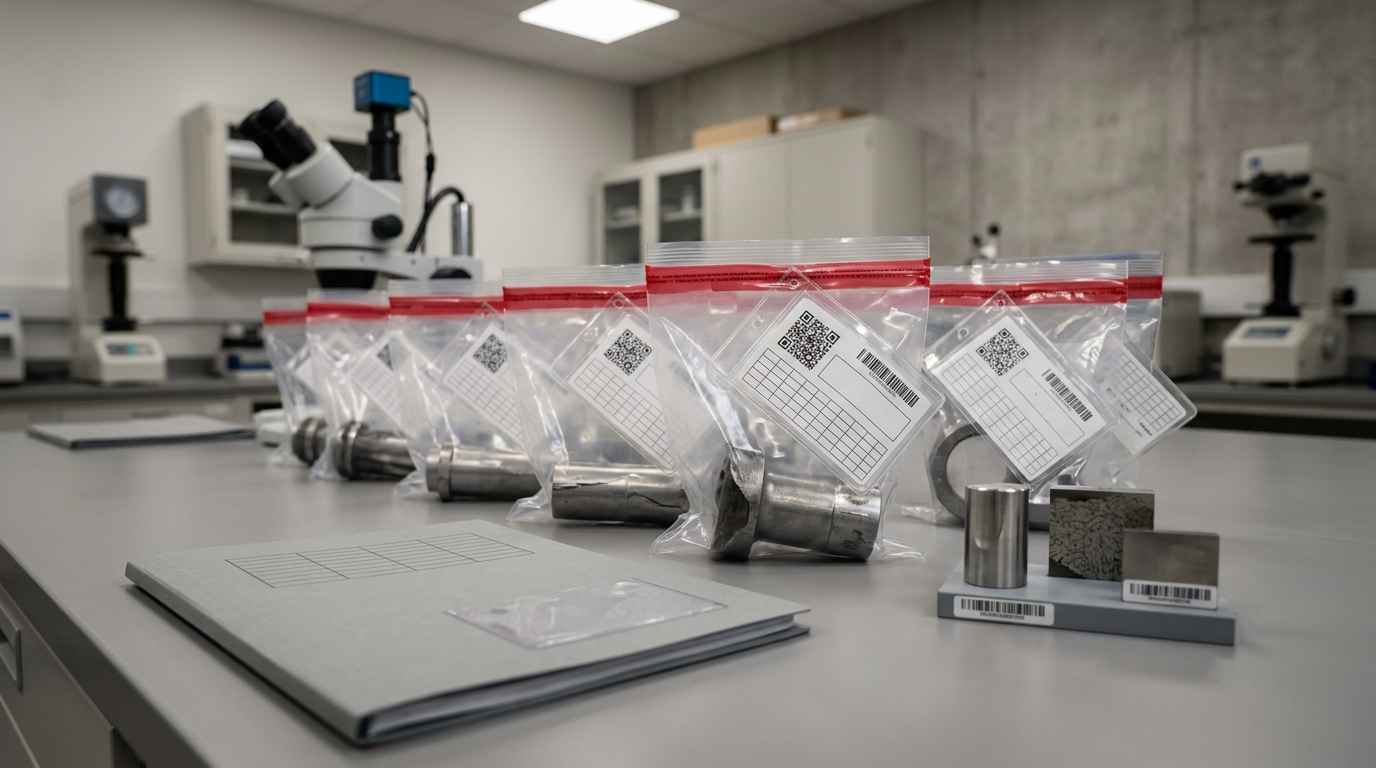
Evidence traceability is the unbroken documentary chain linking each sample, each measurement, and each image to the conclusion it supports. It is what separates a defensible report from an assertion, and it is decisive the moment the failure touches a warranty claim or litigation.
A defensible report states the failure mechanism, the evidence that establishes it, the hypotheses considered and rejected, and the conditions under which the failure will recur. Because the sampling, the instrument settings, and the acceptance criteria are recorded, the same quality control and testing conclusions can be reproduced and audited by a third party. That reproducibility is what gives the report weight in a commercial negotiation, not the authority of whoever signed it.
The output of an independent review is not an opinion but a chain: sample, measurement, mechanism, and the conditions for recurrence, each documented so the conclusion survives challenge from a supplier, an auditor, or a court.

TELL US ABOUT YOUR CASE
Do you have a report or assessment to contrast? Send us your case and we will propose an independent second technical opinion
How a recurring failure is tackled from the outside
A recurring failure is tackled from the outside in four stages: freeze the evidence, build competing hypotheses, run targeted tests that discriminate between them, and verify the surviving root cause against the failure conditions. The sequence is deliberate, because each stage protects the next from contamination.
Freezing the evidence comes first because it is the stage most easily lost. Failed parts get cleaned, reworked, or scrapped, and process data is overwritten; once that happens, no later analysis can recover it. An external reviewer secures the failed components, retains reference samples of conforming parts, and captures the process record before proposing any cause.
From frozen evidence to competing hypotheses
Building competing hypotheses means listing every mechanism physically consistent with the evidence before deciding which to test, so the investigation is never anchored to a single answer. A fracture, a leak, or a dimensional drift each admit several causes, and the value of the exercise is in keeping them all on the table until evidence removes them.
Each hypothesis is then framed as a prediction. If the cause is hydrogen embrittlement, the fracture should show specific intergranular features; if it is fatigue, the surface should carry beach marks and a distinct initiation site. Framing hypotheses as testable predictions is what lets a single well-chosen test eliminate several explanations at once, which is how an investigation that had stalled for months can close in weeks.
Targeted tests that verify the root cause
A targeted test is one designed to discriminate between the surviving hypotheses, not to characterise the part in general. The aim is to run the fewest tests that separate the real cause from the plausible ones, then confirm that the identified cause reproduces the failure under service conditions.
Verification closes the loop. A root cause is only accepted once it explains not just this failure but the pattern of recurrence: why the defect appeared in these batches, survived the previous corrective action, and returned after a change. The table below maps how this external sequence changes the outcome across the situations where a recurring failure most often stalls.
| Situation | Symptom | Why internal diagnosis stalls | What the external second opinion adds | Risk if unresolved |
|---|---|---|---|---|
| Intermittent failure that will not reproduce | Defect appears in the field but not on the bench | The failure never occurs when instrumented, so no test confirms a cause | Reconstructs service conditions and designs a test that forces the mechanism to appear | Continued field returns and open corrective actions that never close |
| Supplier and customer disagree on the cause | Two technical reports reaching opposite conclusions | Each party stops where the evidence would implicate it | Single evidence-based judgment with no commercial stake in the outcome | Stalled negotiation, damaged relationship, and unresolved liability |
| Failure returns after a process change | Defect reappears following a change assumed to be unrelated | The change was not treated as a variable because it was deemed harmless | Re-opens the change as a hypothesis and tests its effect on the mechanism | Repeated recurrence and loss of confidence in the corrective process |
| Warranty claim or litigation | Failure with financial or legal exposure attached | Internal reports lack the traceability to withstand external challenge | Traceable evidence chain and a report reproducible by a third party | Weak position in negotiation and exposure to an adverse ruling |
The pattern across these situations is that the failure keeps its identity secret only for as long as the people looking at it are constrained. A comparable case involving recurring failures in factory equipment resolved through root-cause analysis shows how freezing the evidence and testing competing hypotheses closes a problem that repeated interventions had not. Where the failure concerns fractured or cracked metal components, the equivalent work on failures in metal parts within an industrial assembly illustrates the same evidence-first sequence applied to a mechanical joint.
When a second opinion is not needed, and the cost of leaving a failure unresolved
A second technical opinion is not needed when a failure is a genuine one-off with a confirmed cause, when the corrective action has held across subsequent production, or when the internal evidence is already traceable and undisputed. Bringing in an outside review in those cases adds cost without adding certainty.
The judgment is about recurrence and exposure, not about severity alone. A single non-conformance caught and understood in-house does not justify an external engagement. Setting the scope well matters too: an outside review is most efficient when you can hand over the failed parts, the process records, and the previous internal reports, because that lets the reviewer start from your evidence rather than rebuilding it. A tightly scoped second opinion answers one question (why does this defect recur) rather than auditing the whole line.
Setting the timing and scope of an external review
The right time to commission an external review is after the first corrective action has failed and before the failed evidence is lost, which is a narrower window than it appears. Wait too long and the parts are scrapped; act without defining the question and the review drifts into a general audit.
Scope is set by the failure, not by the product. Define the specific defect, the batches or field returns affected, and the decision the opinion has to support, whether that is a design change, a supplier discussion, or a legal position. A well-defined scope keeps the review targeted and keeps its cost proportionate to the exposure it resolves.
The cost of not resolving a recurring failure
The cost of an unresolved recurring failure compounds through repetition: every cycle carries scrap, rework, field returns, and warranty payouts, while the underlying cause remains free to trigger the next one. Left long enough, a recurring defect migrates from a quality cost to a commercial and legal one.
The escalation is predictable. A defect that recurs in production becomes a field failure, a field failure becomes a warranty claim, and a warranty claim on a safety-relevant part becomes potential litigation or a recall. At each step the evidence needed to defend your position gets harder to recover, which is why the sibling analysis of what happens when laboratory testing is insufficient in industrial settings is worth reading alongside this one: an incomplete diagnosis and an unresolved failure fail in the same way, by leaving the real cause in place. The automotive sector, where a component failure analysis often has to satisfy an OEM audit, shows how quickly an unresolved defect turns into a documented liability.
An unresolved recurring failure is never static: with each cycle it moves closer to a warranty claim or a recall, and the evidence needed to defend your position gets harder to recover.

Turning a failure that keeps returning into a closed case
A recurring failure that your team and your supplier cannot close is not a sign that the diagnosis was careless; it is a sign that everyone examining it is working from the same assumptions. A second technical opinion breaks that constraint by testing every hypothesis, including the accepted one, against physical evidence gathered and documented so the conclusion holds up. What you gain is not a different opinion but a defensible one: the failure mechanism named, the evidence that proves it, and the conditions under which it will return, which is exactly what a durable corrective action needs and what a repeated fix has never had.
Frequently asked questions about second technical opinions
What is a second technical opinion?
A second technical opinion is an independent assessment of a failure’s cause, produced by a party with no role in the original design, manufacture, or supply. Its purpose is to test an existing diagnosis against physical evidence rather than to repeat it, which is what makes it valuable when a defect recurs despite corrective action. Unlike an internal review, it carries no bias toward the current design and no commercial stake in where the responsibility lands.
When should you hire an external technical consultancy?
You should hire an external technical consultancy when a failure has recurred after at least one corrective action, when internal and supplier diagnoses disagree, or when the outcome carries warranty, safety, or legal exposure. Recurrence after a fix is the clearest trigger, because it is direct evidence that the root cause was masked rather than found. Intermittent failures that refuse to reproduce on the bench are a second strong case, since they are where internal teams lose the most time.
How is a second opinion different from re-running the tests?
Re-running a test confirms whether a result reproduces under the same premise, while a second opinion questions the premise before deciding what to measure. Repeating a fatigue test, for example, confirms only that a part can fail by fatigue, not that fatigue is what occurred in service. An independent review reconstructs the failure from the fracture surface, microstructure, and loading history outward, treating the previous conclusion as one hypothesis to be tested rather than a starting point to be defended.
What information should you provide for a recurring-failure analysis?
Provide the failed parts themselves, reference samples of conforming parts, the process records around the affected batches, and any previous internal or supplier reports. Handing over that evidence lets the reviewer start from your data instead of rebuilding it, which shortens the analysis and keeps its cost proportionate. It also helps to state the specific defect, the batches or field returns affected, and the decision the opinion has to support, so the root-cause diagnosis stays scoped to the question that matters.
Can a second opinion serve as an expert or forensic report?
Yes, provided the evidence is traceable and the analysis is documented to a forensic standard from the outset. A second opinion that records its sampling, instrument settings, and acceptance criteria, and that states the hypotheses considered and rejected, produces a report a third party can reproduce and audit. That traceability is what allows the same work to support a warranty negotiation or serve as a forensic report if the failure ends in litigation, which is why the analysis is best commissioned before the failed evidence is lost.