
Preventive failure analysis in defense is the study that identifies how a component can fail before it fails, and defines the tests and controls that keep that failure out of service. It works on the design and on the material, not on a part that has already broken.
In this sector a failure is not measured only in repair cost. A component that cracks in an armoured vehicle, drifts out of adjustment in an optical system or loses its seal in shipborne equipment stops being available at the moment it is needed most, and the consequence is operational before it is economic. Forensic engineering supplies the technical side of that problem, because it reconstructs failure mechanisms and lets you anticipate them instead of explaining them afterwards.
Within failure analysis, the route that gets ahead of the problem is preventive failure analysis, which works on the design, the material and the usage profile before there is any breakage to investigate. In programmes with long service lives and difficult maintenance, that head start is the difference between a test plan and an emergency investigation.
PREVENTIVE FAILURE ANALYSIS
Do you have a critical component that cannot fail in service? Discover our preventive failure analysis service

What preventive failure analysis in defense is
Preventive failure analysis in defense is an engineering exercise that lists the ways a component can stop performing its function, judges which of them are critical, and translates that list into tests, acceptance criteria and incoming controls. Its output is not a failure report, it is a verification plan.
Anticipating a failure means naming it before you see it. Every failure mode identified on the design becomes a specific test with its acceptance criterion, and whatever is not named on that list is never verified and goes into service unchecked.
The difference between preventive analysis and root cause analysis
Root cause analysis starts from a part that has failed; preventive analysis starts from a part that has not failed yet. The first reconstructs an event from physical evidence, the second reasons about known mechanisms and the intended usage profile. They complement each other, but they are not interchangeable, and the window for each one is different.
That is why preventive work feeds on failures already investigated. A failure mode documented in an earlier programme, with its mechanism and its correction, is the most valuable input for anticipating the next one, and it turns the failure mode study into a design tool rather than only a diagnostic one.
Why the defense sector has to anticipate failure
The defense sector has to anticipate failure because its components are used far from the workshop, with scarce maintenance windows and service lives measured in decades. Equipment that fails in the field can rarely be replaced quickly, and the spare may have been out of catalogue for years, so reliability has to be built in before delivery.
Demands on the material are higher too, with narrow specifications and the need for batch-level traceability. What is required of each alloy, composite or coating before it is fitted is developed in high-performance materials analysis for the defense sector, and it is the documentary basis on which preventive analysis decides what deserves a test of its own.
There is also an obsolescence factor. Programmes outlive the commercial components they integrate, so halfway through their life parts have to be replaced with equivalents nobody validated in the original design. Anticipating how a substitute can fail, and not merely checking that it fits, is part of the same preventive exercise.
Which failure modes are anticipated in a defense component
The failure modes anticipated in a defense component are grouped by origin: the service environment, the material and its supply chain, the manufacturing process and the interaction between parts. Separating them this way avoids the mistake of testing heavily against one origin and not at all against another.
Failures caused by the service environment
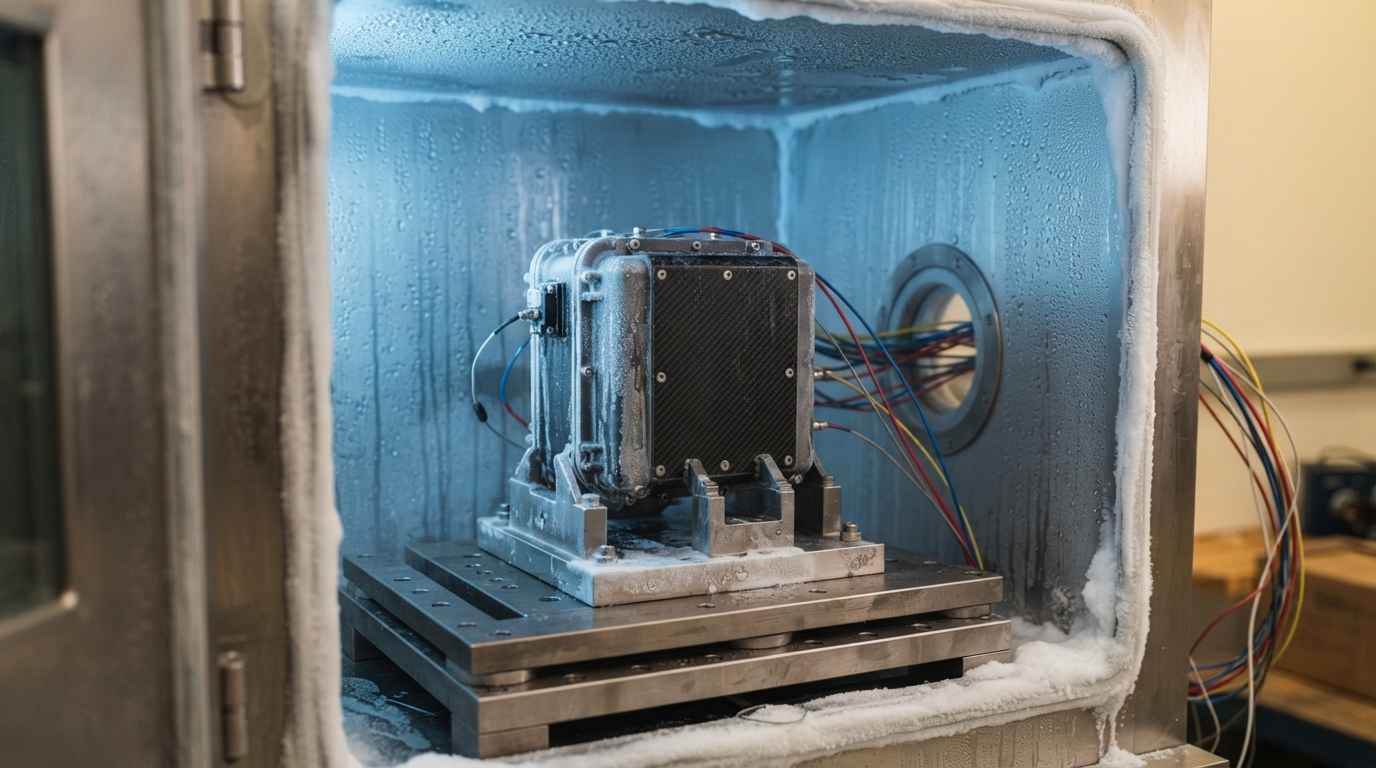
The environment causes failures by accumulation, not through a single event. Alternating temperature fatigues joints between materials with different expansion, humidity and salt degrade coatings and contacts, solar radiation ages polymers and elastomers, and vibration loosens fasteners and wears bearing surfaces. Each of those mechanisms has a test that reproduces it in accelerated form.
Thermal cycling deserves attention of its own because it concentrates stress precisely at the interfaces, which is where the weak points of an assembly usually sit. The thermal shock tests for homologation of materials under extreme conditions show how that effect is reproduced in the laboratory to decide whether a material withstands the intended profile.
Anticipating the environment first requires defining it in numbers. A mission profile described as severe conditions is no basis for designing a test; a temperature range, a relative humidity, a vibration spectrum and a number of cycles are. That definition is the part of the work that most shapes the result and the part most often rushed.
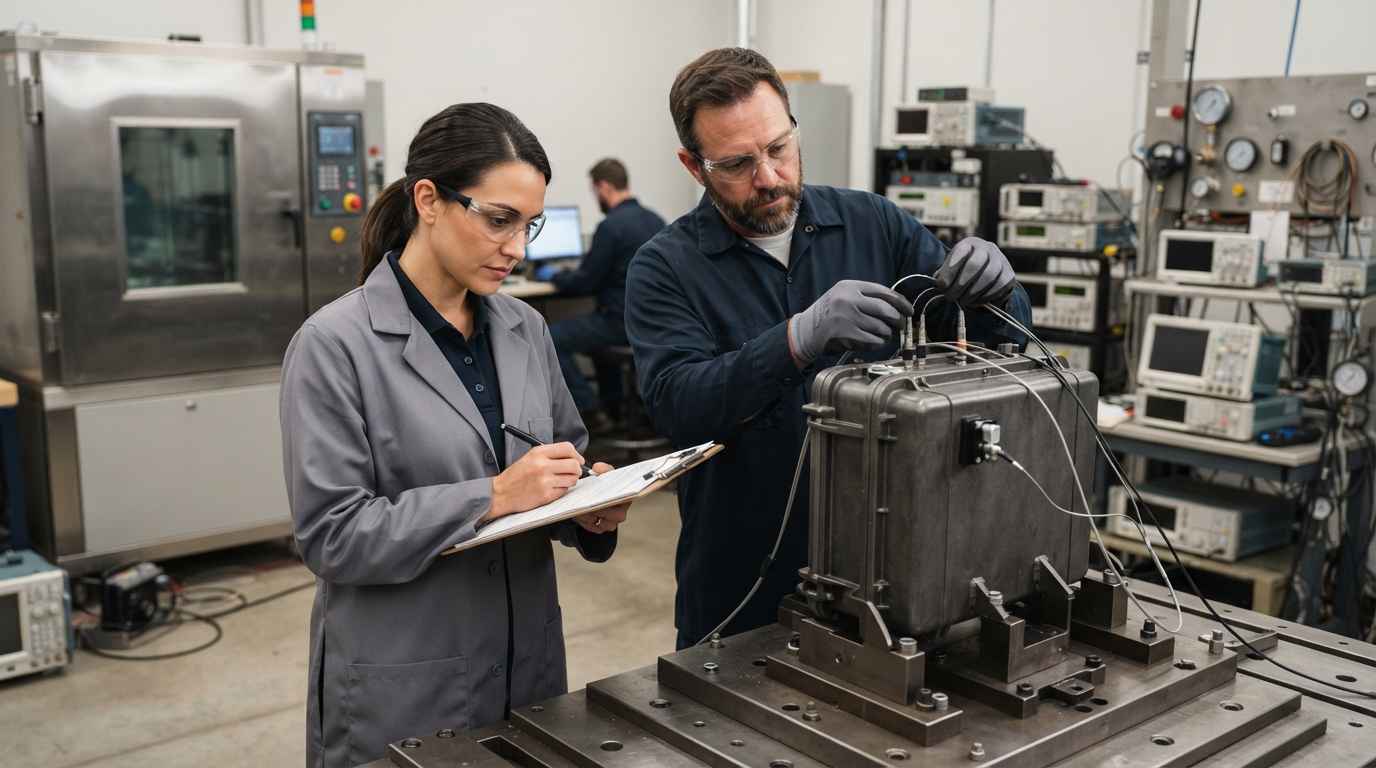
Vibration deserves separate treatment because it does not break the part, it loosens the assembly. A fastener that gives, a connector that loses contact or a mount that wears produce intermittent failures that are very hard to reproduce afterwards, and by the time the equipment reaches the workshop the symptom has gone. Anticipating them means testing the assembled unit, with its fixings and its cabling, and not only the loose component.
Failures caused by the material and the supply chain
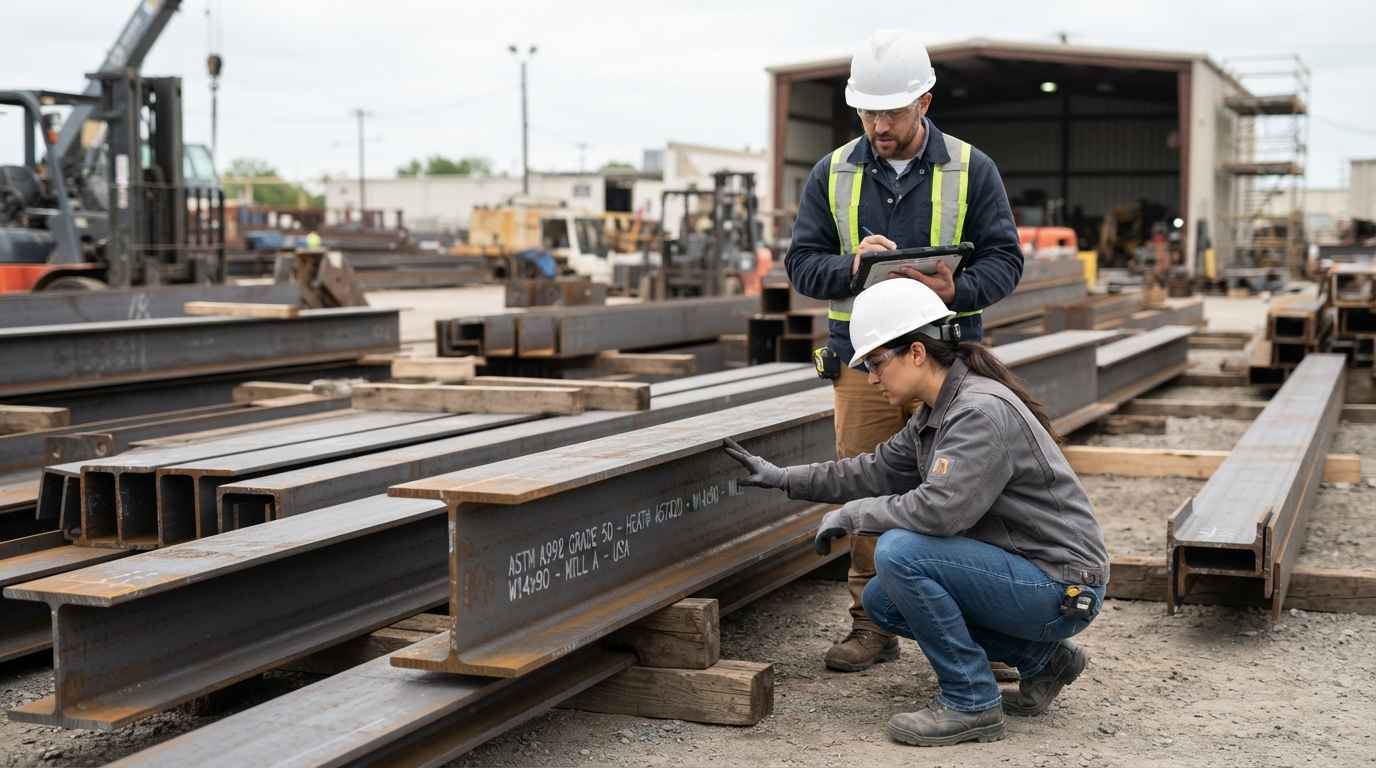
Some failures do not originate in the design but in the batch that arrives. An alloy within specification but with a different microstructure, a coating with uneven thickness or a polymer with a different filler behave differently in service, even when the supplier certificate says everything is correct.
The risk grows with the length of the chain. When a component passes through several intermediaries, non-conforming or outright counterfeit parts become possible, a problem covered in how to detect counterfeit components in the supply chain. In a programme with traceability requirements, that incoming control is as preventive as any design test.
Preventive analysis turns that risk into a specification. Instead of trusting the certificate, it defines what is measured on receipt of each batch, by which method and against which criterion, and states in writing what happens when a result falls outside. Without that last part, incoming control detects but does not decide.
TELL US ABOUT YOUR CASE
Do you have a critical component and need to know how it can fail? Send us the specification and the usage profile and we will propose the test plan that anticipates it
How a preventive failure analysis is structured
A preventive failure analysis is structured in three linked steps: list and prioritise the failure modes, turn the priority ones into tests with an acceptance criterion, and define which decision follows from each result. The value is in the linking, because a list of failure modes with no tests attached changes nothing.
From FMEA to the test plan
FMEA (failure mode and effects analysis) is the tool that orders the exercise: for each function of the component you list the ways it can fail, the effect of each failure and the chance of detecting it before it reaches the user. The resulting priority is what decides where the testing budget goes.
The step most often skipped is the next one. An FMEA that does not end in specific tests, with their specimen, their condition and their criterion, remains a compliance document. The translation has to be explicit: this failure mode is verified by this test, under these conditions, and is accepted if the result meets this threshold.
The quality of an FMEA depends on who sits down to do it. With design alone at the table, the anticipated failures appear; with manufacturing and maintenance present, the ones actually seen appear, and they usually sit in the assembly, in the access needed to inspect the part and in the spare. Detectability is the entry most often overrated, because it is scored against an inspection that does not exist in the field.
Tests that anticipate failure
Preventive tests reproduce in accelerated form the mechanism you want to avoid, with conditions more severe or more repeated than those in service so the result arrives in weeks rather than years. The correspondence between the test and the real mechanism is what gives the result its validity.
| Anticipated failure mode | What is evaluated | Reference | Which decision it supports |
|---|---|---|---|
| Degradation from the service environment | Behaviour of the assembly against temperature, humidity and vibration | MIL-STD-810 | Validating the component for its usage profile |
| Corrosion of the surface finish | Resistance of the coating in a salt atmosphere | ISO 9227 | Accepting or rejecting a surface treatment |
| Ageing of polymers and elastomers | Loss of properties with time, heat and radiation | Accelerated life test | Setting service life and replacement interval |
| Failure mode not identified in design | Criticality and detectability of each failure mode | IEC 60812 | Prioritising what is tested and what is controlled |
| Internal defect not visible | Discontinuities in joints, welds and solid parts | Non-destructive testing | Releasing or holding a batch |
Accelerated testing has a limit worth declaring. Raising temperature or concentration beyond a certain point can activate a mechanism different from the one under study, and then the result no longer extrapolates. Choosing the acceleration factor with judgement, and stating in writing which mechanism is being reproduced, is part of designing the test and not a reporting detail.
Acceptance criteria and what to do with an out-of-range result
An acceptance criterion defines the threshold that separates valid from invalid, with the magnitude measured and its margin. Setting it before testing stops the threshold being adjusted to the result, which is the most common way of closing a test without resolving anything.
An out-of-range result needs a route decided in advance: repeat with more samples, accept with a documented use restriction, change the material or redesign. One example of how that data becomes a service-life decision is the accelerated aging of electronic components to validate their use in extreme environments.
Record the tests that passed as well. The margin by which a component clears its criterion is information for the next programme, and it tells you whether there is slack for a material change or whether the design is working at the limit without anyone having written that down.
What changes when the component is mission critical
When the component is critical, preventive analysis stops being good practice and becomes the documentary backbone of the programme. What changes is not the technique but the demand for traceability: every decision has to be traceable back to the test and the batch that support it.
On a critical component, a result without traceability is worth as much as not having measured it. The chain that links the material batch to the specimen, the test and the decision is what turns a figure into a defensible guarantee.
Traceability from the test to the decision
Traceability links four elements: the batch the material came from, the specimen that was tested, the method used to measure it and the decision taken on the result. If any of the four is missing, the conclusion cannot be reconstructed, and over a programme of years that reconstruction is asked for more often than expected.
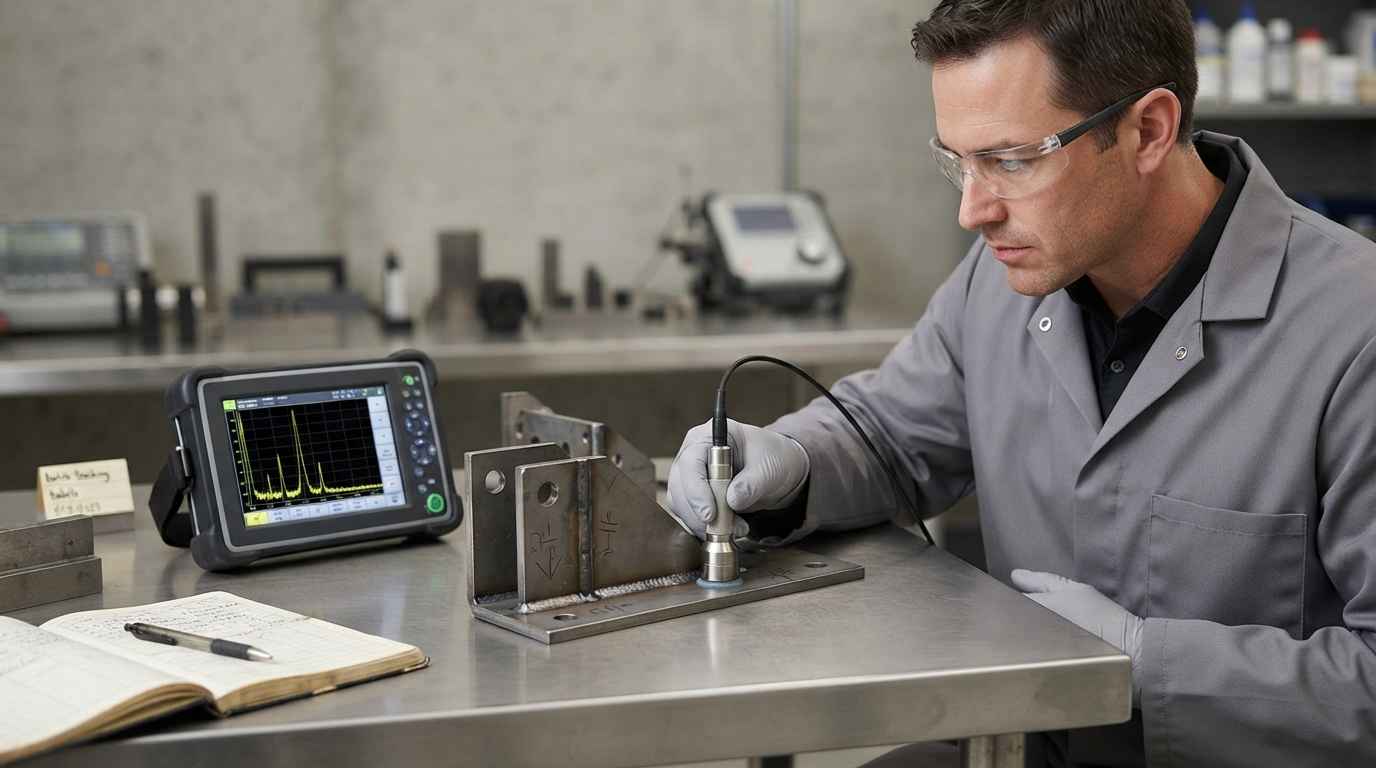
Tests that do not destroy the part play a particular role here, because they let you verify the component that will actually be fitted rather than an equivalent sample. Reverse engineering supports that work when a part has to be verified without documentation, or when an equivalent has to be found for an obsolete component.
What you lose if the failure appears in service
A failure in service costs far more than the component. It forces equipment to be grounded, units sharing the same batch to be reviewed, an investigation with the damaged part under schedule pressure, and a justification to the customer that the problem will not recur. None of that appears in the budget of the test that was not done.
The availability cost is the least visible and the most serious. Equipment stopped by one part is not a repair cost, it is a capability that is absent, and that impact is not recovered by changing the component. That is why in critical programmes spending on anticipation is compared against the unavailability it prevents, not against the price of the part.
There is a documentary contagion effect too. When a failure appears in service with no prior preventive analysis, it is hard to show that the rest of the assembly is verified, and the review spreads to components that had no problem at all. A well-built preventive file bounds that scope from day one.
Preventive analysis does not remove the risk of failure, it moves it to where it can be managed. Shifting the failure from the field to the laboratory turns an operational unavailability into a test result with a date, a criterion and a decision attached.
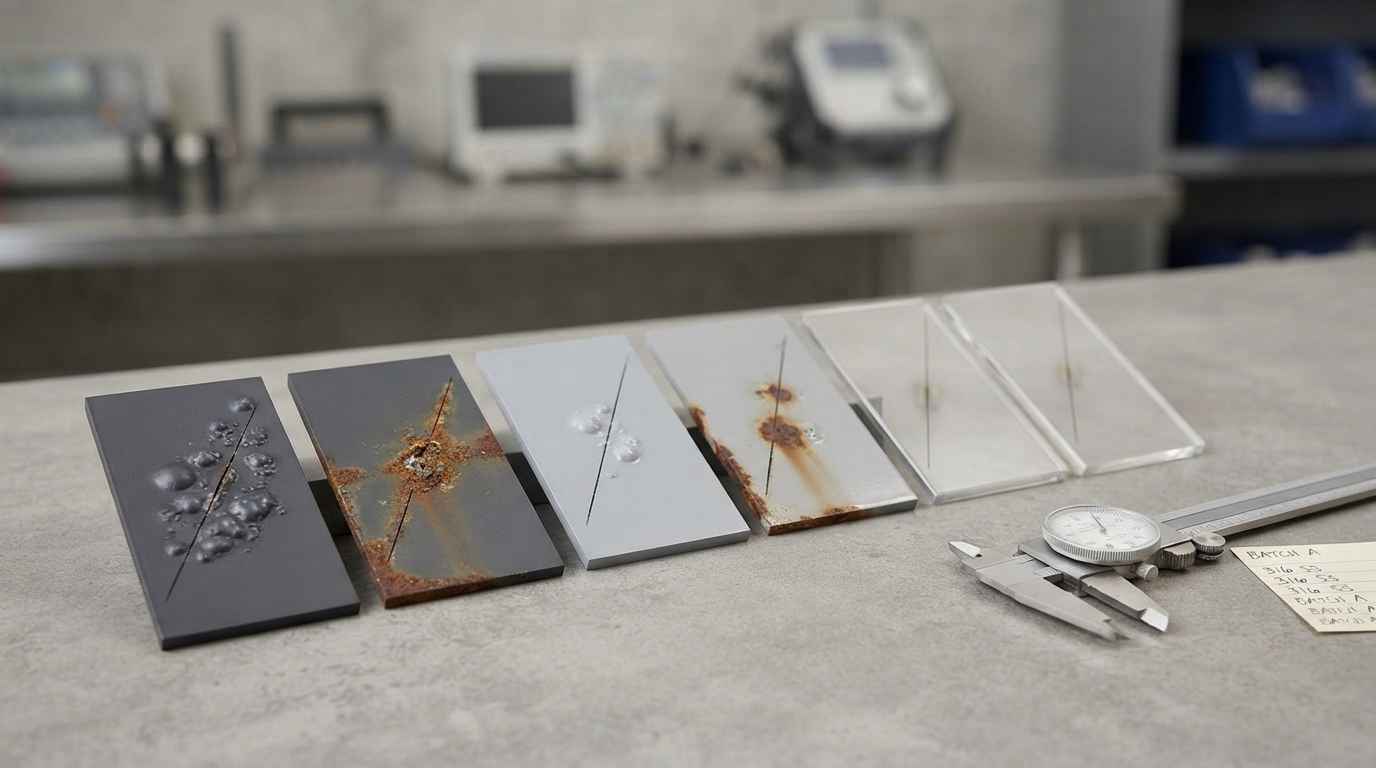
Anticipating failure costs less than repairing it in the field
Anticipating the failure of a defense component is engineering work with a clear sequence: define the usage profile in numbers, list and prioritise the failure modes, turn the priority ones into tests with an acceptance criterion, and keep every decision traceable back to its batch and its method. Done that way, preventive analysis cuts the number of surprises in service and shortens any investigation considerably when something does fail, because the file has already ruled out half the hypotheses.
If you have a critical component in design or a substitute that has to be validated, gather the material specification, the intended usage profile and the drawings and send them to us: we will return the prioritised failure modes, the test plan that verifies them and the acceptance criterion for each one.
Frequently asked questions
Where do you start when the budget does not cover every test?
With the order that comes out of the FMEA, which crosses the severity of the effect with how likely the failure mode is to appear and how likely it is to be detected before the component enters service. Modes with a severe effect and low detectability go first, even when they are infrequent, because those are the ones that reach the field without warning. Modes with a mild effect and high detectability are covered by incoming inspection rather than by testing. That split is what turns preventive failure analysis in defense into a plan that fits a given budget instead of a list of desirable tests.
How does it differ from root cause analysis of a failure?
Root cause analysis starts from a part that has already failed and reconstructs the event from physical evidence; preventive analysis reasons about known mechanisms and the intended service conditions, with no fracture to read. The first closes an incident, the second stops it happening, and the two support each other because every failure investigated improves the list of failure modes for the next programme.
Which tests are used to anticipate the failure of a critical component?
Tests that reproduce the mechanism you want to avoid in accelerated form: thermal cycling and thermal shock for interfaces between materials, salt atmosphere to ISO 9227 for coatings, accelerated ageing for polymers and elastomers, vibration and sealing tests for the assembly, and non-destructive testing to locate internal defects before a batch is released. Quality control and testing brings those techniques together, and the choice depends on the prioritised failure mode, not on the catalogue available.
What determines the cost of a preventive failure analysis?
The cost is set by the number of failure modes to verify, the duration of the tests and how well the usage profile is defined. A profile with concrete ranges and cycles allows a few well-aimed tests to be designed; a profile described in general terms forces you to cover more scenarios and multiplies the work. Long-duration ageing tests are the factor that weighs most on the lead time.
How long does it take and when is external support worth it?
Usual lead times run from one to four weeks for the analysis and prioritisation, and extend with ageing or accelerated life tests, which have their own duration; for critical cases there is an urgent option in 24 to 72 hours. External support is worth it when a substitute material has to be validated, when the usage profile is severe, or when an assessment independent of the part manufacturer is useful. Request an assessment with the specification and the usage profile and we will tell you the scope and the lead time before starting.