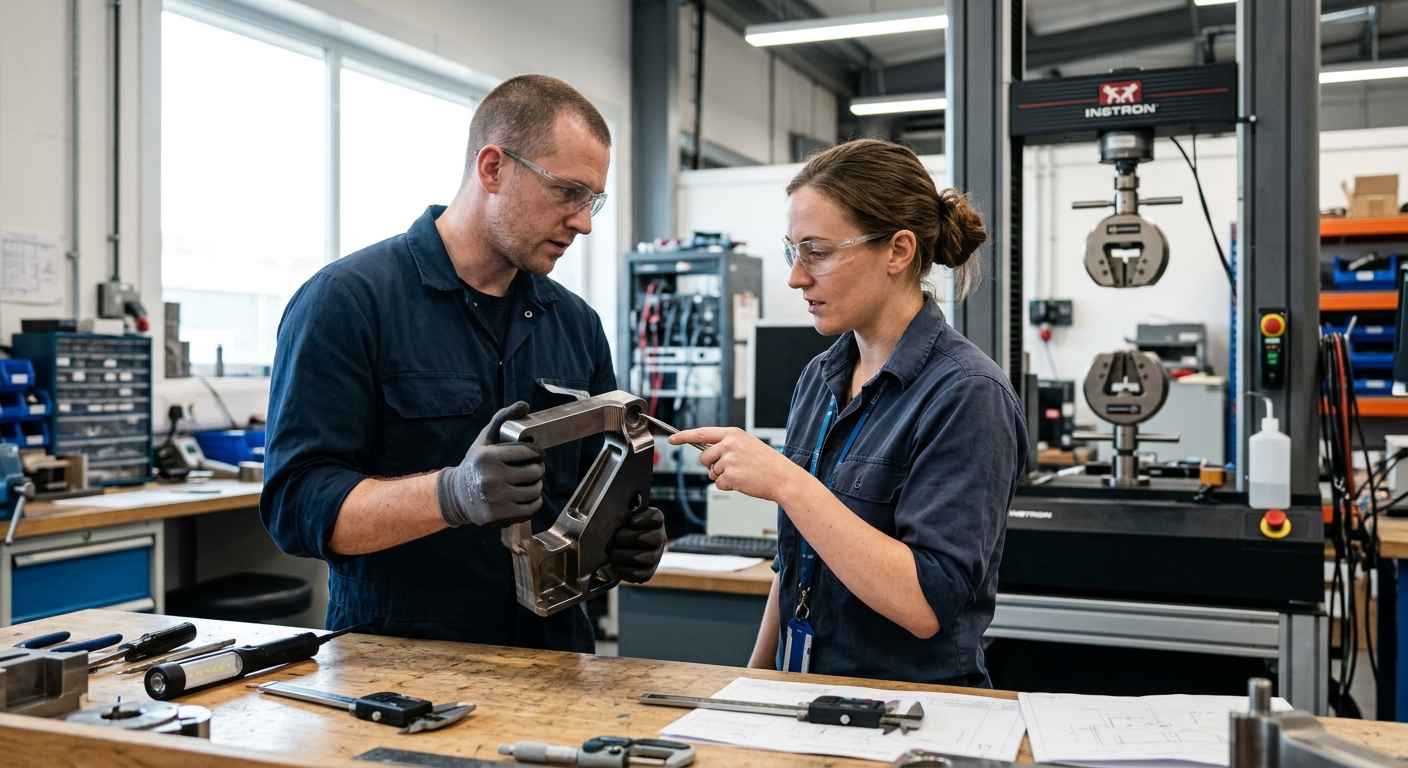

Analysis of high-performance materials for the defence sector means verifying with traceable tests that each alloy, composite or coating meets its mechanical, chemical and in-service specifications before it is fitted into a critical system. Here the margin for error is minimal: a component that fails in an armoured vehicle, a drone or a weapon system compromises the mission and the safety of whoever operates it, so characterization is not a documentary formality, it is the objective proof that the material will withstand the real conditions.
That level of demand connects directly with innovation and technology in materials, because every new grade, every heat treatment or every coating has to be validated with data, and it relies on specialized tests such as composite materials testing when the component combines fibre and a polymer matrix. If you work with defence suppliers or develop a subsystem, this is what you need to know about what is analysed, how and why.
COMPOSITE MATERIALS TESTING
Do you develop high-performance materials for defence? Discover our composite materials testing service

What the defence sector demands of a high-performance material
A material destined for defence is not chosen for a single outstanding property, but for its ability to keep all of them at once in the worst foreseeable scenario. That combination of demands, physical and managerial, is what separates a high-performance material from a merely good one, and what forces you to characterize it in more depth than in a civil application.
Performance at the limit: temperature, impact, fatigue and corrosion
A material destined for defence works at the limit. It has to keep its mechanical properties when the temperature swings between the cold of high altitude and the heat of an engine or a shot, resist impact and fatigue without cracking, withstand corrosion from a marine environment or chemical agents, and behave predictably under continuous vibration. The same grade of steel, aluminium or titanium can be perfectly valid for an industrial application and fall short for a military use, because the requirement is not only that it works, but that it works repeatably batch after batch.
Those conditions rarely act separately. A part vibrates while it heats up, takes an impact while cold or corrodes while carrying load, and many properties degrade precisely when they combine. Resistance to a marine or chemical environment, for example, is checked with the corrosion assessment and protection of the material in its real medium, not with a generic datasheet. That is why characterizing a material for defence is not about passing an isolated test, but about knowing its margin across the whole service range, including the point where several loads coincide and where an apparently over-specified material starts to fail.
Traceability: why the supplier’s certificate is not enough
To that physical demand is added traceability. In defence each material lot must be traceable from its origin to the final component, with the certainty that what was tested on a specimen represents what is fitted in the system. This completely changes the way of working: a supplier’s certificate is not enough, you have to confirm independently that the composition, the microstructure and the mechanical properties match the specification, because a deviation that would be tolerable in another sector can here mean the rejection of the lot or, worse, a failure in the field.
That independent verification is also a protection against counterfeiting and lot mixing, two risks that grow with the length of the supply chain. Confirming the material with your own measurement, and not just with the paper that comes with it, is what guarantees that the declared origin is the real one, a requirement that in defence weighs as much as the material’s performance itself.
The difference between a material that passes and one that is validated for defence is not the one-off test, but showing that the result holds across the whole lot and is backed by a record anyone can audit.
Which properties are analysed and with which tests
Checking that a material meets that set of demands is not a single test, but a coordinated battery where each technique answers one of the previous questions. The key lies in combining them, because an isolated property does not guarantee the behaviour of the whole.
| Property | What it reveals | Reference test |
|---|---|---|
| Strength and yield point | How much load it withstands before deforming or breaking | Tensile (ISO 6892-1) |
| Impact toughness | Energy absorbed at fracture, especially in the cold | Charpy (ISO 148-1) |
| Hardness | Wear resistance and control of the heat treatment | Vickers (ISO 6507-1) |
| Composition | That the alloy is the specified one, without contamination | Alloy composition analysis |
| Microstructure | Grains, phases and inclusions that explain the behaviour | Metallography and microscopy |
Mechanical properties: tensile, impact and hardness
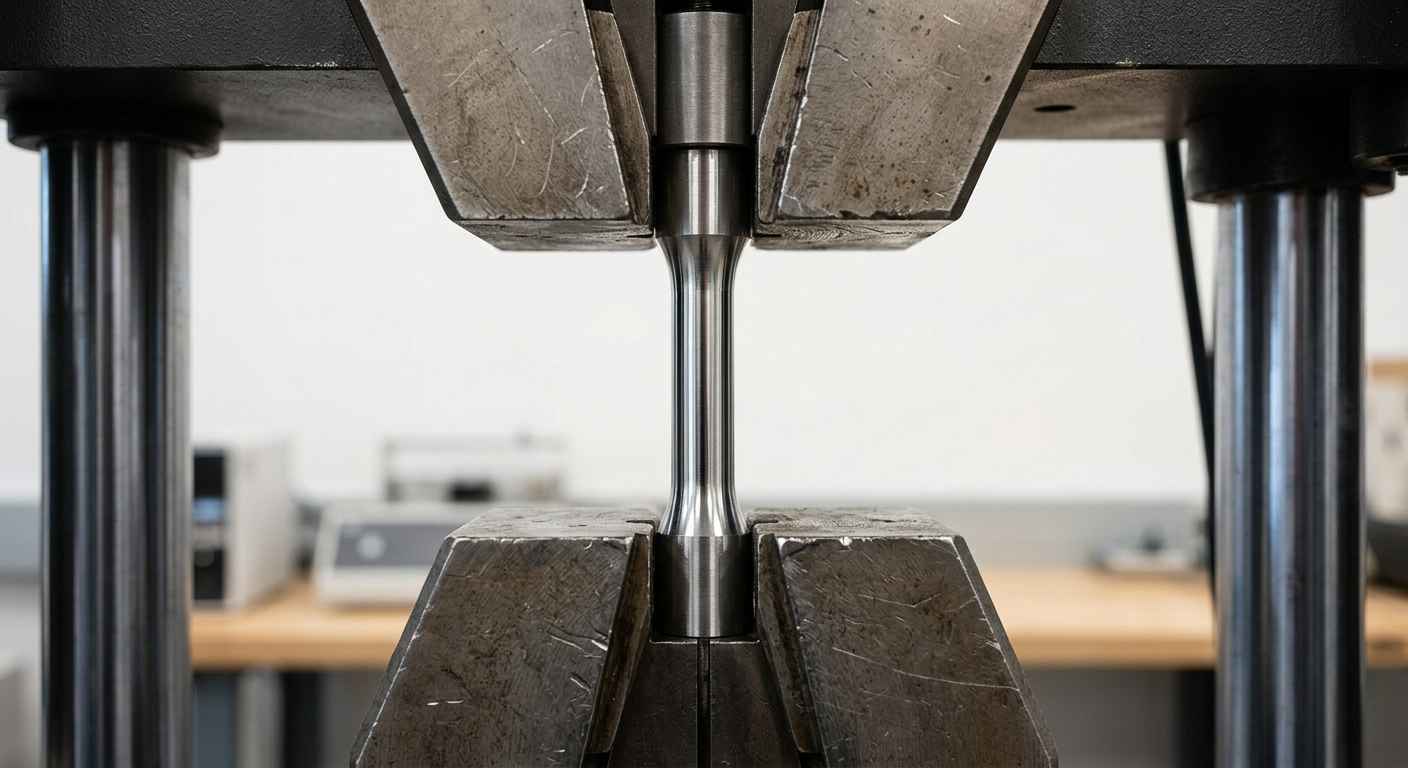
Characterization starts with the mechanical properties, because they decide whether the component withstands the intended load. The tensile test to ISO 6892-1 gives the yield point, the strength and the elongation of the metal, which define how much it holds before deforming permanently or breaking. The Charpy impact test to ISO 148-1 measures the energy the material absorbs at fracture, a decisive figure for parts that take blows or work at low temperature, where many steels go from ductile to brittle. Hardness, measured for example with the Vickers method of ISO 6507-1, correlates with wear resistance and serves as a quick check that the heat treatment was applied correctly.
These three measures are read together, not separately. A high hardness with a low toughness warns of a brittle material despite its strength; a good yield point with a poor elongation indicates it will break with barely any prior deformation, with no warning margin. Cross-referencing the three values, within the material’s set of mechanical properties, is what draws its real behaviour under load, beyond each one separately being in specification.
A material can be in specification in each test separately and still not be fit for purpose: what decides is how strength, toughness and microstructure behave together in the real condition.
Chemical composition and microstructure
The second family is the chemical composition. Confirming that the alloy is the specified one, and not a similar and cheaper grade, is the basis of everything else; the alloy composition analysis detects whether an alloying element is missing, whether there is contamination or whether the percentage of a critical component has drifted out of range. In steels for structural use, this verification is combined with structural steel testing that relates composition, microstructure and mechanical behaviour in a single diagnosis.
Microstructure closes the why. Two parts with the same nominal composition can behave differently if their manufacturing process or their heat treatment left different grains, phases or inclusions, and that is only seen in the metallographic section. Metallography reveals whether the material has the structure that matches its declared properties or whether an incorrect treatment has left it out of condition, a nuance invisible in the certificate but decisive in service.
The case of composite materials
For composite components, characterization extends to the behaviour of the fibre and the matrix, the quality of the bond between layers and the presence of pores or delaminations, factors that determine whether the part will keep its stiffness and strength after thermal and load cycles. Unlike a metal, in a laminate the failure usually starts at the interface between layers, invisible from outside, so inspecting the internal structure is as important as the mechanical test. In every case, the goal is the same: to turn a specification into a set of measured numbers that confirm, or deny, that the material is fit.

TELL US ABOUT YOUR CASE
Do you have a high-performance material to validate? Send us your case and we will propose a testing and characterisation plan
How a characterization plan for defence is structured
Having the techniques is not enough: what turns a set of tests into a guarantee is the order in which they are applied and the criterion by which they are read. A characterization plan for defence defines what is measured, on which samples and against which threshold, before touching the material.
From incoming inspection to the tests
A solid plan does not test at random, it follows a sequence. It starts with the incoming inspection of each material lot, with a defined sampling that is representative of the whole and not a single convenience specimen. On those samples the destructive tests that quantify the mechanical properties and the composition are applied, together with the non-destructive ones that look for internal defects without ruining the part, so that the precise measurement of a few samples is combined with the hundred-percent inspection when the component demands it.
The order matters because each test narrows the next. A composition analysis that rules out the wrong material avoids spending on mechanical tests on a lot already known to be non-conforming; a non-destructive inspection that locates an internal defect directs the metallographic section straight to the critical zone. Chaining the techniques from lowest to highest cost, leaving the destructive ones for last, is what makes the plan efficient without losing rigour.
Acceptance criterion and what to do with an out-of-range result
Each result is compared with an explicit acceptance criterion, tied to the system requirement and not to a generic catalogue value. That is where characterization stops being a list of tests and becomes a decision: this lot goes in, this one does not. The experience in alloy analysis to optimise performance and cost shows how far an apparently minor composition difference changes the real behaviour of the part, and why it is worth verifying it before and not after manufacturing.
The plan also covers what to do when a result falls out of range. A value out of specification does not always mean defective material: it may point to a badly prepared specimen, a mixed lot or a criterion too strict for the application. Telling those causes apart before rejecting or accepting is part of the job, and avoids both throwing away good material and letting through material that does not conform. That judgement, supported by repeating the test and cross-referencing the microstructure, is what separates a control that decides from one that only produces figures.
From characterization to traceability and validation
Data only protects if it can be followed and if it is checked against the reality of service. That is why the process does not end at the test, but at a documented chain that connects the specimen with the fitted part and, if something fails, lets you retrace the steps.
The traceable chain from lot to part
The value of the whole process is lost if the data cannot be followed. That is why each test is documented with the lot identification, the test conditions and the criterion applied, so that the final report is not a simple pass, but an auditable record that connects the tested material with the fitted component. That chain is what makes it possible, if a problem appears in service, to go back to the specific lot and understand what happened.
Traceability also gives consistency to decisions over time. When each lot is tied to its data, comparing one supply with another, detecting a drift from a supplier or justifying a rejection to a customer stops depending on memory and comes to rest on a record. In defence, where a component can stay in service for years, that ability to reconstruct the material’s history is as valuable as the initial test itself.
From the test to failure diagnosis
When a component fails, the same analytical capability is used for the diagnosis: identifying whether the origin was the material, the manufacturing process or the design. The failure analysis in metal parts shows how the root cause is reached by combining fractography and microscopy tests, mechanical tests and composition analysis, instead of settling for a hypothesis. And the logic of characterizing and validating before trusting a material is not exclusive to defence: it is the same one applied to characterizing and validating a lightweight material substitute, only with an even higher demand threshold.
A material is considered validated for defence when its properties are measured, its lots traced and its in-service behaviour confirmed, not when it passes a visual inspection or a single isolated test.
Data that backs every critical component
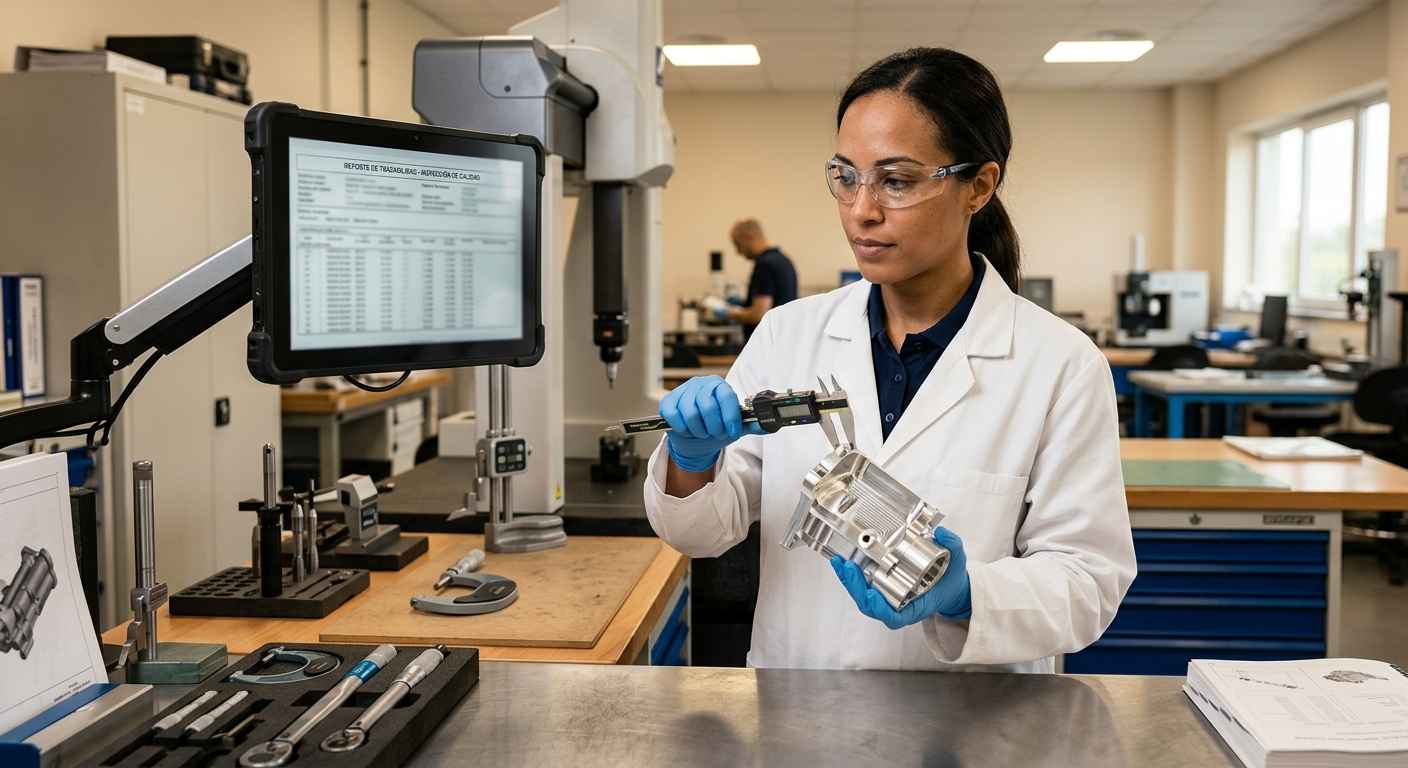
The analysis of high-performance materials for defence stops being a cost and becomes a guarantee when each critical component reaches assembly with its properties measured and its origin traced. The mechanical properties confirm that it withstands the load, the composition confirms that the alloy is the right one, the microstructure explains why it behaves as it does, and traceability connects the specimen with the real part. Together, that data replaces trust in a certificate with the certainty of a measurement.
That is the difference between a lot accepted because it looks correct and one validated because it has been proven to be. If you develop or supply components for defence, send the samples, the specification and the system requirements, and receive a characterization with the mechanical, chemical and microstructural data that confirm whether the material is up to what will be demanded of it.
Frequently asked questions about the analysis of high-performance materials for defence
What is the analysis of high-performance materials for the defence sector?
It is the set of traceable tests that verify that an alloy, composite or coating meets its mechanical, chemical and behaviour specifications before it is fitted into a critical system. Unlike other sectors, it is not enough for the material to work: you have to prove with data that it does so repeatably across all lots and that this behaviour is documented and auditable, because a failure compromises the mission and safety.
Which tests are applied to a high-performance material?
The basic ones are the mechanical tests (tensile to ISO 6892-1, Charpy impact to ISO 148-1 and Vickers hardness to ISO 6507-1), which define how much the material withstands under load, blow and wear. To them are added the composition analysis to confirm the alloy, metallography to review the microstructure and, in composite components, the assessment of the bond between layers and the search for pores or delaminations.
Why is traceability so important in the defence sector?
Because it lets you connect each fitted component with the material lot it comes from and with the tests done on it. If a problem appears in service, traceability makes it possible to go back to the specific lot and determine the cause, instead of being left with a suspicion. Without that documented chain, a test result loses value because you cannot guarantee it represents what was actually installed.
How are composite materials validated for defence?
Besides the mechanical properties, in a composite you characterize the behaviour of the fibre and the matrix, the quality of the bond between layers and the presence of pores or delaminations, since those factors decide whether the part keeps its stiffness and strength after thermal and load cycles. Validation combines mechanical tests with inspection of the internal structure to confirm that the laminate behaves as the design requires.
What sets quality control in defence apart from other sectors?
The demand threshold and the level of proof. In defence the acceptance criterion is tied to the system requirement, the sampling must be representative of the whole lot, the verification of composition and properties is done independently of the supplier’s certificate, and each datum is recorded for audit. A deviation that would be tolerable in another sector can here justify the rejection of the lot, because the cost of a failure in the field is incomparably higher.