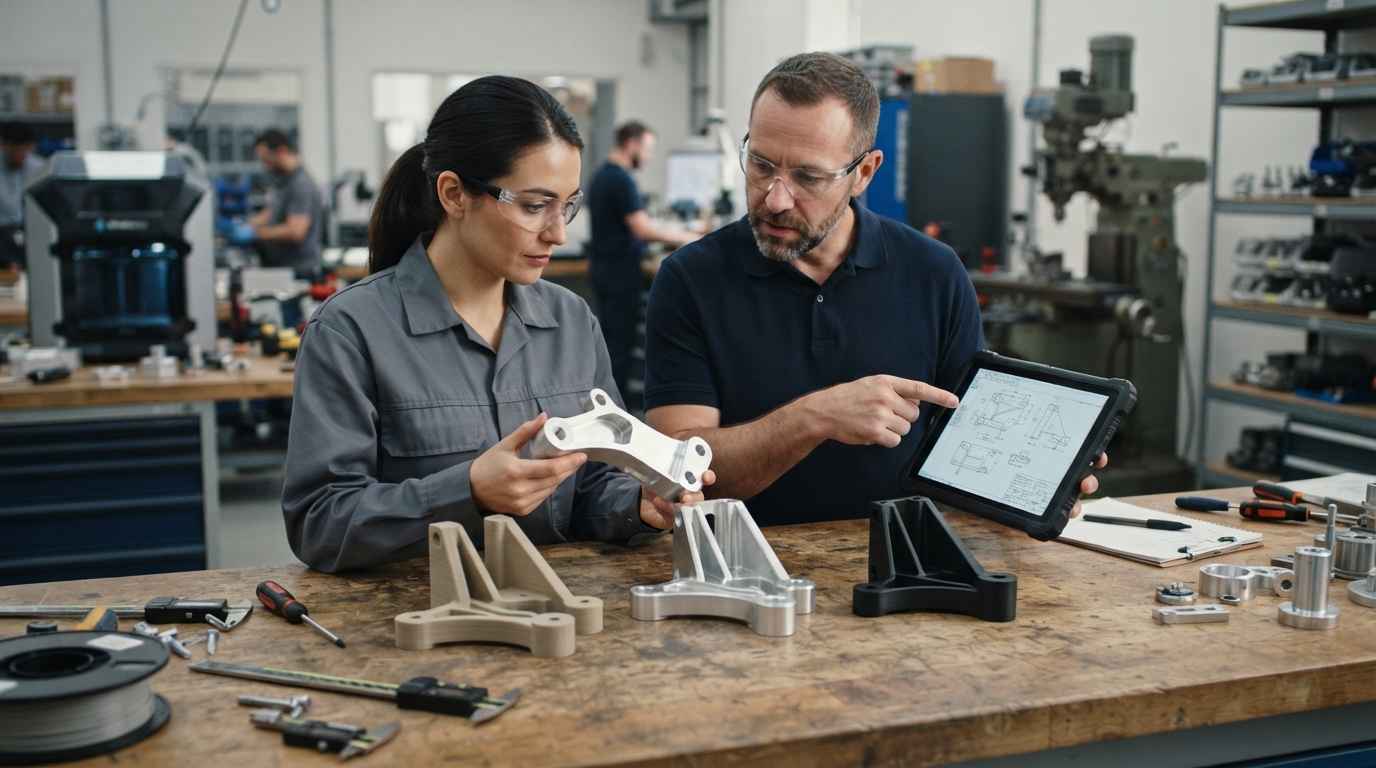

Self-lubricating coatings are surface layers that reduce friction and material loss against wear without adding oil or grease, because the coating itself releases or forms the film that separates the two surfaces in contact. They solve the contact you cannot lubricate.
That situation turns up in very different places: a sealed mechanism nobody will open for ten years, or a joint moving so slowly it never builds a hydrodynamic film. Deciding which of those layers holds is what the characterization of coatings answers.
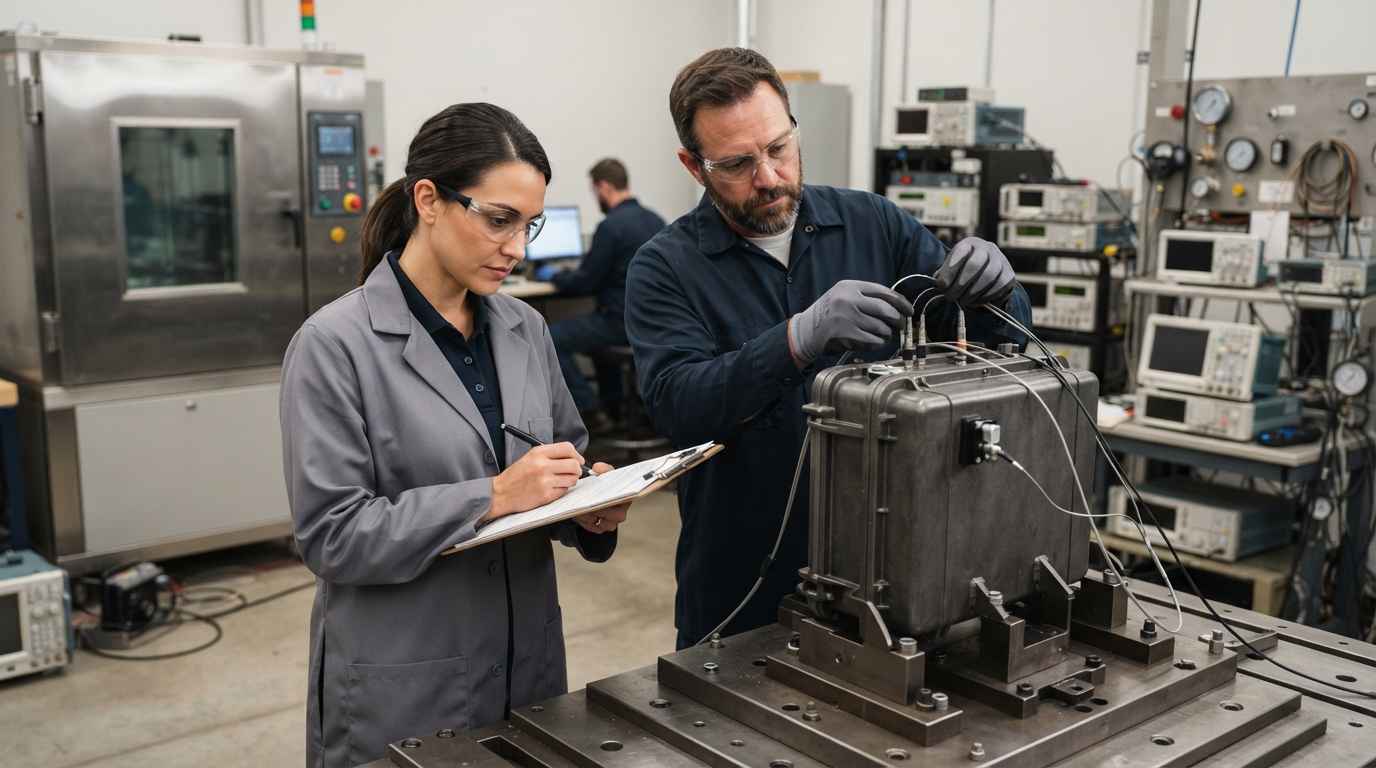
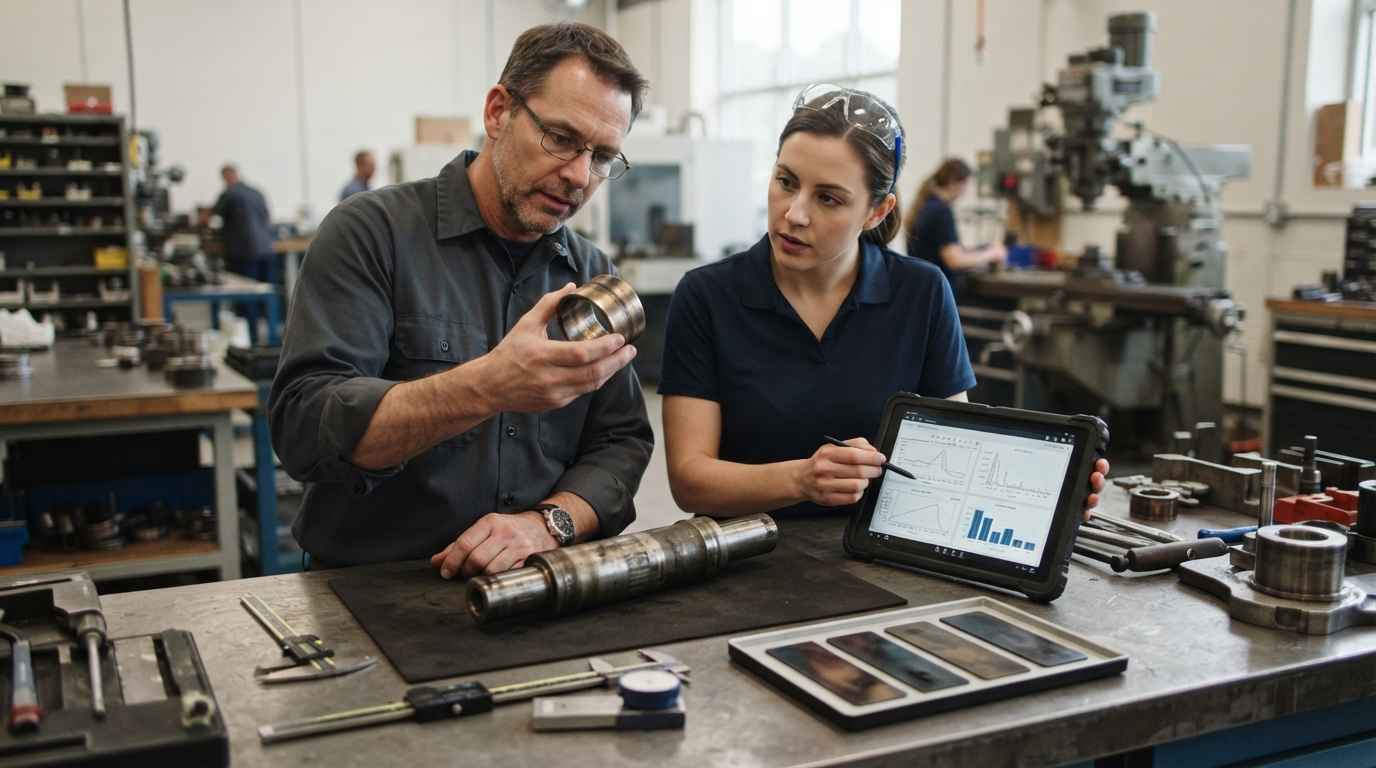
A catalogue friction coefficient says nothing without the load, the sliding speed, the temperature and the counterface it was measured against. The industrial engineering laboratory translates real service conditions into a test that represents them.
CHARACTERIZATION OF COATINGS
Do you have a component wearing out in a contact you cannot lubricate? Discover our coating characterization service

What self-lubricating coatings solve against wear
Self-lubricating coatings solve two problems at once: they lower the friction coefficient of the contact pair and they stop material being torn away by adhesion between metal surfaces. What they do not do is increase the load capacity of the component, which still depends on the base material.
A self-lubricating coating changes what happens in the first few micrometres of the surface. The load capacity of the assembly is still set by the material underneath, and confusing the two is what makes a correctly chosen layer fail.
How a solid layer lubricates without oil
Solid lubrication works through three different mechanisms, and it is worth knowing which one the layer you are buying uses. The first is the transfer film: the coating gives up material to the counterface and between the two a low-friction layer forms that renews itself as the parts move. The second is the lamellar structure, with planes that slide over one another. The third is low surface energy, which stops the surfaces sticking together.
Tribology studies that interaction between surfaces in motion, and its most useful conclusion is that the friction coefficient is not a property of the material but of the system. It changes with load, speed, temperature, the finish of both surfaces and third bodies.
Types of wear a self-lubricating coating does not correct
A self-lubricating coating acts on the adhesive wear that appears in sliding contact, and has little effect on abrasion by hard particles, surface fatigue from rolling contact, and erosion. Identifying the mechanism before choosing the layer is what separates a solution from a repeated expense.
Abrasion by particles is easy to misread. With dust, chips or process product in the contact, the particles embed themselves and score the surface, and a thin low-friction layer is consumed quickly for lack of hardness and thickness. There the answer is a hard coating or better sealing, not lower friction.
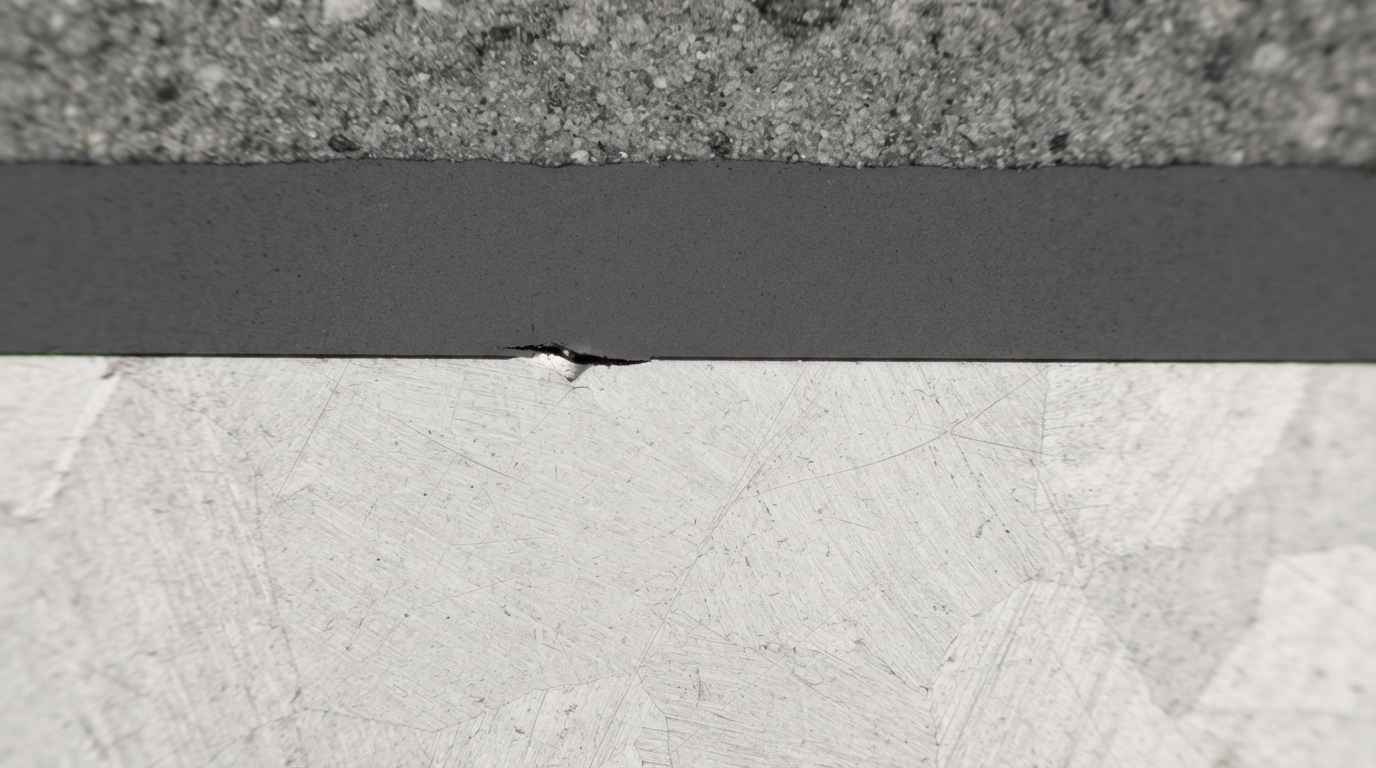
Contact fatigue is the other mechanism the layer does not solve. When pressure generates stresses below the surface, the crack starts in the base material and the coating comes away as a consequence, not as a cause. Telling it apart from an adhesion failure means looking at the cross section and seeing where the damage started, because from the outside they look alike. Types of wear in components and how to tell them apart sets out the marks left by each mechanism.
Families of self-lubricating coatings and materials
Self-lubricating solutions fall into three families with different logics of use: solid lubricants applied as a thin layer, hard coatings with a low friction coefficient, and bulk self-lubricating materials where the lubricant is distributed through the whole volume. The third is not a coating, and sometimes it is the right answer.
Applied solid lubricants, MoS2, graphite and PTFE
Applied solid lubricants are thin layers of a low-friction compound, deposited by spraying with a resin binder, by thermal projection or by impregnating a previously porous layer. Their virtue is very low friction from the first movement; their limit is thickness, a few microns, which sets the material available before you reach the substrate.
Molybdenum disulphide is the reference in vacuum, dry and in space applications, and loses performance as it oxidises in humid air. Graphite sits at the opposite end: it needs adsorbed water vapour to slide, is no use in vacuum, and in air starts to oxidise between 450 and 500 degrees, its real ceiling in use. PTFE gives the lowest friction of the three and tolerates almost any industrial chemical agent, with two limits: low load capacity and deformation under sustained load, with continuous service around 260 degrees.
The choice between them is therefore governed by the environment rather than by the catalogue figure, just as it is when selecting a material for an industrial application. In vacuum, outgassing also governs: organic binders and filled polymers release volatiles that condense on the cold surfaces of the chamber.
Low-friction hard coatings, DLC and nitrides
Low-friction hard coatings combine a hardness far above that of steel with a reduced friction coefficient, and are deposited in layers a few micrometres thick by vapour phase processes. They solve the case where you have to resist load and abrasion as well as lower friction, where applied solid lubricants fall short.
Diamond-like carbon (DLC) occupies the low-friction end: it works dry and resists abrasion, with two conditions: it needs a hard substrate so it does not sink under the layer, and it loses properties in air in the order of 300 degrees, because the carbon oxidises. Titanium, chromium and titanium-aluminium (TiAlN) nitrides hold well above that threshold and reduce friction less, so you have to choose between the two.
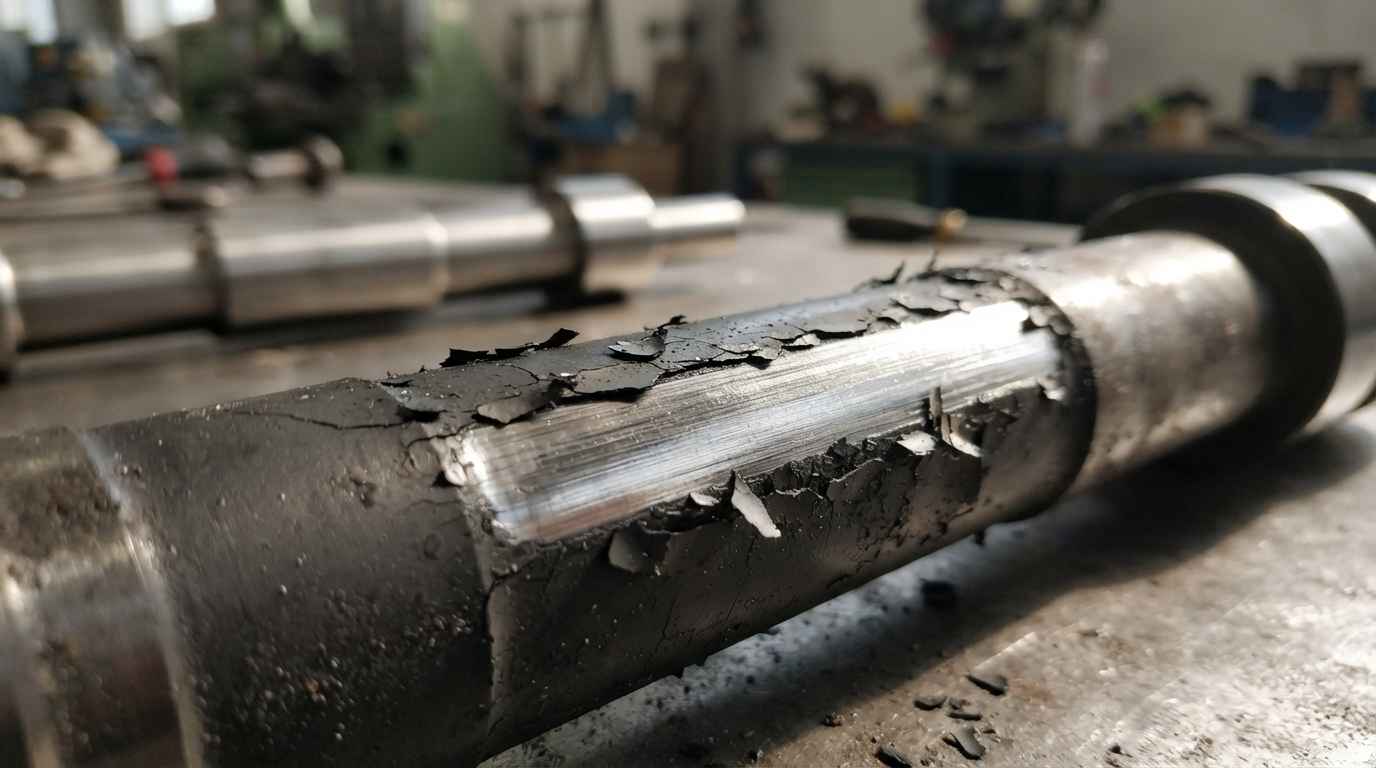
The critical point in this family is not the layer, it is the interface. A hard coating on a poorly prepared surface (oxides, degreasing residue, roughness out of range) comes away in flakes at the first load cycle, and the component ends up worse than uncoated because the fragments act as an abrasive. The evaluation of coating durability to improve resistance puts that interface to the test before committing a production run.
Bulk self-lubricating materials, filled polymers and sintered bronze
Bulk self-lubricating materials carry the lubricant distributed through the whole volume, so the effect does not run out when the surface wears: new lubricant appears. Its reserve is counted in millimetres rather than in the few microns of a thin layer.
In polymers, the usual formulation is an engineering matrix (polyamide, acetal, PEEK) filled with PTFE, graphite or fibre to tune friction, strength and dimensional stability. In metals, porous sintered bronze impregnated with oil gives up lubricant as frictional heating raises its temperature and reabsorbs it on cooling, a zero-maintenance solution as long as the oil is neither degraded nor washed out.
TELL US ABOUT YOUR CASE
A low-friction layer consumed sooner than expected? Send us the part taken out of service and its conditions and we will propose the wear mechanism identified
Which tests decide whether the layer survives your application
The choice between families closes with three measurements: the friction coefficient and wear rate of the pair under representative conditions, the adhesion of the layer to the substrate, and the effective thickness and hardness.
Friction coefficient and wear rate measured on the real pair
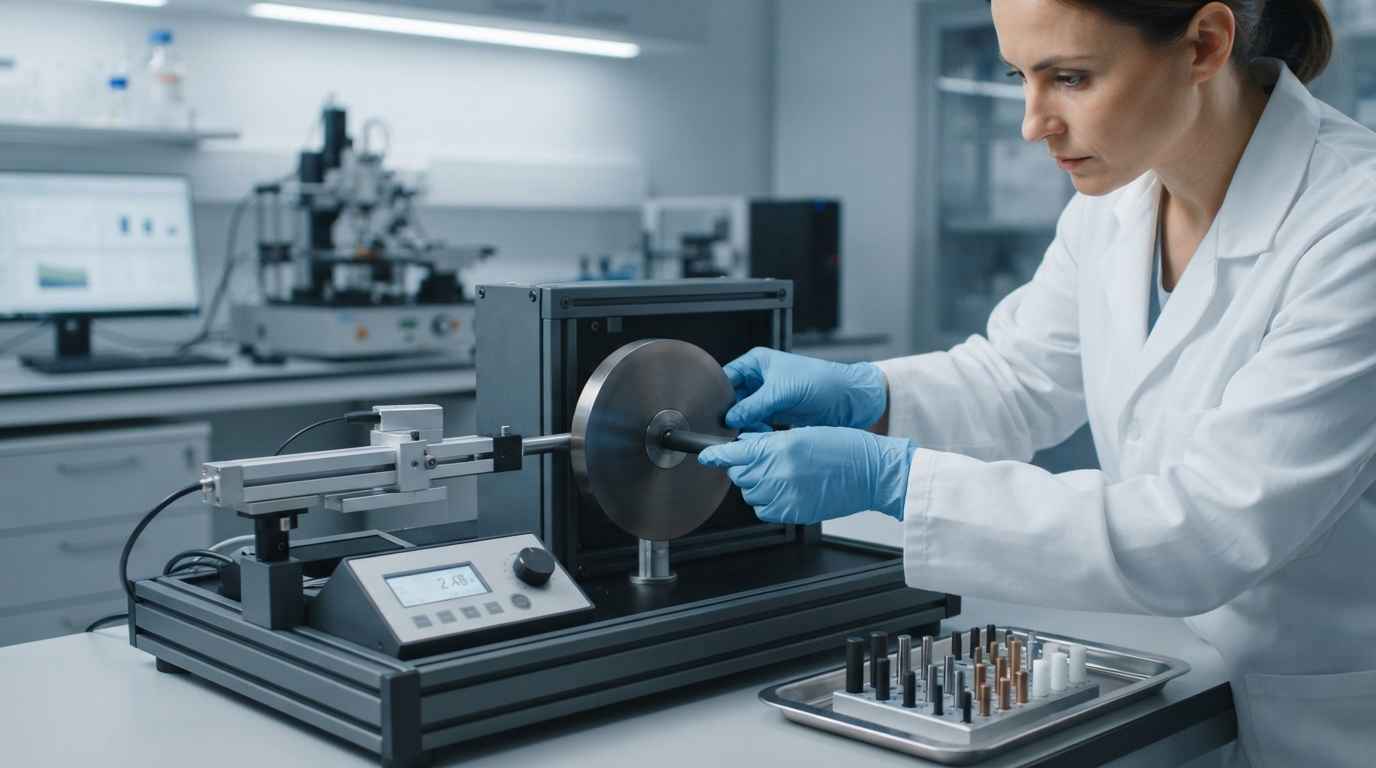
A sliding wear test runs the coated surface against a defined counterface, with controlled load, speed and sliding distance, and records the friction force during the test and the volume lost at the end. ASTM G99 describes the pin-on-disk procedure by which they are obtained reproducibly. The volume lost is normalised by load and sliding distance and expressed as a wear coefficient in mm³/N·m, the figure candidates are compared on.
The values are comparative under the test conditions, and that is their use: they let you rule out candidates before anything is assembled. The step to the real component comes from testing the complete pair afterwards with its geometry and its duty cycle, as happens when reconstructing a factory equipment failure back to its root cause.
Adhesion, thickness and hardness of the layer
Adhesion is the property that decides whether the coating ever gets to work. It is assessed by scratch testing, with an increasing load and an indenter that travels across the surface until the layer cracks or comes away, and for hard vapour phase coatings ISO 20502 sets the procedure; on dry solid lubricant films it is verified by another route. The result is the critical load at which the bond fails, comparable between batches and suppliers, with an acceptance criterion set by the part specification, not by the test standard.
Thickness and hardness complete the picture. Thickness is measured on a prepared cross section or by non-destructive methods depending on the layer and substrate pair, and marks the reserve available. The hardness of a layer a few micrometres thick is not measured with a conventional test, because the indenter would go straight through, so instrumented indentation is used instead, with ISO 14577-4 as the reference, the part specific to coatings, which works at penetrations compatible with the thickness.
| Family | Why it slides | Environment where the effect holds | Limit that governs its use | Laboratory figure that decides it |
|---|---|---|---|---|
| Applied MoS2 | Lamellar structure | Dry, vacuum, inert atmospheres | Oxidises in humid air | Friction and wear in the service atmosphere |
| Applied graphite | Lamellar structure with adsorbed moisture | Air, up to the onset of oxidation (450 to 500 degrees) | No effect in vacuum | Friction against relative humidity |
| Applied or impregnated PTFE | Low surface energy and transfer film | Chemically aggressive, moderate temperature | Low admissible load and creep | Wear at the real contact pressure |
| DLC | Carbon transfer film | Dry, with load and abrasion | Oxidises at high temperature in air | Critical adhesion load and layer hardness |
| Ti, Cr or TiAl nitrides | Hardness with reduced friction | High temperature, abrasive contact | Less friction reduction | Layer hardness and effective thickness |
| Filled polymer or sintered bronze | Lubricant spread through the whole volume | Zero maintenance, moderate loads | Low modulus, expansion and creep | Accumulated wear and dimensional stability |
Why a self-lubricating coating fails in service
A self-lubricating coating fails in three ways: it loses adhesion, it is consumed sooner than expected, or it stops lubricating because the environment changed. All three leave different marks, and reading them keeps you from fitting the same coating again.
When a layer comes away, the question is not which coating to fit now. It is whether the bond to the substrate failed, whether the thickness ran out, or whether the working environment was not the one assumed when it was chosen.
Adhesion failures and surface preparation
An adhesion failure is recognisable because the layer lifts in flakes leaving the substrate clean and its geometry intact. The origin lies before the coating: incomplete degreasing, an oxide not removed, roughness out of range, or a later heat treatment that stressed the interface.
Controlling that stage pays off without changing coating. Measuring the critical scratch load on witness coupons from each batch catches a drift in surface preparation before it reaches the parts, and the analysis of galvanized, anodized and coated materials covers that verification of layer and substrate.
One particular case: a coating applied to a surface that is then machined or formed. Any later operation damages the layer at the edge, and that is where the attack gets in. The order of operations is part of the specification, not a shop floor detail, and correcting it is a job for process improvement, not a change of coating.
Limits of load, temperature and chemical environment
Every family has a window of load, temperature and chemical agents outside which it stops lubricating, and leaving that window produces a failure easily mistaken for a quality defect without being one. The layer is right for the assumption it started from, but the assumption was not the machine’s.
Load overrun shows up as a bright burnished scar, with the substrate deformed underneath. Temperature shows up as a darkened, powdery or missing layer only in the hot zone. Chemical attack follows the outline of a pool or a joint rather than the path of the movement.
The worn part taken off a machine is the most complete test you have, because it carries every real condition at once. Measuring its remaining thickness and the state of its interface turns a breakdown into the figure that chooses the next layer.
The layer solves the surface, the diagnosis solves the component
Self-lubricating coatings are a precise tool for one specific problem, the contact that cannot be lubricated, and the wrong answer for abrasion, contact fatigue and alignment failures. The order that works is to identify the mechanism on the real part, compare candidates with friction, wear and adhesion measured on the correct pair, and verify batch by batch that surface preparation does not drift.
If you have a component wearing out and a contact you cannot lubricate, send us the part taken out of service, the counterface and the working conditions (load, speed, temperature and environment) and we will return the mechanism identified, the compatible families and the test that ranks them before you change supplier.
Frequently asked questions
What does a laboratory wear test not tell you about your real part?
It does not give you the service life of the component. A pin-on-disk test measures friction and volume loss in a fixed geometry under fixed conditions, and that serves to rank candidates, not to predict how many hours a part will last with its own geometry, its pressure distribution, its misalignments and its starts and stops. It does not capture the real third bodies either (dust, product, chips) or the machine’s thermal cycles. The step to service life comes from testing the complete pair, or from measuring the remaining thickness of parts taken out of service after a known time.
When is a coating the right call and when is a bulk self-lubricating material?
A coating is the right call when you need to keep the stiffness, dimensional precision and load capacity of the base metal and only want to change how the surface behaves. A bulk material is the right call when accumulated wear is high and there is no access for maintenance, because as the surface is consumed new lubricant appears and the effect does not run out after a few micrometres. The practical criterion is the thickness you expect to lose: if it is comparable to that of the layer, the bulk material is the option; if the contact barely wears but takes no oil, the layer is enough and preserves the mechanical properties of the component.
What drives the cost of characterising a self-lubricating coating?
Cost depends on how many properties have to be measured and on whether a specific test rig is needed. Determining thickness and composition on a part is quick; adding scratch adhesion, instrumented indentation hardness and a wear test with the real counterface multiplies the scope. The fidelity of the tribological test is what adds specific set-up: reproducing the temperature, the atmosphere or a long duty cycle is not done with a standard test. Sending the part taken out of service together with an unused one from the same batch reduces the work, because it gives the baseline without having to reconstruct it.
What do you risk by fitting a coating without verifying its adhesion?
You risk making the component worse than leaving it uncoated. A hard layer that comes away in flakes generates fragments harder than either surface in contact, and those fragments act as an abrasive and accelerate the very wear the coating was meant to prevent. On top of that, the failure does not show at incoming inspection but after a few load cycles, when the parts are already assembled and distributed, so the correction stops being a change of specification and becomes a replacement campaign. Measuring the critical scratch load on witness coupons from each batch is the check that avoids it.
How long does characterising self-lubricating coatings against wear take?
Usual lead times run from one to four weeks depending on scope, with an urgent route in 24 to 72 hours when a line is down. Thickness, composition and adhesion land in the lower part of that range; a wear test with the real counterface and reproduced conditions takes the upper part, and it stretches further if thermal cycling is needed or if a substrate heat treatment that may have affected the interface has to be verified. If you have a recurring breakdown, request an assessment with the part and the working conditions and we will tell you the scope and the lead time before starting.