

Used oil analysis is the set of tests that measures the condition of a lubricant in service and the particles it carries, so you can work out the state of the machine holding it without opening it.
When a gearbox or a hydraulic circuit starts behaving differently, vibration and temperature tell you that something has changed, and the oil tells you what is changing. It does not warn earlier than they do, it warns about something else: it is the only sample that has touched every working surface and brought back whatever came off them. Reading that record is the work of an industrial engineering laboratory.
That monitoring takes shape in the testing of lubricants and industrial oils, which combines the physicochemical characterisation of the fluid with the counting and identification of the particles in suspension. With those data you decide whether the oil is still fit for use, whether filtering is enough, whether water is getting in and whether a surface is shedding material faster than it should.
TESTING OF LUBRICANTS AND INDUSTRIAL OILS
Is a machine giving signals and you cannot tell whether the problem is the oil or the equipment? Discover our testing of lubricants and industrial oils

What used oil analysis is and what it tells you about the machine
Used oil analysis consists of measuring the properties of the lubricant and its particle and contaminant content at regular intervals, and reading the result against the reference new oil and against earlier samples from the same equipment. It is not an incoming inspection, it is the monitoring of the pair formed by the fluid and the machine.
Oil as a sample, what wear information it carries
Oil works as a sample because it travels the whole circuit and carries away what comes off the surfaces. Particles from gears, bearings or pumps stay in suspension, and their quantity, size and shape describe the process producing them.
Telling particle types apart lets you name the active mechanism, the criterion that separates the types of wear in components and how to distinguish them. A cutting particle, a laminar one and a spherical one come from different processes even when they are the same steel.
Sampling conditions that make the result comparable
A sample is only comparable with earlier ones if it is taken at the same point, with the machine in the same state and following the same procedure. The sampling point determines which fraction of the circuit you see: upstream of the filter you collect what the machine generates and downstream what the filter lets through, which does not support the same decision.
A single oil sample fixes a value, not a trend. Used oil analysis pays off when the same sampling point is repeated at regular intervals, because the maintenance decision rests on the slope of the series and not on the isolated number.
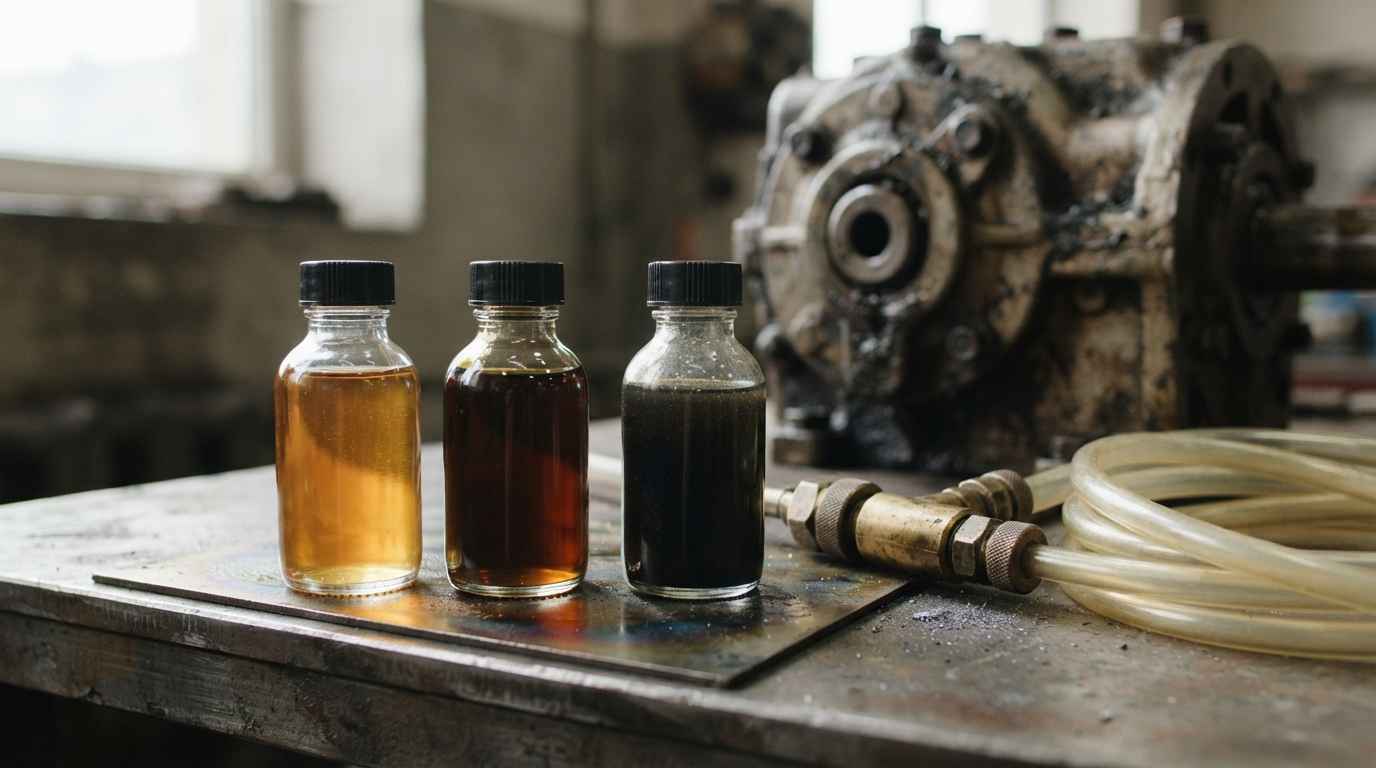
Viscosity, acidity and water, the real condition of the lubricant
The physicochemical characterisation of the oil answers one specific question, whether the fluid is still able to separate the surfaces it has to separate. Three groups cover it, viscosity, which governs film thickness; acidity and basicity, which describe oxidation and the additive reserve; and water content.
All three are read against new oil of the same grade, not against a universal value. Without that baseline, a viscosity measured in service does not say whether the oil has thickened through oxidation or been diluted and topped up. Characterising the product arriving at the store is part of the same work, as in the characterisation of a lubricant across different batches.
| Parameter | What it measures | Reference or scope | Which decision it supports |
|---|---|---|---|
| Kinematic viscosity | Resistance to flow at controlled temperature | ISO 3104, capillary viscometer | Confirm the grade or detect dilution and thickening |
| Acid number (TAN) | Acidic products from oxidation | ASTM D664, potentiometric titration | Place ageing against the new oil |
| Base number (TBN) | Alkaline reserve still available | Potentiometric titration, the result depends on the titration solvent | Decide the oil change in combustion engines |
| Water content | Dissolved, emulsified and free water | Coulometric titration, includes dissolved water | Trace the ingress path and dehydrate |
| Particle count | Particles per millilitre and size range | ISO 4406, cleanliness code | Adjust filtration or close an ingress path |
| Analytical ferrography | Shape, size and nature of the particles | Optical microscopy on a ferrographic substrate | Name the active wear mechanism |
| Elemental spectrometry | Wear metals, additives and contaminants | Elemental analysis, biased towards the finest particles | Attribute each metal to a component |
Kinematic viscosity, the first sign that the oil is no longer the one you charged
Kinematic viscosity is the resistance of the oil to flowing under its own weight, and it is determined by measuring the time it takes to pass through a capillary viscometer at controlled temperature, the procedure set out in ISO 3104. It defines the grade of the oil and is the first figure compared with the equipment specification.
A deviation upwards points to oxidation, to loss of light ends or to contamination with a more viscous fluid. A deviation downwards points to dilution, by fuel, by process solvent or by a top-up with the wrong grade.
In the analysis and evaluation of new and recycled industrial oils to optimise production costs, characterising the fluid made it possible to decide with data whether the recycled oil could replace the new one.
TAN and TBN, oxidation consumed and alkaline reserve available
The acid number, known as TAN, quantifies the acidic products present in the oil, and it is determined by potentiometric titration according to ASTM D664. Its rise relative to new oil measures the progress of oxidation, which ends up generating varnish, sludge and deposits in the hot zones.
The base number, TBN, measures the alkaline reserve left to neutralise acids. It is also determined by potentiometric titration and matters above all in combustion engines, where detergent additives are consumed neutralising combustion products. In a hydraulic circuit or a closed gearbox, TAN carries almost all the information.
Water content, the contaminant that changes the lubrication regime
Water in oil reduces the thickness of the lubricating film, promotes corrosion and accelerates oxidation of the fluid. It appears dissolved, emulsified and free, and the total amount is quantified by coulometric titration, which also detects the dissolved fraction you cannot see.
TELL US ABOUT YOUR CASE
Do you have an oil analysis history you cannot read? Send us the sample and the equipment data and we will propose the action each finding supports
Wear particles, from the count to ferrography
The particles in suspension are the part of used oil analysis that speaks about the machine rather than the fluid. Their number indicates how much material is coming off, their size distribution whether the process is accelerating, and their morphology and composition which surface they come from and by which mechanism.
Particle counting and the oil cleanliness code
Particle counting quantifies how many particles there are per millilitre in each size range, and the result is expressed with the cleanliness code defined in ISO 4406, which assigns a number to each of three ranges. It is a classification code, not an acceptance criterion: the admissible limit is set by the manufacturer of the most sensitive component, usually the pump or the servo valve.
Counting has a limit. The counter registers everything that blocks the light of its sensor, so an air bubble, an emulsified droplet or a precipitated additive count just like a steel chip. That is why a high count is confirmed with a technique that identifies the particles.
Analytical ferrography, the morphology that names the wear mechanism
Analytical ferrography consists of depositing the particles from the oil onto a substrate and observing them under the microscope to describe their shape, size and nature. It turns a number into a diagnosis, because the morphology keeps the imprint of the process that generated it.
Normal rubbing particles are small and flat. Cutting particles, like curled chips, appear when a hard surface machines material off a softer one. Laminar particles, thin and perforated, are associated with contact fatigue in a bearing, and tiny spheres with rolling fatigue cracks.
The number of particles tells you how much wear there is, and the shape of the particles tells you what kind it is. Without that second reading, a high count justifies changing or filtering the oil, but it does not let you decide whether to schedule opening the equipment.
Elemental spectrometry, which component each metal comes from
Elemental spectrometry measures the concentration of metals in the oil and allows each one to be attributed to an origin. Iron points to gears, shafts and liners; copper and tin to bearings and bushings; aluminium to pistons and housings; silicon to mineral dust; and zinc, phosphorus or calcium to the additive package.
The reading becomes diagnostic if combined with the materials in the equipment. A rise in copper in a gearbox whose only copper elements are the bushings locates the problem without dismantling, and chemical analysis of metals on the removed part confirms it.
The technique has a size bias, because sample preparation limits the particle size that reaches detection. Severe wear producing large particles can give moderate metal concentrations. When the metal matches no component of the circuit, the question is where it got in, and the work moves closer to the analysis of contaminants and impurities.

Which maintenance decision each parameter supports
Each parameter supports a different decision, and confusing them turns a correct report into the wrong action. Viscosity, TAN and TBN decide about the oil; the count and the water content, about filtration and ingress paths; ferrography and spectrometry, about the machine.
Change the oil, filter it or dehydrate it
An oil change is justified when the fluid has lost the properties that made it fit for use, not when it has run a given number of hours. A viscosity outside the grade, a TAN above the margin set by the manufacturer or an exhausted TBN point to replacing the whole charge.
Filtering solves another problem, that of an oil in good condition with too many particles. If the physicochemical result is correct and the count is high, filtering in circulation recovers the fluid without draining the circuit, and repeating the analysis confirms whether it worked.
Dehydration addresses the third case, water. Until the ingress path is closed, dehydrating only buys time, and monitoring water content afterwards shows whether the leak is still open.
Open the machine or keep watching the trend
The decision to open a piece of equipment rests on three indications coinciding, a count that is growing, a morphology consistent with a severe wear mechanism and a metal that points to a specific component. All three together justify the shutdown; one alone, shortening the sampling interval.
When the equipment has failed, the oil is still part of the analysis. In the forensic engineering work on failures in factory equipment to reach the root cause, cross-checking the condition of the fluid against examination of the damaged surfaces separates a cause from a consequence, the criterion behind the studies of failures in machinery.
An oil analysis programme does not avoid every shutdown, it turns the unplanned ones into planned ones. That change shows up first in the spares store and the production plan, and only later in the maintenance cost.
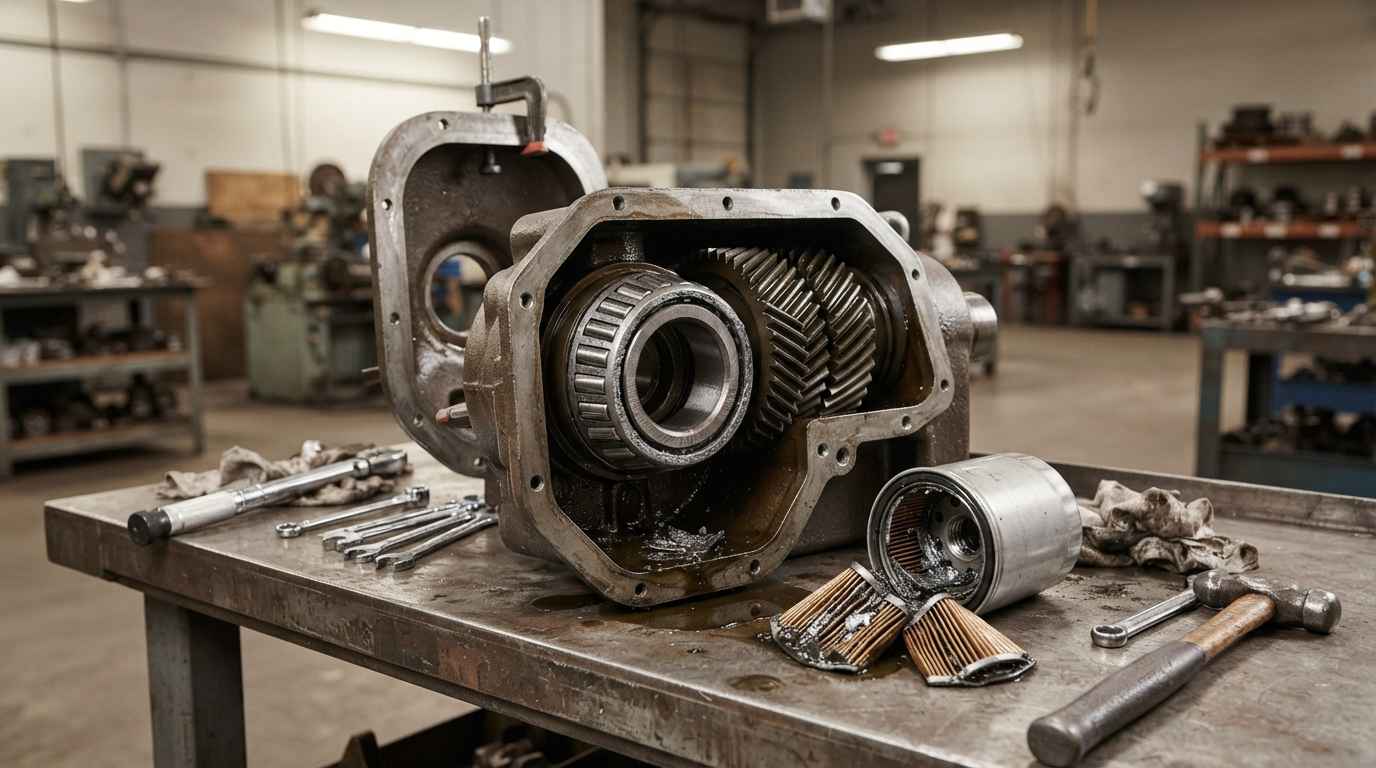
The oil speaks before the machine stops
Analysing oil in service gives you two pieces of information for the price of one sample, the condition of the lubricant and the condition of the surfaces it lubricates. That is why a useful report does not end in a list of values, it says which action each finding supports and how urgently.
If you have equipment behaving in a way you cannot quite explain, or an oil charge with more hours than planned, take the sample hot and at the usual point, note the equipment, the oil with its grade and the service hours, and send it to us. We return the measured parameters, their reading against the new oil and the action each finding supports.
Frequently asked questions
What does used oil analysis not tell you?
Used oil analysis does not tell you how much life the machine has left, nor does it locate on its own the part that is failing. It measures the condition of the fluid and characterises the particles it carries, and with that it narrows the mechanism and the source material, but the match with a specific component is closed by examining the removed part, for instance with metallographic testing of the damaged surface. It also does not replace the other monitoring techniques, because it detects wear that generates particles and degraded fluid well, and detects poorly a clearance or a misalignment that has not yet started removing material. And with a single sample, without reference new oil or history, the report gives values with no slope, which is half the information.
How often should you sample a piece of equipment?
The interval is set by the criticality of the equipment and by the oil volume, and it is shortened as soon as an indication appears. As usual-practice anchors, a critical hydraulic circuit is sampled monthly, a gearbox quarterly and an engine by service hours rather than by calendar, always as an indicative order of magnitude, because the interval that governs is the one set by the equipment manufacturer. A hydraulic circuit on a line that cannot stop needs more frequent monitoring than a redundant gearbox, and a small sump degrades sooner than a large one because the same contaminant is spread through less fluid. What really drives the value of the programme is regularity, with samples always taken at the same point, with the machine running and following the same procedure, because only then is the series comparable. When a parameter moves, the useful response is to double the sampling frequency until there is a slope.
What drives the cost of an oil analysis programme?
The cost depends on the number of parameters per sample, the number of sampling points and the frequency, in that order. A package of viscosity, acidity, water content and particle counting covers routine monitoring of standard equipment. Adding analytical ferrography and elemental spectrometry multiplies the information and also the laboratory time, so it makes sense to reserve them for critical equipment or for samples that have already given an indication. Characterising the reference new oil also weighs in, done once per product and serving the whole programme, as does the level of interpretation you ask for, because a report with a reading and a recommended action is not the same as a sheet of results.
What do you risk by changing oil on a calendar instead of on condition?
Changing on a calendar exposes you to two symmetrical errors, discarding oil that was still serviceable and keeping in service oil that was not. The first is a visible cost in purchasing and waste management. The second is paid by the machine, because an oxidised or contaminated fluid works with a thinner film and accelerates wear on the surfaces it was meant to protect. Calendar changing also has a side effect, in that draining the sump removes the evidence: the particles carrying information about incipient wear leave with the used oil and the history loses the point that would have shown the slope. Knowing whether what is exhausted is the additive package or the base oil means going into the characterisation of additives and fillers, and that figure changes the answer between topping up additive and renewing the whole charge.
How long does the analysis take and what should you send?
A monitoring package is usually resolved in one to two weeks, and a full study with ferrography and spectrometry in two to four, with an urgent option in 24 to 72 hours when critical equipment is waiting on the decision. Send between 100 and 250 millilitres of oil in a clean, sealed container, taken hot and at the usual sampling point, and state the equipment, the oil charged with its grade, the service hours of the fluid and of the machine, and any recent intervention. If it is the first sample, add one of new oil from the same batch to fix the baseline. And if what you need is for someone to read the whole history and tell you where to intervene, tell us about the case with the reports you already have.