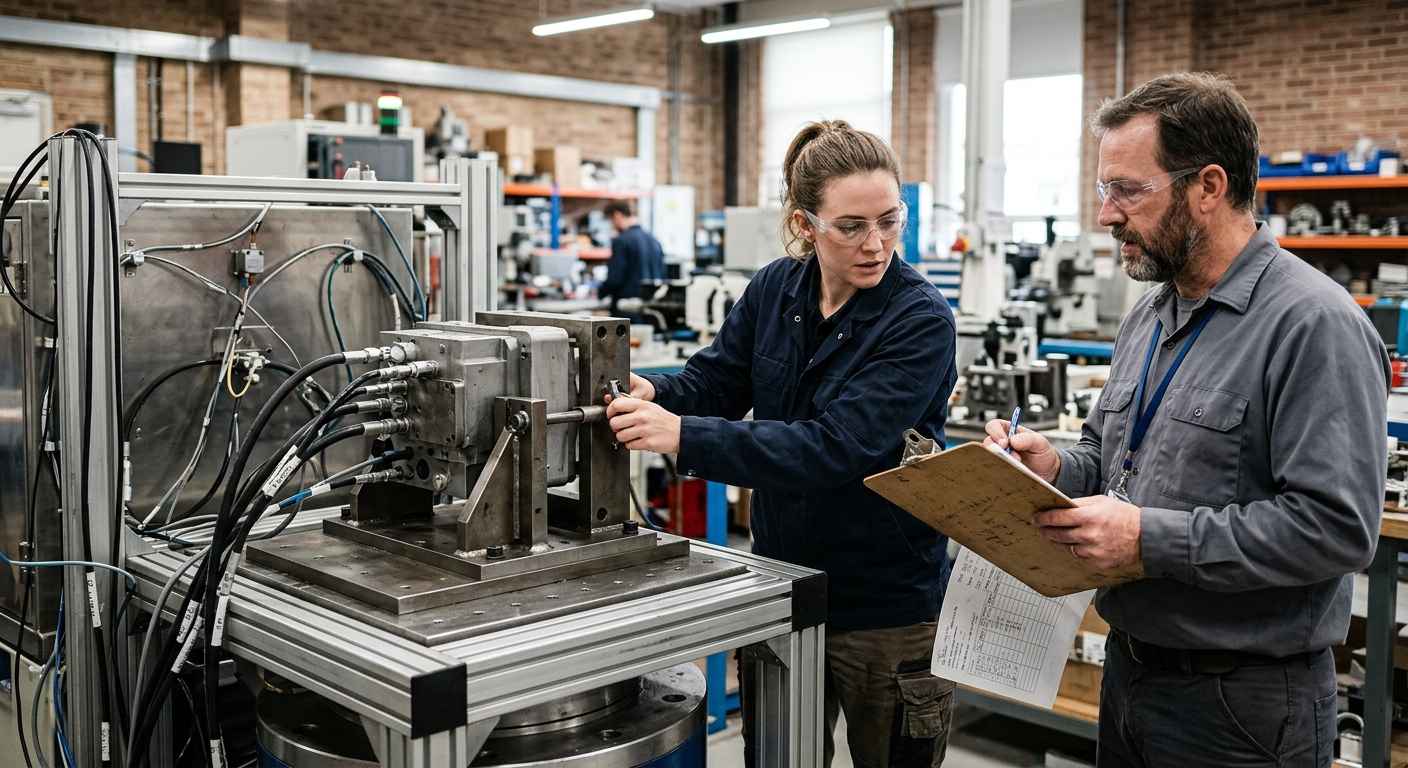

There is not always a standard for what you need to measure, and when there is, sometimes it does not measure what matters to you. In those cases the answer is a tailored test: a setup designed to reproduce the real service condition and answer your specific question, instead of forcing the closest standard and being left with a result that decides nothing. Knowing when it is needed, and how to do it well, is part of the quality control and testing that supports a technical decision.
Test standards are written so that two different laboratories get the same result on the same specimen. That is their purpose and they fulfil it well. The problem is not the standard, it is applying it to a question that does not fit into it. Here is when that happens, what alternative there is and how a tailored test is designed to give a reliable figure and not a number that looks rigorous without being of any use.
ACCELERATED AGEING TESTS
Does the standard test fail to reflect how your product ages in real use? Discover our accelerated ageing testing service

What a test standard is for and where it stops being useful
A test standard fixes the equipment, the specimen, the conditions and the criterion so that the result is reproducible between laboratories. That standardization is its greatest virtue: it lets you compare, certify and trust that a number measured here means the same measured elsewhere. Tests such as the salt spray of ISO 9227 or the tensile test of ISO 527 exist precisely to remove ambiguity and isolate one variable at a time.
That isolation, which is its strength, is also its limit. The standard separates the variables so the test is repeatable, but service reality often combines them. When your product does not live in the controlled conditions of the standard, the standardized result stops answering what you really want to know: whether it will hold up where it is going to work.
That is why the standard is not an end in itself, but a tool for one class of specific questions. Using it when it fits gives a comparable, recognized figure; using it when it does not fit gives a number that reassures but does not inform. Telling one situation from the other is the first step before choosing how to test.
A test that meets a standard and does not answer your question is an expense, not a datum. The signature on the report does not change the fact that you are measuring something else.
What a standard guarantees and what is left out
It is worth being clear about what a standard gives you exactly, so you know when it stops giving you what you need. A standard guarantees reproducibility and comparability: that the test, done by its rules, gives the same result in any accredited laboratory and that the number can be compared with another product tested the same way. That is exactly what you need to certify, to qualify or to compare suppliers on equal terms. That reproducibility is not free: it rests on calibrated equipment, specimens machined within tight tolerances and, in many cases, interlaboratory exercises that confirm the same material yields the same number in different hands. When the test is run in an accredited laboratory, that chain of traceability is precisely what backs the result before a customer or an authority, and it is real value as long as your question fits the condition the standard fixes.
What a standard does not guarantee is that its test condition resembles your service. The specimen, the loading speed or the environment the standard fixes are chosen to be repeatable, not to replicate your specific application, which is why a standardized result can be impeccable and at the same time irrelevant for knowing whether your part holds up where it will work. The standard answers “how does this material behave in standard conditions”, not “how does my product behave in its own”, and that second question is the one you often have to decide.
When the standard does not answer your question
There are four typical situations in which the standard falls short, and they all share the same symptom: the closest standardized test does not reproduce the condition that makes your product fail.
| Situation | Why the standard does not fit |
|---|---|
| The equipment is too large | It does not fit in the chamber or the standardized rig, so you have to test at scale or with your own setup |
| The real condition combines several factors | Temperature, vibration and humidity act at once, and the standard tests them separately |
| What fails is the joint, not the material | The standard characterizes the base material, but the weak point is the interface between two materials |
| The product is new | There is no standard because there is no precedent nor a test meant for that function |
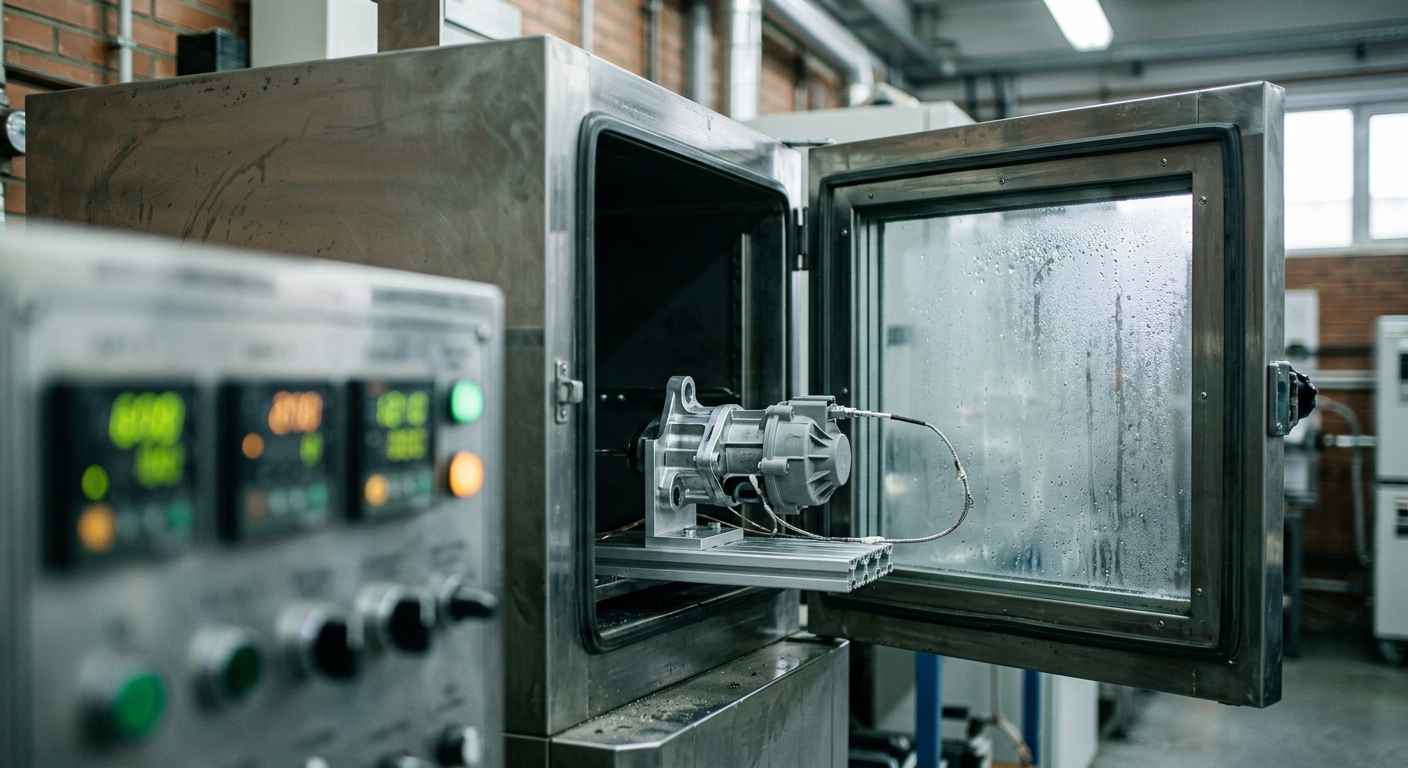
The combined-condition case is the most frequent and the most treacherous. A material can separately pass a temperature test, a vibration test and a humidity test, and still fail when the three happen at once, because the interaction between them generates a failure mode that no isolated test produces. The mechanism is usually sequential: thermal cycling opens microcracks through differential expansion, vibration propagates them and humidity seeps in to finish the job with corrosion, so the damage comes from the order and the simultaneity of the three agents, not from each one on its own. A test that applies them separately never reproduces that chain, and that is the trap of signing off a part that has passed three independent tests. Reproducing that combination is exactly what accelerated ageing tests and chemical resistance tests allow when they are designed around the real condition and not around a generic table.
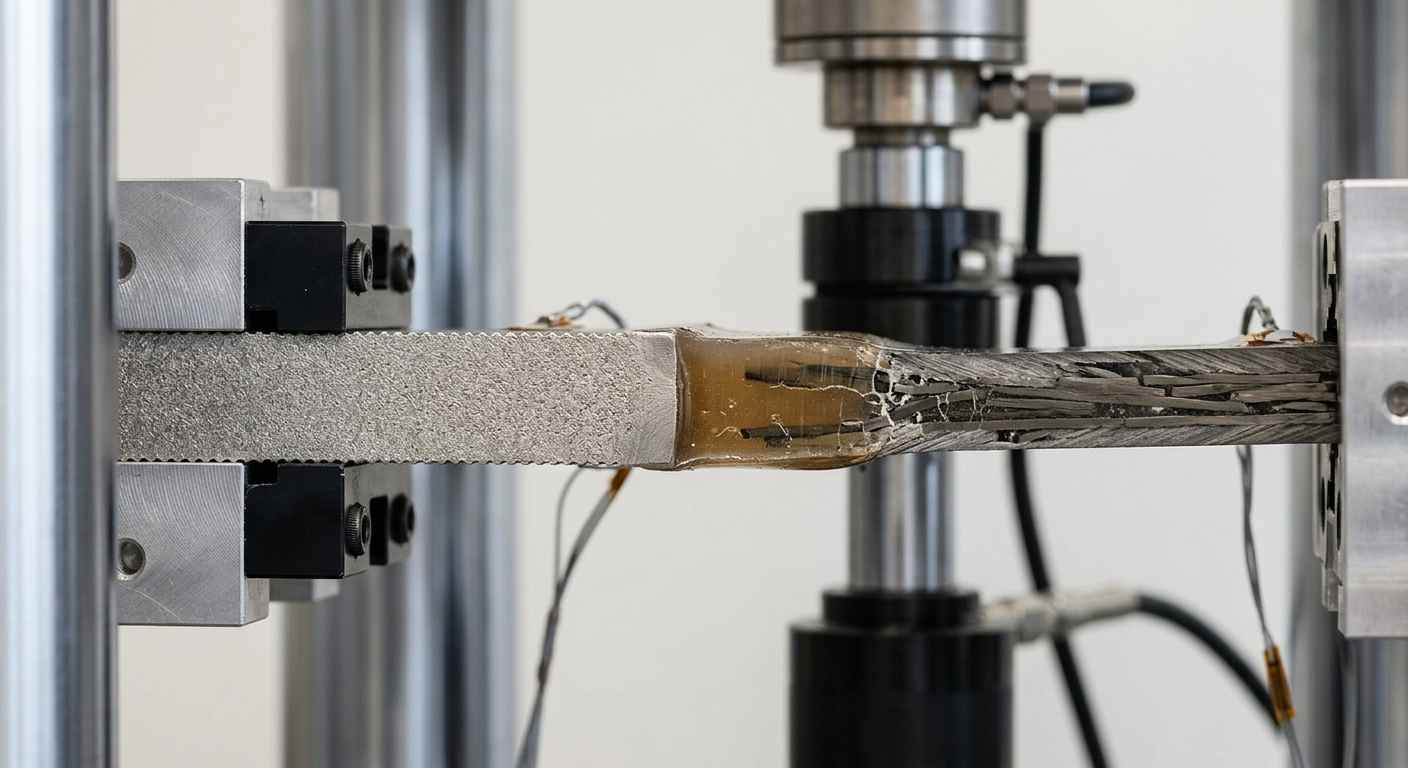
The joint case deserves separate attention. When the failure is not in the material but in the interface between two, characterizing each material by its standard reveals nothing: the problem lives at the boundary. There a test on the assembly, or a specific analysis such as composite materials testing, says what the standards of each component separately keep quiet.
The signs that a standard test falls short for you
Most parts are validated well with a standardized test, and that is always the first option: it is reproducible, comparable and recognized. The problem appears when the standard answers a question that is not exactly yours, and a few signals give it away before you spend on a test that will not decide anything. The first is that the service conditions fall outside the scope of the standard: the part works at a temperature, a pressure, a loading frequency or in a medium the standard test does not cover, and validating a component that will vibrate at 150 °C with a test meant for room temperature gives a result that is correct by the standard and irrelevant for the real use.
The second signal is that the geometry or the material does not fit the standardized specimen, because the standard demands a sample your part cannot give or the result on a specimen does not represent the behaviour of the complete part with its finish and its joints. The third is that the real failure mode differs from the one the standard measures: the test evaluates tension when the part fails by contact fatigue, or measures hardness when the problem is stress corrosion. And the fourth is that there is a customer or application requirement with no standard to cover it, an own functional specification or an acceptance criterion the company defines from its experience. When one of these four appears, the standard test is not wrong: it simply is not the one that answers your question, and forcing it only postpones the failure.
TELL US ABOUT YOUR CASE
Do you need a tailored test when the standard does not fit? Send us your case and we will propose a specific test protocol
The tailored test: what it is, how it is designed and how it is validated
Once the standard is ruled out, the alternative is not to improvise, but to design a test with the same rigour a standardized document would demand, only built around your real condition. That design has a definition part and a validation part, and both decide whether the final datum is of any use.
What a tailored test is and how it is designed
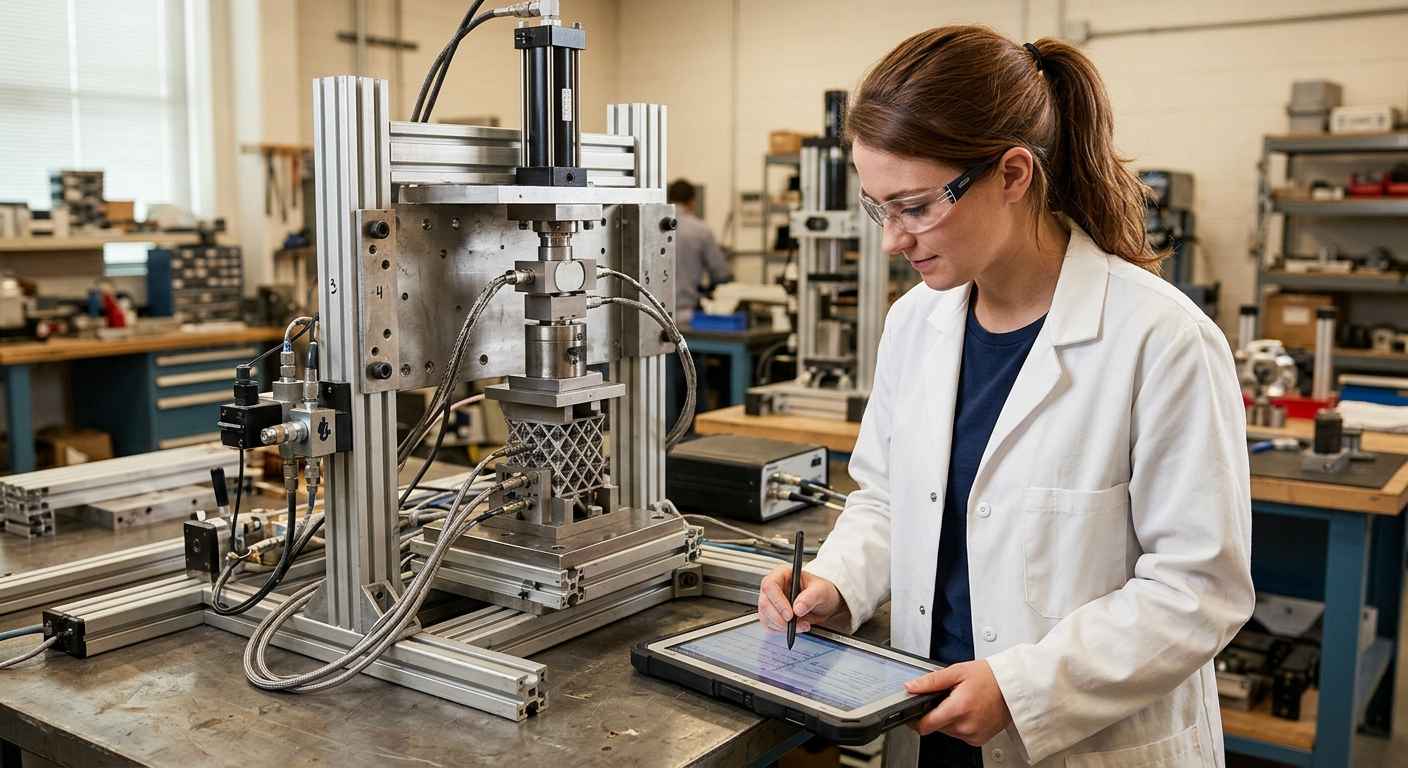
A tailored test is a procedure designed specifically to reproduce the service condition that matters to you and measure the product’s response to it. The starting point is to define the real loading: what load, in which direction, at what temperature, with which medium and for how many cycles the part sees in service. From there come the variables to control and those to measure. That definition forces you to separate three kinds of quantities: the ones you impose (the load, the temperature or the medium that reproduces the loading), the ones you record (the part’s response, with instrumentation and a sampling rate fine enough not to miss the instant of failure) and the ones you hold fixed so they do not contaminate the result. Setting how many samples are tested and how they are prepared is part of the design, because a single specimen cannot tell a trend from a coincidence, and careless preparation introduces a failure mode that is not the one you meant to study.
On that basis, designing it well requires three things. First, justifying the setup, explaining why that configuration represents the real condition and what relation it has with the failure mode you want to study. Second, documenting the conditions (temperatures, loads, frequencies, times and tolerances) with enough detail for someone else to repeat the test. And third, fixing an explicit acceptance criterion, what counts as passed and what does not, before testing, so the result is not interpreted after the fact. Without that prior criterion, a tailored test becomes a demonstration, not a proof.
A tailored test costs more than forcing the closest standardized one: you have to justify it, document it and validate it. In exchange, it answers the question you really have to decide.
How you guarantee that a tailored test is reliable
The obvious objection to a non-standardized test is trust: if there is no standard backing it, how do you know the result is worth anything. The answer lies in traceability and reproducibility. A well-made tailored test documents each condition, uses calibrated equipment, defines an explicit acceptance criterion and shows that, repeated on equivalent samples, it gives consistent results. With that, the result is as defensible as a standard’s, with the advantage that it also answers your case. Reproducibility is demonstrated, not asserted: by repeating the test on several equivalent samples and checking that the scatter in the results is small, so it is clear how much of the variation comes from the material and how much from the setup itself. Estimating the measurement uncertainty, identifying which variables dominate it (the sensor resolution, the temperature stability, the clamping of the specimen) is what lets you state not only how much the part withstands but with what confidence margin, which is exactly what an engineering decision needs to stand on.
Correlation with service is the other piece. A good tailored test does not only reproduce the condition, it is also checked against what happens in reality: if the failure mode of the test matches the one appearing in the field, the setup is valid, and a setup that breaks the part in a way that never happens in service is measuring something else. That is how, for example, a moulding tool to make the first batches and validate materials was validated, and how the corrosion resistance of electronic components was checked with a test tuned to their condition of use, not to a generic table.
That same logic of choosing the test by the question, and not the question by the available test, is what separates a testing programme that is useful from one that only generates paper, as happens when deciding which tests an automotive component requires by its function and not by what is easy to measure.
A well-documented tailored test is no less rigorous than a standardized one: it is a standard written for a single problem, yours.
When the tailored test becomes your own standard
A test designed for a specific case does not have to stay a specific case. When the setup is justified, the conditions documented and the acceptance criterion fixed, that test can become a reusable internal procedure: the next similar part, the next lot or the next supplier are validated with the same method, without designing it again from scratch. That way a company ends up with its own standard for a condition no standard covers, with the advantage that it really represents its product.
That own standard also gives consistency to decisions. When purchasing, quality or engineering base their validation on the same documented test, the results are comparable and the decisions stop depending on who makes them. It is especially useful when the service behaviour depends on external agents, as in behaviour against external agents testing, where the real condition rarely matches a table and it is worth fixing an own method that reproduces it.
A piece of data you can decide on
The standard is the right tool when your question fits into it: to compare, to certify, to guarantee repeatability between laboratories. It stops being so when the equipment does not fit, when the real condition combines factors the standard separates, when the failure is in the joint and not the material, or when the product is so new there is no precedent. In those cases, forcing the closest standardized test gives you a figure that looks rigorous but does not answer, and designing a tailored test gives you a datum you can decide on.
The key is not to confuse meeting a standard with solving your problem. If your question does not fit any standard, define the real condition you want to reproduce and design the test around it, with the setup justified, the conditions documented and the reproducibility demonstrated. Tell us what you need to measure and in what conditions your product works, and we will help you decide whether a standardized test is enough or you need to design a tailored one that really answers.
Frequently asked questions about tailored tests when the standard fails
What is a tailored test?
It is a test procedure designed specifically to reproduce the real service condition of a product and measure its response, instead of applying a standard meant for another case. It is used when no existing standard answers the question: because the equipment does not fit the standardized rig, because the real condition combines factors the standard separates, because the failure is in a joint or because the product is new and there is no precedent.
When is a tailored test better than a standardized one?
When the closest standardized test does not reproduce the condition that makes your product fail. If the standard’s result does not answer what you need to decide, by scale, by combination of loads, by the point of failure or by lack of precedent, forcing it only gives you a figure that is of no use. In that case it is worth designing a test that recreates the real condition, even if it requires more justification and documentation work.
Is a test without a standard reliable?
Yes, if it is designed correctly. Reliability does not come from the existence of a standard, but from traceability and reproducibility: calibrated equipment, conditions documented in detail, an explicit acceptance criterion and the demonstration that the test, repeated on equivalent samples, gives consistent results. With that, the result is as defensible as a standardized test’s, with the advantage that it answers your specific case.
How do you prove that a tailored test reproduces the real condition?
By justifying the setup and correlating it with service. The setup must explain why that configuration represents the real condition and what relation it has with the failure mode studied. Then it is checked: if the failure mode the test produces matches the one appearing in the field, the setup is valid. That correlation between laboratory and reality is what turns a tailored test into a solid basis for deciding.
What happens if I apply the closest standard even though it does not fit?
You get a result that looks rigorous but does not answer your question. The report will be signed and the specimen will have passed the test, but you will be measuring a condition different from the one that makes your product fail, so the decision you make with that datum rests on something that does not represent your case. It is an expense in the shape of a datum, and the failure you wanted to avoid may appear in service all the same.