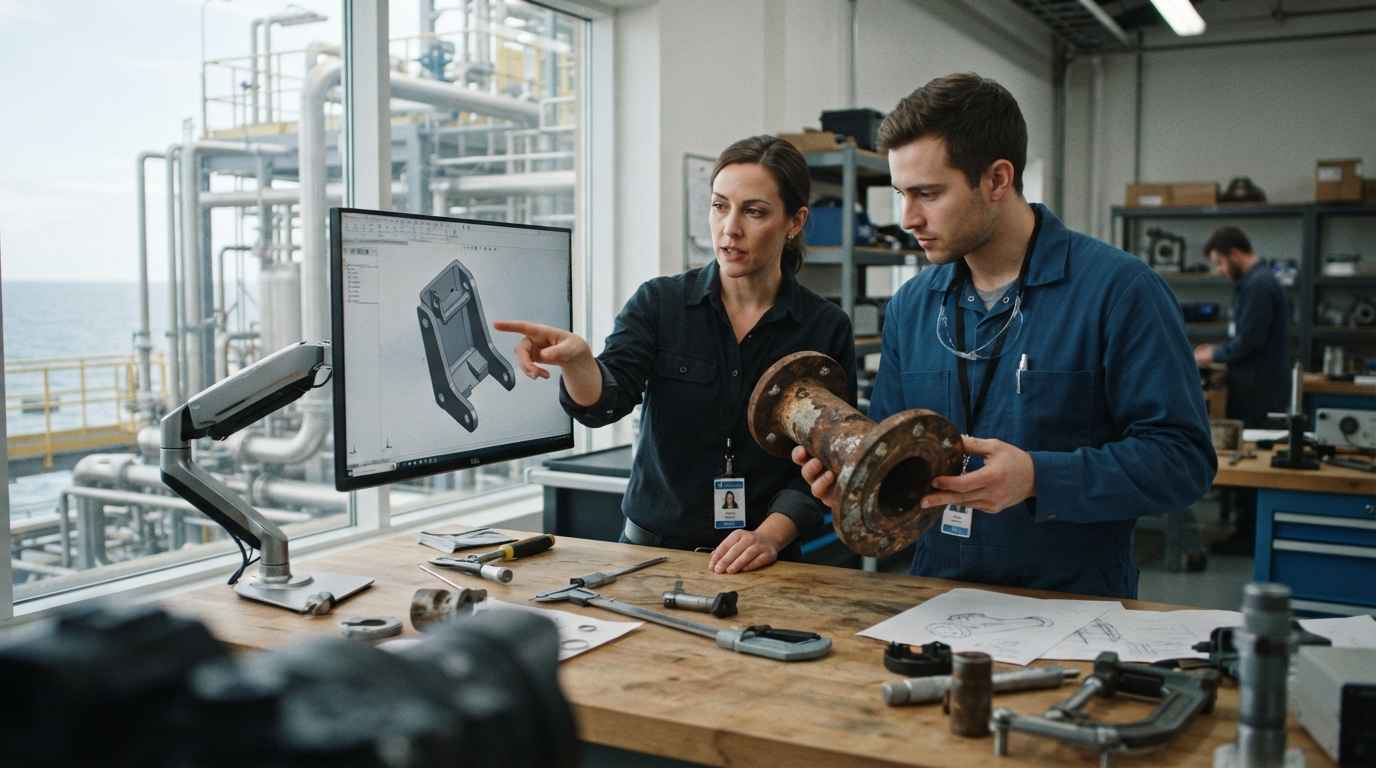

Designing for a corrosive environment is the set of material, geometry and protection decisions that let a mechanical part resist degradation in aggressive settings such as marine, chemical or outdoor exposure, keeping its function throughout its service life without premature failures.
Corrosion is not a material defect but the expected response of a metal to its environment, which is why it is fought from the design, not just from the choice of steel. Anticipating how the medium will attack each area of the part is what separates a component that lasts decades from one that fails in months. That preventive approach is part of well-planned product development, where durability is decided before manufacturing.
Building corrosion resistance into the design and innovation stage is far cheaper than correcting it later. A material change or a geometric detail costs little on the drawing, but reworking a corroded part in service means downtime, claims and, at times, safety risks.
DESIGN AND INNOVATION
Designing a product that will work in a corrosive environment? Discover our design and innovation service

What designing for a corrosive environment means
Designing for a corrosive environment means engineering a part while considering, from the outset, the aggressive medium it will work in, so that the chosen material, shape and protection keep their integrity over the intended service life. It is not about applying a coating at the end, but about making coordinated decisions that slow the corrosion rate That acceptable level is defined case by case: a structural part whose failure is critical is not the same as an easily replaceable cosmetic element, and the demand on the protection should be proportional to the consequences of failure.
A good design for a corrosive environment does not seek an indestructible material, but a combination of material, geometry and protection whose corrosion rate is slow enough to guarantee the required service life with a reasonable margin.
Designing for a corrosive environment, what it covers
Designing for a corrosive environment covers four levers acting at once: material selection (and the compatibility between the different metals of an assembly), geometry (avoiding areas where water or dirt accumulate), protection (coatings, surface treatments or cathodic protection) and the planned maintenance. Ignoring any one of them is usually enough for the part to fail early, however good the rest may be.
The starting point is always to characterise the environment precisely: a rural atmosphere is not the same as a coastal one or the inside of a chemical reactor. Defining the corrosivity category and the specific agents (chlorides, acids, humidity, temperature cycles) is what allows the protection to be sized In practice, that characterisation translates into a standardised corrosivity category (from C1, very low, to CX, extreme), which serves as a common language between the designer, the coating manufacturer and the laboratory. Starting from that category avoids the two things that most inflate a project: under-protecting so the part fails, or over-protecting and paying for a margin nobody needs.
Marine, chemical and outdoor, three different environments
The marine environment combines chloride salts, constant humidity and often moderate temperature, a mix that attacks common steels hard and promotes pitting corrosion of stainless steels. The chemical environment adds the specific aggressiveness of acids, alkalis or solvents, which may require special alloys or resistant linings. Outdoor exposure subjects the part to humidity cycles, ultraviolet radiation and atmospheric pollutants that That is why a single component intended for several of these environments must be sized for the most severe of them all, or planned as different variants depending on its destination.
Each of these environments imposes different priorities, and a material that is excellent for one may be unsuitable for another. That is why design does not start from a universal material, but from the cross between the demands of the medium and An austenitic stainless steel, for example, resists outdoor exposure well but can suffer pitting in a marine environment with chlorides, whereas a galvanised carbon steel handles mild outdoors but not an acidic chemical medium. The practical consequence is that the material is chosen for the specific environment, not for its generic reputation as resistant.
The corrosion mechanisms that shape the design
Understanding corrosion mechanisms is what allows you to design against them instead of reacting once they have acted. Corrosion is not a single phenomenon: it takes different forms depending on the material, the medium and the geometry, and Identifying which of those mechanisms dominates in each case is what avoids generic solutions: a protection meant for uniform corrosion does not stop a pit, and a material resistant to pitting can still be vulnerable to stress corrosion cracking if the part works under load.
Types of corrosion relevant to design
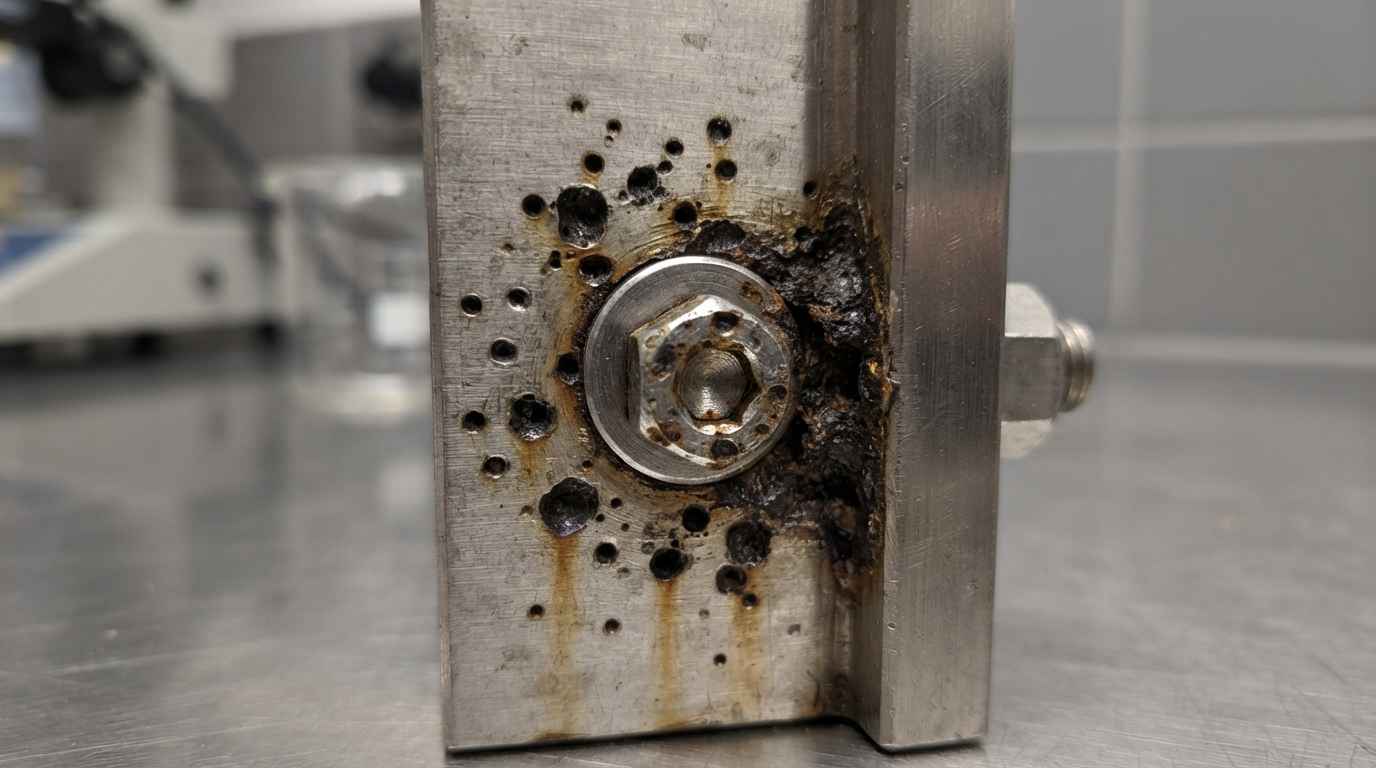
The mechanisms that most shape mechanical design are uniform corrosion (general loss of thickness, the most predictable), galvanic corrosion (when two different metals in electrical contact corrode at different rates), pitting and crevice corrosion (localised attacks typical of stainless steels in the presence of chlorides) and stress corrosion cracking (cracking from the combined action of stress and medium). Each leaves a distinct signature and Recognising the mechanism from the morphology of the attack (pits, uniform layer, branched cracks, attack at the joints) is the first step of the diagnosis, because each pattern points to a different cause and therefore to a different correction. Confusing one for another leads to solutions that do not address the real problem.
Localised corrosion is especially dangerous because it advances in depth with barely any visible weight loss, and it can perforate a wall or start a crack without warning. Analysing a real case, such as corrosion in chemical reactors assessed through materials testing, shows how the specific mechanism determines which material and which design would have prevented the failure.
Pitting and stress corrosion cracking are the most treacherous in mechanical design: they advance in depth with very little visible material loss and can cause a brittle fracture before a visual inspection detects anything.
How geometry speeds up or slows down corrosion
The geometry of a part can accelerate corrosion as much as a poor material. Narrow crevices, overlaps, edges without drainage and areas where water or dirt build up create microenvironments more aggressive than the general setting, and are the origin of most localised corrosion failures. Designing with drainage, generous radii and accessible surfaces reduces those weak points These geometric fixes cost nothing in material and often nothing in manufacturing, yet they remove the very sites where localised corrosion prefers to start, which makes them the cheapest reliability improvement in the whole design.
Contact between different metals is another purely geometric and assembly factor: joining steel with aluminium or with stainless steel without insulation creates a galvanic couple that corrodes the less noble metal. Providing insulators, dielectric washers or compatible materials in the design avoids that attack, which otherwise The orientation of the part in service also matters: a sloped surface drains, a horizontal one accumulates, and a detail as simple as a slope or a drainage hole can completely change the service life without touching the material. These construction details are free on the drawing and very expensive to correct afterwards.
Design levers to resist corrosion
Resisting corrosion from the design means combining several levers until the degradation rate falls below the threshold that guarantees the service life. One alone is rarely enough: the norm is to coordinate material, protection and geometry to The right balance is specific to each case: a coastal handrail, a chemical pump shaft and an outdoor bracket may share the same steel yet need completely different protection and geometry, because the dominant mechanism and That is why two parts made of the same steel can justify very different levels of protection: the one whose failure stops a line or endangers people earns a bigger margin than the one that is merely inconvenient to replace.
Material selection and galvanic couples
Material selection is the first line of defence, and it means choosing the metal whose resistance to the specific medium is sufficient without over-inflating the cost. A protected carbon steel may be enough in mild outdoor settings, whereas a marine environment with chlorides may require a duplex stainless steel or a specific alloy. The key is to cross corrosion resistance with the mechanical requirements and the cost, In stainless steels, a useful indicator is the pitting resistance equivalent number, which combines chromium, molybdenum and nitrogen to estimate behaviour against chlorides: the higher the value, the greater the pitting resistance in a marine environment. It is a starting guide, not a substitute for testing, but Even so, two steels with the same number can behave differently once welded or cold-worked, so the figure narrows the shortlist but the final call still comes from testing the material in its actual condition.
Coatings, protection and construction details
When the base material is not enough on its own, coatings provide a barrier between the metal and the medium. Galvanising, anodising, protective paints and functional coatings are chosen according to the aggressiveness of the environment and the required service life, and their effectiveness depends as much on the formulation as on surface preparation and applied thickness. A poorly applied or assembly-damaged coating can be worse than none, because it concentrates the attack Sharp edges, welds and corners are the points where the coating thins and where failure usually starts, so rounding edges and caring for joint finishing improves protection as much as increasing thickness. The design of the part and that of the coating In practice, the drawing that specifies the coating should also specify how edges and welds are treated, because a protection that is excellent on a flat face and thin on a corner will still fail at the corner first.
Validating those coatings is an essential part of the design, as shown by the evaluation of steel coatings against corrosion, where the real behaviour of different protections is compared. When the current material does not deliver the required service life, the project moves into material substitution, seeking an alternative that resists better without losing mechanical performance or driving up cost.
| Design lever | What it solves | Application example | Technical reference |
|---|---|---|---|
| Material selection | Intrinsic resistance to the medium | Duplex stainless in marine settings | Corrosivity classification ISO 9223 |
| Coating and paint | Barrier against the environment | Paint system for category C5 | ISO 12944 |
| Geometric design | Avoid build-up and crevices | Drainage and generous radii | Good design practice |
| Galvanic insulation | Avoid couples between metals | Dielectric washers at joints | Galvanic compatibility |

TELL US ABOUT YOUR CASE
Do you have a part suffering corrosion or a design to validate? Send us your case and we will propose material, protection and testing
How a design is validated against corrosion
Validating a design against corrosion means checking, through representative tests, that the combination of material, geometry and protection withstands the intended environment over the required service life. A design is only accepted when that resistance is proven with data, That distinction matters because most corrosion failures do not come from a material that was wrong on paper, but from a combination of geometry, coating and environment that was never tested together as it would actually be assembled.
Accelerated corrosion testing
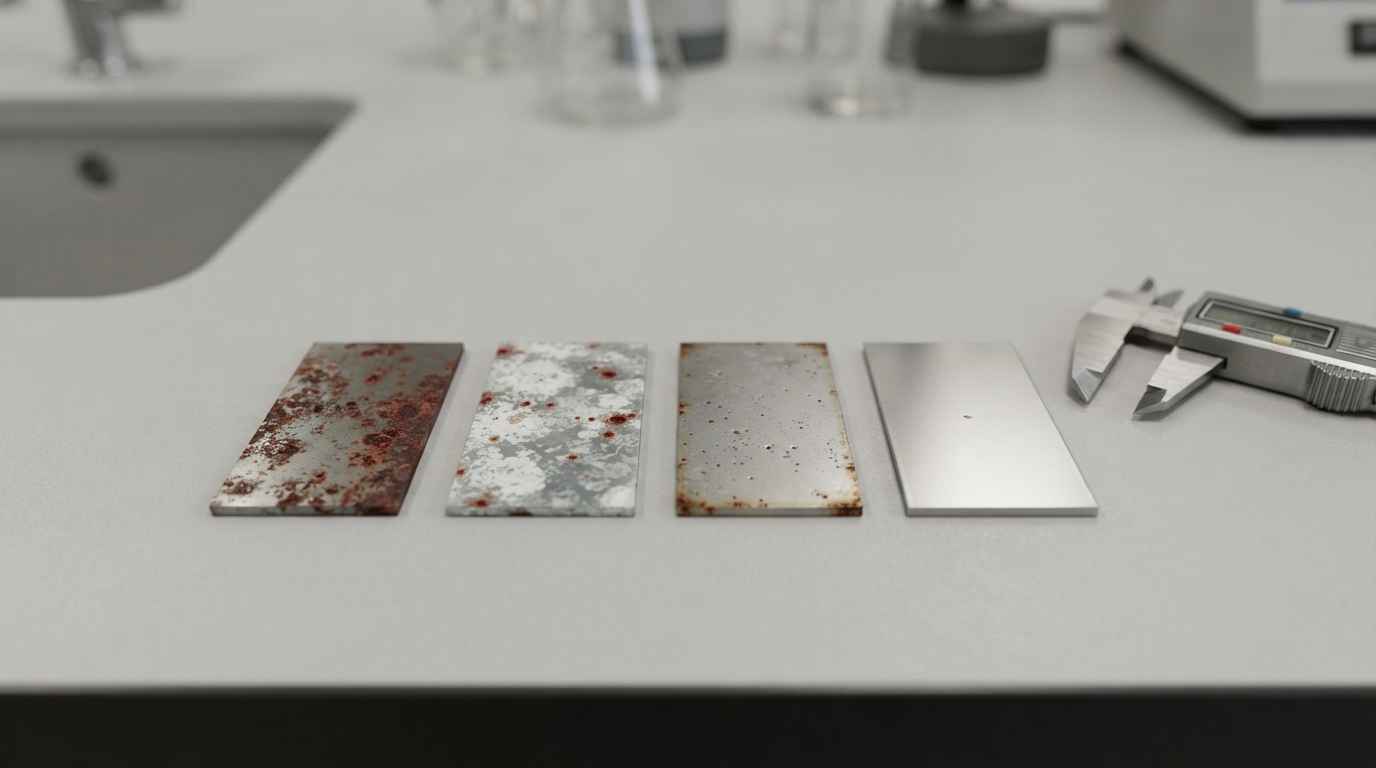
Accelerated tests reproduce in weeks the degradation the real medium would cause over months or years, subjecting the part or specimen to controlled conditions more severe than service. The salt spray test to ISO 9227 is the most widespread for marine environments and for comparing coatings, and it is usually complemented with humidity chambers, thermal cycling or exposure to specific chemical agents. The correspondence between standard and test must be verified in each case, because For many real environments, cyclic tests (alternating humidity, drying and salt) correlate better with service than continuous salt spray exposure, because they reproduce the wet-dry cycles the part actually undergoes. Choosing the right test cycle is A validation that copies a generic test schedule without matching it to the real environment can pass a part that will later fail in service, which is the most expensive kind of false positive.
The support of a materials testing and characterisation laboratory makes it possible to reproduce the aggressive environment and measure degradation objectively. A close example of how that attack is quantified is accelerated corrosion by salt spray, which shows how exposure translates into a measurable acceptance criterion.
Test-to-service correlation and acceptance criteria
The challenge with accelerated tests is their correlation with real service, because accelerating too much or in the wrong way can activate corrosion mechanisms that would not appear in the field, or the other way round. That is why the acceptance criterion is not just passing a number of test hours, but that the type of damage observed is consistent with what the part would suffer in its environment. Interpreting that correspondence well is So when test and service do not agree, the right answer is not to relax the criterion until the part passes, but to check whether the test truly reproduces the corrosion mechanism that will act in the field.
Acceptance criteria are set before testing: hours of salt spray without red rust, maximum admissible thickness loss or absence of pits above a certain size. Documenting what was measured, with which method and against which threshold turns the design into a defensible decision before an audit, That same criterion then serves to define in-service inspections: if the test predicts where and how the attack will start, the maintenance plan can concentrate surveillance on those areas instead of checking the whole part blindly, which cuts costs and catches the problem before it becomes critical.
Corrosion is decided on the drawing, not in maintenance
Designing for a corrosive environment is not about choosing the most expensive steel, but about coordinating material, geometry, protection and validation so that the corrosion rate matches the required service life. The difference between a part that lasts and one that fails usually lies in decisions taken on the drawing: a radius that drains, a galvanic insulation, a validated coating or a test that confirms the resistance before manufacturing. Correcting corrosion in service It also compounds over time: a design that resists from the start needs less maintenance, fewer inspections and fewer unplanned stops, so the return on getting it right is not a one-off saving but a lower cost of ownership In critical installations the gap widens further, because an unforeseen corrosion problem can force an unplanned shutdown whose cost dwarfs that of having Seen that way, the money spent on corrosion design and testing is not an extra cost but an insurance whose premium is paid once, on the drawing, and returns every year the part stays in service instead of failing.
If you are developing a component that will work in a marine, chemical or outdoor environment and need to confirm it will hold up, gather the part, its service conditions and the target service life, and send them over: we return a material and protection recommendation and a data-backed corrosion test plan.
Frequently asked questions
What is designing for a corrosive environment?
It is engineering a mechanical part while considering from the outset the aggressive medium it will work in, so that the chosen material, geometry and protection keep their integrity over the intended service life. It is not limited to applying a coating at the end, but coordinates several decisions to slow the corrosion rate down to an acceptable level in settings such as marine, chemical or outdoor exposure.
Which type of corrosion is most dangerous for a mechanical part?
Localised corrosion, such as pitting, crevice and stress corrosion cracking, is the most dangerous because it advances in depth with very little visible material loss and can perforate a wall or start a crack without warning. Unlike uniform corrosion, which is predictable and compensated with extra thickness, localised corrosion requires controlling the material, geometry and medium to prevent it from starting.
How does geometry influence corrosion?
Geometry can accelerate corrosion as much as a poor material: crevices, overlaps and areas without drainage accumulate water and dirt, creating more aggressive microenvironments that cause localised corrosion. In addition, contact between different metals generates galvanic couples. Designing with drainage, generous radii, accessible surfaces and insulation between dissimilar metals removes those weak points without changing the material.
How is a design validated to resist corrosion?
Through accelerated tests that reproduce the aggressive environment under controlled conditions and measure degradation against an acceptance criterion set in advance. The salt spray test to ISO 9227 is the most common for marine environments and for comparing coatings, complemented with humidity chambers or chemical exposure. The key is that the type of damage in the test matches what the part would suffer in real service.
How much does it cost to correct corrosion afterwards versus anticipating it in the design?
Anticipating corrosion in the design is far cheaper than correcting it in service. A material change or a geometric detail costs little on the drawing, whereas reworking a corroded part means production downtime, claims and, in some cases, safety risks. Building corrosion resistance and its validation into the design stage avoids that over-cost and extends the component’s service life.