
Packaging process optimization is the set of material, sealing-parameter and in-line control decisions that achieve a reliable seal on every unit, avoiding leaks, waste and line claims across the whole production run. When a seal fails, the problem is rarely one specific machine: it is a process that has not been tuned and validated with data.
A sealing failure is not just a cosmetic defect. It is product pulled from shelves, lines stopped, batches reworked and customers returning goods. That is why sealing is tackled from the whole process, not from the last tweak of the sealer. Anticipating how each material behaves with each parameter is what separates a stable line from one that generates waste over and over. That preventive approach draws on forensic engineering, which identifies why a seal fails before the problem repeats across the whole run.
Tackling sealing failures through the failure analysis of the material and the process is far cheaper than fixing it afterwards. Changing a film or refining a sealing window costs little at the process stage, whereas reacting to a wave of claims means recalls, stoppages and, at times, the loss of a customer.
FAILURE ANALYSIS
Is your packaging line generating waste or claims from sealing? Discover our failure analysis service

What packaging process optimization means
Packaging process optimization means tuning material, sealer parameters and quality control in a coordinated way so that the seal withstands the real conditions of filling, transport and use throughout the product’s life. It is not about raising the sealing temperature until it “sticks”, but about finding the combination that guarantees closure without damaging the pack or inflating the cost.
A well-optimized packaging process does not seek the strongest possible seal, but the window of material, temperature, pressure and time that ensures an intact, repeatable closure on every unit of the run.
What packaging process optimization covers
Optimizing packaging covers four levers acting at once: the choice of material and film (and its compatibility with the product it holds), the sealing parameters (temperature, pressure and dwell time), the seal geometry (band width, jaws and overlap area) and the in-line control that catches drift before it produces defective units. Neglecting any one of them is usually enough for the line to start producing failures, however good the rest may be.
The starting point is always to characterise the material and the product well: sealing a monolayer film is not the same as a multilayer barrier film, nor is packing a dry product the same as a greasy or moist one that contaminates the sealing area. Defining precisely what material goes in and under what conditions it works is what allows the process window to be set without over-cost or over-adjustment, and it stops every change of batch or supplier from forcing a blind readjustment of the line.
Why sealing concentrates waste and claims
Sealing is where the integrity of the pack is decided, and that is why it concentrates most of the line’s waste and claims. A microscopic leak is not always visible at the end of the line, but it shows up days later as oxidised, damp or contaminated product, once it is on the shelf or in the customer’s home. That gap between failure and detection is exactly what makes it so expensive, because the cost does not stay in the defective unit: it drags reverse logistics, replacement and wear on the commercial relationship.
On top of this, an inconsistent seal produces a steady trickle of rejects that rarely triggers a clear alarm: it is taken as “normal scrap” until someone crosses the figures and discovers how much product is being thrown away. Analysing that hidden cost is the first step to justify investing in process optimization, as shown by the work on reducing scrap by identifying the critical variables of production, where putting a number on the waste completely changes the improvement priorities.
The most frequent sealing failures and their origin
Understanding sealing failure modes is what lets you design the process against them instead of reacting once they have appeared. Sealing does not fail in a single way: it takes different patterns depending on the material, the parameters and the contamination of the area, and each pattern is fixed with a specific process decision.
Types of sealing failure
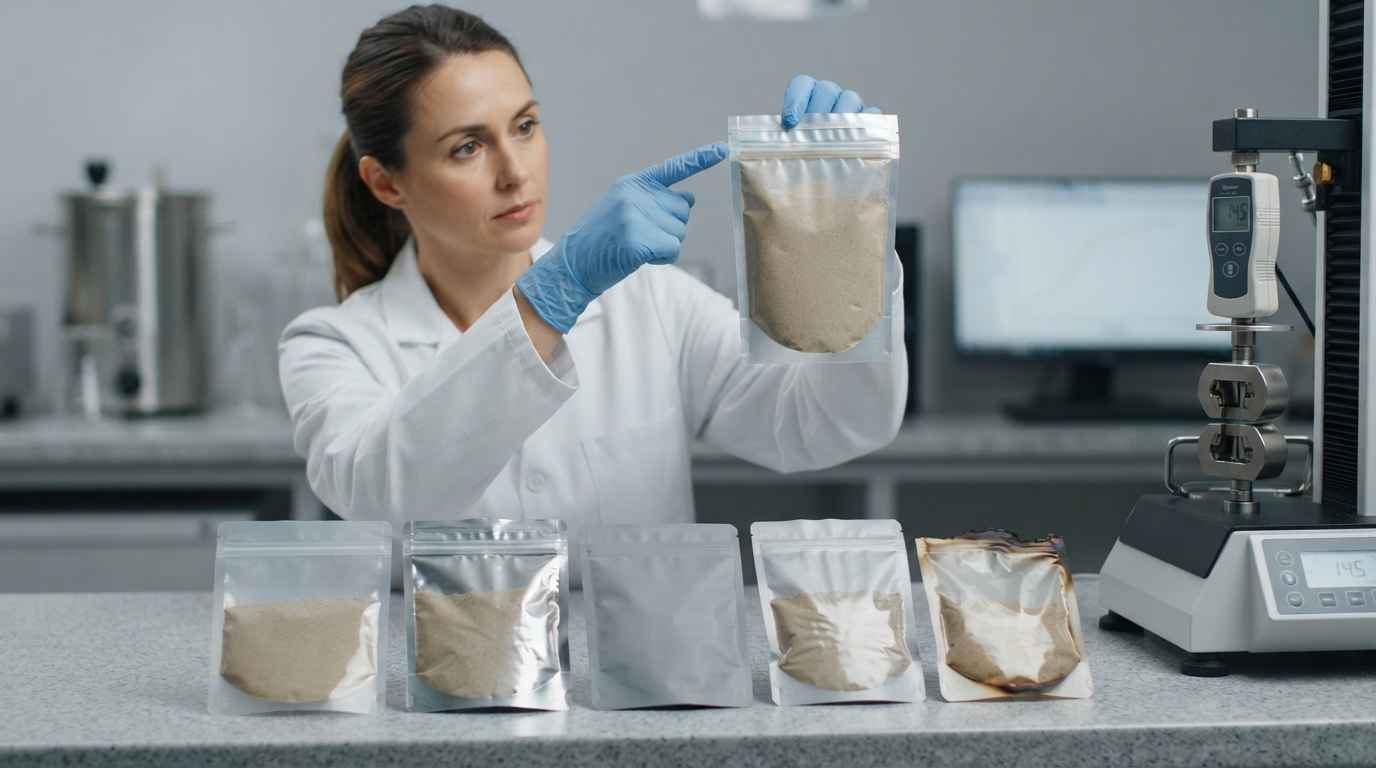
The failures that appear most on a packaging line are the weak or incomplete seal (the band does not close across its full width), the burnt or brittle seal (excess temperature that degrades the film and makes it brittle), joint contamination (product, dust or grease trapped in the sealing area that prevents fusion) and channels or micro-leaks (paths that let air or moisture through even though the seal looks correct to the naked eye). Each leaves a distinct signature and demands its own response, and mistaking one for another leads to correcting the wrong variable.
The most dangerous is usually the micro-leak, because it advances with no visible signs: the pack keeps its appearance and shape until the product degrades from the inside. That is why a purely visual check at the end of the line lets through precisely the failures that end up generating the most claims, and gives a false sense that the line is running well while the problem already travels with the product.
The weak seal and the micro-leak are the most treacherous packaging failures: they pass the line’s visual check and only show up once the product has lost its barrier and reaches the customer degraded.
Which process variables cause them
Most sealing failures do not come from a defective film, but from a badly tuned process window. A temperature that is too low does not fuse the layers well and leaves a weak seal; one that is too high burns the film and makes it brittle; insufficient pressure or dwell time stops the joint from consolidating. The challenge is that these variables interact, and the optimum of one is not the optimum if the others move, so adjusting them separately rarely gives a stable result.
Added to this is contamination of the sealing area, a purely operational factor: greasy product residue, condensation or dust between the layers create micro-paths that no temperature corrects. Controlling the filling, the cleanliness of the jaws and the stability of the film before sealing avoids much of the failure that would otherwise appear right at the joint. A good diagnosis always separates what is a material problem from what is a process problem, because the solution and the cost are very different in each case.

How to optimize the packaging process to avoid failures
Optimizing packaging from the process means combining several levers until the failure rate falls below the threshold that guarantees quality and cost. One alone is rarely enough: the norm is to coordinate material, parameters and control to achieve a reliable and economical result across the whole run, and to do it with a method that lets you repeat the setting when the material or the product changes.
Tuning material, film and sealing parameters
Material and film selection is the first line of defence, and it means choosing the structure whose compatibility with the product and the sealing equipment is sufficient without inflating the cost. A monolayer film may be enough for a dry product, whereas one with a barrier and a specific sealant layer is essential for a product sensitive to oxygen or moisture. The key is to cross barrier and sealing performance with cost, on data and not on catalogue values, because a more tolerant sealant layer widens the process window and forgives small variations of the line.
Validating that choice is an essential part of the process, as shown by the validation of new packaging design proposals for the food sector, where the pack’s real behaviour is checked before taking it to production. When film cutting also conditions the seal, the optimisation of laser cutting parameters for multilayer film shows how far a process detail changes the final result.
Process window and in-line control
Finding the process window means defining the range of temperature, pressure and time within which the seal is intact in a repeatable way, with a margin that absorbs the line’s normal variability. A robust process is not the one that hits the exact point, but the one that keeps producing correct closures even when the film, the product or the machine move a little. Defining that window with data, crossing the variables through a design of experiments instead of by trial and error, is what turns sealing into a stable operation that transfers between shifts and machines.
In-line control closes the loop: temperature sensors, seal-band inspection and periodic integrity tests make it possible to catch drift before it produces defective units. Documenting what is measured, with which method and against which threshold turns packaging into an auditable process rather than a succession of manual tweaks that depend on the shift. That record is also the basis for reacting quickly when a different batch of material comes in or the line speed changes.
| Lever | What it controls | How it is set | Effect on the failure |
|---|---|---|---|
| Material and film | Barrier and sealability | Mono or multilayer structure and sealant layer | Avoids leaks from incompatibility |
| Sealing parameters | Fusion of the joint | Temperature, pressure and time | Avoids weak or burnt seals |
| Seal geometry | Contact area | Band width, jaws and overlap | Avoids channels and unsealed zones |
| In-line control | Process stability | Sensors, sampling and criteria | Catches drift before the defect |
TELL US ABOUT YOUR CASE
Do you have a packaging line losing product to sealing failures? Send us your case and we will propose a diagnosis and a testing plan
How a seal is validated and controlled
Validating a seal means checking, through representative tests, that the closure withstands the intended conditions of filling, transport and service life. A process is only accepted when that integrity is proven with data, not when it is assumed because “the line is running fine”. This is where the laboratory and production meet, and where the process window defined earlier is translated into measurable criteria.
Seal integrity testing
Integrity tests reproduce or reveal the failures the visual check does not see. Seal strength measurement to ASTM F88 quantifies the force needed to open the joint and confirms that the sealing window is valid; leak detection tests locate micro-paths by dye penetration following ASTM F1929, or by bubble emission under vacuum to ASTM F2096; and accelerated ageing tests anticipate how the closure will behave at the end of the service life. The correspondence between standard and test must be verified in each case, because a poorly chosen test gives false confidence.
Combining several tests is what gives a complete picture: strength tells you whether the joint holds, leak detection tells you whether it is tight and ageing tells you whether it will stay that way. A pack can pass the strength test and still have a micro-leak, so relying on a single test leaves gaps that end up appearing as claims in the market.
From the test to production control
The goal of the tests is not to pass an isolated batch, but to carry the criterion into daily production. Once the sealing window and the acceptance thresholds are defined, those values become in-line control points: temperature ranges, sampling frequency and rejection criteria that any shift can apply without depending on one person’s expert eye. That way, seal quality stops being something checked at the end and starts being built throughout the process.
When the material does not deliver the required reliability, the project moves into improving the material or the film itself, seeking an alternative that seals better without driving up the cost of the pack. This approach connects with cases such as injection moulding defects, where analysing the origin of the defect makes it possible to correct the process before it reaches the packaging line, and it shows that many sealing failures are solved upstream, in how the pack itself is manufactured.

Sealing is decided in the process, not in the claim
Packaging process optimization is not about tightening the sealer until it closes, but about coordinating material, film, parameters and control so that the failure rate stays below the threshold that guarantees quality and cost. The difference between a stable line and one that generates waste usually lies in decisions taken in the process: a suitable film, a sealing window with margin, an integrity test that confirms the closure before running at full volume. Correcting a sealing failure as a claim always costs far more than anticipating it in the process.
If you have a packaging line losing product to sealing failures or piling up claims, gather the pack, the material and the process conditions and send them over: we return a diagnosis of the failure’s origin and a data-backed testing and control plan to cut waste and claims.
Frequently asked questions
What is packaging process optimization?
It is the coordinated tuning of material, sealing parameters and quality control to achieve an intact, repeatable closure on every unit. It is not limited to adjusting the sealer, but crosses film selection, the temperature, pressure and time window, and in-line control, with the aim of withstanding the real conditions of filling, transport and service life without generating leaks or waste.
Which sealing failure is hardest to detect?
The micro-leak is the most treacherous, because the pack keeps its appearance and shape while letting air or moisture through micro-channels in the joint. As it passes the line’s visual check, it only shows up days later, when the product reaches the customer degraded. Detecting it requires integrity tests such as dye penetration or bubble leak, not a simple inspection at the end of the line.
Why does the seal fail if the film is correct?
Because most failures come from a badly tuned process window or from contamination in the joint, not from the film itself. A low temperature leaves a weak seal, a high one burns it, and insufficient pressure or time stops the joint from consolidating. In addition, greasy residue, condensation or dust between the layers create micro-paths that no temperature corrects.
How is a seal validated as reliable?
Through representative tests that measure seal strength, detect leaks by dye penetration or bubble under vacuum and anticipate behaviour at end of life with accelerated ageing. References such as ASTM F88, ASTM F1929 or ASTM F2096 guide these tests. The key is that the acceptance criterion is set in advance and then carried into control points in daily production.
How much is saved by optimizing the process versus correcting claims?
Anticipating the failure in the process is far cheaper than correcting it as a claim. Adjusting a film or a sealing window costs little, whereas a wave of leaks means product recalls, line stoppages, rework and the risk of losing the customer. Building seal validation and its control into the process avoids that over-cost and stabilises the line’s waste.