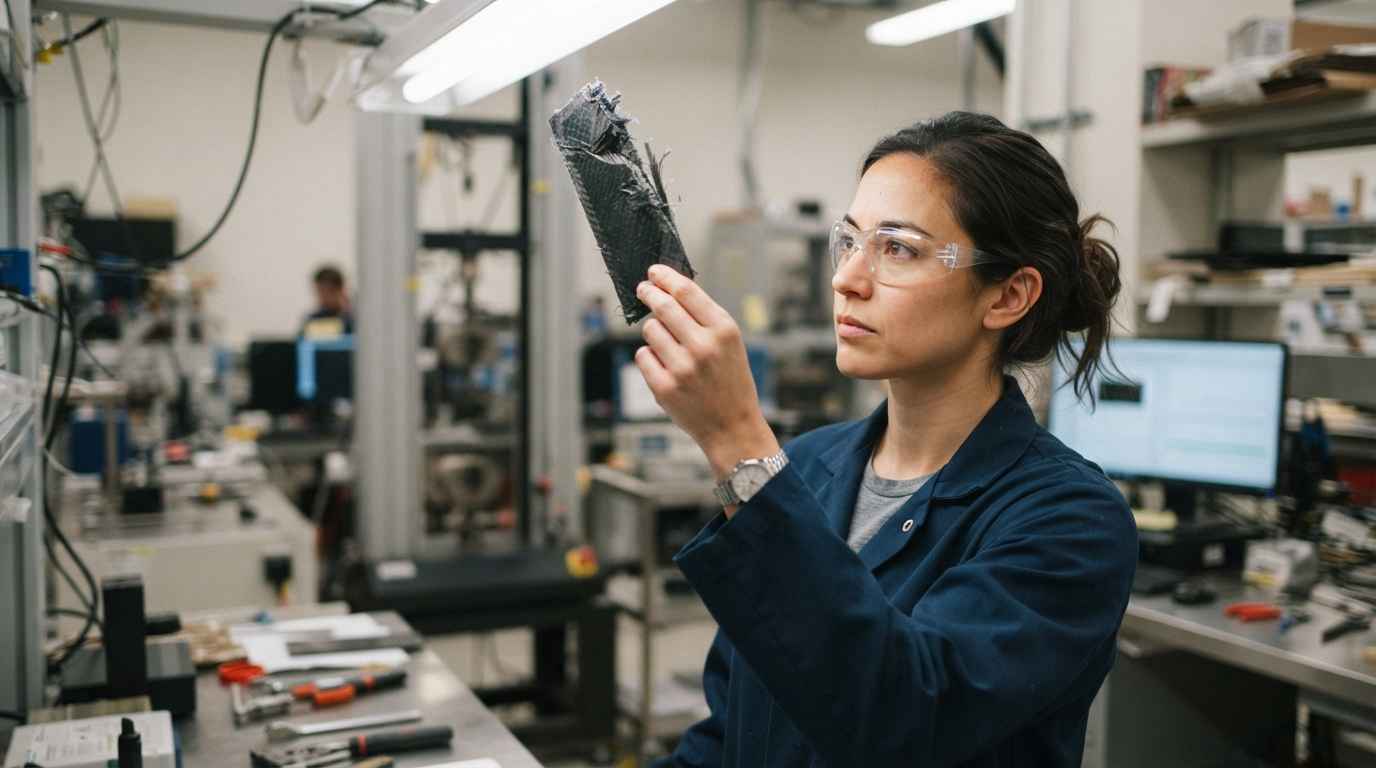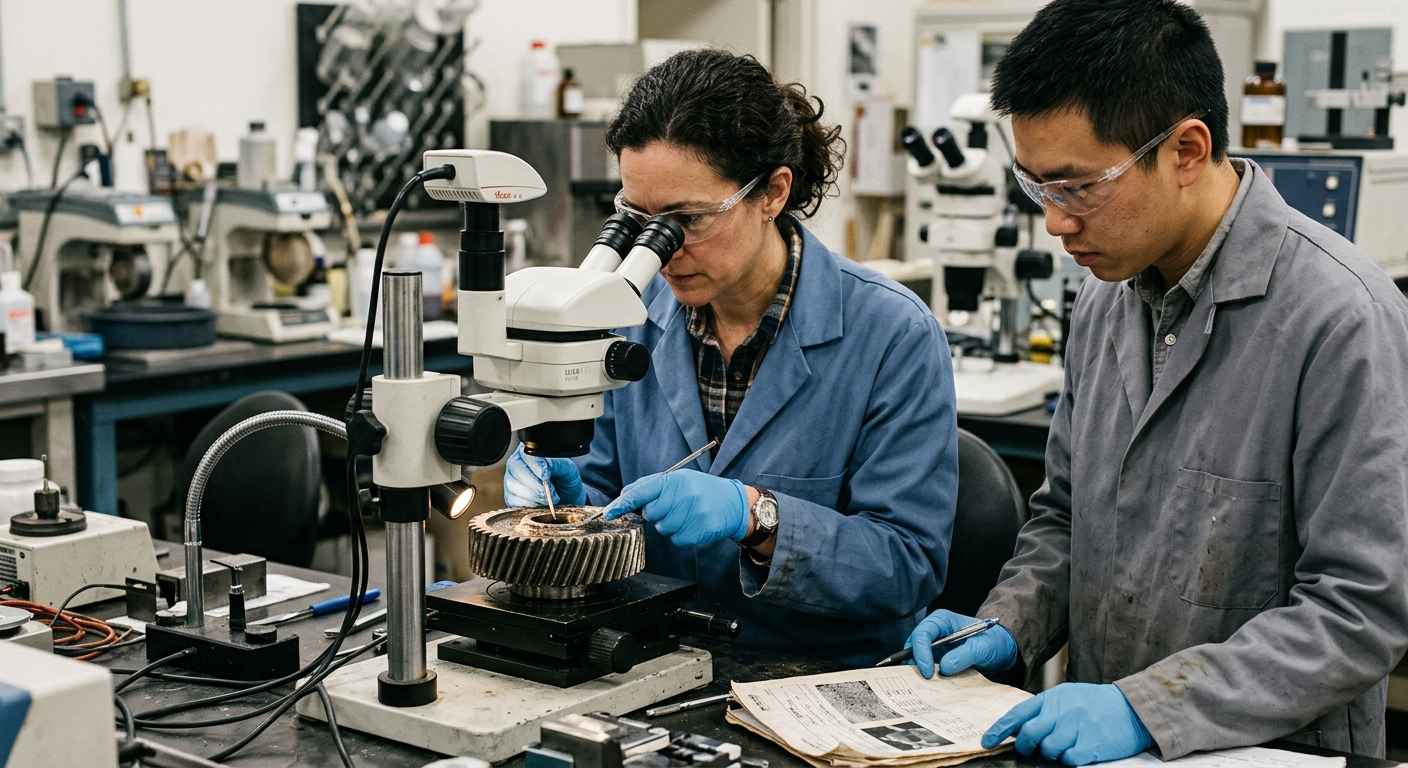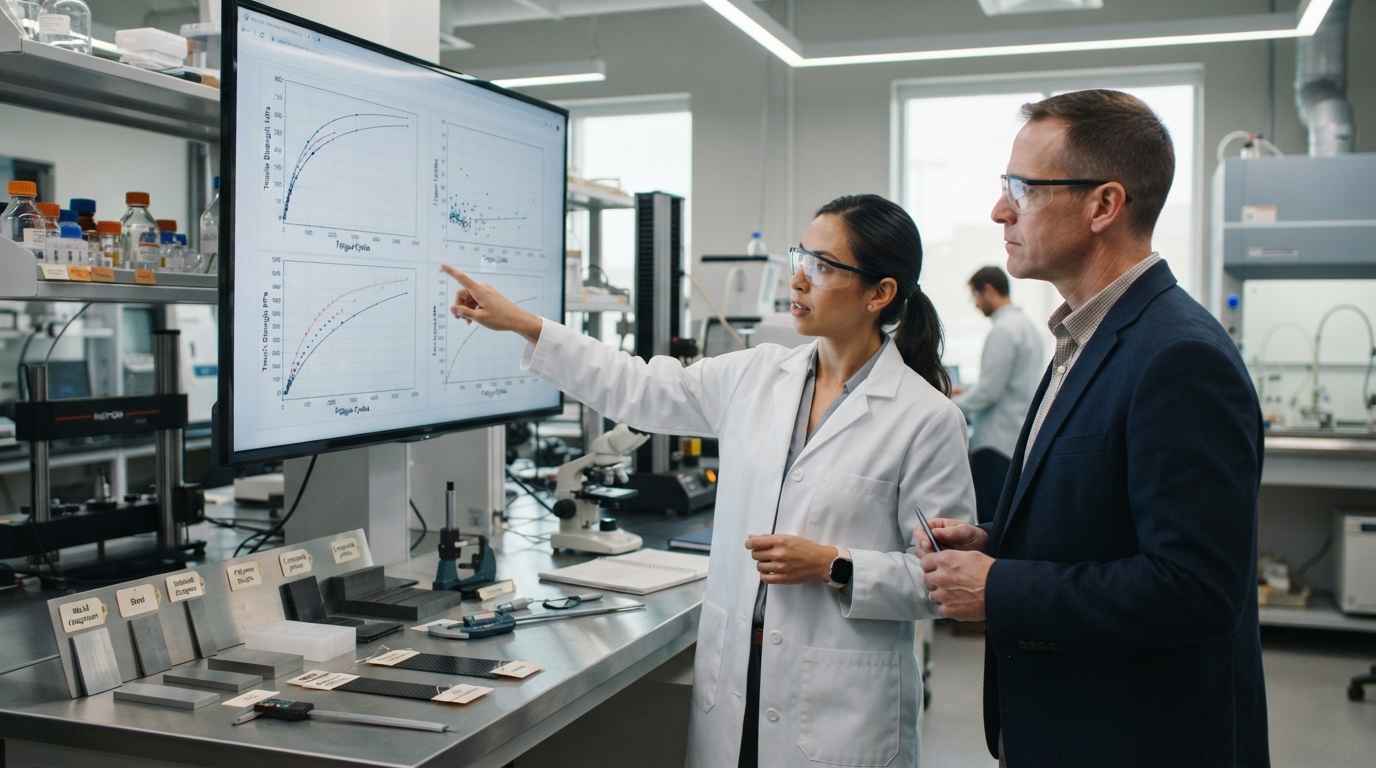

A materials R&D project is the structured process that turns an industrial problem (a recurring failure, an added cost or a new requirement) into a technical hypothesis and a test plan that either validates or rules it out with data, before any change reaches production.
The difference between an improvised material swap and a well-planned materials R&D project is method. Replacing a steel with an aluminium alloy, changing an additive or modifying a coating affects strength, durability and cost all at once, and those variables do not move independently. Framing the work inside a materials and technological innovation plan lets you treat the problem as a chain of traceable decisions rather than an isolated round of trial and error.
That approach connects directly with process improvement, because almost no material change ends in the lab: it feeds into manufacturing, quality control and how the part behaves in service. Planning the project properly from the start avoids repeating tests, scrapping batches and carrying poorly founded decisions all the way to the production line.
What a materials R&D project is and when it is justified
A materials R&D project is a bounded technical effort that starts from a concrete need, defines a hypothesis about which material or modification solves it, and submits it to a test plan with acceptance criteria set in advance. It is not open-ended research without an objective, but a sequence with inputs, deliverables and a final decision to continue, correct or stop.
A materials R&D project does not chase the perfect material in the abstract, but the one that meets the part’s real requirements (mechanical, environmental and cost) with the lowest risk of failure in service.
Materials R&D project, definition and scope
The scope of a materials R&D project runs from characterising the current material to validating the candidate material under conditions representative of the end use. It includes understanding why the incumbent material fails or falls short, identifying which properties are critical and which are secondary, and translating those requirements into concrete tests that yield measurable evidence.
Defining the scope is the first decision that separates a useful project from one that drifts. A project aimed at solving a fatigue failure needs a different plan from one meant to reduce a component’s weight or to replace a raw material for supply reasons. Setting what is in and what is out avoids unnecessary testing and keeps the budget under control.
When an industrial problem justifies a materials R&D project
An industrial problem justifies opening a materials R&D project when the current material no longer meets the need, when the service environment changes, or when a cost, supply or regulatory constraint forces you to look for an alternative. The most common triggers are a premature failure that recurs in the field, a change of raw-material supplier, a new environmental or regulatory demand, and the need to make a part lighter or cheaper without losing performance.
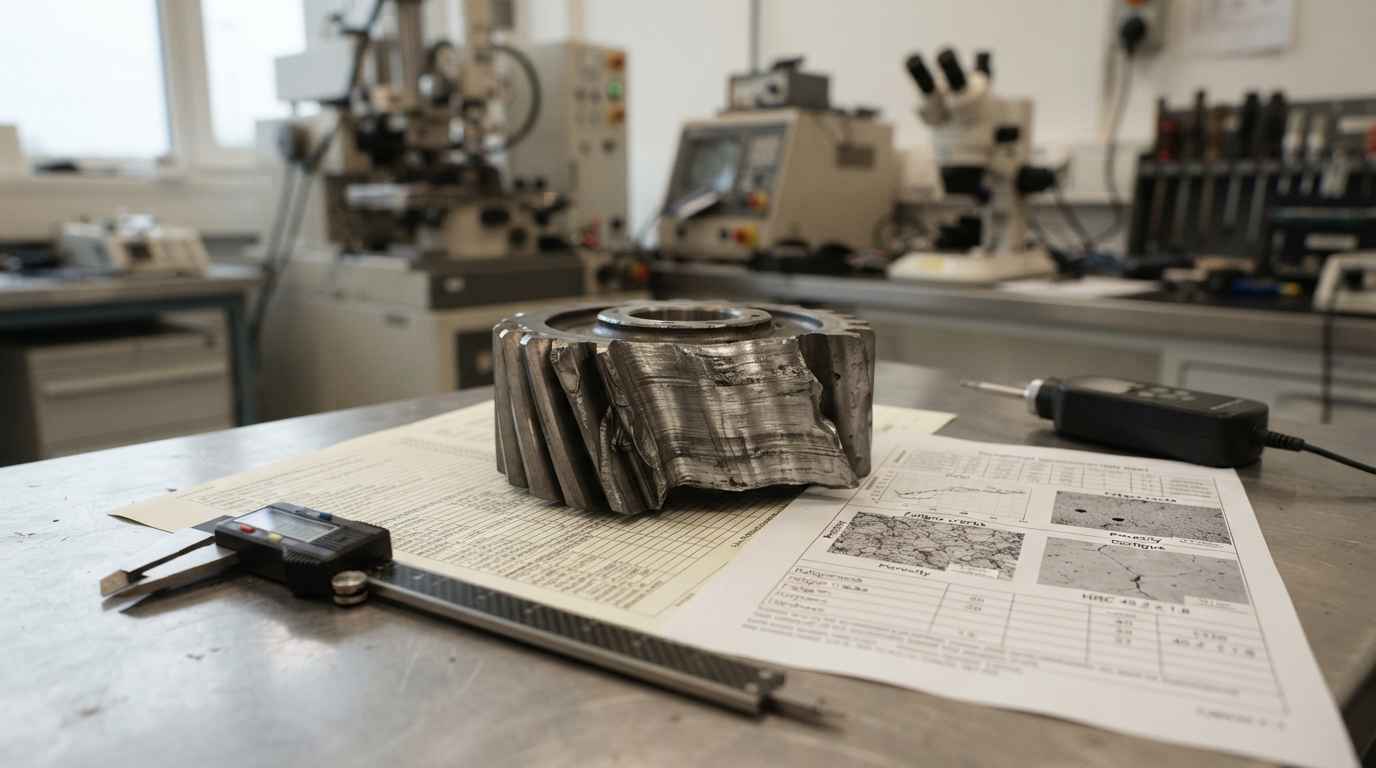
The clearest warning sign is recurrence. An isolated failure can be fixed with a one-off adjustment, but a failure that reappears across different batches points to a root cause in the material or its processing, and there a structured project pays off far more than successive patches. Substituting a material for technical or supply reasons is one of the cases that almost always demands this kind of work, because the candidate has to match or beat the original across several properties at once.
From the industrial problem to the technical hypothesis
The phase that most shapes the outcome of a materials R&D project is problem definition. A poorly framed problem leads to a test plan that measures what does not matter, and no lab later corrects a flawed starting premise. Before choosing candidates, you have to know precisely what the material must do and under which conditions.
Problem definition and material requirements
Defining the problem means turning an operational complaint (“the part breaks”, “the coating peels”, “the plastic yellows”) into a set of quantifiable technical requirements. Each requirement needs a magnitude, a test condition and a limit value, because only then can the later test plan confirm or rule out compliance objectively.
The starting point is almost always to characterise the current material and, where there is a failure, to understand its mechanism. A root-cause analysis on the failing part reveals whether the origin lies in the material, the design, the manufacturing process or the service conditions. Without that diagnosis, the project starts blind and risks replacing a material that was not actually the problem.
A material requirement is only useful if it can be measured: every specification must be expressed as a property, a test condition and a limit acceptance value, not as a qualitative intention.
Requirements are then ranked by priority. Not all properties carry the same weight, and forcing a candidate to maximise every one of them raises cost without adding value. Distinguishing critical requirements (those that cause the failure or the rejection) from desirable requirements (those that improve the product but allow margin) is what makes decisions possible when no candidate is perfect. A requirements matrix, cross-referencing each property with its test method, its limit value and its priority, keeps that traceability and stops a critical requirement from being diluted among the secondary ones as the project advances.
Formulating the hypothesis and selecting candidates
With the requirements defined, the project formulates a hypothesis: which material, family or modification is most likely to meet them. The hypothesis is a testable statement, along the lines of “this reinforced polymer reaches the required stiffness while keeping weight below the limit”, and it is exactly what the test plan will have to confirm or refute.
Candidate selection combines knowledge of the material families (metals, polymers, composites, ceramics and coatings) with supplier data and the constraints of the existing manufacturing process. A candidate that meets the properties but cannot be processed with the available machinery is not viable, and that check is done before testing, not after. Developing a functional material from a concrete requirement, as in the development of catalytic filters to remove ozone, shows how you move from a performance need to a specific, testable material formulation.
It is worth keeping more than one candidate alive in the early phases. Working with two or three alternatives in parallel costs slightly more up front, but it protects the project against the main option being ruled out and provides a comparative reference that makes the final decision more robust. Material selection tools, such as property maps that plot stiffness, density, strength or cost against each other, also help narrow the candidate space before committing to tests, because they rule out on paper the families that cannot reach the requirement by their very nature, so fewer candidates reach the lab and the budget concentrates on the options with real potential.
From the test plan to validation
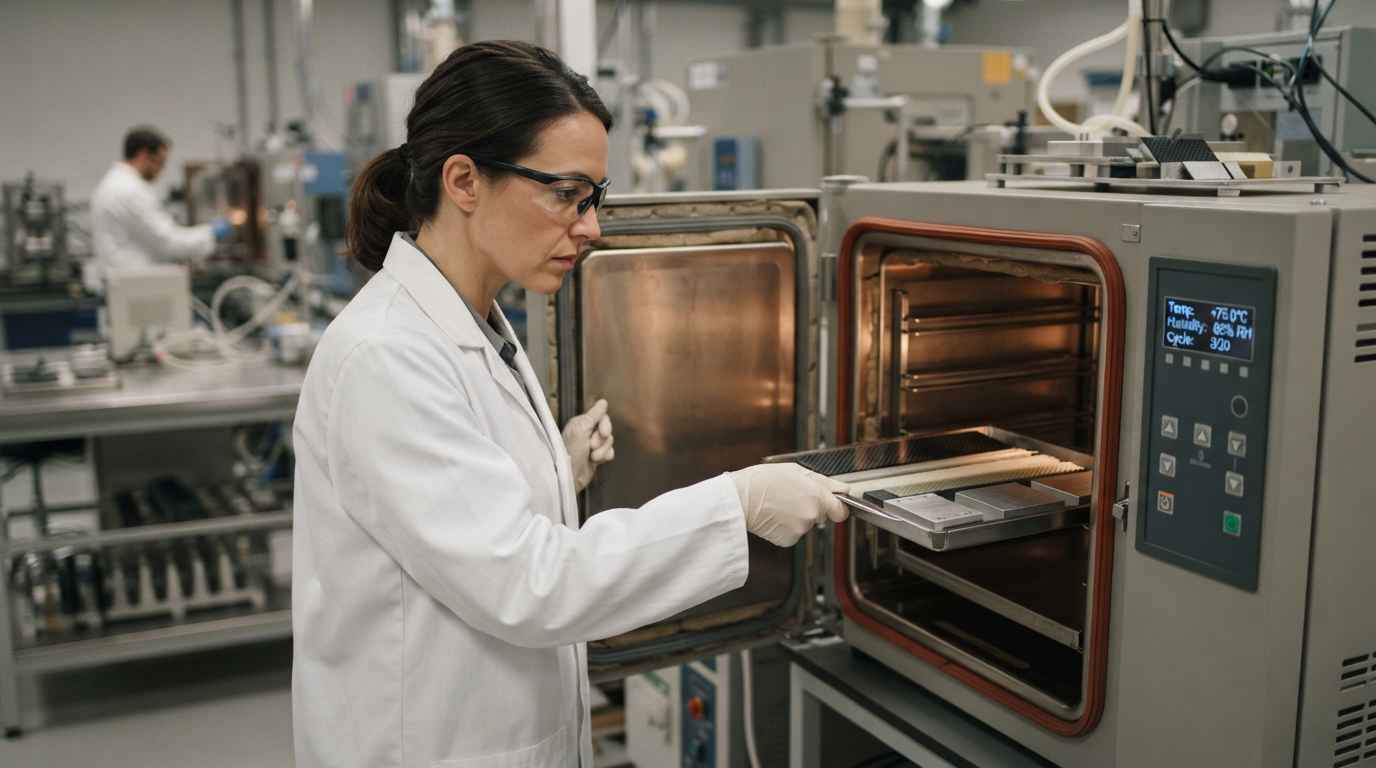
The test plan is the core of the project: the sequence of tests that subjects each candidate to the conditions defining the requirement and generates the data used to decide. A good test plan moves from cheap and fast to expensive and slow, so that weak candidates are ruled out early and resources concentrate on the options with a real chance.
Designing the test plan in phases
The plan is organised in phases, each with an objective and a pass criterion. An initial screening phase uses simple tests (composition, hardness, density) to eliminate clearly unsuitable candidates. A characterisation phase measures the critical properties (tensile, flexural, impact, thermal behaviour) under controlled conditions. A validation phase reproduces the service conditions (accelerated ageing, thermal cycling, exposure to chemicals or salt spray) to confirm that the material withstands real use, not just the laboratory test.
Each technique is chosen for what it contributes to the requirement, not out of routine. Mechanical characterisation covers strength and stiffness; microstructural analysis and fractography explain why a candidate fails when it does; ageing tests anticipate long-term behaviour. A project that wants to validate a coating against outdoor exposure, such as the analysis of high-reflectance coatings for energy savings, needs to measure both the functional property sought and its stability after ageing. The number of coupons per candidate is set according to the material’s expected scatter and the confidence the decision demands, because a single test cannot tell a real difference between candidates from the material’s own noise, and comparing on too few samples leads to conclusions that do not hold up in production.
| Plan phase | Objective | Representative tests | Decision it enables |
|---|---|---|---|
| Screening | Rule out unviable candidates | Composition, hardness, density | Shorten the candidate list |
| Characterisation | Measure critical properties | Tensile, flexural, impact, thermal analysis | Compare candidates |
| Validation | Reproduce service conditions | UV ageing, thermal cycling, salt spray, fatigue | Confirm the hypothesis |
| In-process verification | Check manufacturability | Tests on processed part, dimensional control | Authorise scale-up |
Have a material change on your hands and no idea where to start the test plan? Send us the requirement and the part and we will propose the minimum test sequence to decide with data.
Acceptance criteria and validating the hypothesis
Acceptance criteria are set before testing, not after seeing the results. Each critical requirement carries a limit value and a reference standard or method, so that validation is an objective comparison between the measured data and the agreed threshold. Defining the criterion afterwards is one of the most common ways to bias a project toward the desired conclusion.
Validating the hypothesis is rarely a clean yes or no. Typically a candidate meets the critical requirements and falls short on a desirable one, and there the decision combines the technical data with cost and risk. Documenting what was measured, with which method and with what result, turns the project into a defensible basis for audits, approvals or later claims. When the correspondence between a standard and the criterion is not clear, it is better to describe the technique and the threshold without forcing a standard number that does not apply.
Validating a material is not proving it works in the lab, but proving it meets the acceptance criteria under service conditions, with a traceable method that another team could reproduce.
Risk, management and transfer to production
A materials R&D project manages uncertainty, and uncertainty translates into technical and economic risk. Anticipating where the project might fail, and what each failure would cost, is what allows go or no-go decisions without accumulating losses. Risk management is not paperwork: it is what stops a lab-validated material from becoming a problem on the line.
Managing the project’s technical and economic risk
The main technical risk is that the candidate validated on a coupon behaves differently in the real part, because of geometry, the forming process or interaction with other components. It is mitigated by validating on the processed part, not just virgin material, and by reserving a verification phase under manufacturing conditions before closing the project. A failure mode analysis applied to the material and its process helps rank those risks, because it assigns each mode a severity, a probability and a detectability, and concentrates the tests on what can most compromise the part in service.
Economic risk is controlled with decision points. Structuring the project in phases with a pass criterion at the end of each one lets you halt the investment as soon as a candidate stops being viable, instead of spending the whole budget before discovering the problem. This staged approach fits naturally with any programme of applied innovation solutions for product and process, where each step is authorised against results and not against deadlines.
Scale-up and transfer of the material to production
Transfer to production is where many well-planned projects go wrong. A material that meets the spec in the lab needs the manufacturing process to reproduce it stably batch after batch, with quality control that catches deviations before they reach the customer. The jump from coupon to series demands verifying manufacturability and tuning process parameters, not just approving the material. Before the series it is worth running a pilot batch that reproduces real manufacturing conditions, together with a process capability study that confirms the line’s variability fits within the validated material’s tolerances and that the laboratory result holds batch after batch.
Here the project overlaps with process improvement and with line quality control. Defining what is checked at incoming, in process and on the finished product closes the loop between the material’s R&D and its stable production. A close example of how a technical change moves into the plant’s daily routine is process improvement in the chemical industry, where yield and waste reduction depend on the change being controlled on the line itself. When the project needs analytical capability the company lacks in-house, relying on a materials testing and characterisation laboratory covers characterisation and validation without investing in your own equipment.

A test plan turns uncertainty into decisions
Planning a materials R&D project well is not about testing a lot, but about testing just enough to decide. The sequence (define the problem as measurable requirements, formulate a hypothesis, design a phased test plan with acceptance criteria set in advance, and manage risk through to production transfer) turns a material change from a gamble into a data-backed decision. The difference shows in avoided cost: fewer scrapped batches, fewer field failures and less time lost on tests that led nowhere.
If you have an unresolved material problem (a recurring failure, a new requirement to meet or a substitution to decide), gather the part, its failure history and the requirements it must meet, and send it over: we return a test plan with the phases, techniques and acceptance criteria needed to make the decision on evidence.
Frequently asked questions
What is a materials R&D project?
A materials R&D project is a bounded technical effort that turns an industrial problem into a testable hypothesis and validates it through a test plan with acceptance criteria defined in advance. It starts from a concrete need (a failure, a cost or a new requirement), defines which properties are critical and ends with a data-backed decision on which material to take to production.
When is a project worth opening instead of a one-off fix?
It is worth opening a project when the failure recurs across batches, when the service environment changes, or when a cost, supply or regulatory constraint forces a material change. An isolated failure can be solved with a one-off correction, but a recurring problem points to a root cause that a structured effort resolves better than successive patches.
What determines the cost of a materials R&D project?
Cost depends on the number of candidates, the depth of the test plan and the service conditions to be reproduced. An initial screening with simple tests is inexpensive; validation with accelerated ageing, thermal cycling or fatigue is more costly. Structuring the project in phases with decision points lets you match the investment to the real risk and stop it as soon as a candidate stops being viable.
How do you decide between several candidate materials?
The decision combines meeting the critical requirements with cost, manufacturability and risk. Candidates are compared against the acceptance criteria set before testing, prioritising the properties that cause failure or rejection. When no candidate is perfect, you choose the one that meets the critical requirements with the lowest service risk, documenting the reason for the choice.
How long does a materials R&D project take?
Typical timelines range from a few weeks to several months, depending on the number of phases and the ageing tests involved, which set the pace through their duration. For urgent decisions, a fast screening can rule out unviable candidates in a few days, reserving full validation for the finalist. Request a scope assessment for a timeline estimate tailored to your case.