

Electronic Prototyping
Electronic prototyping develops a product’s electronics in stages, from a test circuit built with off-the-shelf components to a custom board integrated in the housing, to confirm that it works before industrialization.
Within our product development service, prototyping the electronics runs alongside mechanical design from the very first test. We design the schematic, select and test the components, program the microcontrollers and develop the custom electronics that go into the functional prototype, along with the documentation the manufacturer needs.
A component can meet its datasheet and still fail once combined with the rest because of interference, power draw or temperature. If that incompatibility appears once the final board is closed or the housing mold has been ordered, fixing it means redesigning and repeating manufacturing and testing.
Talk to a specialist
Request a free initial consultation; contact a consultant from our team of specialists

What is electronic prototyping?
What is it?
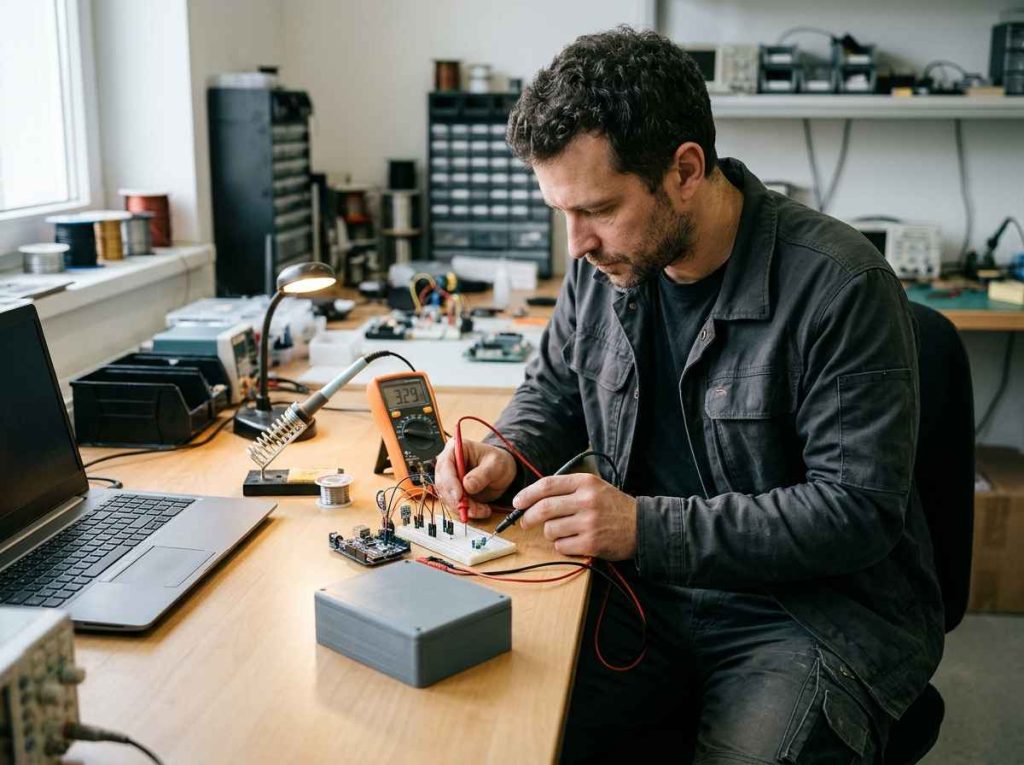
Developing electronic prototypes is the process of building working versions of a product’s electronics to verify the circuit, the components and the firmware before the design is frozen. It is used to check that the device measures, acts and communicates as expected, to measure its power consumption and thermal behavior, and to detect integration problems while they are still cheap to fix, before production boards and molds are ordered.
In products that combine mechanics, electronics and user interaction, each discipline constrains the others: the housing limits the size and position of the board, the board takes up space the mechanisms need, and the interface sets where buttons, displays and indicators go. That is why the electronics are prototyped in parallel with the mechanical design. In printed circuit board design, the IPC-2221 standard is the reference for criteria such as trace width and spacing between conductors.
Each stage covers the schematic, component selection based on datasheets, power supply and consumption, sensor reading and actuator control, microcontroller firmware and communication with other equipment or a user interface. Later stages add the board layout inside the housing, connectors, wiring, heat dissipation and protection against the operating environment.
Electronic prototype development at INFINITIA
We start from the product specifications: functions, power supply, sensors, interfaces and operating environment. From there we design the schematic using the datasheets, select the components and plan a test setup that first verifies the functions with the most uncertainty, since those are the ones that can force a change in the device architecture.
Before finalizing the electronics we test the components together on an early prototype, as in the electronic product development from an undefined idea to a design ready for industrialization, where the resulting custom electronics, covering every product function, serve as the basis for the production version.
We program the microcontrollers and their firmware and, when testing requires it, tools that let non-programmers operate them, such as the Python application to control a device during its life cycle tests, which modifies firmware variables without reprogramming and documents every test performed.
We integrate the board into the housing designed in CAD and made for the prototype, and deliver the functional prototype with the schematics, the board manufacturing files and the BOM (bill of materials), the list of components and quantities the manufacturer needs to quote and produce.
Benefits of prototyping the electronics before freezing the board
Benefits
It allows detecting incompatibilities between components while they are cheap to fix. Interference, higher-than-expected consumption or overheating show up on a test setup, where swapping a component is quick, before a custom board has to be redesigned, remanufactured and retested.
It allows the device to be tested from the earliest versions. An instrumented prototype measures power draw, timing and responses during long-duration tests, as in the assembly of a microcontroller to measure voltage and current in load life tests, which recorded the behavior of several loads over a month and a half.
It validates mechanics and electronics together. Fitting the board into the prototype housing reveals clashes, cables that do not fit, trapped heat or unreachable connectors and buttons, problems that go unnoticed when each part is designed separately. Solving them on the prototype avoids reworking the housing mold and the board at the same time.
It shortens the handover to the manufacturer. Each stage leaves tested components and a verified schematic, so the final documentation (schematics, manufacturing files and BOM) describes electronics that have already worked inside the product. The manufacturer starts from a design that has already been proven.
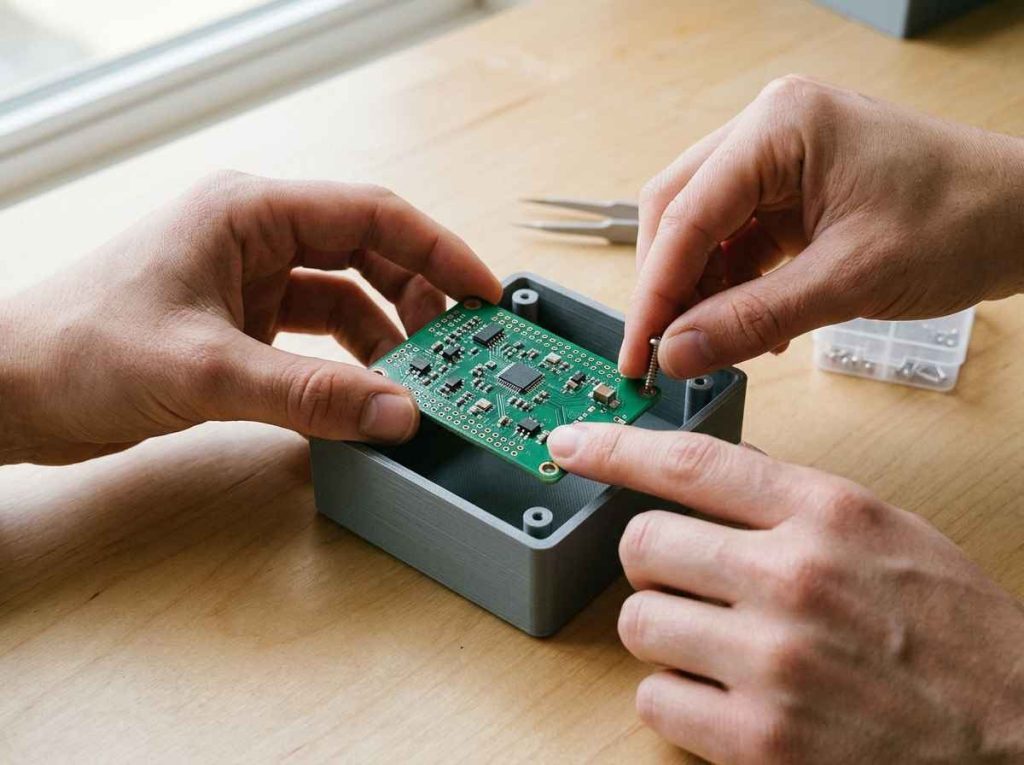
Electronic prototype stages, from early to advanced
Types
An electronic prototype gains fidelity in stages. The first ones answer whether the principle works and whether the chosen components meet requirements; the last ones, whether the whole works inside the product and can be manufactured at scale.
Not every project goes through every stage: a device with well-known functions can start with custom electronics, while one built on a new technology needs more early testing. We choose the starting point according to the uncertainty of each function.
Early circuit with off-the-shelf components
The early circuit is built with development boards, modules and off-the-shelf components on a breadboard or temporary setup, without designing a custom board yet. It shows whether a sensor detects what it needs to detect, whether an actuator delivers the required force or speed and whether two components can communicate. It is the stage where a change costs least: one component is swapped for another without redoing the rest.
It answers whether the principle is viable with the chosen technology. It follows the same logic as a proof of concept: the function with the most uncertainty is isolated and tested before investing in the rest of the device.
Microcontroller prototype with control firmware
At this stage a programmed microcontroller runs the system: it reads the sensors, makes decisions and drives the actuators according to the product logic. Inputs and outputs, power management and the separation between power and control electronics are defined, for example with relays when loads have to be switched. The firmware already implements the functions, although it is still adjusted with each test.
It validates that the device does what it should with its real logic and with all functions running at once. It also allows the consumption of each operating mode to be measured and the first conflicts between functions that share microcontroller resources to be detected.
Instrumentation and data acquisition
Many prototypes need to measure as well as work: logging temperatures, voltages, currents, flow rates or other variables during use or during a test. To do this, sensors are integrated, their readings are programmed and the data are saved to files for later analysis. A graphical interface shows in real time what the device is measuring and lets someone without programming knowledge operate it.
With this stage the prototype also works as a validation instrument. Data logged during life tests or use tests make it possible to adjust firmware parameters, compare components and document the device behavior with figures. Those figures later justify design decisions to the customer or management.
Custom electronics on a printed circuit board
Custom electronics bring together, on a printed circuit board (PCB) designed for the product, all the functions verified in the previous stages. The board shape is defined by the space available in the housing, the position of connectors, buttons and indicators and the component layout needed to limit interference and dissipate heat. The design produces the files required to manufacture it.
This is the stage where the prototype starts to resemble the production electronics in size, connection reliability and power consumption. It serves as the basis for the board that will be industrialized, which can later be adapted to production components or to the manufacturer’s assembly requirements.
Advanced prototype integrated in the housing
The advanced prototype combines the custom board, the firmware and the mechanics in an assembly that reproduces the real behavior of the device. The housing is designed in CAD and made for the prototype, often by 3D printing, with the mounts, cable routes and access points the electronics need. It allows the product to be tested the way the end customer will use it.
| Criterion | Early | Functional | Advanced |
|---|---|---|---|
| Electronics | Commercial modules | In-house setup | Custom PCB |
| Firmware | Isolated tests | Full functions | Near final |
| Integration | On the bench | Partial | In housing |
| Cost of a change | Low | Medium | High |
| Validates | The principle | The functions | The product |
It validates interactions between subsystems that earlier stages do not reveal: heat affecting a sensor, a connector that loosens with use or a button that cannot be reached with the housing closed. The table summarizes what each fidelity level validates and how much it costs to change something at each one.
Documentation to industrialize the electronics
Once the advanced prototype is validated, the documentation that allows a third party to manufacture it is prepared: the schematics, which represent the electrical connections between components; the board manufacturing files; and the BOM, with every component and quantity. On the mechanical side, part drawings and assembly drawings are added to define how everything fits together.
Without that documentation, design knowledge stays with the team that developed it. With it, the manufacturer can quote, source the components and plan electronics production without having to interpret the prototype or repeat tests already carried out during development.
Industrial sectors where prototyping electronics in stages pays off
Sectors
Prototyping the electronics adds the most value in products where sensors, control and a user interface share a compact housing: medical devices, small appliances, measuring equipment and machine control systems.
In all of them, an incompatibility between board, housing and mechanisms detected late forces molds, boards and tests to be repeated, and in regulated sectors part of the validation documentation as well.
Electronic prototyping in electrical and electronic equipment: control, interface and power
In electrical and electronic equipment for professional or home use, the control board shares space with power supplies, displays, buttons and communications, and the room available in the housing limits where each component can go.
- Power consumption: measurement of consumption in each operating mode to size the power supply and heat dissipation.
- Interface: integration of displays, buttons and indicators with their firmware logic and their position in the housing.
- Communications: communication tests between the microcontroller, other equipment and control applications.
Prototyping in stages makes it possible to freeze the control board once power consumption, interface and communications have been tested together inside the equipment and with its real power supply.
Electronic prototyping in medical devices: measurement, reliability and use
In medical devices and laboratory equipment, the electronics measure parameters, control dosing or time processes, and their behavior has to be repeatable in the hands of healthcare professionals or patients.
- Measurement: selection and tuning of sensors to obtain stable readings across the device’s entire operating range.
- Reliability: life and cycle tests on the prototype to detect failures before the device design is frozen.
- Use: tests with professionals on advanced prototypes that work like the final device.
Validating the electronics on representative prototypes helps reach the device verification and documentation phases with a proven design and test data to support it.
Electronic prototyping in consumer goods: small appliances and unit cost
In small appliances and household devices, the electronics have to be compact, low-cost in production and easy to use, and the product is validated with users before investing in production molds and boards.
- Cost: component choice with the target production cost in mind from the earliest stages.
- Usability: control, indicator and alert logic tested with users on advanced prototypes.
- Integration: custom board fitted to the space in the housing and to the position of controls and connectors.
An advanced prototype that works like the final product makes it possible to gather user feedback and finalize the BOM before ordering boards and molds.
Electronic prototyping in machinery: process sensors and custom control
In machinery and production lines, custom electronics come in when no commercial solution fits: detecting or sorting materials, controlling a specific actuator or logging process variables in real time.
- Detection: custom sensors, such as inductive ones, with their signal processed by a microcontroller.
- Control: switching of loads and actuators with separation between power and control electronics.
- Integration: installation of the system on the real machine and tuning with the actual material and line speed.
Prototyping the system on the line itself makes it possible to tune sensitivity and decision logic with the real material before building the final version.
Electronic prototyping in automotive and mobility: temperature, power supply and space
In automotive, personal mobility vehicles and their accessories, the electronics work through temperature changes and a variable power supply, and have to fit into very tight spaces next to other vehicle components.
- Environment: temperature and accelerated aging tests on the prototype to detect weak connections and components.
- Power supply: circuit behavior under variations and spikes in the vehicle supply voltage.
- Space: custom board fitted to the available space and to the connectors of the assembly where it is mounted.
An advanced prototype installed in its real location reveals environmental problems that a bench setup does not show, such as heating caused by nearby components.
Electronic prototyping in food and agriculture: dosing, measurement and cleaning
In equipment for the food industry, ingredient dosing and beverage preparation, the electronics control dosing, temperatures and times, and coexist with liquids, humidity, steam and frequent cleaning.
- Dosing: flow sensors and pump control to adjust the amount dispensed in each cycle.
- Sealing: protection of the electronics against splashes and cleaning, validated with ingress protection tests on the prototype.
- Process: temperature and time control with data logging to fine-tune the recipe or the work cycle.
Testing the electronics with the real fluid and cleaning routine avoids discovering leaks or false readings once the equipment is installed and in use by the customer.
Electronics validated in stages as the basis for industrialization
Value
Prototyping the electronics in stages spreads development risk: each fidelity level answers one question, and the next stage only starts once the previous one is resolved. The result is electronics that have already worked inside the product before production boards and molds are ordered from the manufacturer.
We plan each prototype around the question it has to answer and the fidelity level needed to answer it. A prototype that is too complete too early makes changes expensive, while one that is too simple leaves interactions between subsystems unvalidated, as explained in the article on what a functional prototype does and does not validate. That is why we raise fidelity in stages, only where testing calls for it, and each prototype settles the questions that belong to it.
This approach also keeps costs in order: the components and technologies with the most uncertainty are tested first on low-cost setups, and investment in the custom board and housing comes once the main decisions have been made. If the question is whether a new technology delivers what it promises, technology selection and testing answers it before the electronics are designed around it, with tests in the specific device it is intended for.
If you have a product with electronics under development, or just the idea of what it needs to do, send us the functions it must perform, the planned sensors or actuators, the operating environment and, if available, schematics, CAD models or earlier prototypes. We will propose which stage to start from and what to validate at each one, and deliver the prototype with its test results and the documentation to keep moving toward production.
Frequently asked questions about electronic prototyping
FAQs
What does an electronic prototype built with commercial modules not validate?
It does not validate the size, connection reliability or thermal behavior of the final electronics. Temporary wiring and connections add noise and interference that the custom board will not have, or mask problems that will appear on it, and outside the housing heat dissipates better than inside.
What it does validate is the operating principle, the component selection and the firmware logic. That is why its results are used to decide which electronics to design, while power consumption, temperature and interference are confirmed later on the custom board and inside the product.
When is it time to move from commercial modules to a custom board?
It is time once the operating principle and the components have been validated and the prototype needs to fit in the housing, work reliably during long tests or get closer to production power consumption and cost. Continuing with temporary setups at that point introduces connection failures that have nothing to do with the design.
It also makes sense when several identical units are needed for user tests or parallel testing. Hand-building several identical temporary prototypes is slow and hard to repeat, while custom boards all come out with the same configuration.
What role does firmware play in an electronic prototype?
Firmware is the program the microcontroller runs, and it defines how the device reads sensors, makes decisions and acts. In the prototype it evolves with each stage: it starts with isolated tests of each function and ends up implementing the full product logic.
During testing it helps to be able to adjust parameters without reprogramming the device, for example from a control application that modifies internal firmware variables. That way different values can be tried in the same session, and the configuration that gives the best result is documented before it is fixed in the final version.
Can a function be validated before its electronics are developed?
Yes. If the question is whether the function adds value for the user, it can be tested before investing in sensors, electronics and firmware by simulating its response in a prototype operated by a hidden person. That is the approach of the Wizard of Oz technique, which measures the value of the function for the user.
Technical feasibility is validated afterward, with the real electronics: whether the sensor detects what it has to detect, whether the response is fast enough and what it costs to achieve. Separating the two questions avoids developing electronics for functions the user will not use.
How are the components of an electronic prototype selected?
The starting point is the product specifications (measurement range, power supply, consumption, operating temperature, communications), and candidate components are compared using their datasheets. Size, the target production cost and the availability of the component over the product’s lifetime also weigh in the choice.
Meeting the datasheet is not enough: components are tested together on an early setup, because interference, voltage drops or overheating appear when they are combined. That joint test confirms the selection before the custom board is designed.
How are the electronics integrated into the prototype housing?
The board and the housing are designed together: the board shape follows the available space, and the housing includes mounts, fasteners, cable routes and access for connectors, buttons and indicators. 3D design and modeling using CAD of both makes it possible to detect clashes before manufacturing.
Then the housing is made for the prototype and assembled with the real electronics. That assembly is where the problems the model does not show appear, such as heat building up in a closed corner, a cable that forces a cover open or an indicator that cannot be seen from the position of use.
What tests are run on an electronic prototype?
The prototype undergoes functional tests of each operating mode, power consumption measurements, life and cycle tests with the device running continuously, and temperature and accelerated aging tests. If the product has to be protected against dust or water, its sealing is also checked against the required IP protection rating.
Tests are planned according to the stage: early stages check that the principle works, and advanced stages check that the assembly withstands operating conditions. Logging data during testing makes it possible to compare versions and justify each design change.
Can the prototype electronics serve as the basis for production?
Yes, the custom electronics of the advanced prototype serve as the basis for the version that will be industrialized. Before production they are usually adjusted with equivalent components that offer better cost or availability, board layout changes to make assembly easier and corrections that come out of testing.
That is why it pays to design the advanced prototype with manufacturing criteria from the start. The closer it is to the production board, the fewer changes will be needed later and the more useful the tests run on it will be.
How much does an electronic prototype cost?
Cost depends on the starting stage, the number of functions, sensors and actuators, firmware complexity, whether a custom board and housing are needed and the number of units. An early circuit with commercial modules costs much less than an integrated advanced prototype, which adds board design, housing manufacturing and testing.
To give you a figure we need to know what the device has to do and where development stands. Send us the functions, any specifications you have and any earlier schematic or prototype, and we will propose the stages, their scope and their cost separately.
How long does it take to get an electronic prototype?
It depends on the stage. An early circuit to validate a function is usually ready in one to four weeks depending on its complexity; custom electronics and the advanced prototype add board design, board manufacturing, assembly in the housing and testing, so their lead time is set according to project scope.
If you need the prototype for a specific date, such as a trade show or an investor meeting, tell us at the outset. With it we sequence the stages so that what that date requires is ready on time and leave for later what does not need to be shown.
What do I need to send to get started?
Send us a description of what the device has to do, any specifications you have (power supply, sensors, actuators, interfaces, operating environment) and, if available, schematics, CAD models or earlier prototypes. Also tell us what you will use the prototype for: validating a function, running tests, showing it to customers or investors, or preparing industrialization.
If the product has to meet requirements for a specific sector, include the standards or conditions you know of. With that information we will propose the starting stage and what each prototype will validate, and confirm lead time and budget before we begin.
What should I do if I only have the product idea?
Start by telling us what problem the product solves and what it has to do. Without specifications there is no basis for choosing components, so the first step is to define them from the functions, the user and the operating environment, and to develop concepts that combine mechanics, electronics and interaction.
Once the specifications are defined, prototyping starts with the functions that carry the most uncertainty, on low-cost early setups. That way the idea moves forward on proven decisions and reaches the custom board and advanced prototype with fewer changes and a tighter budget.