

Design risk analysis
Design risk analysis means identifying, assessing and prioritizing what can fail in a product because of the way it is designed, before prototypes or tooling are made, in order to decide what to change in the design and what to validate.
Within our product development service, this phase of mechanical development comes when the 3D model already exists and can still be changed. We review function, strength, tolerances, assembly and use to find the weak points of the design before they show up in the prototype or in production.
A risk discovered once the mold is made or the product is on the market means reworking tooling, repeating validations or handling claims. Detecting it on the model reduces it to a change of geometry, material or tolerance.
Talk to a specialist
Request a free initial consultation; contact a consultant from our team of specialists

What is design risk analysis?
What is it?
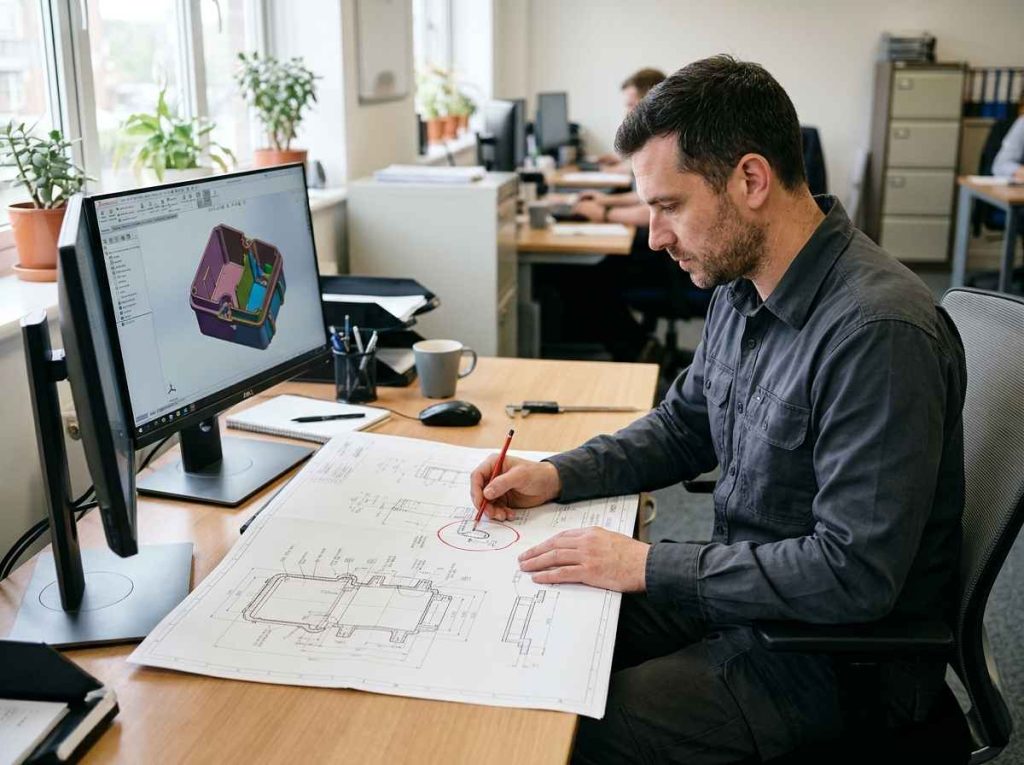
Design risk analysis is the systematic review of a product at the design stage to find the ways in which it can fail in its function, its strength or its use, estimate their severity and likelihood, and define the actions that eliminate or reduce them. It ensures the product reaches the prototype with the main risks resolved or, at least, with a plan to check them. Every risk identified ends in a design change, a calculation, a test or a justified acceptance, so the analysis goes well beyond paperwork.
It is an established practice in sectors with demanding reliability and safety requirements. Design FMEA, whose method is described in IEC 60812, is its best-known tool in automotive and capital equipment, and in medical devices risk management follows ISO 14971. Outside regulated sectors it delivers the same thing: justified, traceable design decisions before investing in manufacturing.
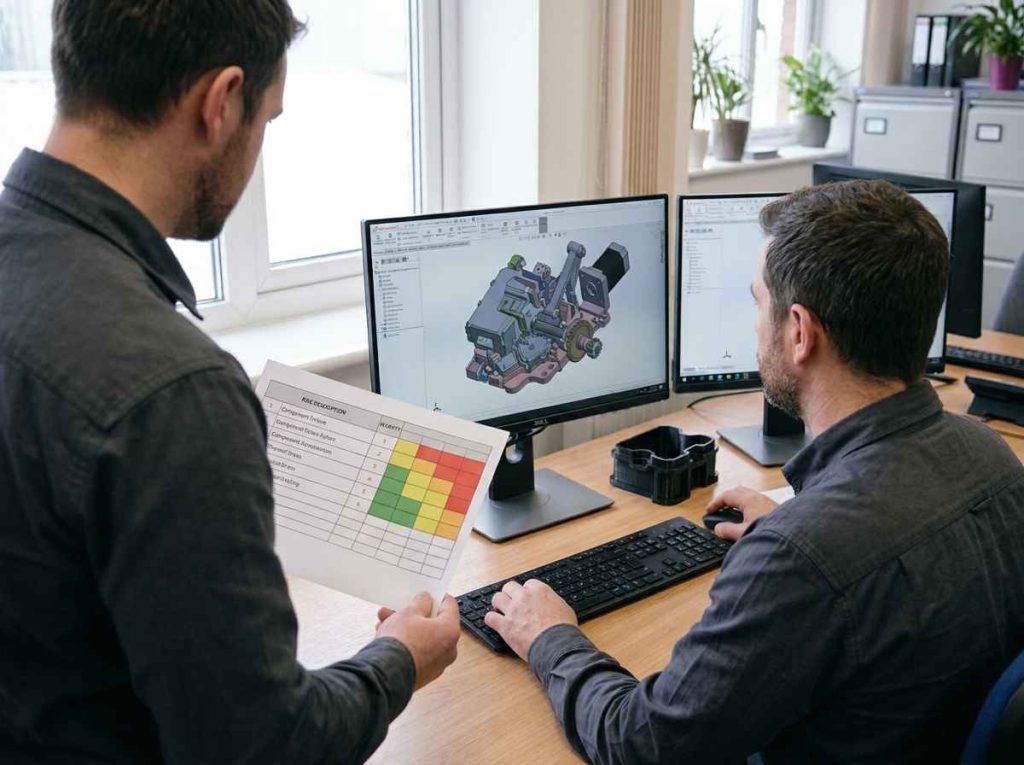
The risks reviewed are functional (the product does not do what it should), structural (breakage, deformation, fatigue), tolerance and assembly risks (parts that do not fit or that interfere), manufacturing risks (geometries that are hard to produce), use risks (incorrect handling or reasonably foreseeable misuse) and regulatory risks. Each one is scored for severity, occurrence and detection to decide where to act first. Functional, assembly and use risks usually emerge in the structured design review; structural and thermal risks need calculation.
Risk analysis of the design at INFINITIA
At INFINITIA we carry out the analysis on the 3D model together with the team that knows the product. We start from the requirements and the real conditions of use, go through the design function by function, and every relevant risk comes out with a concrete action: a change of geometry, material or tolerance, a calculation or a test.
When the risk is structural we check it through simulation, as in the mechanical design improvement of a product that broke within its normal operating range: the real load case was analyzed and feasible changes were proposed within the geometry and volume constraints.
Simulation also makes it possible to compare alternatives before any prototype is made. That is what was done in the design of a compact, high-power aeration device: its different configurations were compared through fluid dynamics simulation and a single version, already backed by calculation, was prototyped.
The outcome is a prioritized risk matrix, with the proposed design actions and the calculation, test or prototype that must close each risk. That validation plan becomes the roadmap for the next phase and avoids prototypes that do not check what matters.
Benefits of risk analysis in product design
Benefits
Reduces the cost of design errors. A risk detected on the model is fixed with a change in CAD; the same risk discovered in the prototype requires remaking parts and, in production, modifying molds, withdrawing product or handling claims. The earlier it is identified, the less it costs to solve.
Shortens development. By prioritizing risks, prototypes and tests focus on checking what can really fail and blind iterations are reduced. That was the approach in the feasibility study that turned a patent into a manufacturable design, where requirements, mechanisms, materials and regulations were reviewed before anything was made. Each physical test thus has a clear objective and an acceptance criterion set in advance.
Increases product reliability and safety. Reviewing loads, fatigue, temperatures and foreseeable misuse at the design stage reduces the likelihood of in-service breakage and of risks to the user, which are the most expensive failures for any brand. In products with end users, a safety failure outweighs any saving made in the design.
Leaves decisions documented. The risk matrix justifies each design choice to management, customers or auditors, and serves as the basis for product approval. It also allows the reasoning to be reconstructed when, years later, the product has to be modified. In regulated sectors, that traceability is also a requirement of the technical file.
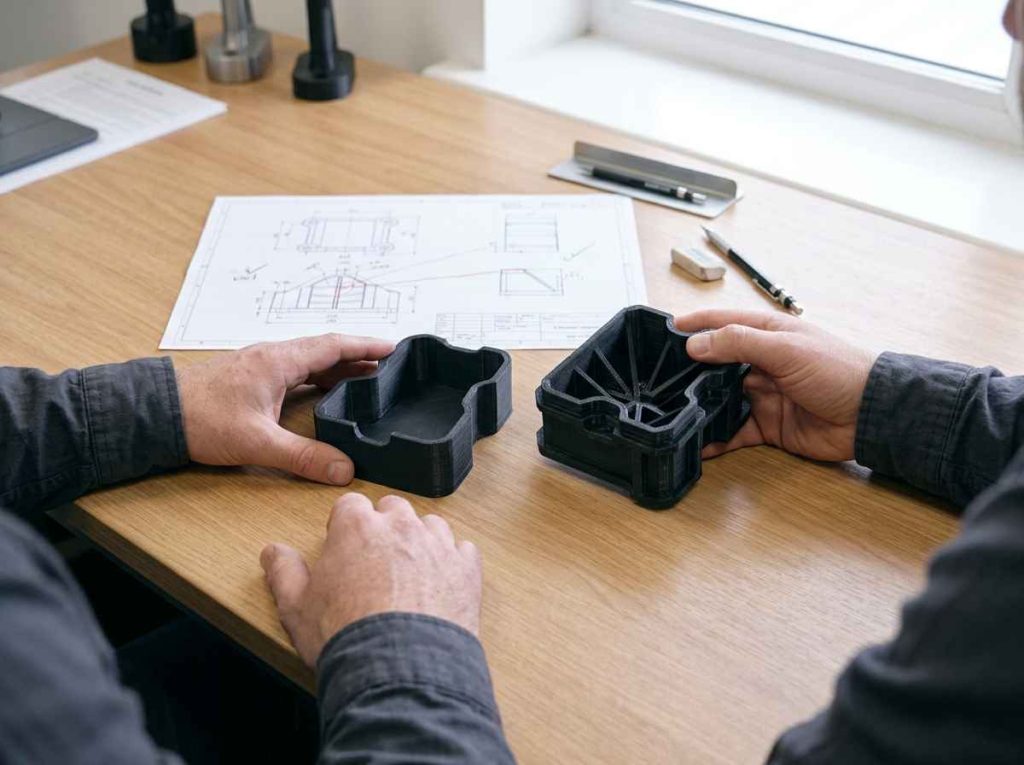
Types of risk analysis in mechanical design
Types
Risk analysis of a design combines several tools, because not all risks are detected in the same way: some come out in a structured review and others only in calculation or a physical test. The choice depends on the project phase and on the severity of what can fail.
In each project we define which tool to apply to each risk, so that the effort is concentrated on the critical points instead of reviewing the whole design at the same level of detail.
Design FMEA (DFMEA)
Design FMEA goes through each function of the product, identifies its potential failure modes, their effects and their causes in the design, and scores them for severity, occurrence and detection. The result is a prioritized list of risks with assigned actions, which is updated as the design evolves. The scoring makes it possible to rank the risks and check, after each action is applied, how much the risk has been reduced.
It is especially useful in products with many functions or components, where the failure of a secondary part can disable the whole assembly. The fundamentals of the method are explained in the article on what FMEA is and how it is applied, and in mechanical development it is carried out directly on the 3D model.
Tolerance analysis and dimensional chains
Tolerance analysis checks that parts fit and work when each one is made within its tolerance, not just at its nominal dimension. Variations are added along the dimensional chain, worst case or statistically, to detect interferences, excessive clearances or misalignments.
It makes it possible to tighten tolerances where they are critical and relax them where they add nothing, which reduces manufacturing cost without compromising assembly. It is the basis for design for manufacturing to set realistic dimensions for the chosen process. In assemblies with many parts or with mechanisms, it avoids surprises in the first assembly of the prototype.
Finite element simulation of the design
Finite element simulation calculates stresses, deformations, temperatures or fatigue life on the 3D model and locates the areas where the design is working at its limit. It allows geometry or material variants to be compared without making them and those that do not comply to be discarded. It also studies behavior under impacts, vibration or thermal expansion between different materials.
It is the right tool for structural and thermal risks: insufficient radii, badly placed ribs, wall thicknesses that cannot withstand the load or joints that concentrate stress. Its results depend on well-defined loads and materials, so they are then checked against prototype tests at the critical points.
Design review by stages
A design review is a structured evaluation of the model at defined milestones (concept, detailed design and before drawings are released), with a checklist covering function, assembly, manufacturing, safety and regulations. Different profiles take part so that each one contributes its own point of view.
It detects risks that do not appear in a calculation: a screw that cannot be reached for maintenance, a part that can be assembled the wrong way round, a sharp edge or a component with no alternative supplier. Placed right after 3D design and modeling using CAD, it prevents those errors from reaching the manufacturing drawings. Each review ends with a list of actions, and their closure is checked in the next one.
Use and user safety analysis
Use analysis assesses how the user interacts with the product, including reasonably foreseeable misuse: knocks, drops, incorrect assembly, aggressive cleaning or handling by people with no technical training. Each scenario becomes a risk with its severity for the user, based on observing real users or on experience with similar products.
It makes it possible to add guards, assembly guides or changes of shape that eliminate the risk at the source, before resorting to warnings in the manual. It is the part of the analysis that weighs most in product conformity and in liability towards the end user, especially in consumer products and work equipment.
Design validation plan
The validation plan assigns to each relevant risk the test that closes it: a calculation, a simulation, a prototype test or an inspection. Each prototype thus has a clear objective, and each result is compared with an acceptance criterion set in advance.
| Risk | Tool | When | Evidence |
|---|---|---|---|
| Functional | Design FMEA | Concept and detail | Risk matrix |
| Structural | Simulation | Detailed design | Calculation report |
| Assembly | Tolerances | Before drawings | Dimensional chain |
| Manufacturing | Design review | Before drawings | List of changes |
| Use and safety | Use analysis | Detail and prototype | Design actions |
Physical tests are concentrated on the risks that calculation cannot close with confidence, and they are carried out on functional prototypes before the final tooling is ordered. When a test does not meet the criterion, the risk goes back to the analysis with new information and the corresponding design action is decided. The resulting plan also serves as documentation for product approval.
Sectors where analyzing design risks prevents in-service failures
Sectors
The priority of the analysis changes by sector: fatigue and repeatability in automotive, operator safety in machinery, regulated risk management in medical devices, or heavy use and cost in consumer goods.
In every case the method is the same, but the severity criteria and the documentation required by the customer or by the regulations of each sector change.
Design risk analysis in automotive: fatigue, vibration and high-volume production
In automotive and mobility, components withstand vibration, thermal cycling and repeated loads throughout their service life, and a design error is multiplied across the entire production volume.
- Design FMEA: common practice in the supply chain of the sector to justify design decisions.
- Fatigue and vibration: review of joints, brackets and stress concentration areas.
- Assembly tolerances: dimensional chains that ensure in-line assembly without manual adjustments.
Solving these risks on the model avoids modifying tooling once series production is committed, in a sector where a recall affects thousands of units.
Design risk analysis in electronics: temperature, sealing and electrical safety
In electrical and electronic equipment, the mechanical design protects the electronics, removes heat and insulates the user, so a failure of the enclosure compromises the whole device. Miniaturization also leaves little margin to correct thermal or assembly problems once the enclosure is fixed.
- Thermal management: hot spots and ventilation reviewed through calculation before the prototype.
- Sealing: gaskets, joints and cable entries assessed against the required degree of protection.
- Electrical safety: clearances, access to live parts and fire behavior.
Reviewing these risks before certification avoids repeating tests because of a late design change and makes it possible to reach certification with a stable design.
Design risk analysis in machinery: operator safety, fatigue and maintenance
In machinery and capital equipment, the design protects the operator and withstands years of cyclic loads, and the risk assessment of the machine is based on ISO 12100.
- Operator safety: entrapment zones, guards and access points identified at the design stage.
- Cyclic loads: sizing for fatigue and not only for static load, as explained in the article on static failure versus fatigue in design.
- Maintainability: access points and wear parts designed to be replaced without dismantling the assembly.
Building these risks into the design reduces downtime and simplifies the technical documentation of the machine, because the risks are already identified and treated from the design stage.
Design risk analysis in consumer goods: misuse, durability and cost
In consumer goods, the product reaches users with no technical training, is used daily and competes on price, so the design must withstand unexpected uses without making each unit more expensive. With high volumes, any design defect turns into a large number of claims.
- Foreseeable misuse: drops, knocks, overloads or incorrect assembly by the user.
- Durability: hinges, latches and mechanisms subjected to repeated cycles of use.
- User safety: edges, pinch points and small parts assessed at the design stage.
Anticipating real use reduces returns and claims without adding cost to each unit or relying on warnings the user does not read.
Design risk analysis in medical devices: risk management and traceability
In medical devices and healthcare equipment, risk management is part of development itself and follows ISO 14971, which requires each risk to be identified, assessed and controlled throughout the life cycle.
- Risks to the patient: functional failures with a clinical effect, prioritized by severity.
- Use by healthcare staff: handling and cleaning errors assessed at the design stage.
- Traceability: each control measure linked to its documented verification.
Building the analysis into the mechanical design eases the technical file and avoids redesigns in the middle of certification, when any change means reviewing the risk documentation and repeating verifications.
Design risk analysis in food industry equipment: hygiene, cleaning and food contact
In equipment and packaging for the food industry, the design determines hygiene: an area where product builds up or a surface that is hard to clean becomes a health risk. Frequent, aggressive cleaning also subjects the materials to continuous chemical wear.
- Hygienic design: geometries without dead zones and surfaces accessible for cleaning.
- Food contact: materials and joints compatible with the product and with cleaning agents.
- Foreign bodies: parts that could come loose or shed particles, identified at the design stage.
Detecting these risks on the model avoids costly modifications to equipment already installed in the plant, where every stoppage to modify it interrupts production.
Design risks solved before the prototype and the tooling
Value
Every risk solved on the model is a prototype, a mold or a claim that does not have to be paid for. Reviewing the design methodically, prioritizing what is critical and checking it through calculation or testing produces documented decisions, built on the knowledge of the team, that can be defended before management, customers and auditors.
The analysis works best when it is part of development rather than a formality at the end. That is why we place it after 3D modeling, when the design is already defined but still cheap to change, and update it at every iteration until the drawings are released. Risks that remain open move into the prototype validation plan. In multidisciplinary projects (mechanics, electronics, software), it is also the point at which the risks that each team sees separately are brought together.
The result is a set of decisions as well as a list of possible failures: what is changed in the design, what is calculated, what is tested and what is consciously accepted, with the reason for each acceptance, something that matters when a claim arises. That traceability is what regulated sectors require and what later eases industrialization with suppliers. When a new version is launched, the previous analysis is the starting point and there is no need to start from scratch.
If you have a CAD design about to move to prototype or production, send us the model, the product requirements and its conditions of use. We will return a prioritized risk matrix, the recommended design actions and the validation plan to check them before investing in tooling.
Frequently asked questions about design risk analysis
FAQs
What risks does design analysis not detect?
It does not detect risks that depend on information nobody provides: unknown conditions of use, real loads that have not been measured or supplier variations that have not been anticipated. Nor does it replace physical validation, because it identifies and prioritizes what can fail, but some hypotheses can only be confirmed with a test.
That is why the analysis is completed with a validation plan and updated when new data arrives from the prototype or the first production runs. An analysis closed once and filed away loses its value as soon as the design changes.
At what point in development is risk analysis carried out?
Risk analysis is carried out once a 3D model of the product exists and before functional prototypes or tooling are made. Earlier, at the concept stage, technical feasibility analysis decides whether the product can be made; risk analysis comes later and reviews the specific design.
It is not a one-off step. It is repeated at every major design iteration and before the manufacturing drawings are released, so that resolved risks are closed and new ones are added in time.
What is the difference between design FMEA and process FMEA?
Design FMEA analyzes how the product can fail because of the way it is conceived (geometry, materials, tolerances, functions), while process FMEA analyzes how it can fail because of the way it is made or assembled (operations, machines, production controls).
They are done in that order: first the design is secured and then the process that will produce it. Design risks that depend on a tolerance or a critical characteristic are carried over into the process FMEA so that manufacturing controls them.
How are the risks of a design prioritized?
Risks are prioritized by combining their severity (what consequence the failure has), their occurrence (how likely it is) and their detection (how easily it is discovered before reaching the user). Severity weighs more than the rest: a failure that affects safety is addressed even if its likelihood is low.
With that score the list is ranked, and it is decided which risks require a design change, which are covered with a calculation or a test and which are accepted in a documented way. The effort is thus concentrated where it reduces risk the most.
How does it differ from preventive failure analysis?
Design risk analysis works on the model and on a design that can still be changed, while preventive failure analysis relies on tests on materials or components to anticipate how they will behave in service. The first decides what to change in the design; the second provides measured data on real behavior.
They are complementary. Risks that design analysis cannot close through calculation move on to testing, and the results of those tests feed back into the design. They are combined when the severity of the risk justifies it.
What role does simulation play in risk analysis?
Simulation quantifies the structural, thermal or flow risks that the analysis has identified: where stresses concentrate, how much a part deforms or what temperature a component reaches. It allows design variants to be compared without making them, and the one to take forward to be chosen with data.
Its limit lies in the input data. If the loads or the behavior of the material are not well defined, the result is validated with a proof of concept or with a prototype test at the critical points before the design is considered sound.
How does it help reduce development costs?
It reduces costs because it brings error detection forward to the phase in which correcting them is cheapest. A change on the model costs hours of design work; the same change with the mold made or the product on the market multiplies the cost in tooling, lead times and claims.
It also saves prototypes: when each prototype has a clear validation objective, fewer iterations are needed to reach a reliable design, and those that are made provide useful information to close specific risks. Documented decisions also avoid reopening design discussions every time the team or the supplier changes.
How much does it cost to analyze the risks of a design?
The cost depends on the complexity of the product (number of parts and functions), the level of detail required by the sector and whether the risks can be closed through review and calculation or need additional simulations and tests. An analysis of a simple product has a very different scope from that of equipment with many critical functions.
To give you a firm quote, send us the 3D model or drawings, a description of what the product does and the sector it is aimed at. With that information we will propose the right scope, without analyzing what is not critical in the same detail.
How long does it take to get the risk analysis?
Typical lead times are between 1 and 4 weeks, depending on the complexity of the product, the information available on its use and whether the analysis includes simulations; in regulated sectors, the required documentation can extend it. A design FMEA of a product of medium complexity sits at the lower end of that range.
To fine-tune the lead time, tell us where your development stands and which decisions depend on the analysis. That way we schedule the review sessions so that the results arrive before prototypes or tooling are ordered.
Is the analysis useful for a product that is already on the market?
It is, especially before introducing changes: a new version, a change of material or supplier, a cost reduction or adaptation to another market. In those cases the analysis assesses which risks the modification introduces and which existing ones change.
Applied to a product already on sale, the analysis also ranks the known weak points and helps decide which improvements to include in the next design revision, with actions prioritized by severity. Real field failures also serve to recalibrate the occurrence and detection scores of the analysis.
Why does a product that passes every test fail in the hands of the user?
A product passes its tests and fails in the hands of the user when those tests do not reproduce real use: combined loads, longer cycles, different environments or misuse nobody considered. Tests confirm what it was decided to check, not what was overlooked.
Use analysis within risk analysis looks for exactly those scenarios before the tests are defined, so that the validation plan includes the conditions that will actually occur in service.
What do I need to send to start the risk analysis?
To start, we need the 3D model or drawings of the product, a description of its functions and conditions of use (loads, environment, users, expected service life), the regulatory requirements of the sector and, if available, the failures detected in previous versions or similar products.
Send us whatever you have, even if it is incomplete: after a first review we will tell you what information is missing, which risks look critical and which tools are worth applying in your case. If the design is still evolving, the analysis can start on the current version and be updated later.