

Material and manufacturing process selection
Material and manufacturing process selection means choosing, on technical and economic grounds, the combination of material and process that allows a part to be mass-produced while meeting its functional, durability and cost requirements.
Within our product development service, this phase opens mechanical development. Before the geometry is frozen, we define which material and manufacturing process fit the loads, operating environment, production volume and target cost of each part.
A choice made out of habit or straight from a catalog is paid for later with parts that cannot be molded, premature wear, corrosion or a unit cost that does not add up. Fixing the material and process pair at the start avoids redesigns and reworked molds once the product is already in industrialization.
Talk to a specialist
Request a free initial consultation; contact a consultant from our team of specialists

What is material and manufacturing process selection?
What is it?
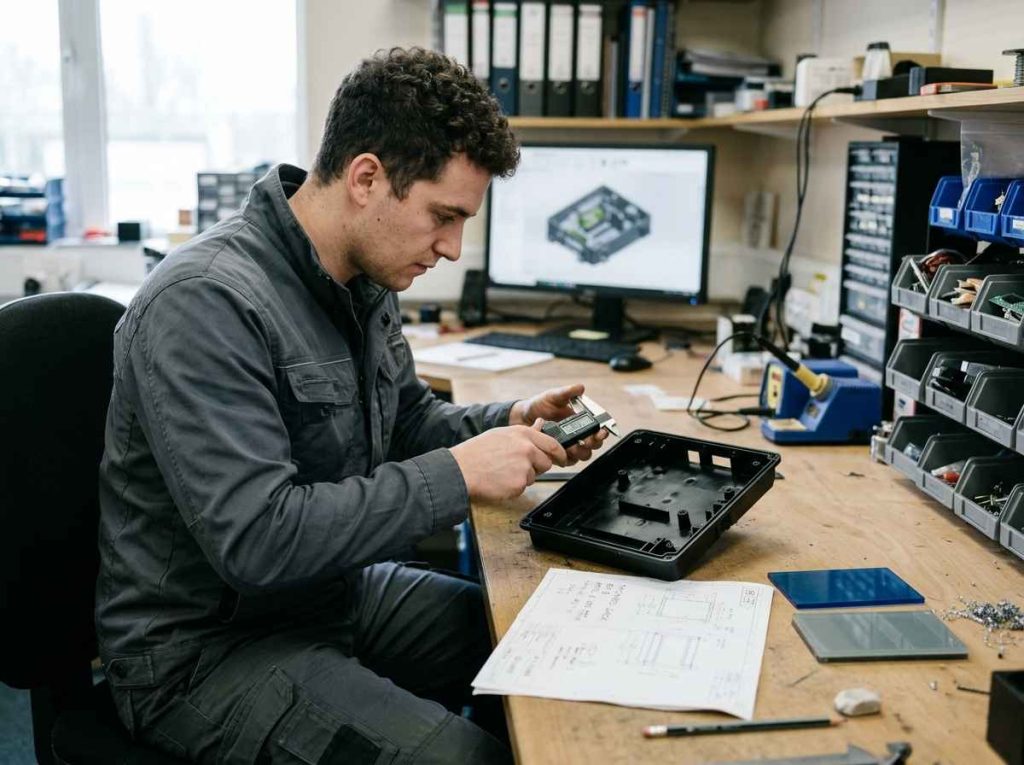
Material and manufacturing process selection is the product development stage in which the requirements of a part become a concrete decision: which material to use and which process to make it with. It ensures the design is tied from the start to a real way of producing it, with predictable in-service behavior and a known cost per part before investing in molds or tooling.
Material and process are not chosen separately. An injection-molded engineering polymer, a machined aluminum alloy or a formed steel sheet offer different properties even when the base material is similar, because the process determines wall thicknesses, tolerances, finish, residual stresses and cost. A glass-fiber-reinforced polyamide, for example, does not have the same stiffness dry as after absorbing moisture, and the fiber orientation left by injection molding changes its strength depending on direction. Market-specific requirements add to this, such as food contact, biocompatibility in medical devices or the substance restrictions of RoHS and REACH in electrical equipment.
The variables studied are mechanical (stiffness, strength, fatigue, wear), thermal (service temperature, expansion), chemical (corrosion, aging, compatibility with fluids) and manufacturing-related (annual volume, geometry, tolerances, finish and tooling cost). They narrow down the candidate families, and the shortlisted alternatives are compared using weighted criteria until a justified recommendation is reached. The order matters: first the non-negotiable requirements are fixed (safety, regulations, maximum temperature), then the ones that allow trade-offs, such as weight or cost, are optimized.
Material and process selection at INFINITIA
At INFINITIA we treat material selection as a decision that has to be demonstrated, not a catalog lookup. We start from the requirements of the part and the product, define comparable alternatives and, when the available information is not enough, design tests that reproduce their real working conditions.
This is how the comparative study of three steels using a set-up that simulated the real wear of the machine was solved. No standard reproduced those operating conditions, so a dedicated test was designed, the wear parameter to measure was defined and the steel was chosen with data obtained under conditions equivalent to service.
When the part is plastic, we combine CAD design with injection molding simulation to anticipate defects before the mold is made. If validation with physical parts is needed, we make prototypes in several materials and tooling for the first samples, as with the molding tool used to validate materials in the first batches of a device.
The outcome is a documented recommendation: the chosen alternative, the rejected ones with the reason for each, the risks that remain open and the pending validation plan. It stays on record so it can be picked up again if a requirement, the volume or the supplier changes later, without repeating the study from scratch.
Benefits of material and process selection for reliable industrialization
Benefits
Cuts the cost per part from the design stage. Material and process set much of the final cost, from raw material to cycle time, finishing and mold amortization. Choosing them with data avoids oversizing the material or paying for a process designed for another volume, and makes it possible to compare the total cost of each alternative (material, process, finish and tooling), not just the price per kilo.
Avoids late redesigns. A part designed for the wrong process ends up with geometry changes when the mold is already under way. Defining the process from the outset allows its design rules to be applied, as in the redesign of plastic components that could not be manufactured because of their wall thicknesses and draft angles.
Extends service life. Choosing the material for the real conditions of use (cyclic loads, abrasion, moisture, chemicals or temperature) reduces the risk of premature failures, claims and downtime. In wear parts or parts exposed to corrosion, the right alloy, treatment or finish makes the difference between replacing the part frequently and keeping it for the whole life of the equipment.
Makes purchasing and approval easier. A well-defined material and process specification makes it possible to request comparable quotes, prepare product approval and keep the same quality when the batch or the manufacturer changes. It also reduces the risk of a supplier change introducing a different material without anyone noticing.
Applications of material and process selection in mechanical development
Types
Choosing material and process is necessary both for new parts and for existing products that need to cut cost, gain durability or change supplier. The approach changes with the starting point and the main risk of the part.
In each case we define what needs to be demonstrated (strength, wear, corrosion, manufacturability or cost) and which tool demonstrates it best: calculation, simulation, prototype or testing under real conditions.
Material selection for new parts
Material selection for new parts starts from a requirements sheet covering loads, temperature, chemical environment, service life, market regulations, aesthetics and expected volume. With that data, the families that do not comply are ruled out and the candidates are compared on properties, availability and cost. At this stage a process is also paired with each material, because an option that is good on properties is ruled out if it requires a process incompatible with the geometry or the volume.
The decision makes it possible to finalize the geometry with real stiffness and strength values, avoid safety oversizing and choose from the outset a material with a stable supply. It is the basis for 3D modeling and the subsequent calculation of the part, and it reduces surprises when the first prototypes arrive.
Choosing the manufacturing process by volume and geometry
Choosing the manufacturing process means comparing routes such as plastic injection molding, machining, sheet metal forming, casting or additive manufacturing according to annual volume, geometric complexity, tolerances and the finish the part requires. The choice shapes the design: uniform wall thicknesses and draft angles in injection molding, tool access in machining or bend radii in sheet metal.
| Process | Volume | Geometry | Tooling | Cost per part |
|---|---|---|---|---|
| Plastic injection molding | Medium to high | High | High | Low |
| Machining | Low to medium | Medium | Low | High |
| Sheet metal | Low to high | Medium | Low to high | Medium |
| Die casting | High | High | High | Low |
| Additive manufacturing | One-off and low | Very high | None | High |
The same component can be cheaper machined in short runs and injection molded above a certain volume, because the mold pays for itself. This comparison avoids investing in tooling that will never be amortized or making every part more expensive with a process designed for prototypes. The next step is design for manufacturing, which adapts the geometry to the chosen process.
Material substitution to reduce cost or weight
Material substitution looks for an alternative to the current material that reduces cost or weight, improves availability or eliminates a restricted substance, without losing performance. It comes up when switching from metal to an engineering polymer, changing between alloys or incorporating recycled material.
A substitute material is only valid once its equivalence in critical properties and in the process has been demonstrated, comparing it with the current one through the same tests and under the same conditions. That is why it is studied together with part optimization and simplification, since a change of material opens the door to integrating functions and reducing the number of components in the assembly.
Wear- and corrosion-resistant materials
When the part works under abrasion, friction, moisture or chemicals, selection focuses on long-term behavior: hardness, heat treatment, coatings and surface finish. Datasheets do not reflect these combined conditions, which are the ones that determine service life. In many parts the surface determines durability more than the base material, so the treatment and the coating are part of the recommendation.
In those cases we compare the alternatives with tests designed for the application (wear under working conditions, accelerated corrosion or electrochemical tests) and by examining the damaged surfaces under scanning electron microscopy. The material and the finish are thus chosen with measured data rather than catalog values.
Injection molding simulation to validate material and process
Plastic injection molding simulation reproduces mold filling and makes it possible to check whether the chosen polymer fills the part, where weld lines, sink marks or air traps appear, and which gate location and process parameters to use. It also helps decide between two candidate polymers, because their different flow and shrinkage change the filling and the final warpage of the part.
Validating material, geometry and process virtually reduces mold iterations, which are the most expensive ones in development. If the simulation detects a problem, it is corrected with changes to wall thickness, gate location or material before the tooling is made, and the part reaches the first mold trial with less uncertainty.
Prototypes and first runs to validate the choice
Prototypes in several materials and first runs made with low-cost tooling make it possible to check the choice with real parts: assembly, hardness, functional behavior and user response. Additive manufacturing and 3D-printed molds shorten this step. When the initial volume is low, the same tooling serves to produce the first batches while the investment in the final mold is decided.
With these samples the final decision is made before ordering the production mold, and a physical reference is obtained to compare the first parts from the chosen supplier. It is the most direct way to confirm that the recommended alternative performs in the part as it did in the analysis.
Sectors where the right material and process reduce risk and cost
Sectors
The priority when choosing material and process changes by sector: weight in automotive and aerospace, durability in machinery, aesthetics and cost in consumer goods, or biocompatibility in medical devices.
The general criteria for comparing materials are explained in the article on how to select a material for an industrial application. In each sector those criteria are weighted differently.
Material and manufacturing process selection in automotive: lightweighting, fatigue and high-volume production
In automotive and mobility, components combine cyclic loads, vibration, thermal cycling and weight requirements, and are produced in volumes that make cost per part and process repeatability decisive.
- Lightweighting: replacing steel with aluminum or reinforced engineering polymers without losing stiffness or fatigue strength.
- High-volume processes: injection molding, stamping or die casting sized for high volumes and stable tolerances.
- Substitute validation: tests that demonstrate the equivalence of the new material, as explained in the article on how a lightweight material is characterized and validated in automotive.
Choosing material and process with service data reduces weight and cost without shifting the risk to vehicle validation.
Material and manufacturing process selection in electronics: enclosures, heat dissipation and restricted substances
In electrical and electronic equipment, the enclosure protects, dissipates heat and insulates, and its material determines sealing, fire behavior and compliance with substance restrictions.
- Thermal management: polymers and alloys with enough conductivity to remove heat from the electronics, or finned geometries that the chosen process can produce.
- Fire behavior: materials with the flame-retardancy rating the product requires.
- Restricted substances: materials compliant with RoHS and REACH from the specification stage.
Defining the material and process of the enclosure at the start avoids redesigns once the equipment is already in certification, when any change of material means repeating tests.
Material and manufacturing process selection in machinery: wear, stiffness and maintenance
In industrial machinery and construction equipment, parts endure abrasion, impacts and high loads over long periods, and a poor choice of steel or treatment leads to downtime and frequent replacements, with a downtime cost higher than that of the part itself.
- Wear resistance: steels, heat treatments and coatings compared under real working conditions.
- Stiffness and weight: balance between sections, material and process in frames and supports.
- Maintainability: wear parts that are easy to make and replace with a standard process.
A selection focused on service life reduces the total cost of the machine, not just the cost of each part.
Material and manufacturing process selection in consumer goods: aesthetics, heavy use and unit cost
In consumer goods and household products, the part has to withstand daily use, keep its appearance and be made at a very tight unit cost, often in large volumes.
- Finish and feel: polymers and surface finishes that keep their appearance against scratching, cleaning and light.
- Cost per part: process and number of mold cavities sized to the real volume.
- Recycled material: incorporating recovered material without compromising strength or aesthetics.
Balancing aesthetics, durability and cost from the selection stage avoids products that look attractive as prototypes but are unviable in production, when unit cost or rejects due to cosmetic defects can no longer be fixed without changing the mold.
Material and manufacturing process selection in medical devices: biocompatibility and sterilization
In medical devices and healthcare equipment, the material is in contact with the patient, drugs or cleaning agents and must keep its properties after repeated sterilization cycles. The process must also avoid contaminants and residues that compromise the cleanliness of the part.
- Biocompatibility: materials assessed under the ISO 10993 series for the type and duration of contact.
- Sterilization resistance: behavior under autoclave, radiation or chemical disinfectants.
- Process traceability: repeatable, documented processes that make device approval easier.
Selecting material and process with approval in mind shortens the path from prototype to certified product and avoids repeating biocompatibility tests because of a late change of material.
Material and manufacturing process selection in aerospace and defense: extreme performance and minimum weight
In aerospace and defense, components work with narrow weight margins, extreme strength, temperature and reliability requirements, and traceability demands throughout the process, from raw material to finished part.
- Strength-to-weight ratio: light alloys, high-strength steels and composites compared by specific performance.
- Extreme conditions: behavior under temperature, vibration, corrosion and thermal shock.
- Qualified processes: precision machining, metal additive manufacturing or composite lay-up with documented control.
A rigorous selection reduces weight without compromising the reliability the sector demands, and documents the reason for each material for audits and customers.
Material and process as the first decision in mechanical development
Value
Material and process determine much of the cost, durability and manufacturability of a product before the first final drawing exists. Choosing them with clear requirements, comparable alternatives and test data produces a technical decision that management, purchasing and suppliers can rely on.
Every alternative ruled out with data is a risk that never reaches production. That is why we combine calculation, injection molding simulation, prototypes in several materials and testing under service conditions, so that the final recommendation rests on measurable evidence rather than industry habit or the proposal of a single supplier. The same logic applies to reviewing existing products, because a part that works may be oversized or made with a process that no longer suits its current volume.
The decision also organizes the rest of the project. With material and process defined, detailed design works to concrete rules, supplier sourcing compares equivalent quotes and approval starts from a closed specification. Even quality control derives from it, because it defines which properties to check when each batch is received. When the product is aimed at a regulated sector (medical, food or electrical), regulatory compliance is built in from the first iteration instead of surfacing as a problem at the end.
If you are defining a new part or want to change the material or process of an existing one, send us the drawings or 3D model, the conditions of use, the expected volume and the target cost. We will return a comparison of alternatives with the recommended option, the risks of each one and the validation plan needed before investing in tooling.
Frequently asked questions about material and manufacturing process selection
FAQs
What does a material datasheet not tell you?
A material datasheet does not tell you how the material will behave in a specific part, because its values are measured on standard test specimens and under test conditions that rarely match those in service. Geometry, process, residual stresses, the combination of temperature and moisture or contact with other materials change the real result.
That is why the datasheet is useful for preselection but not for closing the decision. When the application is demanding, the final comparison between alternatives relies on process simulation, prototypes or tests that reproduce the working conditions of the part.
When in development should material and process be selected?
Material and process are selected at the start of mechanical development, as soon as there are requirements and a product concept, and before the geometry is frozen in CAD. At that point changing option costs very little, whereas doing so with the mold already made means reworking tooling and repeating validations.
The decision is reviewed at each project milestone: after simulation, after prototypes and before launching production. If a test contradicts the initial hypothesis, the material or process is adjusted without carrying the error into production.
How are materials with very different properties compared?
Materials are compared using criteria weighted by their importance in the application: strength, stiffness, density, service temperature, chemical resistance, processability, availability and cost. Property charts show which families meet several requirements at once, such as high stiffness with low weight.
From there, merit indices are calculated for the function of the part and a decision matrix is built with the finalists. The result includes the chosen material and the reason each of the others was rejected, which is what purchasing and quality need to defend the choice.
What is the difference between a standard test and a custom test to validate a material?
A standard test measures a property under standardized conditions and allows materials to be compared with reproducible results. A custom test reproduces the specific conditions of the application when no standard covers them, such as wear combined with impacts or a temperature and humidity cycle specific to the product.
The two are complementary. The standard test rules options out quickly using accepted criteria, and the custom test decides between finalists when the differences only appear in service. Designing it requires knowing the machine or product and defining which parameter to measure so that the result is conclusive.
What does it add compared with using the material the supplier recommends?
It adds an independent decision based on the requirements of the part rather than on the catalog of whoever sells the material or makes the part. The supplier knows its products and its process well, but its recommendation starts from what it has available and from the way it manufactures.
An independent selection compares alternatives from several sources, documents why each one is chosen and makes it possible to request equivalent quotes. That specification then makes supplier sourcing and validation for product development easier and avoids depending on a single source.
When is simulation enough and when is a physical test needed?
Simulation is enough when the question depends on geometry and process and the behavior of the material is well characterized: mold filling, warpage after injection, stiffness or stresses under a known load. It allows many variants to be compared quickly and those that do not work to be ruled out before anything is made.
A physical test is needed when mechanisms that are hard to model come into play, such as wear, corrosion, aging, the combination of moisture and temperature or the behavior of a recycled material. In those cases specimens or prototypes are tested under conditions that reproduce real use, and simulation is reserved for narrowing down which alternatives are worth testing.
How does it help reduce manufacturing costs?
It reduces costs because it matches the material to what the part needs and the process to the real volume. It avoids paying for unused performance, safety oversizing, unnecessary finishes or an oversized mold for a short run.
It also reduces indirect costs: fewer mold iterations, fewer production rejects and fewer claims for premature failures. In existing products, material substitution or a process change, combined with part simplification, lowers cost without redesigning the product from scratch.
How much does a material and process selection study cost?
The cost depends on the number of parts to study, how many alternatives need comparing and whether the decision can be made with analysis and simulation or needs prototypes and testing under service conditions. A selection based on technical analysis has a smaller scope than a custom test campaign.
To give you a firm quote, send us the drawings or model of the part, its requirements and the expected volume. With that information we will propose the minimum scope needed to decide with confidence, without tests that add no information.
How long does it take to get a material and process recommendation?
Typical lead times are between 1 and 4 weeks, depending on the complexity of the part, the number of alternatives and whether the comparison requires prototypes or long-duration tests. An analysis based on requirements, calculation and simulation sits at the lower end of that range.
To fine-tune the lead time, tell us what phase your project is in and which decisions depend on the selection. That way we plan the tests in parallel with the design, and the recommendation arrives before the geometry is frozen or the mold is ordered.
At what volume does an injection mold pay off?
An injection mold pays off when the saving per part compared with another process, multiplied by the expected volume, exceeds its cost and the cost of its adjustments. That break-even point is not a fixed number: it depends on the size and complexity of the part, the number of cavities, the material and the tolerances the design requires.
Below that volume there are alternatives such as machining, additive manufacturing or low-cost molds for first runs, which make it possible to validate the product and its market before investing in the final tooling. Calculating that break-even with real data from the part is part of choosing the process.
Why does the problem come back after changing material?
The problem comes back when the change of material does not address the real cause, which may lie in the process, the geometry or poorly defined conditions of use. Replacing one polymer with a stronger one does not fix a badly placed gate, a radius that is too small or an unidentified chemical attack.
That is why selection is approached together with process and geometry, and each alternative is validated before the final change. Producing short runs through prototyping and prototype manufacturing makes it possible to check that the new material solves the problem in the real part.
What do I need to send to start a material selection?
To start, we need the drawings or 3D model of the part, a description of its function and conditions of use (loads, temperature, chemical environment, expected service life), the expected annual volume and the target cost. If there is a previous version, its current materials and the problems detected provide a lot of information.
Send us whatever you have, even if it is incomplete: after a first review we will tell you what data is missing, which alternatives make sense and whether the decision requires prototypes and tests. The article on the tests that confirm the equivalence of a substitute material summarizes that approach.