

Appearance prototypes
Appearance prototypes are physical models that reproduce the shape, color and finish of a product as it will look in production, used to evaluate its design, show it to customers or investors and test it with users before molds are made.
Within our product development service, appearance prototyping takes a CAD design or an approved render to a part that can be touched, photographed and displayed. We make the parts with high-resolution 3D printing, post-process, paint and assemble them until they come close to the look of the final product, even when real electronics or mechanisms have to be integrated.
A render is convincing on screen, but it does not show how the product is perceived in real light, in the hand or next to other objects. When those defects of proportion, color or finish are discovered once the mold has been made, correcting them means reworking tooling and delaying the launch.
Talk to a specialist
Request a free initial consultation; contact a consultant from our team of specialists

What are appearance prototypes?
What is it?
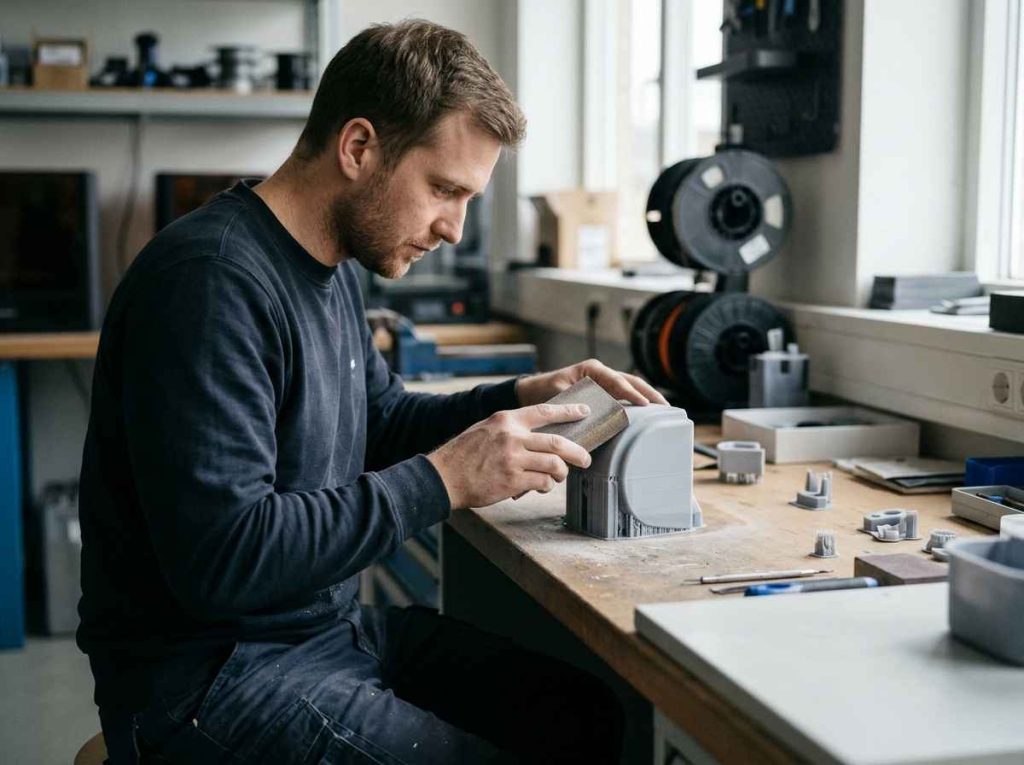
An appearance prototype is a physical model that reproduces the external geometry, proportions, color and surface finish of a product, even if it does not work inside or only works in part. It serves to evaluate the industrial design with the object in front of you, present it outside the engineering team and gather the reaction of users and customers before committing the investment in tooling. It is a decision-making and communication tool as well as a display piece.
Also known as a looks-like model, it differs from the functional prototype, which prioritizes moving mechanisms and fitting parts even if its appearance is provisional, and from the low-fidelity mockup, which only represents volume. In product development it comes after CAD modeling and the first renders, when the shape is defined and it is worth checking it physically before the molds are released. It is often the first time the team, management or the customer see the product at full size.
An appearance prototype works on the external geometry and visible part breakdown, the joints and parting lines, the color, gloss and texture of each surface, and the look of materials such as metal, wood or clear plastic. It is made with 3D printing, post-processed to remove layer lines, primed, painted and assembled until it achieves a look close to that of the production product.
Appearance prototyping at INFINITIA
We start from the CAD model and prepare it for manufacturing: we split the assembly into parts according to the print size and the position of the joints, hide the seams and leave extra material where there will be sanding. That way the part breakdown of the prototype follows the lines the production product will have and adds no cuts where there will be none.
Visible parts are printed in high-resolution resin, which gives clean edges and smooth surfaces, as in the aesthetic prototype made with 3D printing to present a new product at a trade fair, where large parts were printed and the product hardware was integrated into the housing.
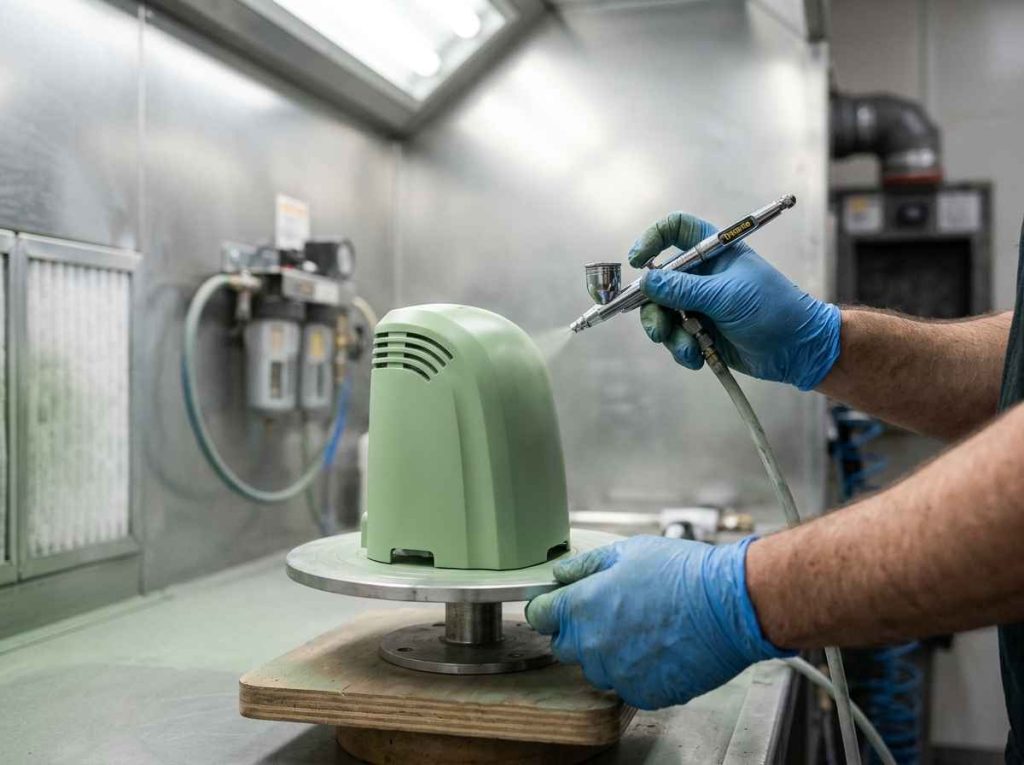
Then comes the finish: mechanical post-processing to remove layer lines, priming and airbrush painting with the reference color, gloss and texture. When the prototype has to work in part, we integrate real components, such as electronics or mechanisms, inside the aesthetic housing.
We deliver the prototype assembled and ready to be handled, photographed or shipped, together with a record of the colors and finishes applied. That record then serves as a reference to specify to production suppliers the color, gloss and texture that the team has already approved on the prototype.
Benefits of an appearance prototype in product development
Benefits
Makes it possible to validate the design with the product in hand before investing in molds. Proportions, colors and finishes that looked right in the render are reviewed in real light and at full size, and changes are made on the CAD model rather than on tooling that has already been built.
Improves the quality of user testing. When someone handles a crude part, they comment on the flash or the layer lines rather than on the product idea. With a prototype that looks final, opinions focus on what needs evaluating: size, shape, color and perceived quality.
Supports management and investment decisions. A finished object conveys the project better than a presentation, as with the functional and aesthetic demonstrator to launch a new product line, with which the management of the client assessed functionality and aesthetics before approving industrialization.
Brings the commercial launch forward. The product can be displayed at a trade fair, photographed for a catalog or shown to distributors before production exists. Unlike product rendering, it can be touched, photographed in real light and shown alongside other products in the range.
Types of appearance prototype by purpose
Types
Not every appearance model needs the same level of finish. A mockup to decide proportions can stay at the shape stage, while a model for a trade fair or a photo shoot has to look like the production product up close and under any light.
We choose the type according to the question it has to answer and who will see or handle it. Matching the finish to that purpose avoids spending on detail where it adds nothing and falling short where the perception of the product is at stake.
Form and volume mockup
A form mockup reproduces the external geometry and proportions of the product without color or final finish, usually in a single material and with the surface barely post-processed. It is the quickest option to assess size, volume and how the product is held or placed while several design proposals are still being compared.
It serves to choose between concepts and fix proportions before investing in finishes. Because its cost is low, several versions can be made and compared side by side, and the decisions that come out of them are carried over to CAD before moving to a high-fidelity model. A shape discarded at this stage never gets painted or assembled.
High-fidelity appearance prototype
A high-fidelity prototype reproduces the product with its final color, gloss, texture and part breakdown, so that at close range it can be mistaken for a production unit. It combines 3D printing with careful post-processing and painting, and the choice of technology depends on the detail and size of each part.
| Criterion | Resin | Filament (FDM) |
|---|---|---|
| Detail and edges | High | Medium |
| Surface before finishing | Smooth | Visible layers |
| Post-processing needed | Low | High |
| Cost per part | Medium | Low |
| Typical use | Visible parts | Hidden volumes |
It is the model for presentations, photography and final validation of the industrial design. The table summarizes the differences between the two printing families most used in this type of prototype; in practice they are combined, with resin for visible parts and extrusion for volumes or hidden structures, to balance finish and cost in each part of the assembly.
Appearance and functional prototype
An appearance and functional prototype combines the final look with part of the operation: screens that light up, buttons that respond or mechanisms that can be actuated. It requires designing the aesthetic housing to hold real components, with their fixings, their wiring and the access needed to assemble them without them being visible from outside. The challenge is for functional integration to alter neither the proportions nor the joints of the design.
It is the format that brings the experience closest to the final product and the one used when the product has to be demonstrated in use. It fits the approach of the minimum lovable product, which aims for a first version that works and is also attractive to the user.
Color, material and finish samples
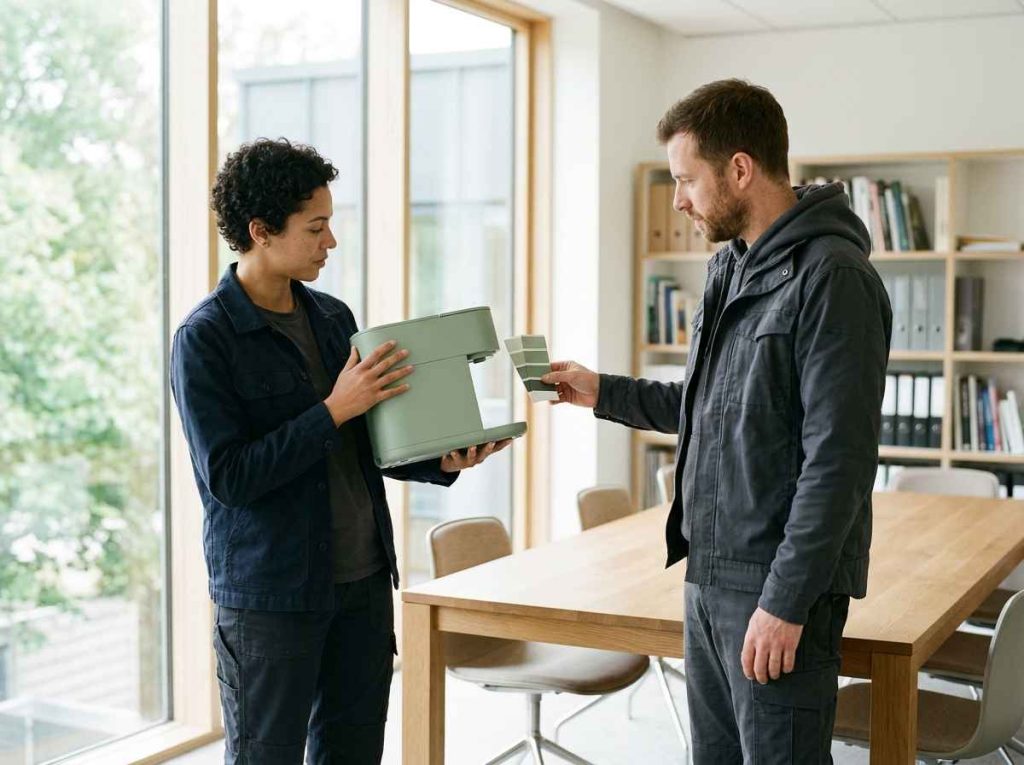
Color, material and finish samples are small parts or panels with different combinations of color, gloss and texture, prepared before the complete prototype is finished. They make it possible to compare options in natural and artificial light, next to the materials the product will sit alongside, which is how the end customer will see it. The same paint can look very different from one light to another.
They serve to close the aesthetic specification without repainting the whole prototype at each iteration. The chosen combination is then applied to the high-fidelity model and remains as a reference for asking production suppliers for the color and texture that have already been approved.
Prototypes for user testing
Prototypes for user testing are made for people to handle: pick them up, position them, open lids or read indicators. Their finish has to withstand repeated use during the sessions, and their weight and feel have to come close to those of the final product wherever they affect perception. Otherwise, opinions drift towards what is provisional about the part.
They provide answers on perceived size, apparent quality and understanding of the product that a render or a survey cannot give. Several versions with small differences in shape or color make it possible to compare preferences using common criteria and to bring into the design changes backed by the real reaction of users.
Prototypes for trade fairs and photo shoots
Prototypes for trade fairs and photography have to withstand transport, setup and hours on display without losing their finish. They are designed with sturdy joints, mounting points similar to those of the real product and surfaces prepared for the lighting of a stand or a studio, where any defect is more noticeable than in a meeting room.
They make it possible to present the product before production exists and to obtain real photographs for catalogs, websites or sales material. Their preparation includes checking every surface under the expected lighting and planning how the prototype will be fixed to the display or next to other products, so that it arrives and stays in good condition throughout the event.
Industrial sectors where appearance models add the most
Sectors
Appearance models add the most where aesthetics weigh on the purchase decision or on the acceptance of the product: consumer goods, electronic devices, medical equipment and packaging.
Also in capital equipment and automotive, where a cover or a visible part conveys the quality of the whole and is usually presented at trade fairs before production exists.
Appearance prototypes in consumer goods: color, finish and perceived quality
In household appliances, kitchenware and small domestic devices, color, gloss and feel decide much of the purchase, and the product is compared in store with others that are very similar.
- Perceived quality: joints, gloss and textures that the buyer judges in a few seconds, in the store or when opening the box.
- Color variants: comparison of color and finish ranges before choosing which ones go into production.
- Product photography: real images for the catalog, packaging and online store before launch.
A high-fidelity appearance prototype makes it possible to decide the range of colors and finishes with the product in hand and to launch the sales campaign while industrialization is under way.
Appearance prototypes in electronics: housings, screens and indicators
In professional and consumer electronic devices, the housing is the first thing the customer sees and has to hold boards, screens, connectors and buttons without losing clean lines or leaving visible joints out of place.
- Integration: housing real screens, buttons and connectors in the aesthetic enclosure, with their fixings.
- Indicators: translucent areas, pilot light illumination and legibility of symbols and markings.
- Visible part breakdown: position of joints, screws, vents and access covers on the visible faces.
Combining an aesthetic housing with real electronics in the same prototype makes it possible to present the device switched on and validate both its appearance and the integration of its components, before ordering the housing molds.
Appearance prototypes in medical devices: trust, cleaning and use
In medical devices and laboratory equipment, appearance conveys reliability and hygiene, and the design has to make cleaning easy and handling clear for professionals or patients, who are often wearing gloves.
- Perceived reliability: continuous surfaces, closed joints, understated colors and no sharp edges.
- Cleaning: shapes without crevices where dirt can build up and surfaces that withstand routine cleaning.
- Use: legibility of indicators and understanding of the controls during testing with professionals and patients.
A prototype that looks final makes it possible to gather the opinion of professionals and patients on shape and handling at a stage when changing the design is still cheap and before it is frozen.
Appearance prototypes in automotive and mobility: visible parts and accessories
In automotive and mobility, visible parts, accessories and personal mobility vehicles are judged by how they fit with the whole and by the perceived quality of joints, textures and gloss.
- Fit with the whole: continuity of lines and apparent gaps with the neighboring parts of the assembly.
- Textures: approximation to the grains, gloss levels and colors of the production parts it sits alongside.
- Presentation: models for trade fairs, customer presentations and design reviews with the complete assembly.
An appearance prototype makes it possible to review a visible part alongside the rest of the real assembly and adjust its shape or finish before the production tooling is launched, while the change is still simple.
Appearance prototypes in machinery: covers, control panels and brand image
In machinery and capital equipment, covers and control panels give the machine its image and are usually what is seen at a trade fair or on a plant visit, even though they account for a small part of the cost.
- Covers: shape, corporate color, continuity between panels and position of vents and logos.
- Control panel: layout of screens, push buttons, emergency stops and signage.
- Trade fairs: light, transportable models that represent the machine without building all of it.
A prototype of a cover or a control panel makes it possible to validate the image of a new machine and present it at trade fairs without waiting to build the first complete unit.
Appearance prototypes in the food industry: packaging, dispensers and shelf presence
In the food sector, packaging, dispensers and displays compete on the shelf or at the point of sale, and their shape, color and opening influence the choice of the consumer.
- Shelf presence: size, proportion and visibility of the packaging compared with competing products.
- Opening and handling: how the product is held, opened, dosed and served at home or at the point of sale.
- Variants: comparison of colors, formats and closures before ordering the molds.
An appearance model makes it possible to evaluate packaging or a dispenser on a real shelf or in consumer tests before investing in production molds and in adapting the packaging lines.
The look of the product, decided before the molds are made
Value
Every change of shape, color or finish decided on the prototype is a mold modification that will not be needed. A model that looks final makes it possible to close the industrial design with users, management and customers at the same time, with the product in front of them and while it can still be modified in CAD.
An appearance prototype adds most when it is planned around a clear question: what needs to be decided and who needs to see it. An aesthetic mockup reproduces shape and finish, but it does not confirm strength or operation, as explained in the article on what a functional prototype does and does not validate. That is why we define its scope together with the other prototypes in the project, so that each one answers its own question and none is made twice. The appearance prototype covers perception, while the functional prototype and the tests cover strength and behavior.
Matching the fidelity to the purpose is also the way to control cost: simple mockups to choose proportions, samples to close colors and a single high-fidelity model to present. The choice of each technology follows the criteria in the article on prototyping technologies by tolerance and lead time, with finish as the main variable. That way the budget is concentrated on the surfaces that will be looked at and touched, which are the ones that decide how the product is perceived.
If you have a CAD design or approved renders and need to show the product, test it with users or take it to a trade fair, send us the model, the color and finish references and the date you need it by. We will propose the right part breakdown, technology and level of finish, and deliver the prototype assembled, together with the record of colors and finishes applied so that it can be carried over to production.
Frequently asked questions about appearance prototypes
FAQs
What can an appearance prototype not validate?
An appearance prototype does not validate the strength, stiffness, sealing or thermal behavior of the production product, because printed and painted parts do not have the internal structure or the properties of the injection-molded or machined material. Nor does it confirm that the parts can be mass-produced with that design.
What it does validate is what is perceived: shape, proportions, color, gloss, texture and apparent quality. For everything else, functional prototypes, tests on the real material and a design for manufacturing review are needed before the molds are launched.
When is an appearance prototype better than a render?
It is better when the decision depends on how the product is perceived in reality: its size in the hand, its gloss in natural light, its texture to the touch or its presence next to other products. A render is faster and cheaper for iterating shapes and colors on screen, but it does not convey weight, scale or tactile quality.
The usual approach is to use both in order: renders to explore and discard options, and an appearance prototype to validate the chosen one and present it. That way the prototype is made on a mature design and with fewer repeats.
Can an appearance prototype also be functional?
Yes, provided the housing design allows from the start for the space, fixings and access needed for the real components. It is common to integrate electronics, screens or simple mechanisms into a prototype that looks final in order to demonstrate the product in use.
If what needs validating is mainly the operation, the effective route is to start with a minimum viable prototype and leave the finish for later. Combining both goals in a single piece makes sense when the function is already solved and has to be shown with the final image, for example at a trade fair.
How close is an appearance prototype to the final product?
Visually, a high-fidelity prototype can be very close to the production product: shape, color, gloss and part breakdown reproduce the design. The differences appear mainly in weight, in the feel of some materials and in mold textures that paint can only approximate.
That is why it is worth agreeing beforehand which aspects must be identical and which only need to be represented. If weight or feel affect perception, ballast can be added or other materials chosen in the areas that people will touch.
How are production colors and textures reproduced?
The color is matched from the references defined in the design or from a physical sample supplied by the customer, and applied with airbrush painting to control thickness and gloss. Textures are approximated with primers, textured paints or surface treatments before painting.
When there are doubts between several options, small samples are prepared first and compared in natural and artificial light next to the neighboring materials. The chosen option is applied to the complete prototype and documented so that production suppliers can reproduce it.
Can a large appearance prototype be made?
Yes. Large parts are printed in one piece when they fit in the build volume, or split into sections that are joined and refinished so that the joint is not visible. The position of those cuts is decided in CAD, taking advantage of the parting lines the real product will have.
In very bulky assemblies, technologies are combined: high-resolution resin for visible and detailed parts, and filament printing for internal structures or areas that will remain hidden. This keeps cost under control without giving up the finish where people look.
Can several units or color versions be made?
Yes. Several units of the same prototype are useful for simultaneous trade fairs, parallel user tests or shipments to different customers, and color versions make it possible to compare ranges before choosing the one for production. Each additional unit costs less than the first, because the part breakdown and preparation are already done.
If the aim is to compare concepts at the start of the project, a few simple mockups are usually enough; the article on the low-fidelity prototype explains which questions they answer, when they fall short and why it is worth leaving the finish until the end.
How is a prototype prepared for a trade fair or for shipping?
The joints and the points where the prototype will be held or fixed are reinforced, the most exposed painted areas are protected and a mounting system similar to that of the real product is provided to place it on the display. Before delivery, every surface is checked under lighting similar to that of the stand.
It is also worth planning the packaging and the assembly at the destination, especially if the prototype is taken apart for transport. A prototype designed for display withstands hours of handling better and arrives in good condition at its destination.
How much does an appearance prototype cost?
The cost depends on the size and number of parts, the level of finish, the number of colors and textures and whether functional components have to be integrated. A model for close-up photography requires more hours of post-processing and painting than a mockup to assess proportions, and each additional color adds preparation and painting time.
To give you a firm figure we need the 3D model and to know what you will use the prototype for. Send us the CAD model or renders and the finish references, and we will prepare a proposal with the part breakdown, the technologies and the recommended level of finish.
How long does it take to get an appearance prototype?
Typical lead times range from one to four weeks depending on the size, the number of parts and the level of finish. Printing is fast; what takes longest is post-processing, painting with its drying times between coats and the final assembly of all the parts.
If the prototype has to be ready for a specific trade fair or meeting, tell us the date from the start. With it we plan the part breakdown and the manufacturing sequence and tell you what level of finish is realistic within that time.
What do I need to send to get started?
Send us the 3D model in a standard CAD format, such as STEP, the renders or reference images of the look you are after and the color and finish references for each part. Also tell us what you will use the prototype for (photography, trade fair, user testing or internal presentation) and whether it has to withstand transport or frequent handling.
If you want the prototype to integrate real components, add their dimensions or send us the parts. With that information we define the part breakdown, technologies and finishes, and confirm lead time and budget before we start manufacturing the parts.
What if I do not have a 3D model of the product yet?
The first step is to define the geometry through 3D design and modeling using CAD, from sketches, renders, 2D drawings or existing parts. An appearance prototype faithfully reproduces what is in the model, so any lack of definition in the design ends up visible in the physical part.
If the model is prepared with the prototype already in mind, with joints, wall thicknesses and part breakdown well defined, manufacturing is faster and the finish is better. Tell us what material you are starting from and we will propose how to get to the model and the prototype.