
The characterisation of lightweight materials in automotive is the disciplined process of measuring, comparing and confirming that a lighter material can genuinely replace a heavier one in a specific component without losing structural performance, durability or safety. Reducing vehicle mass has become one of the central engineering objectives of the sector, driven by tighter emissions limits, the pursuit of lower fuel consumption and the need to offset the considerable weight of electric-vehicle batteries. Yet swapping a proven material for a lighter alternative is never a simple substitution: it is an engineering decision that must be supported by data. It sits within the broader technological innovation in materials for automotive.
Behind every successful weight reduction there is a rigorous sequence of tests, comparisons and validation steps. A lighter material may look attractive on a datasheet, but a component sees real loads, vibration, temperature swings, corrosive environments and years of service.
MATERIAL CHARACTERISATION
Do you work with lightweight materials to reduce a vehicle weight? Discover our material characterisation service

Why lightweighting matters in automotive
Weight reduction, commonly referred to as lightweighting, is the deliberate use of lighter materials or optimised designs to lower the mass of a vehicle or one of its components while maintaining the required function. In automotive engineering it is not a cosmetic exercise: every kilogram removed influences fuel consumption, tailpipe emissions, driving dynamics and, in electric vehicles, the driving range achievable from a given battery. Because the pressures pushing manufacturers toward lighter structures are regulatory, economic and competitive at the same time, lightweighting has moved from a niche optimisation to a core part of vehicle development.
Understanding why the industry invests so heavily in lighter structures is the first step before discussing how those materials are tested. The motivation shapes the requirements, and the requirements define which properties must later be characterised and validated. The following two sections examine the drivers behind weight reduction and the material families that engineers weigh against one another.
Why reducing weight drives emissions, consumption and EV range
Reducing the mass of a vehicle lowers the energy required to accelerate it, to carry it up a gradient and to keep it moving, which translates directly into lower fuel consumption in combustion vehicles and reduced energy draw in electric ones. A lighter body allows smaller braking systems, reduces stress on suspension components and improves the responsiveness of the vehicle, so the benefits ripple through the whole design. This is why lightweighting automotive components is treated as a system-level objective rather than an isolated tweak to a single part.
In electric vehicles the argument becomes even more compelling. A battery pack adds substantial mass, and that mass penalises range, the single most scrutinised metric of an electric car. By removing weight elsewhere in the structure, engineers can offset part of the battery penalty and recover range without enlarging the battery itself, which would only add further cost and weight. Lightweighting therefore acts as a lever that improves efficiency, dynamics and, increasingly, the sustainability profile of the product.
Every kilogram removed from a vehicle reduces the energy needed to move it, which is why weight reduction improves fuel consumption in combustion cars and directly extends the achievable range of electric vehicles, where battery mass is the dominant penalty on efficiency.
These advantages, however, are only real if the lighter component performs as reliably as the part it replaces. The connection between ambitious weight targets and disciplined engineering is a recurring theme in technological innovation across the mobility sector, where advances in materials are inseparable from advances in how those materials are verified.
The lightweight material families and their trade-offs
The materials considered for weight reduction fall into a handful of families, each with distinct strengths and limitations. Advanced high-strength steels, known as AHSS, offer very high strength for their thickness, allowing thinner sections that save weight while remaining familiar to existing manufacturing lines. Aluminium alloys are considerably lighter than steel and resist corrosion well, but they behave differently under load and require adapted joining methods. Magnesium alloys are lighter still, attractive for housings and brackets, yet they demand careful attention to corrosion and to their behaviour at elevated temperatures.
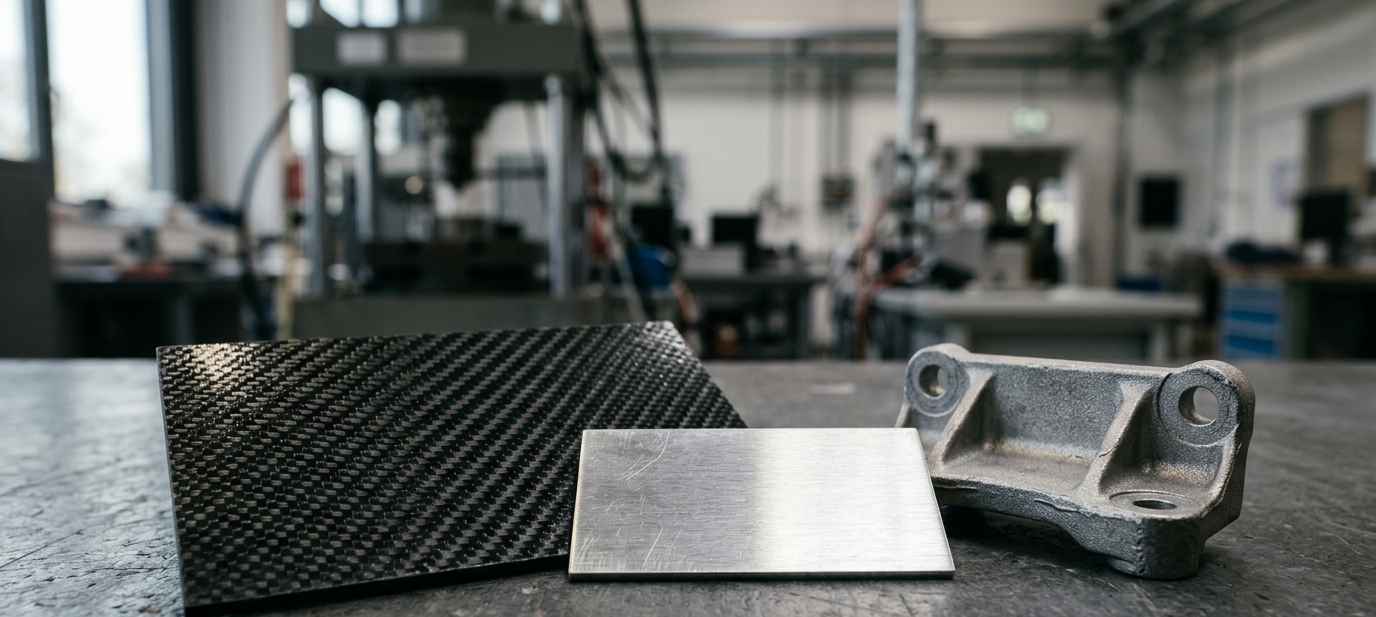
Composite materials expand the options further. Carbon-fibre reinforced polymers, or CFRP, deliver exceptional stiffness and strength for very low mass, which makes them appealing for structural and high-performance applications, though their cost and processing complexity remain significant. Glass-fibre reinforced polymers, or GFRP, provide a more economical composite route with good mechanical properties for less demanding parts. Reinforced technical thermoplastics, filled with glass or mineral fibres, are widely used for brackets, housings and semi-structural elements because they combine low weight with design freedom and recyclability.
No single family wins on every criterion. A CFRP panel may be extraordinarily light and stiff but expensive and hard to repair; an aluminium bracket may save weight yet introduce galvanic corrosion risk when bolted to steel; a magnesium housing may cut mass but behave poorly in a specific thermal environment. Selecting the right candidate is a balancing act between mechanical performance, cost, manufacturability, joining, durability and end-of-life recycling. Because these trade-offs are so component-specific, the decision to substitute one material for another must be grounded in measured data rather than general reputation.
Why a substitute material is not a drop-in swap
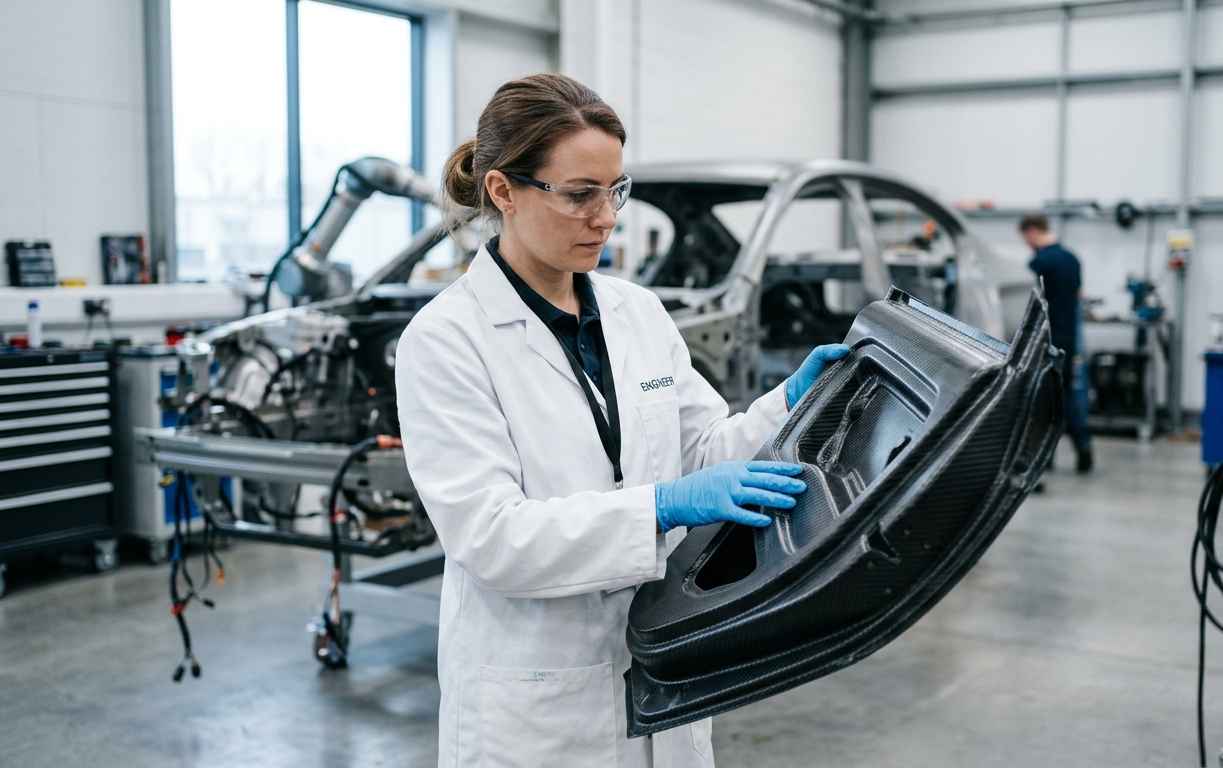
A drop-in swap is the mistaken assumption that a lighter material can simply take the place of a heavier one because it appears comparable on paper. In reality, two materials that share a similar strength value on a datasheet can behave completely differently once shaped into a component and subjected to service conditions. Replacing steel with aluminium, or a metal with a composite, changes stiffness, fatigue behaviour, thermal response, corrosion tendencies and the way the part absorbs impact. Ignoring these differences is how weight reduction turns into premature failure.
To substitute a material responsibly, an engineering team must first define what the component actually has to do, then characterise the candidate against every relevant requirement. This is where the characterisation of lightweight materials in automotive becomes indispensable: it converts assumptions into evidence. The next two sections describe which properties must be assessed and the laboratory techniques used to measure them.
What must be characterised to validate a lightweight substitute material
To validate a lightweight substitute material, engineers must characterise a broad set of properties, because a component is rarely limited by a single one. Static mechanical properties, such as tensile strength, yield strength and elongation, establish how the material responds to steady loads. Fatigue behaviour describes how it withstands millions of load cycles, which is critical for suspension parts and structural reinforcements that flex continuously in service. Impact and crash performance determine how the material absorbs energy in a collision, a decisive factor for any part contributing to occupant safety.
Beyond raw strength, specific stiffness, meaning stiffness relative to weight, often governs whether a lightweight design truly performs, because a part that saves mass but flexes excessively is unacceptable. Thermal properties matter for components near the powertrain, the brakes or the battery, where materials must retain their behaviour across a wide temperature range. Corrosion resistance and galvanic compatibility become central whenever dissimilar materials are joined, since an electrochemical mismatch can quietly degrade a joint over years. Ageing and durability confirm the material keeps its properties throughout the vehicle life, while noise, vibration and harshness, abbreviated NVH, affect perceived quality and comfort.
Two materials with the same strength on a datasheet can behave very differently in a real component, because service performance depends on stiffness, fatigue, impact behaviour, thermal response and corrosion, not on a single headline number.
Assessing this full property map is the essence of rigorous material characterisation, and it is also the foundation of any credible product improvement effort aimed at lighter, better parts. Only when each requirement has been measured can an engineer say with confidence that a substitution is sound.
Characterisation techniques that turn assumptions into data
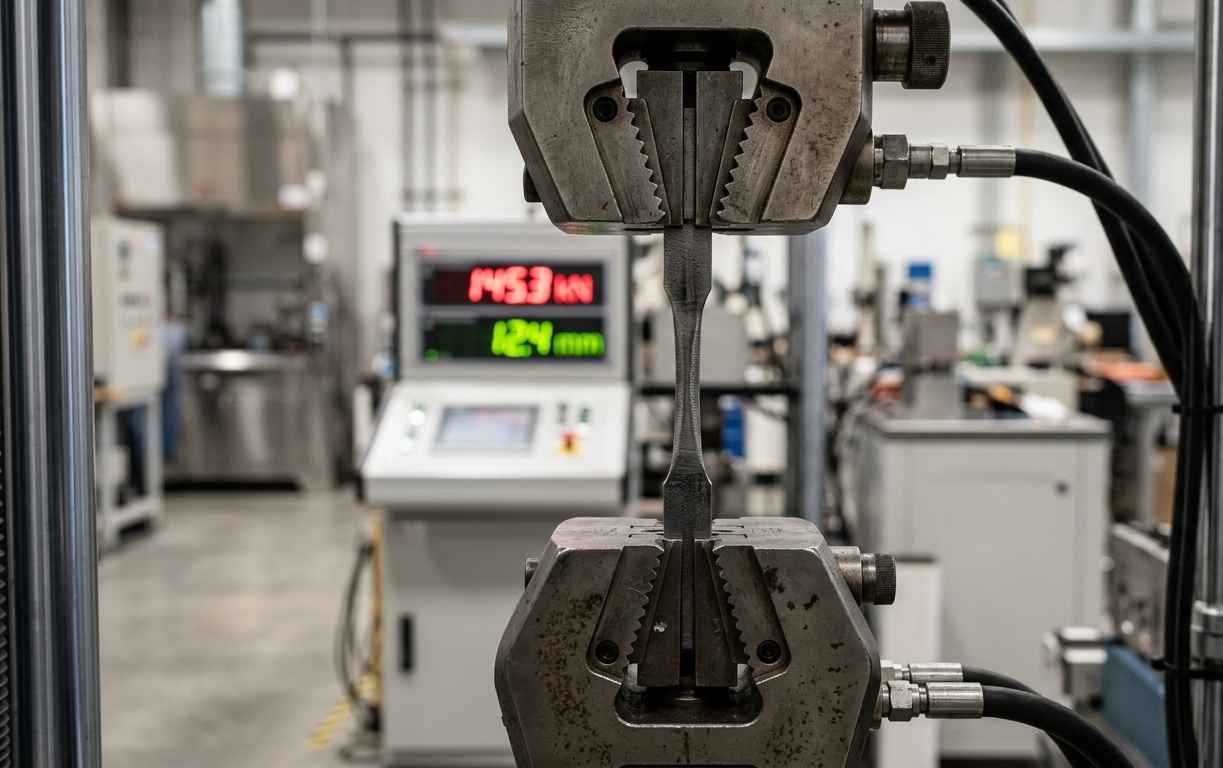
The characterisation techniques used to evaluate a candidate material span chemistry, mechanics, thermal analysis and microscopy, and together they build a complete picture of behaviour. Chemical composition is confirmed with methods such as X-ray fluorescence, XRF, or optical emission spectrometry, OES, ensuring the material actually matches its specification. Tensile testing, carried out to standards such as ISO 6892, measures strength and ductility, while hardness testing provides a fast indicator of mechanical condition. Fatigue testing subjects samples to repeated loading to establish endurance, and Charpy or Izod impact tests quantify how much energy the material absorbs before fracturing.
For polymers and composites, thermal analysis is essential. Differential scanning calorimetry, DSC, reveals transition temperatures and thermal events, thermogravimetric analysis, TGA, characterises composition and thermal stability, and dynamic mechanical analysis, DMA, describes how stiffness and damping change with temperature and frequency, which is directly relevant to NVH. Microscopy and metallography expose the internal structure, revealing grain size, fibre orientation, porosity or defects that influence performance. Corrosion resistance is assessed through salt-spray testing to standards such as ISO 9227, which accelerates the environmental attack a part would experience over years of exposure.
Each technique addresses a specific question, and the value comes from combining them into a coherent evidence base. Metallic candidates draw on established methods for testing of metallic materials and alloys, while fibre-reinforced parts rely on dedicated composite materials testing to capture anisotropic behaviour that simple metal tests cannot describe. A practical example of this discipline is documented in a project on custom thermal conductivity testing in polymers, where measured data defined new material requirements rather than relying on generic assumptions.
TELL US ABOUT YOUR CASE
Do you have a lightweight material to characterise or compare? Send us your case and we will propose a tailored characterisation plan
Joining, validation and homologation of lighter structures
Characterising a material in isolation is necessary but not sufficient. In a real vehicle, lightweight parts must be joined to their neighbours, must survive as an assembly, and must ultimately be approved against automotive quality requirements before entering production. Two challenges dominate this final stage: how to connect dissimilar materials reliably, and how to prove, through a traceable validation and homologation process, that the substituted component performs as intended over its whole life.
These challenges are where many well-intentioned weight-reduction projects encounter difficulty, because a material that tests beautifully as a coupon can behave differently once welded, bonded, riveted or bolted into a structure. The sections below address the joining of dissimilar materials and the validation and homologation framework that gives an approved substitution its credibility.
The challenge of joining dissimilar materials
Joining dissimilar materials is the task of connecting parts made from different material families, such as an aluminium panel to a steel frame or a composite reinforcement to a metal bracket, in a way that is strong, durable and safe. It is one of the hardest problems in lightweighting because the classic solution, welding, often does not work between incompatible materials, and even when it does it can create brittle zones or residual stresses. As a result, engineers increasingly rely on structural adhesives, self-piercing riveting and mechanical fasteners, frequently in combination, to build reliable multi-material assemblies.
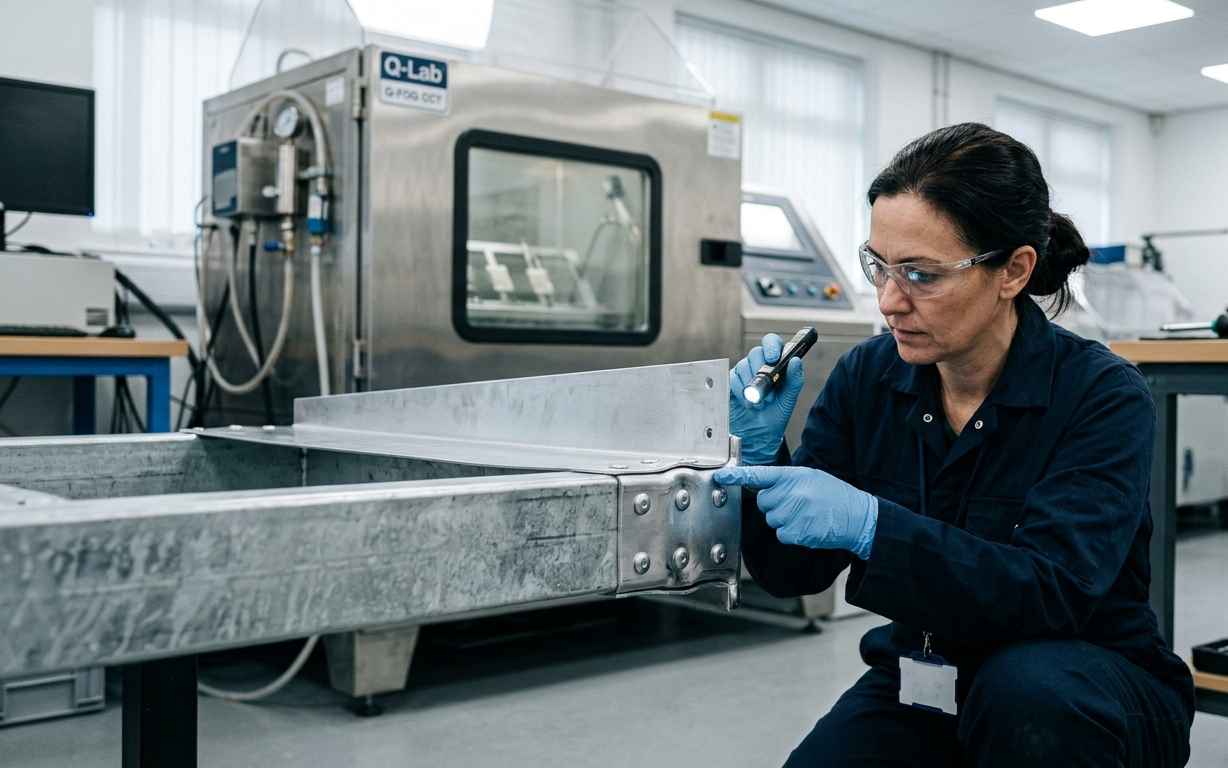
Every joining method introduces its own considerations. Structural adhesives distribute load over a wide area and tolerate dissimilar materials well, but their performance depends on surface preparation, curing and long-term ageing, all of which must be characterised. Self-piercing riveting joins layers mechanically without melting them, which suits aluminium and mixed stacks, yet the joint strength must be validated for each material combination. Above all, joining dissimilar metals raises the risk of galvanic corrosion, an electrochemical process in which contact between two different metals in the presence of moisture accelerates the corrosion of one of them. Preventing it requires careful material selection, coatings, isolation layers and validation through corrosion testing.
Galvanic corrosion occurs when two different metals are in electrical contact in the presence of moisture, accelerating the deterioration of the less noble metal, which is why joining dissimilar materials in lightweight structures demands deliberate isolation and corrosion validation.
Recycling adds a further dimension. Multi-material assemblies that are difficult to separate at end of life can complicate recovery, so designers increasingly consider disassembly and material compatibility from the outset. Some weight-reduction routes sidestep joining altogether by redesigning a part for additive manufacturing, as shown in a case on reducing component weight through 3D printing, where consolidating several parts into one both cut mass and removed joints.
That galvanic risk is one of the causes of warranty failures from corrosion in multi-material joints, a recurring problem when aluminium and steel are combined without isolating the joint.
Validation, simulation correlation and homologation
Validation is the structured process of demonstrating, through a traceable plan of tests and analyses, that a substituted component meets every performance and safety requirement before it is approved for production. It goes beyond characterising the raw material: it evaluates the finished part, in its real geometry, under representative loads, and confirms that results are repeatable. A robust validation plan defines what will be tested, how, to which standards and against which acceptance criteria, so that the evidence is auditable rather than anecdotal.
A central element of modern validation is correlation with simulation. Finite element analysis, FEA, predicts how a component will behave under load, but its predictions are only trustworthy when they match physical test results. By correlating measured data with simulated behaviour, engineers gain confidence to explore design variants virtually while grounding the analysis in reality. Repeatability is equally important: a property confirmed once may be coincidental, whereas a property confirmed consistently across samples is dependable. This discipline sits within the automotive quality framework defined by IATF 16949, and by supplier requirements from bodies such as the VDA, which expect documented, traceable evidence for every safety-relevant decision.
Skipping or shortcutting this process carries real consequences. A substitution validated only on paper can lead to premature failure in service, compromised crash performance, or field problems that end in costly recalls and reputational damage. The purpose of validation and homologation is precisely to catch these risks before production, converting a promising lightweight candidate into a component that can be trusted. This is where an analytical criterion independent of the part’s manufacturer often adds value, bringing independent testing capability and a structured plan that links material data, component behaviour and simulation into a single defensible chain of evidence.
| Validation level | What is verified | Example tests | Objective |
|---|---|---|---|
| Basic material properties | Intrinsic behaviour of the material itself, independent of geometry | Composition by XRF or OES, tensile testing to ISO 6892, hardness, DSC and TGA | Confirm the material matches its specification and baseline properties |
| Structural behaviour | How the real component responds to loads, cycles and stiffness demands | Fatigue testing, component stiffness measurement, FEA correlation, DMA for polymers | Prove the part carries service loads with adequate durability and stiffness |
| Functional and crash validation | Performance under impact, environment and full service life | Charpy or Izod impact, crash testing, salt-spray corrosion to ISO 9227, ageing and NVH | Confirm safety, durability and homologation readiness under IATF 16949 |
Lightweighting demands technical rigour
Lightweighting has become an engineering imperative in the automotive industry, driven by emissions targets, fuel and energy efficiency, driving dynamics and the pressing need to offset battery mass in electric vehicles. Yet weight reduction succeeds only when it is disciplined. Choosing the lightest available material is not the objective; proving that a chosen material performs reliably in a specific component, under real loads, temperatures, vibration and corrosive conditions, is. That proof comes exclusively from characterisation and validation.
A substitute material is never a drop-in swap. Two materials that appear equivalent on a datasheet can diverge sharply once shaped into a part and put into service, because behaviour depends on stiffness, fatigue, impact response, thermal properties, corrosion and durability rather than on a single headline figure. Characterising these properties with established techniques, from tensile and fatigue testing to thermal analysis, microscopy and salt-spray corrosion, and then validating the finished component against a traceable plan correlated with simulation, is what separates a genuine improvement from a hidden liability. The challenges of joining dissimilar materials and controlling galvanic corrosion make this rigour even more essential in multi-material designs.
Evaluating a substitute material and unsure which tests are essential and which you can skip? Tell us the component and its service conditions and we’ll return a characterisation plan prioritised by risk.
Frequently asked questions
What does the characterisation of lightweight materials involve?
It involves measuring the full set of properties that determine whether a lighter material can safely replace a heavier one in a specific component. This includes static mechanical properties, fatigue behaviour, impact and crash response, specific stiffness, thermal properties, corrosion resistance, ageing and NVH. The aim is to build an evidence base that confirms the substitute performs as required under real service conditions, rather than relying on datasheet values alone. Sound characterisation is the foundation on which any weight-reduction decision is justified.
How is a lightweight material selection decision made for a component?
A lightweight material selection decision balances mechanical performance, weight, cost, manufacturability, joining and end-of-life recycling for the specific role the part must play. Engineers first define the component requirements, then compare candidate families such as AHSS, aluminium, magnesium, CFRP, GFRP and reinforced thermoplastics against those requirements using measured data. Because no material wins on every criterion, the choice is a documented trade-off rather than a search for the single lightest option. The selected candidate is then characterised and validated to confirm the choice.
Why must mechanical properties be tested rather than taken from a datasheet?
Datasheet mechanical properties describe idealised material behaviour, but a real component depends on geometry, processing, joints and service conditions that a datasheet cannot capture. Two materials with the same nominal strength can behave very differently under fatigue, impact or temperature once formed into a part. Testing the actual material and the finished component reveals how it truly performs, exposing defects, processing effects or anisotropy that generic values omit. This is why measured data, not published figures alone, underpins any responsible substitution.
What role do homologation tests play in lightweighting?
Homologation tests provide the formal, traceable evidence that a substituted component meets all applicable performance and safety requirements before approval for production. They sit at the end of the validation chain, confirming that results are repeatable and that the part satisfies the acceptance criteria defined in the test plan. Within frameworks such as IATF 16949 and VDA requirements, this documented approval is mandatory for any safety-relevant part. Homologation therefore transforms a validated candidate into a component that can legitimately enter a production vehicle.
What are the risks of substituting a material without validation?
Substituting a material without validation risks premature failure, compromised safety and costly recalls. A part that appears equivalent on paper may fatigue early, absorb impact poorly, corrode at a dissimilar-material joint or lose properties at temperature, none of which is visible without testing. In safety-relevant components the consequences can be severe, affecting occupants and exposing the manufacturer to warranty and reputational damage. A traceable programme of characterisation and validation exists precisely to identify and eliminate these risks before the component reaches the road.